

P2135 on 2005-2009 GMC Envoy: Throttle Position Sensor Fault, Causes and Fixes
P2135 on a 2005-2009 GMC Envoy is almost always caused by a failing electronic throttle body assembly. This triggers the 'Reduced Engine Power' message. The most reliable fix is to replace the entire throttle body, which costs about $150-$300 for the part and is a common DIY repair. Cleaning the throttle body will not fix the electronic failure that causes this code.
- P2135 on a 2005-2009 Envoy is a serious code that will put your truck in 'Reduced Engine Power' mode, making it unsafe to drive in traffic.
- The cause is almost always a failed electronic throttle body assembly. Do not waste money on an accelerator pedal sensor first.
- Replacing the entire throttle body is the correct repair. It is a DIY-friendly job for those with basic tools, typically taking less than an hour.
- After replacing the part, you may need to perform a throttle relearn procedure, which can often be done by a specific sequence of idling and driving.
What's Unique About the 2005-2009 Gmc ENVOY
The GMT360 platform, which includes the Envoy, Chevrolet Trailblazer, and Saab 9-7x, is notoriously prone to issues with its electronic throttle control system. General Motors issued Technical Service Bulletin (TSB) #11-06-04-007C specifically for this problem. The TSB details a procedure for replacing the throttle position sensor cover due to P2135 and reduced power messages, indicating a known vulnerability in the throttle body's construction. GM also issued Special Coverage Adjustment #11273, extending the warranty on the throttle position sensor to 10 years or 120,000 miles for many affected V8 models, further acknowledging the high failure rate.
Diagnostic Flowchart
Tap your situation to follow the diagnostic path that matches what you're seeing on this vehicle.
Symptoms You May Notice
- "Reduced Engine Power" message on the dashboard 🎬 Watch: Diagnosing reduced engine power and stalling caused by P2135.
- Check Engine Light is on
- Vehicle will not accelerate properly (limp mode)
- Hesitation or surging during acceleration
- Unstable or rough idle
- Engine may stall when coming to a stop
- Traction control or stability control light may illuminate simultaneously
- Replacing the Accelerator Pedal Position (APP) Sensor. While the APP sensor is part of the 'drive-by-wire' system, P2135 specifically points to a correlation issue at the throttle body. Owners often replace the pedal first without success. Codes related to the APP sensor are different (e.g., P2138).
- Cleaning the throttle body. While cleaning carbon buildup from a throttle body can solve idle issues, it will not fix the internal electronic sensor failure that causes code P2135. If the code is present, replacement is necessary.
Most Likely Causes
- Failing Electronic Throttle Body Assembly 🔴 High Probability → Shop Fuel Injection Throttle Body The internal throttle position sensors (TPS) are a well-documented failure point on the GMT360 platform, as acknowledged by GM's TSB #11-06-04-007C. The sensors are not sold separately and are integrated into the throttle body assembly, making complete replacement the standard repair.
How to confirm: Use a scan tool to monitor live data for TP Sensor 1 and TP Sensor 2. As the throttle is manually opened (with the engine off, key on), the voltage readings should be smooth and sweep in opposite directions. Any jumps, dropouts, or non-linear readings confirm a faulty sensor within the throttle body.
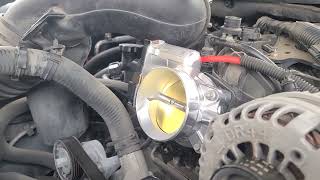
Typical fix: Replace the entire throttle body assembly. 🎬 See this walkthrough for replacing the throttle body and sensor. After replacement, a throttle relearn procedure is required to prevent high or unstable idle. This can often be done without a scan tool by following a specific sequence of idling and driving.
Est. part cost: $150 - $300 - Wiring Harness or Connector Issue 🟡 Medium Probability The wiring harness leading to the throttle body is subject to engine heat and vibration, which can cause wires to fray, chafe, or pins in the 8-pin connector to become loose or corroded over time.
How to confirm: Visually inspect the wiring harness for any signs of damage. With the vehicle running (or key on) and a scan tool monitoring TP sensor data, wiggle the harness and connector to see if the voltage readings fluctuate wildly. Check for 5-volt reference signals at the correct pins on the connector with a multimeter.
Typical fix: Repair the damaged section of wire or replace the connector pigtail. Secure the harness away from any sharp edges or heat sources.
Est. part cost: $10 - $50
Rare But Worth Checking
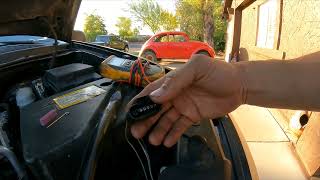
- Faulty Fan Clutch Wiring: On these specific vehicles, a short in the electronic fan clutch wiring can back-feed incorrect voltage into the 5-volt reference circuit shared by the throttle body sensors. A video from a diagnostic technician showed that a P2135 code was resolved by fixing a damaged wire at the fan clutch connector, after the throttle body and pedal had already been replaced without success. This should be inspected before replacing an expensive PCM. 🎬 Watch: How to solve P2135 and P0641 wiring issues easily.
- Failing Powertrain Control Module (PCM): → Shop Engine Control Module (ECM) This is very rare. The PCM is the last component to suspect. All other possibilities, especially the throttle body and all related wiring (including the fan clutch), should be thoroughly ruled out before considering PCM replacement, as it is expensive and requires programming.
Diagnosis Steps
- Read the fault codes with an OBD-II scanner. Confirm P2135 is present. Note any other codes, such as P1516 or P2101.
- Turn the ignition off. Open the hood and locate the throttle body at the front of the engine, connected to the air intake tube.
- Thoroughly inspect the 8-pin electrical connector and wiring harness going to the throttle body. Look for any broken wires, corrosion in the pins, loose connections, or chafing.
- If you have a scan tool with live data, turn the key to the 'ON' position (engine off). Monitor the voltage of 'TP Sensor 1' and 'TP Sensor 2'. They should show opposite and smooth voltage sweeps as the gas pedal is slowly pressed. Any erratic jumps, flat spots, or drop-offs indicate a failed throttle body.
- Perform a 'wiggle test': while watching the live data, gently wiggle the wiring harness at the throttle body connector and along its length. If the voltage numbers spike or drop out, you have a wiring problem.
- If the wiring appears good and the sensor data points to a failure, the throttle body assembly is the most likely cause.
- As a final check before condemning the PCM, inspect the wiring to the electronic fan clutch. A short in this harness is a known, though rare, cause of a false P2135 on these trucks.
- After replacing the throttle body, perform the throttle relearn procedure to ensure proper idle and performance. A common method is: idle for 3 minutes, turn off for 60 seconds, idle again for 3 minutes.
Parts You'll Likely Need
- Electronic Throttle Body Assembly
(OEM #ACDelco 217-2296 (GM 12568580) for 4.2L I6; ACDelco 12694872 for some V8 models. Verify by VIN.)— This is the primary cause of code P2135. The internal throttle position sensors are integrated into the assembly and cannot be replaced separately on this vehicle. Replacing the entire unit is the standard and most reliable repair.
Trusted brands: ACDelco, Delphi, Hitachi, Standard Motor Products (SMP), Dorman, TRQ
OEM price range: $200-$300
Aftermarket price range: $150-$220 - Throttle Body Connector Pigtail
(OEM #ACDelco PT2628 (Varies))— If the 'wiggle test' confirms a bad connection at the throttle body, replacing the connector pigtail is necessary to ensure a solid connection to the new part.
Trusted brands: ACDelco, Dorman
OEM price range: $25-$40
Aftermarket price range: $15-$30
Related Codes That Often Appear With This One
- P1516 — This GM-specific code relates to 'Throttle Actuator Control (TAC) Module Throttle Actuator Position Performance'. It often appears with P2135 because both codes are triggered by faults within the electronic throttle control system.
- P0120 — This code means 'Throttle Position Sensor 'A' Circuit Malfunction'. It can be set alongside P2135 if the ECM detects a specific problem with the primary TPS circuit in addition to the correlation failure between the two sensors.
- P2101 — This code, 'Throttle Actuator Control Motor Circuit Range/Performance', points to an issue with the motor that moves the throttle plate. It can be triggered by the same root causes as P2135, such as a faulty throttle body or wiring issue.
Technical Service Bulletins (TSBs) & Recalls
- Bulletin #11-06-04-007C: 'Diagnosis and Repair - Malfunction Indicator Lamp (MIL) Illuminated, Reduced Engine Power Message Displayed, DTC P2135 Set'. This TSB provides a detailed procedure for replacing the TPS cover and terminals as a fix.
- Special Coverage #11273A: 'Throttle Position Sensor Replacement'. This document extended warranty coverage for the specific condition to 10 years/120,000 miles for certain models including the 2008-09 Envoy, and provided dealers with repair instructions.
Platform-Specific Known Issues
- GM Technical Service Bulletin #11-06-04-007C directly addresses DTC P2135 and 'Reduced Engine Power' messages on the 2008-2009 GMC Envoy. It provides a specific procedure for replacing the throttle position sensor cover, confirming this is a known manufacturer-recognized issue.
- A Special Coverage Adjustment (#11273A) was also issued by GM, extending the warranty on the throttle position sensor to 10 years or 120,000 miles for some V8 models, including the 2008-09 Envoy. This allowed owners to get the repair done at a dealer at no charge if the vehicle was within the specified age and mileage.
- The wiring for the electronic fan clutch shares a 5-volt reference circuit with the TPS. A short circuit in the fan clutch harness can cause a P2135 code, even if the throttle body is perfectly fine.
Mechanic-Grade Diagnostic Values
- Throttle Position Sensor 1 (TPS1) Voltage — expected: Approx. 0.35V - 0.7V at closed throttle, sweeping up to approx. 4.0V - 4.5V at wide-open throttle.. Failure: Voltage is erratic, jumps, has dropouts, or does not sweep smoothly when the pedal is pressed.
- Throttle Position Sensor 2 (TPS2) Voltage — expected: Approx. 4.5V - 4.8V at closed throttle, sweeping down to approx. 0.5V at wide-open throttle.. Failure: Voltage does not move in the opposite direction of TPS1, is erratic, or has dropouts.
- 5-Volt Reference at Throttle Body Connector — expected: 4.8V to 5.2V with key on, engine off.. Failure: Voltage is significantly lower than 4.8V or is absent. This can indicate a short on the 5V reference circuit, possibly from the fan clutch wiring.
- Low Reference (Ground) Circuit Resistance — expected: Less than 5 ohms between the low reference circuit terminal at the throttle body connector and a known good ground.. Failure: Resistance is greater than 5 ohms, indicating an open or high resistance in the ground circuit.
Scan Tool Commands That Help
- Professional Scan Tool (e.g., Tech2, GDS2): Idle Learn Reset / Throttle Relearn — This function should be used after replacing the throttle body assembly to command the ECM to learn the new closed-throttle position. While manual procedures exist, a scan tool reset is the most direct and reliable method.
- Professional Scan Tool (e.g., Tech2, GDS2): Live Data Graphing for TP Sensor 1 & TP Sensor 2 — This is the primary diagnostic step. Graphing both sensor voltages simultaneously while slowly pressing the accelerator pedal (engine off) will visually show any dropouts or glitches where the signals fail to correlate, confirming an internal throttle body fault.
Wiring & Ground Locations
- Throttle Body Connector (C1) — 8-pin connector directly on the electronic throttle body assembly at the front of the engine.. This is the main interface for all signals related to P2135. A poor connection, corrosion, or damaged wire at this connector is a common cause. Wiggling this connector while monitoring live data is a key diagnostic step.
- Fan Clutch Connector — Connector for the electronic cooling fan clutch, located on the fan shroud or near the fan clutch itself.. The fan clutch position sensor shares the same 5-volt reference circuit (Circuit 2 / Ref 2) with the throttle position sensors. A short in the fan clutch or its wiring can pull down this voltage, causing the PCM to set a P2135 code, even though the throttle body is not at fault.
- Throttle Body Connector Pinout (Typical) — At the 8-pin throttle body connector.. Knowing the pin functions allows for direct testing with a multimeter. Typical pinout includes: Pin A (5V Ref 2), Pin B (Low Ref), Pin C (TP Sig 2), Pin D (TP Sig 1), Pin E (5V Ref 1), Pin F (Low Ref), Pin G (TAC Motor +), Pin H (TAC Motor -). Technicians can verify 5V reference and ground integrity at the component.
Real Owner Repair Stories
- GMTNation Forum & YouTube Diagnostic Videos (2005 GMC Envoy) — Reduced Engine Power light, codes P2135, P2138, and P0641 (5-volt reference circuit fault).
❌ Tried (didn't work) Replacing the throttle body assembly, Replacing the accelerator pedal position (APP) sensor
✅ What actually fixed it The wiring harness for the electronic fan clutch was damaged and shorting out the 5-volt reference circuit shared by the throttle body. Repairing the damaged wire at the fan clutch connector resolved all codes and the reduced power issue. - YouTube Comment (GM Vehicle (unspecified model)) — Chronic P2135 error code that persisted for years, costing thousands of dollars in attempted repairs.
❌ Tried (didn't work) Multiple part replacements (unspecified)
✅ What actually fixed it The owner finally fixed the issue by unplugging, cleaning with compressed air, and firmly reseating every wiring harness connector between the throttle body, the accelerator pedal, and both plugs on the ECM. The root cause was a poor connection at one of the harnesses, not a failed part.
When the Usual Fixes Don't Work
- While the most common fix for P2135 is replacing the throttle body, numerous owner and technician reports for the GMT360 platform emphasize that this is not always the solution. Before spending money on a new throttle body, it is critical to rule out a wiring issue, particularly a short in the electronic fan clutch harness. Several documented cases show that after replacing both the throttle body and the accelerator pedal without success, the final fix was a simple wiring repair at the fan clutch, which shares the same 5-volt reference circuit.
OEM Part Supersession History
12568580→This part number appears to be stable for the specified application.— N/A
Heads up: GM Part #12568580 is specified for the 4.2L I6 engine in the 2003-2007 Envoy. It is also used in a wide variety of other GM vehicles with different engines (e.g., 3.5L, 3.7L, 5.3L) such as the Colorado, Canyon, and Impala. Always verify the part number by VIN, but be aware of its broad application.
Helpful Videos

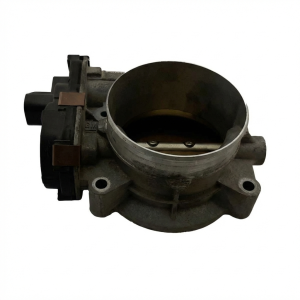
Used OEM Parts in Stock
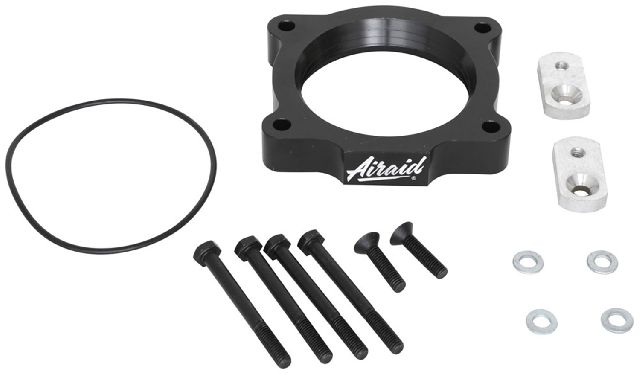
New Aftermarket Parts Available





The information in this article is provided for general reference and educational purposes only. Vehicle specifications, procedures, and part compatibility can vary by production date, trim level, and region. Always consult your vehicle's factory service manual and verify part numbers before purchasing or performing repairs. Safety-critical components such as airbags, seat belts, and braking systems should be installed by a qualified professional.
- Gmc ENVOY:
- 🧭 Diagnostic Flowchart
- 🎬 Helpful Videos
- 🛍️ Shop This Part
- What's Unique About the 2005-2009 Gmc ENVOY
- Symptoms You May Notice
- Most Likely Causes
- Rare But Worth Checking
- Diagnosis Steps
- Parts You'll Likely Need
- Related Codes That Often Appear With This One
- Technical Service Bulletins (TSBs) & Recalls
- Platform-Specific Known Issues
- Mechanic-Grade Diagnostic Values
- Scan Tool Commands That Help
- Wiring & Ground Locations
- Real Owner Repair Stories
- When the Usual Fixes Don't Work
- OEM Part Supersession History
- 🎟️ Get 5% Off