

P2135 on 2010-2011 GMC Yukon Denali: Causes and Fixes for Reduced Engine Power
On a 2010-2011 GMC Yukon Denali, code P2135 almost always indicates a failing throttle body assembly or its integrated throttle position sensor (TPS). This triggers the 'Reduced Engine Power' message and limits vehicle speed. The most common fix is replacing the entire throttle body assembly, though a specific GM TSB also details a repair involving only the TPS cover and terminals. A throttle relearn procedure is mandatory after the repair.
- P2135 on a 2010-2011 Yukon Denali will cause the vehicle to enter 'Reduced Engine Power' mode, making it unsafe for highway driving.
- The most common cause is a faulty throttle body assembly due to a known weakness in the integrated throttle position sensors.
- Do not mistakenly replace the accelerator pedal (gas pedal); the fault is located at the throttle body on the engine.
- A GM Technical Service Bulletin (TSB #110604007C) exists for this issue, which may allow for a cheaper repair by replacing only the sensor cover and terminals.
- After any repair, a throttle relearn procedure is necessary to ensure the engine idles and responds correctly.
What's Unique About the 2010-2011 Gmc YUKON DENALI
This is a notoriously common issue on the GMT900 platform (which includes the 2010-2011 Yukon Denali). The problem was so widespread that General Motors issued a specific Technical Service Bulletin (TSB #11-06-04-007C) and a Special Coverage Adjustment (#11273A) that extended the warranty for the throttle position sensor to 10 years or 120,000 miles for many affected trucks and SUVs. This indicates a known weakness in the throttle body components for this generation, with many owners on forums confirming the high failure rate.
Diagnostic Flowchart
Tap your situation to follow the diagnostic path that matches what you're seeing on this vehicle.
Symptoms You May Notice
- "Reduced Engine Power" message displayed on the dashboard.
- Illuminated Check Engine Light (Malfunction Indicator Lamp).
- Severely limited acceleration and top speed (limp mode), often 15-25 mph.
- "Service Stabilitrak" and "Service Traction Control" messages may also appear.
- Vehicle may stall or have a high/unstable idle.
- Hesitation or surging during acceleration.
- Having to pull over, shut off the engine, and restart to temporarily restore normal operation.
- Some owners report the issue is more frequent in cold or damp weather, suggesting a wiring or moisture intrusion problem.
- Replacing the Accelerator Pedal Position (APP) sensor. P2135 specifically points to a correlation error between the two sensors on the throttle body at the engine, not the sensor on the gas pedal inside the cabin. The APP sensor typically sets its own codes, such as P2138.
Most Likely Causes
- Faulty Throttle Body Assembly 🔴 High Probability → Shop Fuel Injection Throttle Body The integrated electronic throttle position sensors are a known high-failure item on this GM platform, leading to premature failure and the P2135 correlation error. This is the most common cause reported by owners and mechanics.
How to confirm: Using a scan tool, monitor the live data for TP Sensor 1 and TP Sensor 2. The voltage readings should be mirror images of each other as the throttle is slowly opened and closed (one increases, one decreases). If they are erratic, jumpy, or do not correlate, the throttle body is likely faulty. Cleaning the throttle body will not fix this electronic failure.
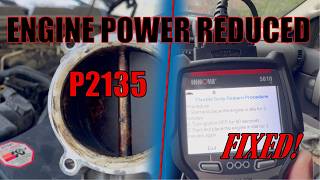
Typical fix: Replace the entire throttle body assembly. This is often a more reliable long-term repair than attempting to replace individual components. A throttle relearn procedure is required after installation. Using a 🎬 Watch this step-by-step throttle body replacement and relearn procedure. quality OEM brand like ACDelco is highly recommended for a lasting repair.
Est. part cost: $150-$400 - Faulty Throttle Position Sensor (TPS) Cover/Terminals 🟡 Medium Probability → Shop Fuel Injection Throttle Body GM issued TSB #11-06-04-007C specifically for this issue, indicating that moisture or a defect in the sensor cover itself can cause the P2135 code. The TSB provides a procedure to replace only the cover, terminals, and gasket, which is a cheaper but more complex repair.
How to confirm: This is difficult to confirm without attempting the repair. If the TSB applies to your vehicle (2008-2011 models) and has not been performed, this is a possible cause. The TSB explicitly states not to replace the entire throttle body for this specific repair path.
Typical fix: Follow the procedure in TSB #11-06-04-007C to replace the throttle position sensor cover, gasket, and terminals (Kit P/N 19259452). For 2010-2011 models, this procedure also requires reprogramming the ECM with the latest calibration.
Est. part cost: $50-$100 - Damaged Wiring or Connector ⚪ Low Probability The wiring harness to the throttle body is subject to engine heat and vibration, which can lead to chafed wires, corrosion, or loose pins in the connector over time. Wires can break internally within 1-4 inches of the connector, making the damage difficult to spot. Some owners have found the harness rubbing against a bracket near the ECM.
How to confirm: Visually inspect the wiring harness leading to the throttle body for any signs of damage, fraying, or melting. Unplug the connector and check for corrosion, moisture, or backed-out pins. Wiggle the harness with the key on, engine off while watching live TPS data on a scan tool; any voltage jumps indicate a wiring fault.
Typical fix: Repair the damaged section of wiring or replace the connector pigtail. Ensure connections are soldered and sealed with heat-shrink tubing for a durable repair.
Est. part cost: $20-$50
Rare But Worth Checking
- Faulty Powertrain Control Module (PCM): → Shop Engine Control Module (ECM) This is very rare and should only be considered after the throttle body and all related wiring have been confirmed to be in good condition. A faulty PCM can incorrectly interpret sensor data or fail to provide a stable 5-volt reference.
- Poor Engine/Chassis Grounds: Corroded or loose ground straps, particularly those on the back of the cylinder head or from the engine block to the frame, can cause erratic sensor readings and trigger a P2135 code. This should be inspected, especially on higher-mileage vehicles.
Diagnosis Steps
- Verify that code P2135 is present using an OBD-II scanner. Check for any other related codes like P1516, P0121, or P0220.
- With the scanner, access live data and monitor the voltage of Throttle Position Sensor 1 and Throttle Position Sensor 2. As you slowly press the accelerator pedal with the engine off (key on), the voltages should change smoothly and correlate with each other (one may increase while the other decreases). Any jumps, drops, or non-responsive behavior indicates a sensor fault.
- Turn the ignition off. Disconnect the electrical connector at the throttle body. Inspect the connector and pins for corrosion, damage, moisture, or backed-out/loose terminals.
- Inspect the wiring harness leading to the throttle body for any signs of chafing, melting, or physical damage, paying close attention to areas where it might rub against brackets or the engine.
- Check engine ground straps for corrosion and tightness, especially G102 (lower left front of engine) and G103 (front of right cylinder head).
- If wiring and grounds are good, and live data points to a sensor issue, the most common repair is to replace the entire throttle body assembly.
- Alternatively, check if TSB #11-06-04-007C applies. If so, you can opt to replace only the TPS cover, terminals, and gasket as per the bulletin's instructions. Note that a 2010-2011 model requires an ECM reprogram after this specific repair.
- After replacing parts, clear all DTCs and perform a throttle relearn procedure. A common method is to start the engine and let it idle for 3 minutes, turn it off for 60 seconds, start and idle again for 3 minutes, and turn it off for 60 seconds. Driving the vehicle may also be required.
Parts You'll Likely Need
- Throttle Body Assembly
(OEM #12601387 (ACDelco 217-3153))— This is the most common cause of P2135, as the failing throttle position sensors are integrated into the assembly. Replacing the entire unit is the most reliable fix.
Trusted brands: ACDelco, Bosch, Hitachi, Dorman
OEM price range: $250-$400
Aftermarket price range: $150-$250 - Throttle Position Sensor Cover Kit
(OEM #19259452)— Per TSB #11-06-04-007C, this kit can be used to fix the issue without replacing the entire throttle body, addressing a known failure point in the sensor's cover and terminals.
Trusted brands: ACDelco
OEM price range: $50-$100
Aftermarket price range: $30-$60
Related Codes That Often Appear With This One
- P1516 — This code relates to Throttle Actuator Control (TAC) performance and often appears with P2135 because the module controlling the throttle motor detects the same performance error that the ECM sees from the sensors.
- P0121 — This code indicates a performance problem with the 'A' circuit of the throttle position sensor, which is one of the two sensors involved in the P2135 correlation fault.
- P0220 — This code points to a malfunction in the 'B' circuit of the throttle position sensor, the other sensor involved in the P2135 fault.
Technical Service Bulletins (TSBs) & Recalls
- 11-06-04-007C: Details a procedure for replacing the throttle position sensor cover (Kit P/N 19259452) to fix DTC P2135 and a 'Reduced Engine Power' message. It explicitly states NOT to replace the entire throttle body for this repair and requires an ECM reprogram for 2008-2010 models.
Platform-Specific Known Issues
- A known issue documented in GM Technical Service Bulletin #11-06-04-007C specifically addresses DTC P2135. It provides a procedure to replace the throttle position sensor cover, terminals, and gasket rather than the entire throttle body assembly.
- GM also issued Special Coverage Adjustment #11273A, extending the warranty for the throttle position sensor to 10 years or 120,000 miles on many 2008-2011 models due to the high failure rate.
Mechanic-Grade Diagnostic Values
- 5-Volt Reference Circuit Voltage — expected: 4.8 - 5.2 Volts. Failure: Voltage below 4.8V suggests a short to ground or open/high resistance. Voltage above 5.2V suggests a short to voltage. In either case, if the circuit tests normal, the ECM may be faulty.
- Low Reference Circuit to Ground Resistance — expected: Less than 5.0 Ohms. Failure: A reading greater than 5.0 Ohms indicates high resistance in the ground circuit which needs to be repaired.
- TPS1 and TPS2 Voltage Correlation — expected: One sensor's voltage increases (e.g., ~0.5V to ~4.5V) while the other decreases. The signals should be mirror images and stay within a close tolerance of each other (e.g., 0.2V).. Failure: If the voltage signals jump, are erratic, or diverge significantly from each other while the pedal is slowly depressed, the sensor is faulty.
- TPS Sensor 1 Signal Circuit Test — expected: Greater than 4.8 Volts. Failure: With a fused jumper wire between the signal circuit (Pin D) and the 5V reference (Pin E), a reading less than 4.8V indicates a short to ground or an open/high resistance in the signal circuit.
Scan Tool Commands That Help
- Tech2 / GDS2 / Professional Scan Tool: Idle Learn Reset / ETCS (Electronic Throttle Control System) Reset — This function is found in the ECM's 'Module Setup' or 'Special Functions' menu. It should be used after replacing the throttle body or TPS cover to force the ECM to immediately erase old learned values and establish a new baseline idle position, which can prevent high idle or stalling issues that might otherwise take several drive cycles to resolve on their own.
Wiring & Ground Locations
- G102 — Lower left front of the engine block.. This is a primary engine ground. A poor connection here can cause unstable voltage readings for multiple engine sensors, including the throttle body.
- G103 — On the front of the right cylinder head.. This ground is critical for the sensors located on the right side of the engine. Corrosion or looseness can directly impact sensor reference voltages, leading to correlation codes like P2135.
- Rear Cylinder Head Grounds — On the back of the passenger side cylinder head.. These grounds are less obvious and can be damaged or left disconnected during other engine repairs. A user fixed their P2135 code by finding and repairing these specific grounds after replacing other parts.
- Throttle Body Connector — The main 6-pin or 8-pin electrical connector on the throttle body assembly.. This is the single point of connection for both TPS signals, the 5V reference, ground, and the throttle actuator motor. Corrosion, backed-out pins, or chafed wires within inches of this connector are a common cause of intermittent P2135 faults.
Real Owner Repair Stories
- Tahoe Yukon Forum user (2008 Hybrid (similar GMT900 electronics)) — Recurring P2135, especially in cold or damp weather.
❌ Tried (didn't work) Multiple unspecified part replacements.
✅ What actually fixed it Found the wiring harness had rubbed through against a bracket near the ECM, exposing copper wires. Repairing the chafed wires permanently resolved the code. - Tahoe Yukon Forum user 'harbison' (Year not specified, GMT900 platform) — P2135 with reduced engine power, occurring intermittently for 2 years, sometimes triggered by going over railroad tracks.
❌ Tried (didn't work) Replaced TPS Sensor 4 times (noting aftermarket Duralast parts failed, switched to AC Delco), Replaced throttle body pigtail connector, Replaced MAF Sensor, Replaced Accelerator Pedal with sensor, Had dealership reprogram ECM
✅ What actually fixed it The user's last post detailed the long history of failed part swaps, with the symptom of the fault triggering on bumps (railroad tracks) strongly indicating the final cause was an intermittent short in the wiring harness that had not yet been located. The story highlights that even after replacing every related component, a wiring issue can be the true root cause. - Tahoe Yukon Forum user (2004 Yukon Denali 6.0L (similar issue)) — Randomly enters limp mode with P2135.
❌ Tried (didn't work) Replaced throttle body (was 2 years old), Replaced multiple other parts
✅ What actually fixed it Found bad/damaged grounds on the back of the passenger side cylinder head and another on the driver's side bell housing. Cleaning and repairing these grounds fixed the issue for two months before it returned, suggesting either another intermittent electrical issue or a stored code issue. - Reddit user r/Cartalk (2010 Yukon) — Intermittent limp mode, P2135, Stabilitrak warning.
❌ Tried (didn't work) Replaced throttle body with sensors, Replaced accelerator pedal and sensor
✅ What actually fixed it The user was asking for the next step after the two most common parts (throttle body and pedal) failed to fix the issue. This highlights a real-world scenario where the problem lies deeper, likely in the wiring harness or ECM, which are the next logical diagnostic steps.
"I Checked Everything" — The Actual Cause
- A smoke test is used to find vacuum leaks and is not applicable for diagnosing the electronic fault code P2135. The equivalent scenario for this code is when a technician confirms the throttle body and its sensors are working correctly via scan tool data, yet the code persists. In these cases, the root cause is almost always an intermittent electrical issue elsewhere, such as a chafed wiring harness rubbing on a bracket, a corroded ground connection on the back of the engine block, or loose pins in a connector.
When the Usual Fixes Don't Work
- While replacing the throttle body assembly is the most common and often successful fix for P2135, there are numerous documented cases where this does not resolve the issue. Several owners have replaced the throttle body (sometimes multiple times), the accelerator pedal sensor, and other components only to have the code return. In these instances, the actual cause was ultimately traced to problems in the electrical system that are harder to diagnose. These include wiring harnesses chafing against engine or chassis brackets, poor terminal connections at the ECM, and corroded or loose engine ground straps, particularly those on the back of the cylinder heads. If the fault occurs when hitting a bump or in damp weather, it is a strong indicator of a wiring or connection issue rather than a component failure.
OEM Part Supersession History
Unknown, multiple revisions exist→12601387 (Stamped on part), ACDelco 217-3153 (Box P/N)— The original throttle position sensors were prone to premature electronic failure, causing the P2135 code. Later revisions aimed to improve the durability of the internal electronics.
Heads up: The part number 12670839 is often incorrectly listed for this vehicle by online retailers but is for different, newer GM engines (e.g., 2015+ Malibu/Colorado). Using the wrong throttle body can result in incorrect operation even if it physically fits. Always verify the part number for the specific 6.2L or 5.3L engine in the 2010-2011 Yukon.N/A→19259452 (TPS Cover Repair Kit)— GM released this kit as a specific, lower-cost repair alternative to replacing the entire throttle body, as documented in TSB #11-06-04-007C. It addresses failures isolated to the sensor cover, terminals, and seal.
Model Year Variations Within This Range
- 2010-2011: When performing the repair outlined in TSB #11-06-04-007C (replacing the TPS cover kit), the ECM must be reprogrammed with the latest calibration. The bulletin was revised to specifically add 2011 models to this requirement. For 2011 vehicles, this updated calibration also includes a new algorithm for the Engine Oil Life Monitor (OLM).
Helpful Videos
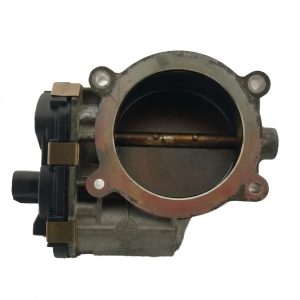
Used OEM Parts in Stock
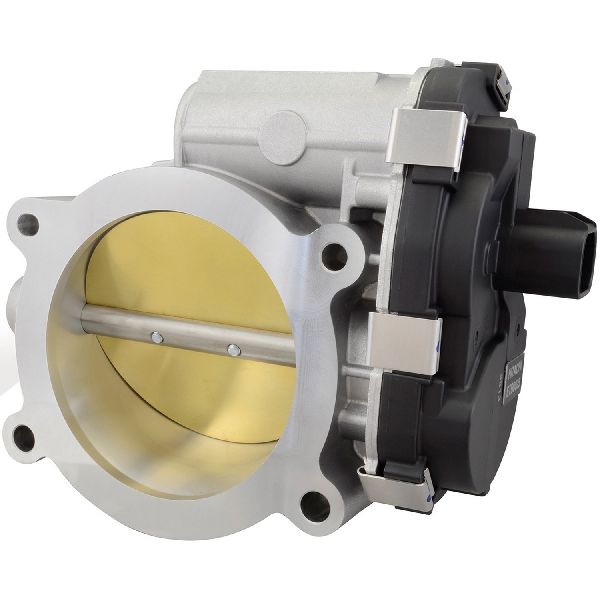
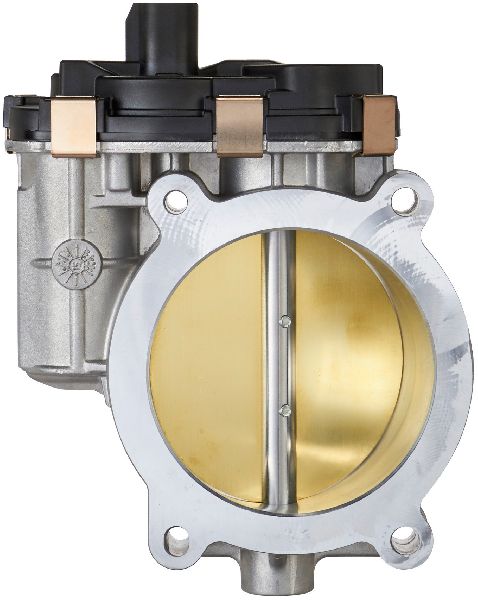
New Aftermarket Parts Available


The information in this article is provided for general reference and educational purposes only. Vehicle specifications, procedures, and part compatibility can vary by production date, trim level, and region. Always consult your vehicle's factory service manual and verify part numbers before purchasing or performing repairs. Safety-critical components such as airbags, seat belts, and braking systems should be installed by a qualified professional.
- Gmc YUKON DENALI:
- 🧭 Diagnostic Flowchart
- 🎬 Helpful Videos
- 🛍️ Shop This Part
- What's Unique About the 2010-2011 Gmc YUKON DENALI
- Symptoms You May Notice
- Most Likely Causes
- Rare But Worth Checking
- Diagnosis Steps
- Parts You'll Likely Need
- Related Codes That Often Appear With This One
- Technical Service Bulletins (TSBs) & Recalls
- Platform-Specific Known Issues
- Mechanic-Grade Diagnostic Values
- Scan Tool Commands That Help
- Wiring & Ground Locations
- Real Owner Repair Stories
- "I Checked Everything" — The Actual Cause
- When the Usual Fixes Don't Work
- OEM Part Supersession History
- Model Year Variations Within This Range
- 🎟️ Get 5% Off