

P2135 on 2016-2021 Honda Civic: Throttle Position Sensor Failure Causes and Fixes
On a 2016-2021 Honda Civic, code P2135 is almost always caused by a failing throttle position sensor. Since the sensor is integrated into the throttle body, the fix is to replace the entire throttle body assembly and perform an idle relearn procedure. Expect to pay $200-$450 for an OEM part.
- P2135 on a 10th gen Civic almost always means you need a new throttle body assembly.
- The throttle position sensors are built into the throttle body and cannot be replaced separately.
- Before buying parts, always inspect the wiring and connector at the throttle body for obvious damage.
- After replacing the throttle body, you MUST perform an idle relearn procedure for the car to run correctly.
- Ensure you purchase the correct throttle body for your engine (1.5L Turbo or 2.0L Naturally Aspirated) as they use different parts.
What's Unique About the 2016-2021 Honda Civic
🎬 Watch: A detailed overview of P2135 on this specific Civic generation.For the 10th generation Honda Civic (2016-2021), the dual throttle position sensors are integrated directly into the electronic throttle body assembly and are not sold by Honda as separate, serviceable components. This design choice means that a failure of either internal sensor, which is the most common cause of P2135, requires the replacement of the entire throttle body assembly. This is a common failure pattern on modern 'drive-by-wire' Hondas and Acuras.
Symptoms You May Notice
- Check Engine Light illuminated
- Multiple warning lights on the dashboard, such as 'Emissions System Problem', 'Brake System Problem', and Vehicle Stability Assist (VSA) warnings
- Vehicle enters 'limp mode' with drastically reduced engine power and throttle response
- Sluggish, hesitant, or erratic acceleration
- Unstable, high, or surging idle speed
- Engine may stall when coming to a stop
- Replacing only the accelerator pedal position sensor without testing it first. P2135 more commonly points to the throttle body.
- Cleaning a dirty throttle body. While cleaning carbon buildup is good for maintenance and can fix some idle issues, it will not repair an internal electrical sensor correlation fault.
Most Likely Causes
- Faulty Throttle Body Assembly 🔴 High Probability → Shop Fuel Injection Throttle Body The throttle position sensors (TPS) are integrated into the throttle body and are not sold separately. Internal failure of one of the sensors is the most common trigger for this code, often occurring between 60,000 and 100,000 miles.
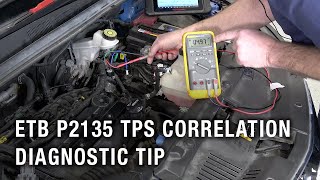
How to confirm: After confirming the wiring is intact, use a high-end scan tool to monitor the live data for TPS Sensor 1 and TPS Sensor 2. As you slowly press the accelerator pedal, the voltage readings should change smoothly and correlate. If one is erratic, jumps, or doesn't move, the throttle body has failed. 🎬 See this diagnostic tip for confirming a TPS correlation fault.
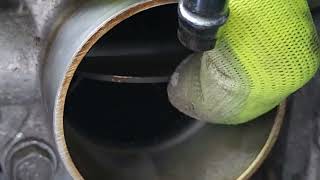
Typical fix: Replace the entire throttle body assembly and the corresponding gasket. An idle relearn procedure must be performed afterward. 🎬 Watch: How to perform the Honda idle relearn procedure yourself.
Est. part cost: $180-$450 - Wiring or Connector Issue 🟡 Medium Probability While some forums mention the wiring harness to the throttle body can be under stress, leading to frayed wires, it is a less frequently confirmed cause than a faulty throttle body. However, it should always be checked before replacing parts.
How to confirm: Visually inspect the wiring harness leading to the throttle body connector. Check for any chafed, broken, or corroded wires. Gently wiggle the connector and harness with the engine running to see if it causes the idle to change or the code to appear.
Typical fix: Repair the damaged section of wire or replace the throttle body connector pigtail if the damage is at the connector itself.
Est. part cost: $15-$40 - Faulty Accelerator Pedal Position (APP) Sensor ⚪ Low Probability → Shop Accelerator Pedal Assembly While possible, this is an infrequent cause for P2135 on this platform. The APP sensor has its own specific correlation codes (like P2138) that are more likely to set if it fails. A failure here is less common than the throttle body.
How to confirm: Use a scan tool to monitor the live data for the APP sensors (APP1 and APP2). Confirm their signals are smooth and correlate correctly as you press and release the gas pedal. A fault here would point to the pedal assembly.
Typical fix: Replace the accelerator pedal assembly.
Est. part cost: $150-$250
Rare But Worth Checking
- Faulty Powertrain Control Module (PCM): → Shop Engine Control Module (ECM) This is extremely rare and should only be considered after all other possibilities, including wiring and sensors, have been thoroughly ruled out.
Diagnosis Steps
- Scan for Codes: Read the DTCs with an OBD-II scanner and check for any other related codes.
- Inspect Wiring: Perform a thorough visual inspection of the wiring harness and connector at the throttle body. Look for any signs of damage, corrosion, or loose pins.
- Analyze Live Data: Use a scan tool to monitor the voltage or percentage of both throttle position sensors (TPS1 and TPS2) and both accelerator pedal position sensors (APP1 and APP2).
- Test TPS Correlation: With the key on and engine off, slowly press the gas pedal to the floor and release it. The TPS voltage signals should change smoothly and mirror each other. If one signal is erratic, drops out, or is flat, the throttle body assembly is faulty.
- Test APP Correlation: If the TPS signals look good, perform the same test while watching the APP sensor signals to rule out the pedal assembly.
- Perform a Wiggle Test: With the engine idling, gently wiggle the connector and wiring at the throttle body. If this causes the engine to stumble or the code to set, you have a wiring issue.
- Replace Faulty Component: Based on the tests, replace the faulty component. For P2135, this is most often the throttle body assembly.
- Perform Idle Relearn Procedure: This step is mandatory after replacing the throttle body. See specific steps below.
Parts You'll Likely Need
- Throttle Body Assembly (2.0L Engine)
(OEM #16400-5BA-A01)— This is the most common failure for code P2135 on Civics with the 2.0L naturally aspirated engine (K20C2), as the internal sensors fail and are not sold separately.
Trusted brands: Honda (Genuine OEM), Hitachi, Bosch, Spectra Premium
OEM price range: $200-$300
Aftermarket price range: $85-$175 - Throttle Body Assembly (1.5L Turbo Engine)
(OEM #16400-59B-003)— This is the most common failure for code P2135 on Civics with the 1.5L turbo engine (L15B7), as the internal sensors fail and are not sold separately.
Trusted brands: Honda (Genuine OEM), Hitachi, Spectra Premium
OEM price range: $185-$280
Aftermarket price range: $95-$180 - Throttle Body Gasket
(OEM #17107-5AA-004)— This gasket should always be replaced when the throttle body is removed to prevent vacuum leaks. This part number is for the 1.5L engine. A similar gasket is required for the 2.0L.
Trusted brands: Honda (Genuine OEM), Fel-Pro, Mahle
OEM price range: $10-$20
Aftermarket price range: $5-$15
Related Codes That Often Appear With This One
- P0121 — This code indicates a general performance problem with TPS Sensor 'A', which can be triggered alongside the correlation fault of P2135.
- P2101 — This code points to a problem with the throttle actuator control motor, which is housed in the same throttle body assembly. A failing unit can have both bad sensors (P2135) and a bad motor (P2101).
Platform-Specific Known Issues
- CivicX.com Forum Experience: A user with a 2016 Civic EX-T experienced P2135 at 85,000 miles. Symptoms included limp mode and multiple dash lights. The confirmed fix was replacing the throttle body assembly. Thread: 'P2135 code, limp mode, throttle body?' URL: https://www.civicx.com/forum/threads/p2135-code-limp-mode-throttle-body.44913/
- Reddit User Story: A user on r/CivicSi reported getting P2135 along with a fuel tank pressure code. The community advised that P2135 is almost always the throttle body and recommended a TPS calibration with an advanced scan tool after replacement. URL: https://www.reddit.com/r/CivicSi/comments/1d3w9a7/need_help/
- PakWheels Forum Diagnosis Challenge: A user with an 8th Gen Civic reported a persistent P2135 code even after replacing both the throttle body and the accelerator pedal sensor, highlighting a rare but possible case where the issue lies within the wiring harness itself, requiring further diagnosis. URL: https://www.pakwheels.com/forums/t/p2135-persistent-error-code-honda-civic-8th-gen-reborn/3004358
Mechanic-Grade Diagnostic Values
- Throttle Position Sensor (TPS) Voltage at Closed Throttle — expected: ~0.5 V - 0.7 V. Failure: Voltage is significantly different with the throttle plate closed.
- Throttle Position Sensor (TPS) Voltage at Wide-Open Throttle (WOT) — expected: ~4.0 V - 4.5 V. Failure: Voltage does not reach the expected range when the throttle is fully open.
- Accelerator Pedal Position (APP) Sensor Voltage with Pedal Released — expected: 0.5 V - 0.9 V. Failure: Voltage is outside this range with no pedal input.
- Voltage difference between TP Sensor A and TP Sensor B — expected: Must not be 200 mV (0.2V) or less for more than 200 milliseconds.. Failure: If the voltage difference between the two sensors is less than 200mV for a sustained period, the PCM flags a correlation error.
Scan Tool Commands That Help
- Honda Diagnostic System (HDS) or compatible (e.g., Foxwell NT510): TP POSITION CHECK — This function is required after cleaning or replacing the throttle body. It clears the stored throttle position learned value in the PCM before you perform the idle relearn procedure.
- Honda Diagnostic System (HDS): ETCS TEST (Electronic Throttle Control System Test) — This is an official diagnostic step used to confirm if the P2135 fault is currently active after clearing codes. It helps verify a hard fault before replacing components.
Wiring & Ground Locations
- Throttle Body 6-Pin Connector — On the electronic throttle body assembly, where the engine wiring harness connects.. This is the primary connection for both throttle position sensors (TPSA/TPSB), their power, and ground. A loose connection, corrosion, or frayed wire at this specific connector is a common cause of P2135. Wiggling this connector while monitoring live data is a key diagnostic step.
- G101 (ECU Power and Logic Ground) — Typically located on the thermostat housing, providing a ground path for the engine control unit.. A loose or corroded G101 ground can cause a wide range of erratic electrical issues, including incorrect voltage readings for sensors like the TPS, potentially triggering a P2135 code. Ensuring this ground is clean and tight is a crucial step if sensor and wiring checks don't reveal the fault.
Real Owner Repair Stories
- Unofficial Honda FIT Forums (2012 Honda Fit M/T, ~70,000 miles) — Engine shudders, CEL and traction control light on, car enters limp mode. Code P2135.
❌ Tried (didn't work) Clearing the code (it returned multiple times)., Checking connections at the throttle body.
✅ What actually fixed it The user noticed on a scan tool that one APP sensor and one TP sensor had 'twitchy' readings. Unplugging the Accelerator Pedal Position Sensor (APPS) connector made the TPS reading stable. After simply unplugging and securely reconnecting the APPS connector, the problem was resolved, indicating a poor connection at the pedal sensor was the root cause. - PakWheels Forums (Honda Civic 8th Gen) — Persistent P2135 error code for over a year.
❌ Tried (didn't work) Replacing the throttle body., Replacing the accelerator pedal sensor., Performing the throttle relearn procedure multiple times.
✅ What actually fixed it The issue was not resolved in the thread, but the user concluded the only remaining possibility was a fault within the wiring harness itself, requiring a detailed wire-by-wire inspection. This serves as a cautionary tale for rare cases where multiple part replacements do not fix the issue.
Documented NHTSA Reports
- NHTSA ODI #11479189: An owner of a related Honda model reported experiencing the P2135 code five times, with four occurrences in a single year. The fault caused the dashboard to flash numerous warnings and the vehicle to enter an immediate limp mode.
- NHTSA ODI #10537865: A report for a similar Honda platform describes a technician finding DTC P2135 (TP Sensor A/B Incorrect Voltage Correlation). In this instance, the technician initially attempted to recalibrate the TP sensor to address the correlation fault.
Diagnostic Flowchart
Other Known Issues on This Vehicle
Issues unrelated to this code that are worth knowing about as an owner of this generation:
- A/C Condenser Failure 🔴 High — Very common across 2016-2021 models. Tiny holes develop in the condenser tubes, causing refrigerant to leak out. (Ref: Honda Service Bulletin 19-091; Honda extended the warranty for this specific part to 10 years with unlimited mileage.)
- Oil Dilution (1.5L Turbo Engine) 🟠 Medium — More prevalent in 2016-2018 models, especially in cold climates with frequent short trips. Unburned fuel mixes with engine oil. (Ref: Honda issued software updates and extended the powertrain warranty by one year (to 6 years/unlimited miles) for certain vehicles to address drivability concerns.)
- Sticky or Stiff Steering 🟠 Medium — Owners report a sticky or notchy feeling in the steering, particularly at highway speeds, requiring constant small corrections. (Ref: Honda Service Bulletin 22-002; Honda extended the warranty for the electronic power steering (EPS) gearbox to 10 years from the original purchase date.)
- Dashboard Warning Light Cascade 🟡 Low — A single fault, often a weak battery or failing wheel speed sensor, can cause a cascade of unrelated warning lights (Brake System, ABS, VSA, Power Steering) to illuminate simultaneously.
- Weak OEM Rear Motor Mount 🟡 Low — The stock rear motor mount on non-Type R models is soft and prone to wear, leading to increased engine movement and potential wheel hop under acceleration.
Used vs. New Parts: Buying Guide for This Vehicle
When a used part is the smart pick: A used throttle body from a low-mileage, verified-running donor vehicle can be a cost-effective option, as this part is a complete electronic and mechanical assembly. Given the high cost of a new OEM unit, a used part from a reputable salvage yard with a short warranty is a reasonable gamble.
Donor-vehicle mileage cap: roughly under 60000 miles for the part to have meaningful remaining life.
What to inspect on the donor part:
- Verify the part number on the used unit matches your original exactly.
- Inspect the 6-pin electrical connector for any bent pins, corrosion, or signs of damage.
- Look at the throttle bore; excessive carbon buildup may indicate high mileage or poor engine health of the donor car.
- Ensure the throttle plate moves freely by hand (with battery disconnected) and doesn't stick or bind.
OEM-only on this vehicle (don't cheap out):
- For this specific repair, sticking to a Genuine Honda (new or used) or Hitachi (often the OEM supplier) throttle body is strongly recommended. The sensitive electronics must correlate perfectly with the PCM's expectations.
Aftermarket brands forum-validated for this vehicle:
- Hitachi (often the OEM manufacturer for Honda)
- Bosch
Brands owners have reported issues with on this vehicle:
- Unknown, no-name brands from online marketplaces. These often have a high failure rate or can cause idle and performance issues due to slight calibration differences not tolerated by the Honda PCM.
Real Owner Stories
Aggregated from forums and TSBs cited above. Mileages and costs reflect what owners reported in those sources.
2016 Civic EX-T — 85000 miles
Symptoms: Vehicle entered limp mode with multiple dashboard warning lights illuminated.
What fixed it: Replacement of the throttle body assembly.
Source hint: CivicX.com forum thread 'P2135 code, limp mode, throttle body?'
2016-2021 Civic Si
Symptoms: P2135 code appearing along with a fuel tank pressure code.
What fixed it: Throttle body replacement followed by a TPS calibration with an advanced scan tool.
Source hint: Reddit r/CivicSi thread 'need help'
8th Gen Civic
Symptoms: Persistent P2135 error code that remained even after replacing the throttle body and accelerator pedal sensor.
What fixed it: Further diagnosis of the wiring harness itself.
Source hint: PakWheels Forum 'P2135 persistent error code Honda Civic 8th Gen Reborn'
Related OBD-II Codes
Frequently Asked Questions
Can I just replace the sensor on my 2016-2021 Honda Civic throttle body to fix P2135?
Is there a specific mileage when the throttle body usually fails on this Civic generation?
Do I need to do anything special after installing a new throttle body (P/N 16400-59B-003)?
My Civic has P2135 and multiple warning lights like 'Emissions System Problem' and 'Brake System Problem'. Are these separate issues?
Does the 1.5L Turbo engine oil dilution TSB address the P2135 code?
Could the P2135 code be related to the hot weather I'm experiencing?
Helpful Videos


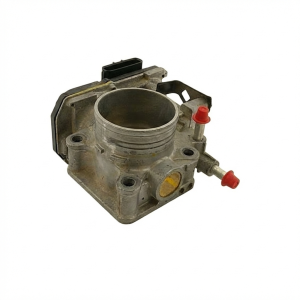
Used OEM Parts in Stock
New Aftermarket Parts Available


The information in this article is provided for general reference and educational purposes only. Vehicle specifications, procedures, and part compatibility can vary by production date, trim level, and region. Always consult your vehicle's factory service manual and verify part numbers before purchasing or performing repairs. Safety-critical components such as airbags, seat belts, and braking systems should be installed by a qualified professional.
- Honda Civic:
- 🧭 Diagnostic Flowchart
- 🎬 Helpful Videos
- 🛍️ Shop This Part
- What's Unique About the 2016-2021 Honda Civic
- Symptoms You May Notice
- Most Likely Causes
- Rare But Worth Checking
- Diagnosis Steps
- Parts You'll Likely Need
- Related Codes That Often Appear With This One
- Platform-Specific Known Issues
- Mechanic-Grade Diagnostic Values
- Scan Tool Commands That Help
- Wiring & Ground Locations
- Real Owner Repair Stories
- Documented NHTSA Reports
- Other Known Issues on This Vehicle
- Used vs. New Parts: Buying Guide for This Vehicle
- Real Owner Stories
- 2016 Civic EX-T — 85000 miles
- 2016-2021 Civic Si
- 8th Gen Civic
- Related OBD-II Codes
- Frequently Asked Questions
- 🎟️ Get 5% Off