

P2135 on 2011-2015 Kia Optima: Causes, Fixes, and Throttle Body Issues
Code P2135 on a 2011-2015 Kia Optima almost always means the electronic throttle body assembly has failed due to an internal sensor fault. The vehicle will unpredictably enter a low-power 'limp mode,' making it unsafe to drive. The definitive fix is to replace the entire throttle body, as the sensors are integrated and not sold separately. An OEM part costs around $260-$450, while aftermarket options are available for $150-$300. A throttle 'relearn' procedure is required after replacement.
- P2135 on a 2011-2015 Optima is a serious code that will likely put the car in a dangerous, low-power 'limp mode'.
- The most probable cause is a failed electronic throttle body assembly. Do not attempt to buy individual sensors as they are integrated.
- Before replacing parts, have a dealer check if your vehicle needs the Knock Sensor Detection System (KSDS) software update (TSB PI1802), as it causes identical symptoms.
- After replacing the throttle body, a 'relearn' procedure is necessary to calibrate the new part. This can often be done manually by cycling the ignition without starting the engine.
What's Unique About the 2011-2015 Kia Optima
For the 2011-2015 Kia Optima (and its corporate sibling, the Hyundai Sonata), the dual throttle position sensors are integrated directly into the electronic throttle body assembly and are not sold separately by Kia. This design means that a failure of either internal sensor—the overwhelmingly common cause of P2135 on this platform—requires the replacement of the entire throttle body unit. While some owners might first suspect the accelerator pedal sensor, that part has its own specific codes (like P2138) and is rarely the cause for a P2135 fault on this vehicle.
Generation note: The 2011-2015 year range covers the third generation of the Kia Optima, known as the TF series. The issue is consistent across this generation for both the 2.4L GDI and 2.0L Turbo GDI Theta II engines.
Symptoms You May Notice
- Sudden loss of engine power (Limp Mode), limiting RPMs to around 2,000.
- Check Engine Light is illuminated, sometimes flashing.
- Poor, hesitant, or surging acceleration.
- Engine may stall, especially when coming to a stop or at idle.
- Rough or unstable idle.
- Engine revving higher than normal without pressing the gas pedal.
- The issue may appear intermittently, often occurring on cold mornings before resolving after an engine restart, indicating the early stages of sensor failure.
- Replacing the accelerator pedal assembly. While it's part of the overall system, the P2135 code on this Optima model points more directly to a fault at the throttle body.
- Replacing only one throttle position sensor. The sensors are not sold separately for this vehicle; they are integrated into the throttle body assembly.
Most Likely Causes
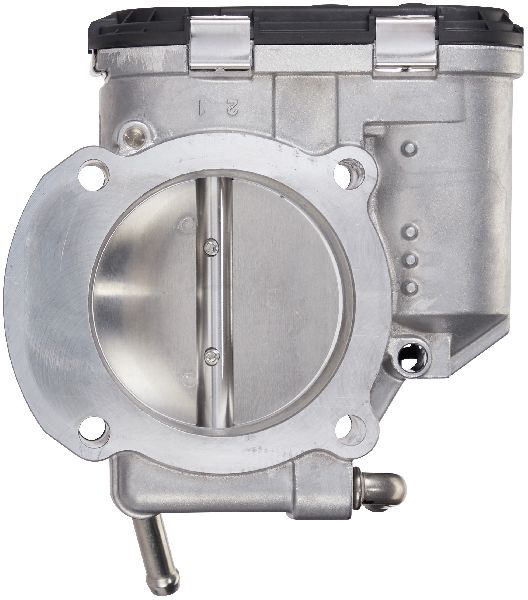
- Failed Electronic Throttle Body Assembly 🔴 High Probability → Shop Fuel Injection Throttle Body The internal throttle position sensors (TPS) are a known high-failure item on this platform. Wear and tear on the sensor's internal electrical contacts cause them to send erratic signals. Since they are integrated into the throttle body, the entire unit must be replaced when they fail.
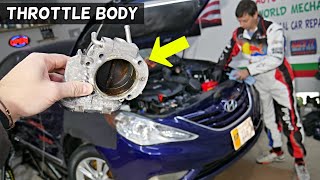
How to confirm: Use an OBD-II scanner to monitor the live data for TPS circuits 'A' and 'B' (sometimes labeled TPS1 and TPS2). As the accelerator is slowly pressed, both voltage readings should move smoothly and in correlation (one rising, one falling). A faulty throttle body will show 🎬 Watch: How to test and replace an electronic throttle body one or both signals being erratic, spiking, dropping out, or not moving at all.
Typical fix: Replace the entire electronic throttle body assembly. A 'relearn' procedure is required after installation to calibrate the new part with the ECU.
Est. part cost: $150 - $450 - Wiring or Connector Issue 🟡 Medium Probability
How to confirm: Visually inspect the wiring harness and the electrical connector at the throttle body for any signs of damage, corrosion, loose pins, or oil contamination. Wiggle the connector and wiring with the key on (engine off) and live data on screen to see if the sensor voltage fluctuates, which would indicate a poor connection.
Typical fix: Repair the damaged wiring or clean/replace the connector pins. Ensure a secure connection.
Est. part cost: $10 - $50 - Dirty Throttle Body ⚪ Low Probability → Shop Fuel Injection Throttle Body Carbon buildup is common on GDI engines but usually causes sticking or idle issues, not an electrical correlation code. However, cleaning is good preventative maintenance.
How to confirm: Visually inspect the throttle bore and plate for significant black carbon buildup.
Typical fix: Clean the throttle body with a dedicated throttle body cleaner and a soft brush. Note: While recommended as a first step, cleaning will almost never fix an electrical correlation code like P2135, but it can resolve mechanical sticking issues that may cause other codes.
Est. part cost: $5 - $15
Rare But Worth Checking
- Faulty Powertrain Control Module (PCM): → Shop Engine Control Module (ECM) This is very rare. The PCM should only be considered after all other possibilities, including the throttle body and wiring, have been thoroughly tested and ruled out. An outdated PCM software version could also be a factor.
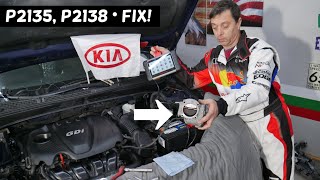
- Faulty Accelerator Pedal Position (APP) Sensor: → Shop Accelerator Pedal Assembly While the code definition includes the pedal sensor, it is far less likely to be the cause than the throttle body on this specific vehicle. The APP sensor has its own set of 🎬 See this step-by-step fix for codes P2135 and P2138 specific trouble codes, such as P2138.
Diagnosis Steps
- Scan the vehicle's computer for trouble codes. Confirm P2135 is present and note any other codes, especially P1326 or other TPS-related codes.
- Visually inspect the throttle body's electrical connector and wiring harness. Look for loose connections, corrosion, bent pins, or damaged wires.
- With the key on and engine off, use a scan tool to view live data for the two throttle position sensors (TPS1 and TPS2).
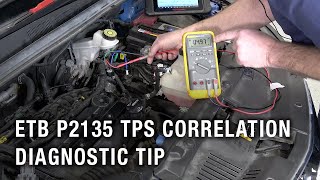
- Slowly press and release the accelerator pedal. Both sensor voltage readings should rise and fall smoothly and in correlation with each other (e.g., one rises from ~0.5V to ~4.5V while the other falls from ~4.5V to ~0.5V).
- If one sensor's voltage is erratic, flat, or doesn't mirror the other, the throttle body assembly is highly suspect and should be replaced.
- If the sensor data seems fine, check for any Technical Service Bulletins (TSBs) related to P2135 or knock sensor software updates (PI1802) for your vehicle's VIN, as a software issue could be the cause.
- After replacing the throttle body, 🎬 Watch: When and how to perform a throttle body relearn perform a relearn procedure. A common manual method is: warm up the engine, turn it off, turn the key to 'ON' (engine off) for 15 seconds, then 'OFF' for 5 seconds. Repeat this cycle 5 times. Alternatively, disconnecting the battery for several minutes or letting the car idle for 10-15 minutes with the A/C on may also work.
- If wiring and the throttle body are confirmed good, the issue could be a rare fault in the PCM, which may require professional diagnosis.
Parts You'll Likely Need
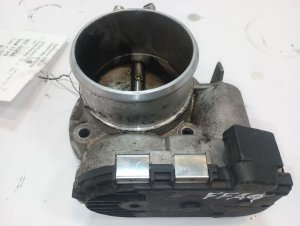
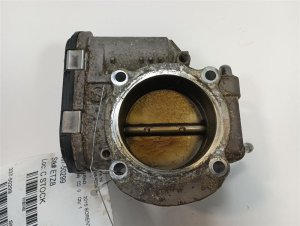
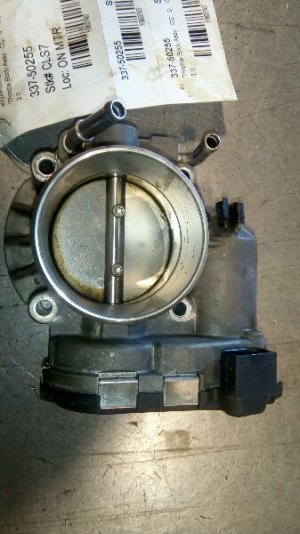
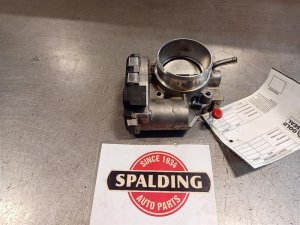
- Electronic Throttle Body Assembly
(OEM #35100-2G700 (for 2.4L & some 2.0L Turbo), 35100-2G710 (for 2.0L Turbo))— This is the most common failure. The internal, non-serviceable throttle position sensors fail, requiring replacement of the entire assembly. It is critical to verify the correct part number with your vehicle's VIN.
Trusted brands: Kia (OEM), Hyundai (OEM), Bosch, Cardone (Remanufactured), Standard Motor Products
OEM price range: $260-$450
Aftermarket price range: $150-$300
Related Codes That Often Appear With This One
- P1326 — This code is for the Knock Sensor Detection System (KSDS). It can also put the car into an identical limp mode. It's crucial to check for this code, as it may indicate a separate, serious engine issue related to bearing wear or require a software update per TSB PI1802.
- P0121, P0122, P0123, P0222, P0223 — These are all related throttle position sensor circuit codes (Range/Performance, Low Input, High Input for Sensor A and B). Seeing them alongside P2135 strongly confirms the problem is with the throttle body assembly or its wiring.
- P2106 — This code means 'Throttle Actuator Control System - Forced Limited Power'. It is often a companion code to P2135, as it is the code that signifies the PCM has actively placed the vehicle into limp mode as a result of the sensor correlation fault.
Technical Service Bulletins (TSBs) & Recalls
- PI1802 - Relates to a Knock Sensor Detection System (KSDS) software update that can cause similar limp-mode symptoms with code P1326. The TSB explains the system is designed to detect bearing wear and protect the engine by inducing limp mode.
- CHA068 - A TSB related to partial repair of the Motor Driven Power Steering (MDPS) system, which is a separate common issue but not directly related to P2135.
- TSB 044 - A manufacturer service bulletin that addresses TPS failure and electronic stability control reprogramming, as noted in NHTSA ODI #10477012.
Platform-Specific Known Issues
- The throttle position sensors are integrated into the throttle body and cannot be replaced individually, making the repair more expensive.
- There is a known software update for the Knock Sensor Detection System (KSDS) under campaign PI1802 that can cause identical limp mode symptoms with code P1326. It's crucial to rule this out, as a simple software flash at a dealer might be needed instead of or in addition to parts replacement. Some early versions of this update were faulty and required a second update.
- Manufacturer documentation suggests that for some Kia models, a low idle and P2135 fault may require the ECM to be reprogrammed using the Global Diagnostic System (GDS) as described in NHTSA ODI #10779832.
Mechanic-Grade Diagnostic Values
- TPS 'A' (TPS1) Signal Voltage at Connector Pin 4 — expected: Approx. 0.5V - 1.0V at closed throttle, sweeping smoothly to approx. 4.5V at wide-open throttle (Key On, Engine Off).. Failure: Voltage is stuck, erratic, has dropouts, or does not sweep smoothly when the pedal is pressed.
- TPS 'B' (TPS2) Signal Voltage at Connector Pin 6 — expected: Approx. 4.5V at closed throttle, sweeping smoothly down to approx. 0.5V at wide-open throttle (Key On, Engine Off). This signal should be inverse to TPS1.. Failure: Voltage does not mirror TPS1, is stuck, erratic, or has dropouts.
- TPS 5V Reference Voltage at Connector Pin 5 — expected: Stable 5.0V from the PCM.. Failure: Voltage is significantly lower than 5.0V or is absent, indicating a wiring or PCM issue, not a sensor failure.
- TPS Sensor Ground at Connector Pin 3 — expected: 0V (continuity to ground).. Failure: Any voltage reading above 0V indicates a poor ground connection, which can cause erratic sensor readings.
Scan Tool Commands That Help
- Kia GDS (Global Diagnostic System): Actuation Test > ETC Motor — This bidirectional control allows a technician to command the electronic throttle control motor to open and close with the engine off. It's used to verify the mechanical integrity of the throttle body, separating a physical jam from an electrical sensor failure.
- Kia GDS (Global Diagnostic System): Vehicle S/W Management > Resetting Adaptive Values — This is the official dealer-level procedure required after replacing the throttle body. It forces the ECU to erase old calibration data and learn the closed, open, and idle positions of the new sensor, which is critical for correct performance and to prevent idle issues.
Wiring & Ground Locations
- Throttle Body Connector — The 6-pin electrical connector plugged directly into the electronic throttle body assembly, located at the engine's air intake.. This single connector carries power, ground, and both TPS signal wires. Corrosion, moisture, or loose pins in this specific connector are a common cause of P2135. A 'wiggle test' on this connector while watching live scan tool data is a key diagnostic step.
Real Owner Repair Stories
- Hyundai-Forums user (2013 Hyundai Sonata 2.4L (platform mate)) — Check engine light on with codes P2135 and P2138.
❌ Tried (didn't work) Initially suspected the accelerator pedal sensor due to code P2138.
✅ What actually fixed it The problem was resolved by first cleaning the throttle body, which provided a temporary fix. When the code returned, replacing the entire electronic throttle body assembly permanently fixed the issue. - NHTSA ODI #10442598 — An owner reported a "safety nightmare" involving sudden deceleration and the check engine light illuminating with code P2135. The failure of the throttle position switch caused the vehicle to enter a "Limp Home Mode."
- NHTSA ODI #10474233 — A report describes a vehicle where fault codes P2135 and P2106 often appear, creating a dangerous driving situation.
OEM Part Supersession History
35100-2G700→35100-2G700 (current)— This is the primary part number for the 2.4L engine and is also listed for some 2.0L Turbo models. It's crucial to verify by VIN.
Heads up: While this part fits a wide range of 2011-2016 Kia/Hyundai vehicles, it is not interchangeable with 35100-2G710 without confirming VIN compatibility.35100-2G710→35100-2G710 (current)— This part number is specified primarily for the 2.0L Turbo engine in the Optima, Sonata, and Sportage.
Heads up: This part is specific to the 2.0L Turbo models and should not be used on a 2.4L engine unless specified by VIN.
Model Year Variations Within This Range
- 2014-2015: The Kia Optima received a mid-cycle refresh for the 2014 model year. While the core engine and throttle body part number (35100-2G700) remained the same, minor differences in wiring harnesses and fuse box layouts may exist compared to the 2011-2013 models.
Diagnostic Flowchart
Other Known Issues on This Vehicle
Issues unrelated to this code that are worth knowing about as an owner of this generation:
- Catastrophic Engine Failure (Theta II GDI) 🔴 High — Widespread across 2.0L Turbo and 2.4L GDI engines, often occurring under 100,000 miles. Caused by manufacturing debris restricting oil flow to rod bearings. (Ref: Multiple recalls (e.g., SC147) and a major class-action lawsuit resulted in lifetime warranties and engine replacements for many affected VINs.)
- Degrading Steering Coupler 🟠 Medium — Very common. The flexible rubber coupler in the electronic power steering column disintegrates over time, causing a distinct clicking or clunking noise in the steering wheel when turning. (Ref: No recall, but it's a well-documented issue. The replacement part (OEM # 56315-2K000-FFF) is inexpensive, but labor can be significant.)
- Knock Sensor Detection System (KSDS) Issues 🟠 Medium — Common. The vehicle may enter limp mode and set code P1326. This is often due to a required software update (Product Improvement Campaign PI1802) designed to detect early signs of engine bearing failure. (Ref: TSB PI1802)
- Engine Compartment Fires 🔴 High — A significant number of non-collision fires have been reported, leading to NHTSA investigations. Linked to issues within the Theta II engine family. (Ref: Part of broader NHTSA investigations and recalls related to the Theta II engine family.)
- General Electrical Problems 🟡 Low — Owners report various electrical gremlins, including flickering interior lights, infotainment system malfunctions, and parasitic battery drain that is difficult to diagnose.
Used vs. New Parts: Buying Guide for This Vehicle
When a used part is the smart pick: A used throttle body is generally NOT recommended for this repair. The failure is due to electronic wear on internal sensor contacts. A used part from a junkyard has a high probability of having the same fault or a very short remaining service life. It should only be considered as a last resort for extreme budget constraints.
Donor-vehicle mileage cap: roughly under 60000 miles for the part to have meaningful remaining life.
What to inspect on the donor part:
- Verify donor vehicle mileage is as low as possible.
- Inspect the electrical connector pins for any signs of corrosion, moisture, or physical damage.
- Check the throttle bore for excessive carbon buildup, which might indicate a poorly maintained engine.
- Ensure the locking tab on the electrical connector is not broken.
OEM-only on this vehicle (don't cheap out):
- While not strictly OEM-only, using a new OEM (Kia/Hyundai) or reputable new aftermarket part is strongly advised over a used or remanufactured unit for long-term reliability.
Aftermarket brands forum-validated for this vehicle:
- Bosch
- Standard Motor Products
- Dorman (specifically their 'OE FIX' versions which may feature improved internal sensors like Hall effect sensors).
Brands owners have reported issues with on this vehicle:
- Unbranded, no-name parts sold on marketplaces without a warranty or clear return policy.
- Cardone (remanufactured) parts have mixed reviews; some mechanics prefer to avoid them for electronic components in favor of new units.
Real Owner Stories
Aggregated from forums and TSBs cited above. Mileages and costs reflect what owners reported in those sources.
2011 Hyundai Sonata 2.4L I4
Symptoms: The vehicle threw multiple codes including P2135, P2106, and P0221 simultaneously, indicating a major electrical failure point in the throttle system.
What fixed it: The owner was advised to check ground connections as a potential cause for the multiple simultaneous sensor codes.
Source hint: Hyundai Forums - Thread '11 Sonata 2.4l multiple codes about Throttle position sensor'
2012 Kia Optima 2.4L I4 — ~95000 miles
Symptoms: Sudden loss of engine power (Limp Mode) with RPMs limited to approximately 2,000 and a flashing Check Engine Light.
What fixed it: Replacement of the entire electronic throttle body assembly followed by a calibration relearn procedure.
Source hint: vehicle_specific_issues and symptoms context
Kia Owner Report — NHTSA ODI #10649926
Symptoms: An owner reported that their vehicle's engine codes included P2135, defined as a Throttle Pedal/Position Sensor 'A/B' Voltage Correlation fault.
What fixed it: Diagnostic verification at an auto parts store confirmed the correlation code, pointing toward the integrated sensor failure common on this platform.
Related OBD-II Codes
Frequently Asked Questions
My 2011 Kia Optima is in limp mode with code P1326; is this the same as the P2135 throttle issue?
Can I just replace the sensor on my 2.4L Optima's throttle body to fix P2135?
Is there a specific procedure I need to follow after installing a new throttle body on my 2013 Optima?
Why does my P2135 code only seem to happen on cold mornings?
Could the Knock Sensor Detection System (KSDS) update PI1802 be causing my throttle-related symptoms?
Will cleaning the carbon buildup in my GDI engine fix the P2135 correlation code?
Helpful Videos


Used OEM Parts in Stock
New Aftermarket Parts Available


The information in this article is provided for general reference and educational purposes only. Vehicle specifications, procedures, and part compatibility can vary by production date, trim level, and region. Always consult your vehicle's factory service manual and verify part numbers before purchasing or performing repairs. Safety-critical components such as airbags, seat belts, and braking systems should be installed by a qualified professional.
- Kia Optima:
- 🧭 Diagnostic Flowchart
- 🎬 Helpful Videos
- 🛍️ Shop This Part
- What's Unique About the 2011-2015 Kia Optima
- Symptoms You May Notice
- Most Likely Causes
- Rare But Worth Checking
- Diagnosis Steps
- Parts You'll Likely Need
- Related Codes That Often Appear With This One
- Technical Service Bulletins (TSBs) & Recalls
- Platform-Specific Known Issues
- Mechanic-Grade Diagnostic Values
- Scan Tool Commands That Help
- Wiring & Ground Locations
- Real Owner Repair Stories
- OEM Part Supersession History
- Model Year Variations Within This Range
- Other Known Issues on This Vehicle
- Used vs. New Parts: Buying Guide for This Vehicle
- Real Owner Stories
- 2011 Hyundai Sonata 2.4L I4
- 2012 Kia Optima 2.4L I4 — ~95000 miles
- Kia Owner Report — NHTSA ODI #10649926
- Related OBD-II Codes
- Frequently Asked Questions
- 🎟️ Get 5% Off