

P2135 on 2004-2008 Suzuki Forenza 2.0L: Throttle Position Sensor Causes and Fixes
This code means the two sensors inside your electronic throttle body are giving conflicting signals. The most common fix for a P2135 on this vehicle is to replace the entire throttle body assembly. An aftermarket assembly costs around $90-$150 and is a moderately difficult DIY job. After replacement, a specific 'relearn' procedure is required.
- P2135 on your Forenza almost always points to a problem with the electronic throttle body.
- Before replacing parts, try cleaning the throttle body thoroughly, but be aware this is often a temporary fix.
- The most reliable fix is to replace the entire throttle body assembly, not just an individual sensor.
- After replacement, a specific throttle 'relearn' procedure is required to sync the new part with the car's computer.
- Do not continue driving with this code, as the car can lose power or stall at any time.
What's Unique About the 2004-2008 Suzuki Forenza
The Suzuki Forenza is a rebadged General Motors (Daewoo) product, specifically the Daewoo Lacetti (J200 platform). Electronic throttle body issues are a known pattern on many GM-Daewoo vehicles of this era, including the Chevrolet Aveo. For the Forenza specifically, a service bulletin (SC-60R-1) was issued regarding a 'counter measure procedure for dtc p2135,' which highlights that a specific process must be followed after replacing the throttle body to ensure the code doesn't return. This indicates the issue is common enough to warrant manufacturer guidance and is not unique to the Suzuki badge.
Symptoms You May Notice
- Check Engine Light is on
- Vehicle enters 'Reduced Power' or 'Limp Mode'
- Poor, hesitant, or surging acceleration
- Engine stalls, especially when coming to a stop
- Engine revs higher than normal at idle
- Unpredictable or no throttle response
- Fault is often intermittent; it may disappear and then return without warning.
- Replacing the accelerator pedal position sensor (APPS). While the code definition can include 'Pedal Position Sensor,' the specific failure mode on the Forenza and its platform mates almost always points to the correlation error between the two sensors on the throttle body, not the pedal.
- Replacing only the TPS sensor. On this vehicle, the sensors are integrated into the throttle body and are not sold as a separate, replaceable part. Attempts to do so will fail.
Most Likely Causes
- Faulty Throttle Body Assembly 🔴 High Probability → Shop Fuel Injection Throttle Body The dual throttle position sensors (TPS) are integrated into the assembly and cannot be replaced separately. The internal potentiometers, which use tiny wire fingers to read the throttle position, wear out or develop defects over time, causing the correlation error. This is a very common failure pattern for this GM-Daewoo platform.
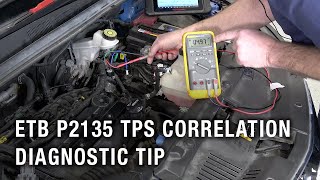
How to confirm: Use a scan tool with live data to graph the voltage of TP Sensor 1 and TP Sensor 2 while slowly pressing the accelerator pedal (with the engine off, key on). The two signals should be smooth and mirror each other (one rising, one falling). Any jumps, spikes, 🎬 See this diagnostic tip for graphing TPS correlation on a scan tool. or flat spots in the voltage indicate a faulty sensor within the throttle body.
Typical fix: Replace the entire throttle body assembly. After replacement, a throttle relearn procedure is necessary.
Est. part cost: $90 - $160 for an aftermarket assembly. - Dirty or Sticking Throttle Body 🟡 Medium Probability → Shop Fuel Injection Throttle Body Carbon and oil vapor from the PCV system can build up inside the throttle body, causing the throttle plate to stick or move slowly. This can cause a temporary mismatch in sensor readings.
How to confirm: Remove the air intake hose from the throttle body and visually inspect the throttle plate and bore for heavy carbon buildup. Check if the plate moves smoothly by hand (with ignition off).
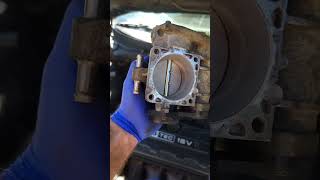
Typical fix: Clean the throttle body thoroughly with a dedicated throttle body cleaner and a soft brush 🎬 Watch: This DIY guide shows how to remove and clean the unit. or rag. Many owners report that cleaning provides only a temporary solution and the P2135 code returns, indicating the underlying sensor is failing.
Est. part cost: $5 - $15 for cleaner. - Damaged Wiring or Poor Connection ⚪ Low Probability Engine vibration and heat can cause wiring to fray or the connector pins at the throttle body to become loose or corroded over time. This was a common issue on GM-Daewoo vehicles.
How to confirm: Visually inspect the wiring harness leading to the throttle body for any signs of damage, chafing, or melting. Unplug the connector and check for corrosion or bent pins. With the key on, engine off, use a multimeter to verify 5V reference and a good ground at the connector pins. Wiggle the connector and wiring with the engine running (or while graphing data) to see if it causes the problem to appear.
Typical fix: Repair the damaged section of wire or clean the connector terminals. If the connector itself is damaged, it may need to be replaced with a new pigtail.
Est. part cost: $10 - $40 for a connector pigtail or wiring repair supplies.
Rare But Worth Checking
- Faulty Engine Control Module (ECM): → Shop Engine Control Module (ECM) This is very rare. The ECM should only be considered after all other possibilities, including the throttle body and wiring, have been definitively ruled out by a professional.
Diagnosis Steps
- Scan for codes to confirm P2135 is the primary fault.
- Visually inspect the wiring harness and connector at the throttle body for any obvious damage, chafing, or corrosion.
- With the key on and engine off, unplug the throttle body connector. Use a multimeter to confirm the presence of a 5-volt reference signal and a good ground connection on the appropriate pins in the harness connector.
- If wiring is confirmed good, remove the air intake duct and inspect the throttle body bore and plate for heavy carbon buildup. If dirty, clean it thoroughly. Note that this may only be a temporary fix.
- Using a scan tool capable of graphing live data, monitor the voltages for 'TP Sensor 1' and 'TP Sensor 2'.
- With the key on and engine off, slowly press and release the gas pedal. Watch the graphs. The voltage readings should be smooth, without any glitches, spikes, or dropouts. One should sweep from low to high voltage, and the other from high to low.
- If the voltage readings are erratic, show spikes/dropouts, or do not correlate properly, the throttle body assembly is faulty and needs to be replaced.
- After replacing the throttle body, perform the 'Idle Relearn Procedure'. A common procedure for these GM-based systems is: a) Start the engine and let it idle in Park for 3 minutes. b) Turn the engine off for 60 seconds. c) Start the engine again and let it idle in Park for 3 minutes. d) The ECM should now have relearned the new throttle body's idle and closed-throttle positions.
- If the sensor signals look perfect and the wiring is confirmed good, the problem may be an extremely rare intermittent issue or an ECM fault.
Parts You'll Likely Need
- Throttle Body Assembly
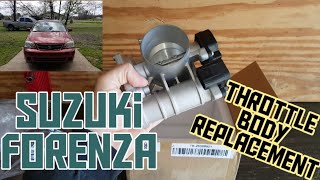
(OEM #96417730 (cross-references to GM/Daewoo))— This is the most common cause of a P2135 code on this vehicle, as the faulty throttle position sensors are integrated into this assembly. Replacing the whole unit is the most reliable fix. 🎬 Watch: A step-by-step walkthrough for replacing the throttle body assembly.
Trusted brands: Standard Motor Products, Walker, Autopart Premium, Replacement (133-289)
OEM price range: $250-$400
Aftermarket price range: $90-$160
Technical Service Bulletins (TSBs) & Recalls
- SC-60R-1: Mentions a counter measure procedure for DTC P2135. This is understood to be the idle relearn procedure required after throttle body replacement to prevent the code from returning.
Platform-Specific Known Issues
- Suzuki issued Service Bulletin SC-60R-1 regarding a 'counter measure procedure for dtc p2135.' This procedure is the 'Idle Relearn' process that must be performed after the throttle body is replaced to allow the ECM to calibrate to the new sensor's values.
Mechanic-Grade Diagnostic Values
- TP Sensor 1 and TP Sensor 2 Voltage Sweep — expected: With key on, engine off, one sensor should sweep smoothly from ~0.5V to ~4.5V while the other sweeps from ~4.5V to ~0.5V as the accelerator is pressed.. Failure: Any jumps, spikes, dropouts, or non-linear movement in the voltage indicates a failing sensor.
- 5V Reference at Throttle Body Connector — expected: Approximately 5.0 volts DC between the 5V reference pin and the ground pin with the key on, engine off.. Failure: Significantly lower or no voltage indicates a wiring or ECM problem, not a throttle body failure.
- TPS Internal Resistance (between 5V and Ground pins) — expected: A stable resistance reading that does not change when the throttle plate is moved. The value is typically in the range of 2k to 4k ohms.. Failure: An open circuit (infinite resistance) or a resistance value that changes as the throttle moves indicates a fault in the sensor's fixed resistance element.
- TPS Wiper Resistance (between Signal and Ground pins) — expected: Resistance should change smoothly from low to high (or high to low) as the throttle plate is opened, typically sweeping through a range like 0.2k to 4.0k ohms.. Failure: Sudden jumps to infinite resistance or erratic readings indicate wear spots on the sensor's resistive track.
Hidden / Shadow Codes Worth Checking
- P1516: A GM-specific code for 'Throttle Actuator Control (TAC) Module Throttle Actuator Position Performance'. It often appears alongside P2135 and indicates the PCM's command to the throttle motor doesn't match the resulting throttle position reported by the TPS. (see via Standard OBD-II scanner. Its presence reinforces that the fault is within the electronic throttle control system.)
Scan Tool Commands That Help
- Professional Scan Tool (e.g., Tech 2 or equivalent): Live Data Graphing (TP Sensor 1 vs TP Sensor 2) — This is the primary diagnostic step. Graphing both sensor voltages simultaneously while operating the pedal is the fastest way to see the correlation fault, glitches, or dropouts that condemn the throttle body.
- Professional Scan Tool (e.g., Tech 2 or equivalent): Idle Learn / Throttle Learn Reset — This function must be performed after replacing the throttle body. It allows the ECM to learn the new closed-throttle and idle position values from the replacement sensors. Failure to do this can cause the P2135 code to return or result in an unstable idle.
Wiring & Ground Locations
- G104 — Lower right side of the engine compartment.. A poor engine ground at this location can introduce electrical noise or voltage offsets, potentially causing the ECM to misinterpret sensor data and trigger a correlation code.
- G201 — Left side of the dash, likely behind the kick panel.. This is a major interior/dash ground point. While less likely to be the primary cause than an engine ground, a fault here could affect the ECM or related circuits.
- Throttle Body Connector — The 6-pin electrical connector on the electronic throttle body assembly.. This is the most critical connection. The pins for the two TPS sensors, the throttle motor, 5V reference, and ground are all located here. Corrosion or poor pin tension is a common point of failure.
- Standard GM TPS Wire Colors — Wiring harness leading to the throttle body.. Knowing the typical GM wire colors helps in testing: Black is usually ground, Grey is the 5V reference, and Blue is the signal output. This aids in correctly identifying pins for multimeter testing.
Real Owner Repair Stories
- YouTube channel 'WALI AUTOMOTIVE SERVICES' (Suzuki Wagon R (demonstrates a similar GM-based system)) — Check engine light on, P2135 code present, no acceleration when pressing the gas pedal.
❌ Tried (didn't work) The technician first suspected a broken wire.
✅ What actually fixed it A continuity test of the wiring from the throttle body to the ECM showed no broken wires. The actual fix was to tighten the female pin terminals ('loops') inside both the throttle body connector and the corresponding pins at the ECM connector to ensure a secure fit. This resolved the intermittent connection and cleared the code without replacing any parts.
Diagnostic Flowchart
Used vs. New Parts: Buying Guide for This Vehicle
When a used part is the smart pick: A used throttle body is a high-risk purchase and only makes sense if the budget is extremely constrained. The failure is due to electronic wear, so a used part has an unknown amount of remaining life.
Donor-vehicle mileage cap: roughly under 60000 miles for the part to have meaningful remaining life.
What to inspect on the donor part:
- Ask for the VIN of the donor car to verify mileage; aim for the lowest possible.
- Visually inspect the connector for any corrosion, bent pins, or damage.
- Check the throttle bore for excessive carbon buildup, which might indicate a poorly maintained engine.
- Only buy from a reputable seller who guarantees the part was pulled from a running vehicle that did not have a P2135 code.
OEM-only on this vehicle (don't cheap out):
- Engine Control Module (ECM) - Requires vehicle-specific programming that makes used units difficult to install.
Aftermarket brands forum-validated for this vehicle:
- Standard Motor Products (SMP)
- Walker Products
Brands owners have reported issues with on this vehicle:
- Unbranded, 'white-box' parts from online marketplaces should be avoided, as their internal sensor quality is unverified and they have a higher risk of premature failure.
Real Owner Stories
Aggregated from forums and TSBs cited above. Mileages and costs reflect what owners reported in those sources.
2007 Suzuki Forenza — 140000 miles
Symptoms: Car won't accelerate and struggles to start. Multiple codes were present, including P2135, P0223, P0123, P2110, P2106, and P2127.
What fixed it: The owner had not yet found a solution and was asking for help, questioning if the fault was with the computer or the accelerator pedal sensor.
Source hint: Opinautos
2008 Suzuki Forenza
Symptoms: Owner was trying to fix a P2135 code and was incorrectly told by a parts store that the sensor could be bought separately.
What fixed it: A dealer correctly advised the owner that the entire throttle body assembly needed to be replaced to fix the issue.
Cost: $750-$750
Source hint: 2CarPros - 2008 Suzuki Forenza How to Replace Throttle Body
2008 Chevrolet Aveo
Symptoms: Owner experienced a 'TPS sensor issue' which triggered the P2135 code, a very common problem for this platform mate.
What fixed it: Forum members confirmed that cleaning the throttle body is only a temporary fix at best and that the ultimate solution is to install a new throttle body assembly.
Source hint: Aveo Forum - P2135-TPS sensor issue-08 aveo
Related OBD-II Codes
Frequently Asked Questions
Can I just replace the Throttle Position Sensor (TPS) on my 2004-2008 Forenza, or do I have to buy the whole throttle body?
I cleaned the throttle body on my Forenza, but the P2135 code and limp mode came back. Is this normal?
Is there a special procedure required after installing a new throttle body on my Suzuki Forenza?
Are other cars built on the same platform as the Forenza also known for having this P2135 issue?
My mechanic wants to check the wiring for P2135. What are the key things to look for on this car?
How can I be sure the throttle body is bad before I buy a new one?
Helpful Videos
We Have This Part in Stock

The information in this article is provided for general reference and educational purposes only. Vehicle specifications, procedures, and part compatibility can vary by production date, trim level, and region. Always consult your vehicle's factory service manual and verify part numbers before purchasing or performing repairs. Safety-critical components such as airbags, seat belts, and braking systems should be installed by a qualified professional.
- Suzuki Forenza:
- 🧭 Diagnostic Flowchart
- 🎬 Helpful Videos
- 🛍️ Shop This Part
- What's Unique About the 2004-2008 Suzuki Forenza
- Symptoms You May Notice
- Most Likely Causes
- Rare But Worth Checking
- Diagnosis Steps
- Parts You'll Likely Need
- Technical Service Bulletins (TSBs) & Recalls
- Platform-Specific Known Issues
- Mechanic-Grade Diagnostic Values
- Hidden / Shadow Codes Worth Checking
- Scan Tool Commands That Help
- Wiring & Ground Locations
- Real Owner Repair Stories
- Used vs. New Parts: Buying Guide for This Vehicle
- Real Owner Stories
- 2007 Suzuki Forenza — 140000 miles
- 2008 Suzuki Forenza
- 2008 Chevrolet Aveo
- Related OBD-II Codes
- Frequently Asked Questions
- 🎟️ Get 5% Off