

P2138 on 2005-2012 Cadillac Escalade EXT: Causes and Fixes for Reduced Engine Power
On a 2005-2012 Escalade EXT, code P2138 almost always points to a faulty accelerator pedal position (APP) sensor or a bad electrical connection to it. This triggers the 'Reduced Engine Power' message. Before replacing the pedal assembly (~$60-$150), you MUST inspect the wiring. The most common culprit is corrosion in the large IP-to-body harness connector in the driver's kick panel, a well-documented issue covered by GM TSB #07-06-04-019F.
- P2138 on your Escalade EXT will cause 'Reduced Engine Power' mode for safety.
- Before buying any parts, you MUST inspect the large wiring connector in the driver's kick panel for corrosion, as this is a very common cause documented in GM service bulletins.
- If wiring is clean and secure, the next most likely fix is replacing the entire accelerator pedal assembly, which is a simple DIY job.
- Do not replace the throttle body for a P2138 code unless other specific throttle body codes are also present.
What's Unique About the 2005-2012 Cadillac ESCALADE EXT
On this generation of GM trucks, including the Escalade EXT, the P2138 code is notoriously linked to wiring and connector problems, not just a failed pedal sensor. GM has issued multiple Technical Service Bulletins (TSBs) highlighting that poor terminal tension or water intrusion into harness connectors can cause the exact symptoms of a bad pedal. The most cited is TSB #07-06-04-019F, which details 🎬 Watch: How to identify and clean the corroded harness connector. how water leaks from the A-pillar or sunroof can corrode the IP-to-body harness connector, causing the APP sensor circuits to fail. Owners often replace the pedal assembly, only for the problem to return because the root cause was a corroded or loose connection elsewhere in the circuit.
Diagnostic Flowchart
Tap your situation to follow the diagnostic path that matches what you're seeing on this vehicle.
Generation note: This range covers two generations of the Escalade EXT: the first generation (2005-2006, based on the GMT800 platform) and the second generation (2007-2012, based on the GMT900 platform). The underlying cause related to the accelerator pedal position sensor and its wiring is common to both, but part numbers for the pedal assembly and the specific location of harness connectors may differ slightly. The TSBs provided specifically reference the GMT900 generation, where the issue is very well-documented.
Symptoms You May Notice
- "Reduced Engine Power" message displayed on the dashboard.
- Check Engine Light is on.
- "Service StabiliTrak" or "Traction Control Off" message may also appear.
- Severely limited acceleration and vehicle speed ('limp mode').
- Vehicle may hesitate or have an erratic/unresponsive throttle.
- In some cases, the engine may stall when coming to a stop.
- Replacing the throttle body. P2138 specifically relates to the accelerator pedal sensors disagreeing with each other, not the throttle body. While a throttle body can fail, it usually produces different codes (like P2135).
- Replacing the accelerator pedal without checking the wiring. Many owners replace the pedal only to find the 'Reduced Engine Power' message returns because the actual fault was corrosion in the IP-to-body harness connector, as detailed in TSB #07-06-04-019F.
Most Likely Causes
- Poor Connection at IP-to-Body Harness Connector 🔴 High Probability → Shop Body Wiring Harness As documented in TSB #07-06-04-019F, this large connector, located in the driver's side kick panel, is highly susceptible to water intrusion from windshield, A-pillar, or sunroof drain leaks. This causes green or white corrosion on the APP sensor circuit pins, creating a voltage mismatch that triggers P2138.
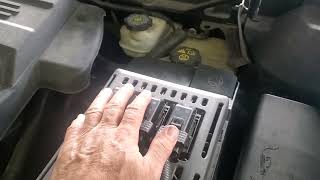
How to confirm: Remove the driver's side kick panel and locate the large, multi-wire harness connector. Disconnect it and meticulously inspect both male and female sides for any signs of corrosion, moisture, or backed-out pins. Look for evidence of water trails or rust on nearby bolts.
Typical fix: Clean the connector terminals with a dedicated electrical contact cleaner and a small brush. Apply dielectric grease before reconnecting to seal out future moisture. If corrosion is severe, the affected terminals or the entire connector pigtail may need to be replaced. The source of the water leak must also be found and repaired.
Est. part cost: $5-$35 - Faulty Accelerator Pedal Position (APP) Sensor Assembly 🔴 High Probability → Shop Accelerator Pedal Assembly The internal electronic components (potentiometers) of the sensors wear out over time, leading to inconsistent or erratic voltage signals that no longer correlate. This is the most likely component failure *after* all wiring issues are ruled out.
How to confirm: If all wiring and connectors are confirmed clean and secure, the pedal assembly is the next likely culprit. A scan tool can monitor live data for APP Sensor 1 and APP Sensor 2. Normal operation should show APP1 sweeping from ~1.0V to ~4.2V and APP2 from ~0.5V to ~2.5V. Jumps, drops, or non-correlating readings while slowly pressing the pedal point to a bad sensor.
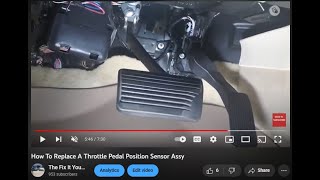
Typical fix: Replace the entire accelerator pedal assembly. 🎬 See this step-by-step walkthrough for replacing the pedal assembly. It is a single, non-serviceable unit that includes the pedal and the integrated sensors.
Est. part cost: $60-$150 - Poor Connection at the APP Sensor 🟡 Medium Probability The connector plugs directly into the top of the pedal assembly and can become loose or develop poor terminal tension over time, as noted in TSB #PIP3783D. This can cause intermittent signal loss.
How to confirm: Visually inspect the connector at the accelerator pedal. Wiggle the connector while the vehicle is running (in Park) to see if it triggers the fault. Check for loose or spread terminals inside the connector housing.
Typical fix: Ensure the connector is fully seated and the locking tab is engaged. Applying a small amount of dielectric grease can help ensure a stable connection. If terminals are damaged, the connector pigtail may need to be replaced.
Est. part cost: $0-$30 - Damaged Wiring ⚪ Low Probability Wires can get stretched, chafed, or damaged, particularly in the harness between the pedal assembly and the main body connector, or near the ECM.
How to confirm: Perform a 'wiggle test' on the harness sections between the pedal, the body connector, and the ECM while monitoring sensor voltage on a scan tool. A sudden drop or spike in voltage indicates a break in the wire. A continuity test with a multimeter can also find an open or short.
Typical fix: Repair the broken or shorted section of wire using a solder and heat-shrink butt connector for a durable, sealed repair.
Est. part cost: $1-$10
Rare But Worth Checking
- Faulty Throttle Body: → Shop Fuel Injection Throttle Body While less common for P2138 specifically (which points to the pedal), a failing throttle position sensor (TPS) on the throttle body can sometimes cause correlation issues with the pedal sensors. This usually sets other codes like P2135.
- Faulty Engine Control Module (ECM): → Shop Engine Control Module (ECM) This is very rare. The ECM should only be considered after all other possibilities have been ruled out. In one documented case, a technician confirmed the pedal and wiring were good but the ECM was incapable of reading the full voltage range from the APP sensor, necessitating ECM replacement.
Diagnosis Steps
- Read the DTCs with an OBD-II scanner to confirm P2138 is the primary code. Note any other APP or TPS codes.
- CRITICAL STEP: Locate and inspect the IP-to-body harness connector in the driver's side kick panel. Disconnect it and check thoroughly for any signs of moisture or green/white corrosion. This is the most common cause according to GM TSB #07-06-04-019F.
- If corrosion is found, clean the connector with electrical contact cleaner, apply dielectric grease, and reconnect. Find and fix the source of the water leak (e.g., sunroof drain, windshield seal). Clear codes and test drive.
- Visually inspect the electrical connector at the top of the accelerator pedal assembly. Ensure it is securely plugged in and check for any damaged wires or spread/pushed-out pins.
- If a scan tool with live data is available, monitor the voltage of APP Sensor 1 and APP Sensor 2. Press the pedal slowly from 0% to 100%. APP1 should read ~1.0V-4.2V and APP2 should read ~0.5V-2.5V. The signals must be smooth and track each other without glitches. Any jumps or flat spots indicate a failing pedal assembly.
- If the wiring and connectors are good, but the scan tool data is erratic, the accelerator pedal assembly is the cause. Replace the assembly.
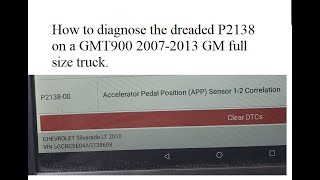
- If the problem persists, perform a detailed wiring continuity and 'wiggle test' between the pedal connector, the IP-to-body connector, and the ECM to find an intermittent open or short. A technician in one video provided ECM pinouts for a similar GM truck: At the ECM, APP1 signal is dark blue, APP2 signal 🎬 Watch: A professional diagnostic guide with wiring diagrams and pinouts. is light blue.
Parts You'll Likely Need
- Accelerator Pedal Assembly
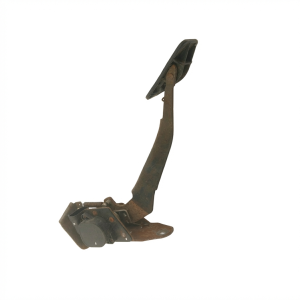
(OEM #GMT900 (2007-2012): 25832864 (supersedes 15847349, 15101848). GMT800 (2005-2006): 15107594.)— This is the most common part to fail *after* wiring issues are ruled out. The assembly contains the two sensors that produce the P2138 code when they no longer agree.
Trusted brands: ACDelco, Standard Motor Products (SMP), Dorman
OEM price range: $100-$180
Aftermarket price range: $60-$120 - Electrical Contact Cleaner & Dielectric Grease — Essential for cleaning corrosion from the IP-to-body harness connector and preventing future moisture intrusion, which is the most common cause of P2138 on this platform.
Trusted brands: CRC, Permatex, ACDelco
OEM price range: $10-$20
Aftermarket price range: $5-$15
Related Codes That Often Appear With This One
- P2122 — Indicates 'APP Sensor 1 Circuit Low Voltage,' pointing to a specific circuit issue within the same system.
- P2123 — Indicates 'APP Sensor 1 Circuit High Voltage,' also related to the pedal sensor circuits.
- P2127 — Indicates 'APP Sensor 2 Circuit Low Voltage,' pointing to the second sensor circuit in the pedal assembly.
- P2128 — Indicates 'APP Sensor 2 Circuit High Voltage,' also related to the second pedal sensor circuit.
Technical Service Bulletins (TSBs) & Recalls
- TSB #07-06-04-019F: This is the most critical TSB for this issue. It directly addresses intermittent P2138 codes with 'Reduced Engine Power'. It identifies the cause as water intrusion into the Instrument Panel (IP) to Body harness connector, typically located in the driver's side kick panel. The bulletin explicitly warns technicians *not* to replace the accelerator pedal until this connector has been inspected for corrosion caused by leaks from A-pillar seals, sunroof drains, or windshield sealing.
- TSB #PIP3783D: This bulletin points to poor terminal tension at the accelerator pedal position sensor's electrical connectors as a cause for P2138 and a range of related APP sensor codes. This reinforces that the connection points, both at the pedal and further down the harness, are known weak points.
Platform-Specific Known Issues
- TSB #07-06-04-019F and its revisions specifically call out water intrusion into the IP-to-body harness connector as a cause for P2138 on these vehicles.
- TSB #PIP3783D notes that poor terminal tension in the APP sensor circuits can cause P2138 and related codes, reinforcing the need to check all connections before replacing parts.
Mechanic-Grade Diagnostic Values
- APP Sensor 5-Volt Reference at ECM — expected: 4.8-5.2 Volts. Failure: Voltage below 4.8V or above 5.2V points to a short/open in the reference circuit or a faulty ECM.
- APP Sensor Sweep Test (using DMM) — expected: 0.30V to 4.98V. Failure: Voltage is not within range, is erratic, or shows spikes/dropouts, indicating a faulty pedal assembly.
- APP Sensor 1 & 2 Voltage (Key On, Scan Tool) — expected: 0.32V to 4.75V. Failure: Voltage is outside this range or does not change smoothly with pedal input.
- Resistance on all APP sensor circuits to ECM — expected: Less than 5.0 Ohms. Failure: Resistance greater than 5.0 Ohms indicates an open or high resistance in the circuit.
Hidden / Shadow Codes Worth Checking
- P0697 or P06A3: These are 5-Volt Reference Circuit codes. GM diagnostic procedures state that if these codes are present alongside P2138, they must be diagnosed first, as a fault in the 5V reference circuit will cause the APP sensor to malfunction. (see via Standard OBD-II scanner.)
- P2138:00: Some advanced scan tools may display the code with a two-digit failure type suffix. While the meaning of ':00' is not universally defined, it indicates a generic or primary fault type for that code. (see via Professional-grade scan tool.)
Scan Tool Commands That Help
- Tech2 / GDS2 (or high-level generic): Throttle Relearn / Idle Relearn Procedure — This function may be required after replacing the throttle body to allow the ECM to learn the new sensor's idle and wide-open positions. While some manual procedures exist, a scan tool command is the most reliable method.
Wiring & Ground Locations
- IP-to-Body Harness Connector — Located in and around the left-hand kick panel area, inside the cabin.. This is the most common failure point. TSB #07-06-04-019F identifies it as being highly prone to water intrusion from A-pillar or sunroof leaks, causing corrosion on the APP circuit pins passing through it.
- APP Sensor Connector (6-pin) — Directly on the accelerator pedal assembly.. Provides the 5V reference, ground, and signal lines for both APP Sensor 1 and 2. Pinout (typical): A-Low Ref, B-APP2 Signal, C-5V Ref, D-Low Ref, E-APP1 Signal, F-5V Ref.
- G201 — A primary interior ground point located behind the upper left end of the dashboard.. A poor ground at this location can cause fluctuating voltage readings for multiple interior electronic components, including the APP sensor's low reference circuit.
- G200 — An interior ground point located at the right front corner of the HVAC case under the dash.. Similar to G201, a fault here can introduce electrical noise and unstable reference voltages for sensor circuits.
- C109/X109 and C205/X205 — C109/X109 is on the left side of the engine compartment below the underhood fuse block. C205/X205 is under the Upper Instrument Trim Panel.. TSB PIP3783D recommends inspecting these connectors for corrosion or poor pin tension if the kick panel connector is clean, as they are other junctions in the APP sensor circuits.
Real Owner Repair Stories
- DF Kit Car Forum (Cobalt donor) (Chevrolet Cobalt (donor for kit car), which uses a similar GM electronic throttle control system.) — Intermittent limp mode with code P2138.
❌ Tried (didn't work) Replaced the accelerator pedal assembly., Replaced the throttle body., Replaced the accelerator pedal jumper harness.
✅ What actually fixed it The problem was ultimately traced to the wiring harness. One user noted that the extension of the pedal harness involves 12 splices, any of which can fail. Another user confirmed their fix was creating fresh solder joints on the APP circuit wires 6 inches from the ECU plug, eliminating the intermittent connection issue.
OEM Part Supersession History
07-06-04-019E→07-06-04-019F— The Technical Service Bulletin for repairing the IP-to-Body harness connector was updated to include model years up to 2018.
Model Year Variations Within This Range
- 2007-2012 (GMT900): The well-documented TSBs (#07-06-04-019F and #PIP3783D) specifically apply to the GMT900 platform. While the earlier GMT800 (2005-2006) models can experience the same code, the exact location and designator for the problematic IP-to-body harness connector may differ. TSB PIP3783D explicitly states it is 'For New Body Style Trucks Only - Not for Classic Models'.
Helpful Videos

We Have This Part in Stock

The information in this article is provided for general reference and educational purposes only. Vehicle specifications, procedures, and part compatibility can vary by production date, trim level, and region. Always consult your vehicle's factory service manual and verify part numbers before purchasing or performing repairs. Safety-critical components such as airbags, seat belts, and braking systems should be installed by a qualified professional.
- Cadillac ESCALADE EXT:
- 🧭 Diagnostic Flowchart
- 🎬 Helpful Videos
- 🛍️ Shop This Part
- What's Unique About the 2005-2012 Cadillac ESCALADE EXT
- Symptoms You May Notice
- Most Likely Causes
- Rare But Worth Checking
- Diagnosis Steps
- Parts You'll Likely Need
- Related Codes That Often Appear With This One
- Technical Service Bulletins (TSBs) & Recalls
- Platform-Specific Known Issues
- Mechanic-Grade Diagnostic Values
- Hidden / Shadow Codes Worth Checking
- Scan Tool Commands That Help
- Wiring & Ground Locations
- Real Owner Repair Stories
- OEM Part Supersession History
- Model Year Variations Within This Range
- 🎟️ Get 5% Off