

P2138 on 2005-2009 GMC Yukon Denali: Reduced Power Causes and Fixes
On a 2005-2009 GMC Yukon Denali, code P2138 is almost always caused by a wiring issue, specifically corrosion in the IP-to-body harness connector (X202) in the driver's kick panel, as noted in GM TSB #07-06-04-019F. Before replacing the accelerator pedal assembly (ACDelco #25832864), inspect this connector for signs of water damage from A-pillar, sunroof, or windshield leaks.
- P2138 on a 2005-2009 Yukon Denali will put the truck in 'Reduced Engine Power' mode.
- The most likely cause is NOT the pedal sensor itself, but water damage causing corrosion in a large wiring connector located in the driver's side kick panel.
- ALWAYS inspect for signs of water leaks and check this connector for corrosion before buying any parts.
- Cleaning the corroded connector with electrical cleaner and protecting it with dielectric grease is the most common and cheapest fix.
- If wiring is confirmed to be good, the next most likely cause is a failed accelerator pedal assembly.
What's Unique About the 2005-2009 Gmc YUKON DENALI
For this generation of GMC trucks and SUVs (GMT800/GMT900 platforms), the P2138 code is very frequently linked to specific, well-documented issues that go beyond a simple sensor failure. General Motors has released multiple Technical Service Bulletins (TSBs) that point directly to wiring connector problems as the primary culprit. A known design susceptibility allows water to leak into the cabin from the A-pillar seals, sunroof drains, or windshield cowl and corrode a critical harness connector (often referred to as X202) in the driver's kick panel, causing the sensor signals to become erratic.
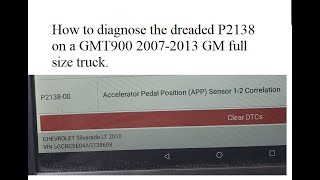
🎬 Watch: Pinpointing P2138 on GMT900 trucks using wiring diagrams.Diagnostic Flowchart
Tap your situation to follow the diagnostic path that matches what you're seeing on this vehicle.
Generation note: This range covers two Yukon generations: the second-gen GMT800 (2005-2006) and the third-gen GMT900 (2007-2009). The wiring harness issues are particularly well-documented for the GMT900 platform in TSBs like #07-06-04-019F. However, the underlying cause related to water intrusion and connector corrosion can affect both generations, as they share similar body and wiring architecture.
Symptoms You May Notice
- "Reduced Engine Power" message displayed on the dash.
- Check Engine Light (Malfunction Indicator Lamp) is on.
- Poor or no acceleration; vehicle may feel like it's in 'limp mode'.
- Vehicle may stall, especially when coming to a stop.
- Intermittent or erratic throttle response.
- Sudden loss of power while driving.
- Replacing the accelerator pedal assembly without first inspecting the IP-to-body harness connector. Many owners replace the pedal, sometimes multiple times, only to have the code return because the true fault was corrosion in the wiring.
- Replacing the throttle body. P2138 specifically relates to a correlation error between the two sensors in the accelerator pedal, not the throttle body. The primary throttle body correlation code is P2135.
Most Likely Causes
- Wiring/Connector Issue at IP-to-Body Harness 🔴 High Probability As documented in GM TSB #07-06-04-019F, these vehicles are prone to water leaks from the A-pillar, windshield cowl, or clogged sunroof drains. This water drips onto the Instrument Panel (IP) to body harness connector (often X202) in the driver's kick panel, causing corrosion on the terminals for the APP sensor signals.
How to confirm: Pull back the driver's side kick panel and carpet, near your left foot. Visually inspect the large electrical connector (often black, may be labeled X202) for any signs of green or white corrosion, moisture, or rust on the surrounding metal. A water hose test on the windshield and A-pillar area can help identify the source of the leak.
Typical fix: Disconnect the battery. Unplug the connector, clean the terminals thoroughly with an electrical contact cleaner (like Deoxit D5), and use a small pick or brush to remove corrosion. Let it dry completely. Apply dielectric grease to the terminals before reconnecting to prevent future moisture intrusion. If terminals are severely damaged, the connector pigtail may need to be replaced. Finding and fixing the source of the water leak is critical to prevent recurrence.
Est. part cost: $10-$25 for cleaner and grease. - Faulty Accelerator Pedal Position (APP) Sensor 🟡 Medium Probability → Shop Accelerator Pedal Assembly While wiring is the most common issue, the sensor integrated into the accelerator pedal assembly can fail internally over time, causing the voltage signals to become erratic or uncorrelated. This is a common wear item.
How to confirm: After confirming the wiring and connectors are clean and tight, use a scan tool to monitor the live data for APP Sensor 1 and APP Sensor 2. Press the pedal slowly and watch for any jumps, dropouts, or non-linear movement in the voltage readings. Wiggling the harness at the pedal connector can also help identify an intermittent sensor or wire.
Typical fix: Replace the entire accelerator pedal assembly, as the sensor is not sold separately. This is usually held in by two or three bolts and is a simple replacement. An OEM part is often recommended over aftermarket to avoid repeat issues.
Est. part cost: $60-$180 - Poor Terminal Tension at APP Sensor Connector ⚪ Low Probability TSB #PIP3783D notes that the female terminals in the connector at the pedal itself can lose their grip on the male pins of the sensor over time, leading to an intermittent connection. This can be caused by repeated vibrations or previous unplugging/plugging of the connector.
How to confirm: With the pedal connector unplugged, carefully inspect the female terminals to ensure they are not spread too far apart. A wiggle test of the connector while monitoring live data can often confirm this issue. If wiggling the connector causes the voltage to jump or drop out, this is the likely cause.
Typical fix: Sometimes the terminals can be carefully re-tensioned with a special tool. More commonly, the connector pigtail is replaced. This involves cutting the old connector off and splicing the new one in, wire by wire.
Est. part cost: $15-$40
Rare But Worth Checking
- Faulty Engine Control Module (ECM): → Shop Engine Control Module (ECM) This is very rare. Before condemning the ECM, all other possibilities, including a thorough inspection of the entire wiring harness for damage between the pedal and the ECM, must be exhausted. An ECM failure is a last resort diagnosis.
- Dirty or Faulty Throttle Body: → Shop Fuel Injection Throttle Body While less common for P2138 (which points to the pedal), a sticky or malfunctioning throttle body can sometimes cause erratic behavior that the ECM misinterprets. This is more commonly associated with code P2135, but it's worth checking if all pedal-side diagnostics pass.
Diagnosis Steps
- Read the code with an OBD-II scanner and check for any other related DTCs.
- Visually inspect the driver's side footwell and kick panel area for any signs of water intrusion, such as damp carpets, rust, a musty smell, or a stained headliner.
- Remove the driver's kick panel and locate the large IP-to-body harness connector (X202). Disconnect it and inspect thoroughly for any green or white corrosion on the pins.
- If corrosion is found, clean the terminals with electrical contact cleaner and apply dielectric grease before reconnecting. Trace and repair the source of the water leak (sunroof drains, windshield seal, A-pillar grommets).
- If no corrosion is found, inspect the wiring and connector directly at the accelerator pedal for damage or loose pins (poor terminal tension).
- Use a scan tool to monitor live data for APP Sensor 1 and APP Sensor 2. The voltage readings should be smooth and react instantly as you press and release the pedal. APP1 usually sweeps from low to high voltage, while APP2 sweeps from high to low.
- While watching the live data, wiggle the wiring harness at the pedal and at the IP-to-body connector to see if you can force the fault to occur. A signal dropout indicates a wiring problem.
- If all wiring and connectors are confirmed to be good, the accelerator pedal assembly is the most likely cause of the failure.
Parts You'll Likely Need
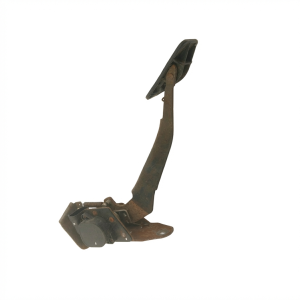
- Accelerator Pedal Assembly
(OEM #25832864)— This is the most commonly replaced part when wiring is not the issue, as the internal sensors fail and are not serviced separately. The OEM part number 25832864 is widely cited for this generation.
Trusted brands: ACDelco, GM Genuine, Dorman, Standard Motor Products
OEM price range: $100-$180
Aftermarket price range: $60-$120 - Electrical Contact Cleaner & Dielectric Grease — Needed for the most common repair: cleaning corrosion from the IP-to-body harness connector.
Trusted brands: CRC, Permatex, DeoxIT
OEM price range: $10-$25
Aftermarket price range: $10-$25
Related Codes That Often Appear With This One
- P2122 — Indicates APP Sensor 1 circuit is low, often appearing with P2138 due to the same wiring fault.
- P2123 — Indicates APP Sensor 1 circuit is high, pointing to a short or open in the APP wiring.
- P2127 — Indicates APP Sensor 2 circuit is low, another code related to the same sensor assembly and wiring.
- P2128 — Indicates APP Sensor 2 circuit is high, often triggered by the same connector corrosion or wiring issue.
- P2135 — Throttle Body Position Sensor correlation error. If seen with P2138, it could indicate a more complex wiring issue affecting both circuits, but P2138 alone points to the pedal side.
Technical Service Bulletins (TSBs) & Recalls
- 07-06-04-019F: Intermittent MIL Illuminated, DTC P2138 with Reduced Engine Power (Repair Instrument Panel (IP) to Body Harness Connector). This is the primary TSB for this issue, pointing to water intrusion in the kick panel connector.
- PIP3783D: Malfunction Indicator Lamp on or reduced engine power message. Technician may find Diagnostic Trouble Codes P2120, P2122, P2123, P2125, P2127, P2128, and/or P2138. Technician will need to inspect the Accelerator Pedal Position circuits for poor terminal tension.
Platform-Specific Known Issues
- Water intrusion into the IP-to-body harness connector (X202) in the driver's kick panel is a widely documented cause for P2138 on this platform, as detailed in TSB #07-06-04-019F. Sources of the leak are often clogged sunroof drains, poor windshield seals, or leaking A-pillar grommets.
- Poor terminal tension in the accelerator pedal position sensor circuits can also trigger this code, as noted in TSB #PIP3783D.
Mechanic-Grade Diagnostic Values
- APP Sensor 1 Voltage (Signal) — expected: Approx. 0.5V - 1.0V with pedal released, sweeping smoothly to 3.9V - 4.7V when fully depressed.. Failure: Voltage is jumpy, flat, outside of range, or does not sweep smoothly when viewed on a scan tool.
- APP Sensor 2 Voltage (Signal) — expected: Approx. 0.15V - 0.6V with pedal released, sweeping smoothly to 1.95V - 2.4V when fully depressed. Often tracks at about half the voltage of Sensor 1.. Failure: Voltage does not correlate with Sensor 1, or shows jumps, dropouts, or flat spots.
- 5-Volt Reference at APP Connector — expected: Between 4.8V and 5.2V with Key On, Engine Off.. Failure: Voltage is significantly lower or higher, indicating a short, open, or an ECM issue.
- APP Low Reference Circuit Resistance — expected: Less than 5.0 ohms between the low reference circuit pin at the APP connector and a known good ground.. Failure: Resistance over 5.0 ohms indicates a bad ground connection or high resistance in the wiring.
Scan Tool Commands That Help
- Tech2 / GDS2: ETC Relearn / Throttle Relearn — Generally not required for just an accelerator pedal replacement, which is plug-and-play on these models. It is primarily used if the throttle body is cleaned or replaced. A simple battery disconnect for 15 minutes is often sufficient to reset the system after pedal replacement.
Wiring & Ground Locations
- Connector X202 — In the driver's side kick panel area, where the instrument panel harness connects to the main body harness.. This is the most common failure point noted in TSB #07-06-04-019F. Water leaks into the cabin and corrodes the pins carrying the APP sensor signals to the ECM, causing the P2138 code.
- APP Sensor Connector — A 6-pin connector that plugs directly into the top of the accelerator pedal assembly.. This is the source of the signal. TSB #PIP3783D notes that poor terminal tension here can cause an intermittent connection and trigger the code. The wires can also break at the connector from stress.
- ECM Connector X1 — One of the large multi-pin connectors at the Engine Control Module (ECM), located in the engine bay.. The APP sensor circuits terminate here. A final diagnostic step involves checking for continuity and resistance between the APP sensor connector and the corresponding pins at this connector to rule out a wiring break.
Real Owner Repair Stories
- Reddit user in r/MechanicAdvice (2007 GMC Yukon Denali XL) — Intermittent Check Engine Light with code P0122 (TPS related) and Reduced Engine Power, especially when decelerating.
❌ Tried (didn't work) Replacing the Throttle Position Sensor (TPS)., Replacing the Mass Airflow (MAF) sensor., Replacing the accelerator pedal assembly (this changed the code from P0122 to P2138).
✅ What actually fixed it The owner discovered that oil from the engine bay had wicked its way up the TPS wiring harness, contaminating the inside of the connector. Cleaning the oil out of the male and female connector terminals resolved the issue.
OEM Part Supersession History
15101848, 15847349→25832864— Standard part evolution and design updates by the manufacturer.
Heads up: The pedal assembly for 2005-2006 (GMT800) is different and part of a system with a separate Throttle Actuator Control (TAC) module. Part number 25832864 is specified for 2007-2011 models.
Model Year Variations Within This Range
- 2005-2006 (GMT800 Platform): These models use a separate Throttle Actuator Control (TAC) module. The accelerator pedal connects to the TAC module, which then communicates with the ECM. Troubleshooting must include the TAC module and the wiring harness between the pedal and the module.
- 2007-2009 (GMT900 Platform): These models have the throttle control logic integrated into the Engine Control Module (ECM). The accelerator pedal sends its signals directly to the ECM (via connectors like X202). The TSB regarding water intrusion at connector X202 is most relevant to this platform.
Helpful Videos




We Have This Part in Stock

The information in this article is provided for general reference and educational purposes only. Vehicle specifications, procedures, and part compatibility can vary by production date, trim level, and region. Always consult your vehicle's factory service manual and verify part numbers before purchasing or performing repairs. Safety-critical components such as airbags, seat belts, and braking systems should be installed by a qualified professional.
- Gmc YUKON DENALI:
- 🧭 Diagnostic Flowchart
- 🎬 Helpful Videos
- 🛍️ Shop This Part
- What's Unique About the 2005-2009 Gmc YUKON DENALI
- Symptoms You May Notice
- Most Likely Causes
- Rare But Worth Checking
- Diagnosis Steps
- Parts You'll Likely Need
- Related Codes That Often Appear With This One
- Technical Service Bulletins (TSBs) & Recalls
- Platform-Specific Known Issues
- Mechanic-Grade Diagnostic Values
- Scan Tool Commands That Help
- Wiring & Ground Locations
- Real Owner Repair Stories
- OEM Part Supersession History
- Model Year Variations Within This Range
- 🎟️ Get 5% Off