

P2138 on 2005-2012 GMC Yukon XL: 'Reduced Engine Power' Causes & Fixes
On a 2005-2012 GMC Yukon XL, code P2138 almost always points to a problem with the Accelerator Pedal Position (APP) sensor or its wiring. This will cause the 'Reduced Engine Power' message to appear. The most common fix is replacing the APP sensor assembly, but a known wiring issue documented in GM Technical Service Bulletins (TSBs) should be investigated first to avoid misdiagnosis. Specifically, water intrusion into the IP-to-body harness connector in the driver's kick panel is a very frequent
- P2138 on your Yukon XL will trigger the 'Reduced Engine Power' mode, which is a serious safety issue.
- Before buying any parts, inspect the wiring. Check for water damage in the driver's kick panel, as this is a known GM issue documented in TSBs.
- The most common failed part is the Accelerator Pedal Position (APP) sensor, which is sold as a complete pedal assembly.
- Do not immediately replace the expensive throttle body; it is a less likely cause for this specific code.
- Proper diagnosis with a scan tool that can read live sensor data is crucial to pinpointing the exact cause, whether it's the pedal sensor or a wiring fault.
What's Unique About the 2005-2012 Gmc YUKON XL
For this generation of GMC trucks and SUVs (GMT900 platform), the P2138 code is very frequently linked to specific, well-documented issues. GM has released multiple Technical Service Bulletins (TSBs) pointing to problems with wiring connectors, not just the sensor itself. Specifically, water intrusion into the instrument panel-to-body harness connector (often called the X211 connector) is a known cause of this code, leading to corrosion and faulty signals. This water leak can originate from a bad windshield seal, clogged sunroof drains, or even a poorly sealed roof antenna, which then runs down the A-pillar into the driver's side kick panel. This makes checking the wiring a critical first step before replacing any parts.
Diagnostic Flowchart
Tap your situation to follow the diagnostic path that matches what you're seeing on this vehicle.
Generation note: This range covers two generations of the Yukon XL: the GMT800 (2005-2006) and the GMT900 (2007-2012). The provided TSBs from NHTSA specifically mention models from 2007 onwards, indicating the wiring harness issues are particularly well-documented for the GMT900 platform. However, the underlying cause can affect both generations as they use similar drive-by-wire technology.
Symptoms You May Notice
- "Reduced Engine Power" message on the dashboard
- Check Engine Light is on
- "Service StabiliTrak" or similar stability control warnings
- Poor or erratic acceleration
- Vehicle may stall or have a very low idle
- No response from the gas pedal
- Sudden loss of power while driving at cruising speed
- Cruise control is inoperative
- Replacing the throttle body assembly when the fault is actually with the accelerator pedal sensor or its wiring.
- Replacing the accelerator pedal sensor when the true cause is a corroded IP-to-body harness connector in the kick panel.
Most Likely Causes
- Wiring/Connector Issue at IP-to-Body Harness 🔴 High Probability As documented in GM TSB #070604019F and its revisions, these vehicles are susceptible to water leaks from the A-pillar, sunroof drains, or windshield cowl area, which drips onto the Instrument Panel (IP) to body harness connector located in the driver's side kick panel. This causes corrosion on the terminals carrying the APP sensor signals, creating a voltage discrepancy that the ECM flags as a fault.
How to confirm: Pull back the driver's side carpet and remove the kick panel. Inspect the floor for signs of moisture, rust, or a stained headliner. Unplug the large IP-to-body harness connector (often a large black lever-lock connector) and check for green or white corrosion on the terminals.
Typical fix: Clean the connector terminals with a specialized contact cleaner and a small brush if corrosion is minor. Apply dielectric grease before reconnecting to prevent future moisture intrusion. If severe, the connector and affected wires may need to be repinned or replaced. The source of the water leak must also be found and repaired.
Est. part cost: $10-$50 for cleaning supplies or a new connector pigtail. - Faulty Accelerator Pedal Position (APP) Sensor 🔴 High Probability → Shop Accelerator Pedal Assembly The sensor is a high-use electronic component that can wear out over time, causing its internal signals to drift or fail. This is a common failure point on many drive-by-wire vehicles and is often the correct fix if all wiring has been confirmed to be in good condition.
How to confirm: Use a scan tool with live data capability to monitor the two APP sensor voltages (APP1 and APP2). As you press the pedal, both voltages should increase smoothly and in correlation with each other. A jump, drop, or flat-line from one sensor indicates failure. A wiggle test on the pedal's harness can also reveal an issue.
Typical fix: Replace the entire accelerator pedal assembly, which contains the integrated sensor. This is typically held on by two nuts or bolts.
Est. part cost: $60-$150 - Poor Terminal Tension at APP Sensor Connector 🟡 Medium Probability TSB #PIP3783D specifically calls out inspecting the APP circuits for poor terminal tension. The female terminals in the connector at the pedal itself can loosen over time, causing an intermittent connection to the male pins on the sensor.
How to confirm: With the connector unplugged from the pedal, carefully check if the female terminals have a snug fit on the sensor pins. A loose connection can be detected by wiggling the harness while watching live data on a scan tool.
Typical fix: The affected terminals may need to be carefully re-tensioned with a special tool or replaced. Applying a small amount of dielectric grease can also help ensure a good connection.
Est. part cost: $5-$20 for terminals or grease. - Damaged or Dirty Throttle Body ⚪ Low Probability → Shop Fuel Injection Throttle Body While less common for this specific code, a throttle plate that is sticking due to heavy carbon buildup can cause a mismatch between what the pedal is requesting and what the throttle position sensors (TPS) are reporting, sometimes triggering a P2138. However, this will more commonly set other codes like P2135.
How to confirm: Visually inspect the throttle body bore and plate for heavy carbon deposits. The throttle plate should move freely without sticking.
Typical fix: Clean the throttle body thoroughly with a dedicated throttle body cleaner and a soft brush, being careful not to damage the electronic components.
Est. part cost: $10-$20 for cleaner.
Rare But Worth Checking
- Failing Engine Control Module (ECM): → Shop Engine Control Module (ECM) This is very rare. The ECM should only be considered after all other possibilities, including all wiring (at the pedal, IP-to-body connector, and ECM), connectors, and sensors, have been exhaustively tested and ruled out.
Diagnosis Steps
- Read all diagnostic trouble codes with an OBD-II scanner. Note any other codes present alongside P2138.
- Visually inspect the driver's side floor, kick panel area, and headliner for any signs of water intrusion, dampness, or rust.
- Locate and inspect the IP-to-body harness connector in the kick panel for any blue or green corrosion, as detailed in TSB #070604019F.
- Using a scan tool, observe the live data for APP Sensor 1 and APP Sensor 2. The values should be different but change in correlation as you slowly press and release the gas pedal. One sensor's voltage is typically about half of the other's.
- Perform a 'wiggle test': while watching the live data, gently wiggle the wiring harness at the accelerator pedal, at the IP-to-body connector, and at the ECM to see if the voltage readings jump or drop out.
- Inspect the APP sensor connector at the pedal for loose or spread terminals, as noted in TSB #PIP3783D.
- If all wiring and connectors appear clean, dry, and secure, the accelerator pedal assembly is the most likely culprit.
- As a final check, inspect the throttle body for heavy carbon buildup that could cause the throttle plate to stick.
Parts You'll Likely Need
- Accelerator Pedal Position (APP) Sensor Assembly
(OEM #25832864)— This is the most common part to fail and cause a P2138 code when wiring issues are not present. The entire pedal assembly is replaced as a single unit. The OEM part number 25832864 is widely cited for this generation of trucks.
Trusted brands: ACDelco, Delphi, Dorman, Standard Motor Products
OEM price range: $100-$180
Aftermarket price range: $60-$120
Related Codes That Often Appear With This One
- P2122 — This code indicates 'APP Sensor 1 Circuit Low Voltage', pointing directly to an issue with the accelerator pedal assembly or its wiring. TSB #PIP3783D mentions this code appearing with P2138.
- P2123 — This code indicates 'APP Sensor 1 Circuit High Voltage', also pointing to the accelerator pedal assembly or wiring.
- P2127 — This code indicates 'APP Sensor 2 Circuit Low Voltage', pointing to the second sensor circuit within the same pedal assembly.
- P2128 — This code indicates 'APP Sensor 2 Circuit High Voltage', also related to the second sensor circuit in the pedal assembly. TSB #PIP3783D and owner complaint #11230769 both mention these codes appearing with P2138.
Technical Service Bulletins (TSBs) & Recalls
- 070604019F: Intermittent MIL Illuminated, DTC P2138 with Reduced Engine Power (Repair Instrument Panel (IP) to Body Harness Connector)
- 07-06-04-019E: A previous revision of the same TSB for intermittent MIL and P2138.
- PIP3783D: Mentions P2138 along with other APP codes and advises inspection of APP circuits for poor terminal tension.
Platform-Specific Known Issues
- GM Technical Service Bulletin #070604019F directly addresses this code, stating the cause can be water intrusion into the instrument panel-to-body harness connector, leading to intermittent 'Reduced Engine Power' messages. The bulletin explicitly warns 'Do Not replace the accelerator pedal assembly' before performing this check.
Mechanic-Grade Diagnostic Values
- APP Sensor 5V Reference Voltage — expected: > 4.8V (typically 5.0-5.1V). Failure: Voltage below 4.8V indicates a problem with the 5V reference circuit, which could be a wiring issue or a fault in another sensor sharing the circuit.
- APP Sensor Low Reference Circuit Resistance — expected: < 5.0 Ω. Failure: Resistance over 5.0 Ω indicates excessive resistance in the ground circuit, often due to corrosion or a bad connection.
- APP Sensor 1 vs. Sensor 2 Voltage (Key On, Engine Off, Pedal at Rest) — expected: One sensor should read approximately double the other (e.g., APP1 ≈ 0.8-0.9V, APP2 ≈ 0.4-0.5V, or vice-versa). The key is that they are not identical and have a set relationship.. Failure: Voltages are identical, one is at 0V, or they do not maintain a consistent ratio when the pedal is pressed.
Hidden / Shadow Codes Worth Checking
- P2138:00: This is a more specific logging of the same P2138 fault, sometimes seen on manufacturer-level scan tools like the GM Tech2 or GDS2. It does not indicate a different failure mode but is the formal designation. (see via GM-specific diagnostic tools (Tech2, GDS2))
Scan Tool Commands That Help
- Tech2/GDS2 or equivalent professional scan tool: Throttle Body Relearn / Idle Relearn Procedure — This procedure may be required after cleaning or replacing the throttle body assembly. It allows the ECM to learn the new closed and wide-open throttle positions. It is generally not required after replacing only the accelerator pedal assembly.
Wiring & Ground Locations
- IP-to-Body Harness Connector — Located in the driver's side kick panel area, sometimes behind the panel or under the carpet. It is a large, multi-pin connector, often with a lever-lock mechanism.. This is the primary location for water intrusion to cause corrosion on the APP sensor signal wires, as documented in TSB #07-06-04-019F. The APP sensor signals pass through this connector on their way to the ECM.
- APP Sensor Connector (at pedal) — Directly plugs into the top of the accelerator pedal assembly.. This is the source of the signal. Wire colors for 2007-2012 models are typically: Purple (Low Reference 1), Brown (Low Reference 2), Tan (5V Reference 1), White/Black (5V Reference 2), and two signal wires. Poor terminal tension here is a common issue.
- ECM Connector X1 — On the Engine Control Module (ECM), typically located in the engine bay. The X1 connector is one of several large connectors plugging into the module.. This is the destination for all six APP sensor wires. A wiring diagram for a similar GM truck shows all six wires terminating at this connector, which often has a blue internal face. A poor connection or corrosion here can also cause the code.
Real Owner Repair Stories
- Tahoe Yukon Forum user (2011 Yukon XL 2500 (6.0L)) — P2138 code with reduced engine power, known water intrusion on driver's side.
❌ Tried (didn't work) Replaced all 6 wires to the accelerator pedal., Replaced the accelerator pedal assembly., Replaced the entire throttle body assembly., Cleaned sunroof drains and sealed the GPS antenna to stop water leaks.
✅ What actually fixed it The user diagnosed the final problem as a faulty Engine Control Module (ECM). After replacing all common-fail parts and wiring, resistance tests through the ECM's internal low-reference circuits were still higher than the 5-ohm maximum, indicating an internal failure within the ECM itself. - CorvetteForum user (Chevrolet Corvette (similar GM system)) — P2138 and other intermittent warnings.
❌ Tried (didn't work) Multiple dealer and independent shop visits.
✅ What actually fixed it The owner found the connector at the throttle body was not fully seated and locked. After cleaning all related system connectors (ABS, throttle body, etc.) with a terminal cleaning kit and applying dielectric grease, the problem was resolved.
"I Checked Everything" — The Actual Cause
- In the context of P2138, the equivalent of a 'smoke test clean' scenario is when all wiring tests pass, connectors are clean, and the pedal has been replaced, yet the code persists. One well-documented case pointed to a high-resistance failure *inside* the Engine Control Module (ECM) on its low-reference circuits. This is a rare but possible root cause that can only be diagnosed after every other component and wire has been proven to be good.
OEM Part Supersession History
N/A (concept applies to replacements)→N/A— Part Design Change
Heads up: While outside the 2005-2012 range, it's a critical trap for mechanics. Around 2016, GM reversed the internal logic for APP Sensor 1 and APP Sensor 2. A pedal from a newer GM truck will physically fit an older one, but it will not work and will set a P2138 code immediately because the voltage signals will be swapped from what the ECM expects. The only fix is to use the correct part for the year or manually de-pin and swap the signal wires in the harness connector.
Model Year Variations Within This Range
- 2007-2012 (GMT900 Platform): These models are particularly susceptible to the water leak issue causing corrosion in the IP-to-body harness connector, as documented extensively in TSB #07-06-04-019F and its revisions. While the earlier GMT800 (2005-2006) models can also experience P2138, the specific water leak path into the kick panel connector is a well-known pattern on the GMT900s.
Helpful Videos
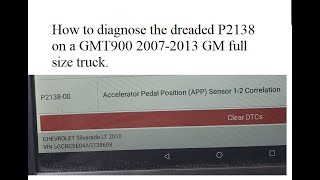
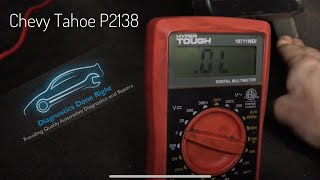
We Have This Part in Stock
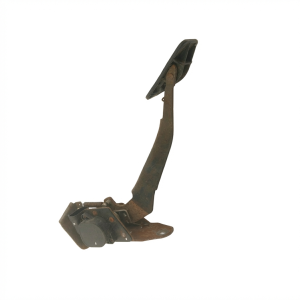

The information in this article is provided for general reference and educational purposes only. Vehicle specifications, procedures, and part compatibility can vary by production date, trim level, and region. Always consult your vehicle's factory service manual and verify part numbers before purchasing or performing repairs. Safety-critical components such as airbags, seat belts, and braking systems should be installed by a qualified professional.
- Gmc YUKON XL:
- 🧭 Diagnostic Flowchart
- 🎬 Helpful Videos
- 🛍️ Shop This Part
- What's Unique About the 2005-2012 Gmc YUKON XL
- Symptoms You May Notice
- Most Likely Causes
- Rare But Worth Checking
- Diagnosis Steps
- Parts You'll Likely Need
- Related Codes That Often Appear With This One
- Technical Service Bulletins (TSBs) & Recalls
- Platform-Specific Known Issues
- Mechanic-Grade Diagnostic Values
- Hidden / Shadow Codes Worth Checking
- Scan Tool Commands That Help
- Wiring & Ground Locations
- Real Owner Repair Stories
- "I Checked Everything" — The Actual Cause
- OEM Part Supersession History
- Model Year Variations Within This Range
- 🎟️ Get 5% Off