

P2138 on 2010-2015 Kia Optima: Causes and Fixes for Limp Mode and Power Loss
This code almost always means you have a faulty accelerator pedal sensor or throttle body. The car enters a 'limp mode' for safety. Replacing the accelerator pedal assembly is the most common fix and is a simple DIY job costing around $100-$200 for the part. In some cases, a throttle body relearn procedure is required after the repair.
- P2138 on a 2010-2015 Optima means the car is in a safety 'limp mode' due to a sensor mismatch.
- The most likely cause is a bad accelerator pedal sensor; replacing the pedal assembly is the fix.
- The second most likely cause is a bad throttle position sensor; replacing the throttle body is the fix.
- Diagnose with a scanner's live data to confirm which sensor is failing before buying parts.
- This is a DIY-friendly repair, especially the accelerator pedal, which is located inside the cabin and held by a few bolts.
What's Unique About the 2010-2015 Kia Optima
On this generation of Kia Optima and its platform-mate, the Hyundai Sonata, the electronic throttle control system is sensitive to component wear. While the code can point to either the pedal or the throttle body, owner experiences suggest the accelerator pedal position (APP) sensor is a frequent failure point. Unlike some vehicles where the sensor can be replaced separately, on the Optima, both the APP and TPS are integrated into their respective assemblies (the accelerator pedal and the throttle body), meaning the entire unit must be replaced.
Symptoms You May Notice
- Sudden and severe loss of engine power (Limp Mode)
- Vehicle is unable to accelerate past a low speed
- Check Engine Light is on
- Electronic Stability Control (ESC) warning light may be on
- Unresponsive or hesitant accelerator pedal
- Rough or unstable idle
- Jerky or erratic throttle response during acceleration.
- Replacing only the throttle body when the accelerator pedal sensor was the actual cause.
- Replacing spark plugs or ignition coils, which do not relate to a sensor correlation fault.
- Replacing the accelerator pedal multiple times when the root cause is a wiring or connector issue, as detailed in some owner forum posts.
Most Likely Causes
- Faulty Accelerator Pedal Position (APP) Sensor 🔴 High Probability → Shop Accelerator Pedal Assembly The internal electronic contacts of the dual sensors wear out over time, leading to erratic or mismatched voltage signals. The ECM expects the two signals to have a specific, correlated relationship, and when they deviate, the code is set.
How to confirm: Use a scan tool with live data to monitor the voltages of APP Sensor 1 and APP Sensor 2. As you press the pedal, the voltages should change smoothly and in a correlated manner (e.g., one is always half the other). A jump, drop, or frozen signal from one sensor confirms the failure.
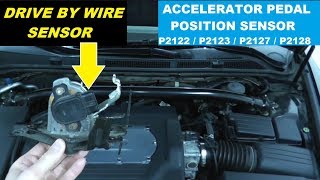
Typical fix: Replace the entire accelerator pedal assembly. 🎬 Watch: How to test and replace the accelerator pedal sensor The sensor is integrated and not sold separately.
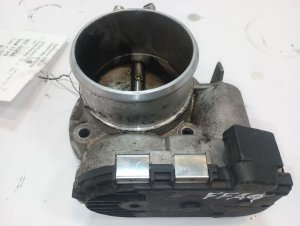
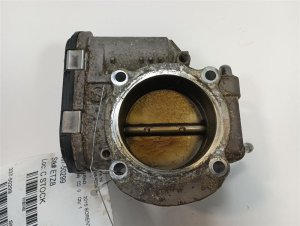
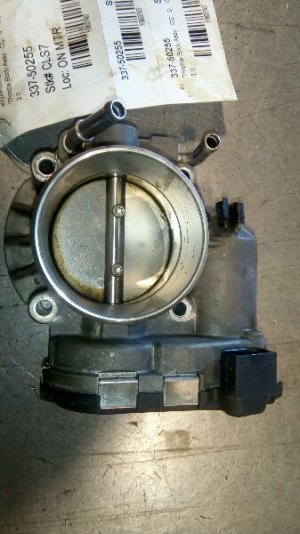
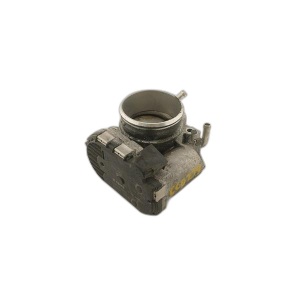
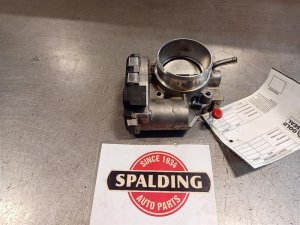
Est. part cost: $100-$250 - Faulty Throttle Position Sensor (TPS) 🟡 Medium Probability → Shop Fuel Injection Throttle Body The TPS is integrated into the electronic throttle body. Internal wear or electronic failure of the sensor requires replacement of the whole unit. This part is shared with other Kia/Hyundai models like the Sorento and Sportage, indicating a common design.
How to confirm: Using a scan tool, monitor the live data for TPS Sensor 1 and TPS Sensor 2. The voltages should correlate smoothly as the throttle plate moves. A signal that is erratic or doesn't match its counterpart points to a bad TPS. After replacement, a 'throttle relearn' procedure may be necessary.
Typical fix: Replace the entire throttle body assembly.
Est. part cost: $150-$350 - Dirty or Sticking Throttle Body ⚪ Low Probability → Shop Fuel Injection Throttle Body Carbon can build up around the throttle body bore, preventing it from moving smoothly. This can cause the actual throttle angle to differ from the commanded angle, leading the TPS readings to mismatch what the computer expects and triggering the code.
How to confirm: Remove the air intake hose and visually inspect the throttle body bore and plate for black carbon deposits. Manually move the plate (with the engine off) to feel for any binding or sticking.
Typical fix: Clean the throttle body thoroughly with a dedicated throttle body cleaner and a soft brush.
Est. part cost: $5-$15
Rare But Worth Checking
- Wiring Harness or Connector Issue: A GM TSB for P2138 highlights that water intrusion into an instrument panel-to-body harness connector can cause this exact code by corroding pins. This is corroborated by owner experiences on other vehicles where rainstorms preceded the fault, which was temporarily fixed by cleaning the connector. Check for damp carpets or signs of water leaks near the driver's side kick panel.
- Low Battery Voltage / Lost PCM Memory: If the vehicle's battery voltage drops too low (e.g., below 10V) or the battery is disconnected, the PCM can lose the learned 'basic settings' for the throttle body. This can cause a correlation fault. A 'throttle body relearn' procedure with a capable scan tool may be required to resolve the code.
- Faulty Powertrain Control Module (PCM): → Shop Engine Control Module (ECM) This is very rare. The PCM should only be considered after all other possibilities, including sensors, wiring, and throttle body calibration, have been definitively ruled out.
Diagnosis Steps
- Connect an OBD-II scanner and confirm P2138 is the primary code. Note any other codes present, like P2135 or P2127.
- Access the live data stream on the scanner.
- Display the graphs for APP Sensor 1, APP Sensor 2, TPS Sensor 1, and TPS Sensor 2.
- With the engine off but the key in the 'ON' position, slowly press and release the accelerator pedal multiple times. Watch the APP sensor voltages. They should move smoothly without any dropouts or spikes. The two signals should mirror each other in a specific, correlated pattern. If one signal is erratic, the accelerator pedal assembly is faulty.
- If the APP sensors test okay, start the engine (or have an assistant operate the pedal). Watch the TPS sensor voltages. They should also move smoothly in correlation with the pedal movement. If the TPS signals are erratic, the throttle body is likely faulty.
- If sensor data is inconclusive, visually inspect the wiring and connectors at the accelerator pedal and the throttle body for any signs of damage, corrosion, or looseness. Pay close attention to the connector at the pedal, as it can be kicked or damaged.
- Inspect the throttle body for carbon buildup. If it's dirty, clean it, clear the codes, and perform a test drive to see if the problem returns.
- If all sensors and wiring appear good, investigate the rare possibility of water intrusion in the body harness connector near the driver's kick panel, especially if the issue appeared after heavy rain.
- If the battery was recently disconnected/replaced, or if the throttle body/pedal was replaced, perform a 'Throttle Body Relearn' procedure using a compatible scan tool to reset its learned values. Failure to do this can cause the code to persist even with new parts.
Parts You'll Likely Need
- Accelerator Pedal Assembly
(OEM #32700-3Q110)— This is the most common failure for code P2138 on this vehicle. The integrated Accelerator Pedal Position (APP) sensor wears out. This part also fits the 2011-2014 Hyundai Sonata.
Trusted brands: Kia (Genuine OEM), Duralast, Standard Motor Products, Carquest Premium
OEM price range: $180-$250
Aftermarket price range: $100-$180 - Throttle Body Assembly
(OEM #35100-2G700)— This is the second most likely cause. The integrated Throttle Position Sensor (TPS) fails, requiring replacement of the entire assembly. This part is also used on the Kia Sorento and Sportage.
Trusted brands: Kia (Genuine OEM), Bosch, Cardone
OEM price range: $250-$350
Aftermarket price range: $150-$250
Related Codes That Often Appear With This One
- P2135 — This code is for 'Throttle/Pedal Position Sensor/Switch A/B Voltage Correlation.' It's a very similar code that often points to the same root causes, just referencing a different sensor circuit designation.
- P2127 — This code specifically points to 'Throttle/Pedal Position Sensor/Switch 'E' Circuit Low Input', often appearing alongside P2138 and reinforcing that a sensor circuit is failing.
- P2106 — This code indicates the Throttle Actuator Control System is in Forced Limited Power mode. NHTSA ODI #11002783 and #11011400 show this code frequently appearing with P2138 when a vehicle enters limp mode.
Technical Service Bulletins (TSBs) & Recalls
- While not a Kia TSB, General Motors TSB 18-NA-233 is highly relevant as it details how water intrusion into an interior body harness connector can cause P2138, a plausible scenario for any make.
Platform-Specific Known Issues
- There are no official recalls for code P2138 on this vehicle. However, Kia did issue a Product Improvement Campaign (PI1802) for the Knock Sensor Detection System (KSDS) on 2014-2015 models, which could also cause a limp mode and might be confused with this issue.
Mechanic-Grade Diagnostic Values
- Accelerator Pedal Position (APP) Sensor Voltage — expected: Both sensors (D and E, or 1 and 2) should sweep smoothly from ~0.5V (pedal released) to ~4.5V (full throttle). The signals are correlated; often one sensor's voltage is half of the other's.. Failure: A voltage divergence greater than 0.5V between the two sensors, or any jumps, drops, or non-responsive readings from one sensor while the pedal is moved. A reading like 3.8V with the pedal released is a definitive failure.
- APP/TPS Sensor Ground Circuit Voltage Drop — expected: Less than 100mV (0.1V).. Failure: A reading higher than 100mV indicates excessive resistance in the ground circuit, which can alter sensor readings and cause correlation faults.
- APP/TPS Signal Wire Resistance — expected: Near 0 ohms from the sensor connector to the ECM connector.. Failure: Resistance greater than 20 ohms indicates a problem in the wiring harness, such as corrosion or a partial break.
Scan Tool Commands That Help
- Kia GDS or compatible professional scanner: Reset Adaptive Values / Throttle Position Sensor Recalibration — This must be performed after replacing the throttle body, cleaning the throttle body, or disconnecting the battery to make the ECM relearn the throttle plate's home and end positions. Failure to do so can cause the P2138 code to persist even with new parts.
- No Tool (Manual Procedure): Manual Throttle Position Relearn — If a scan tool is unavailable. After warming up the engine, turn the key to 'ON' (engine off) for 15 seconds. Turn key 'OFF' for 5 seconds. Repeat this cycle 5 times. This allows the ECM to passively relearn the throttle limits.
- No Tool (Manual Procedure): ECU Hard Reset — As a last resort if other relearn procedures fail. Disconnect the negative battery terminal, then press and hold the brake pedal for 20 seconds to discharge stored power in the modules. Reconnect the battery. This forces the ECU to clear its adaptive memory.
Wiring & Ground Locations
- Throttle Body Connector Pins (Typical) — On the electronic throttle body assembly where the main engine harness connects.. These pins must be tested for correct voltage and continuity. Based on general Kia schematics, typical pin functions are: Pin 1: ETC Motor (-), Pin 2: TPS Ground, Pin 3: ETC Motor (+), Pin 4: TPS 2 Signal, Pin 5: TPS 5V Supply, Pin 6: TPS 1 Signal.
- Accelerator Pedal Connector Pins (Example) — At the top of the accelerator pedal assembly, under the driver's side dashboard.. This connector is prone to being kicked or damaged. A loose connection here is a common cause of P2138. For example, on a similar Kia, APP1 uses Yellow/Orange (Signal), Brown/Black (Ground), Red (5V Power), while APP2 uses Blue/Orange (Signal), Black/Orange (Ground), Pink/Black (Power). These specific colors should be verified for the Optima but show the 6-wire, dual-sensor setup.
Real Owner Repair Stories
- Reddit user on r/MechanicAdvice (2007 Kia Sorento 3.8L (similar electronic throttle system)) — P2138 code, APP sensor 1 reading 3.8V at closed throttle.
❌ Tried (didn't work) Replaced accelerator pedal assembly, Replaced wiring harness pigtail, Replaced PCM
✅ What actually fixed it The problem was high resistance found within the main wiring harness itself, not at the connectors or in the components. The entire harness had to be addressed to resolve the fault. - JL's Auto Solution on YouTube (2017 Kia Soul 1.6L Turbo) — P2138 and P2127, no acceleration, especially during temperature changes.
❌ Tried (didn't work) Initial scan and live data analysis did not show a persistent fault.
✅ What actually fixed it Found two signal wires for the accelerator pedal assembly had been cut and poorly spliced into, likely for an aftermarket remote starter or alarm system. Removing the bad splices and restoring the factory wiring resolved the issue.
Documented NHTSA Reports
- NHTSA ODI #10545514: An owner reported that acceleration became sluggish and sometimes unresponsive. Diagnostic codes showed active and stored codes of P2138, P2127, and P2106 (Limp Mode).
- NHTSA ODI #10471955: A report describes a vehicle that could not maintain speed, decreasing below 40 MPH on hills. OBD-II codes P2138, P2127, and P2106 were recorded, all reflecting a malfunction in the accelerator control system.
- NHTSA ODI #11002783: An owner experienced a sudden drop in speed to 5 MPH without warning. The diagnostic scan returned P2106 (Forced Limited Power) and P2138 (Throttle/Pedal Position Sensor "D"/"E" Voltage Correlation).
- NHTSA ODI #11011400: A driver reported having codes pulled after a failure, which returned P2138 and P2106 (Throttle Actuator Control System - Forced Limited Power).
When the Usual Fixes Don't Work
- While replacing the accelerator pedal assembly is the most common fix, there are numerous documented cases where this did not solve the problem. In these instances, the root cause was often traced back to the wiring. One owner replaced the pedal multiple times before a technician found that a poorly installed aftermarket alarm was spliced into the pedal's signal wires, causing the voltage correlation error. Another case saw the pedal, its connector, and even the PCM replaced before discovering the fault was high resistance deep within the main engine harness, requiring a wiring repair instead of a component replacement. These cases prove that a thorough wiring diagnosis is critical before condemning expensive components.
Model Year Variations Within This Range
- 2014-2015: These are facelift models. While the core engine and throttle components are largely the same as the 2010-2013 models, there may be differences in ECM software calibrations. A recall for a deteriorating low-pressure fuel hose was issued for 2013-2014 models, and a recall for potential electrical shorts in the HECU applies to 2013-2015 models; either could create electrical issues that might be misdiagnosed.
Diagnostic Flowchart
Used vs. New Parts: Buying Guide for This Vehicle
When a used part is the smart pick: For the accelerator pedal assembly, a used part from a low-mileage (<60,000 miles) donor vehicle is a cost-effective and generally reliable option. A used throttle body can also be considered, but requires careful inspection.
Donor-vehicle mileage cap: roughly under 60000 miles for the part to have meaningful remaining life.
What to inspect on the donor part:
- For accelerator pedal: Ensure the connector is not cracked or damaged and the pedal moves smoothly without binding.
- For throttle body: Visually inspect the throttle bore for excessive carbon buildup. Manually move the throttle plate (engine off) to ensure it moves freely and does not stick or bind.
- Check the donor vehicle's history if possible to avoid parts from flood or collision-damaged cars.
OEM-only on this vehicle (don't cheap out):
- Powertrain Control Module (PCM) - While specialized remanufacturers exist, a new OEM unit or one from a reputable, VIN-programming service is the safest bet to avoid compatibility issues.
Aftermarket brands forum-validated for this vehicle:
- Standard Motor Products (SMP)
- Bosch (for throttle body)
- Genuine Kia/Hyundai (OEM)
Brands owners have reported issues with on this vehicle:
- Be cautious of unbranded, deeply discounted parts from online marketplaces, as their internal electronics may not meet the precise specifications required by the ECM, leading to a quick return of the P2138 code.
Related OBD-II Codes
Frequently Asked Questions
Is there an official recall for the P2138 code on my 2010-2015 Kia Optima?
My mechanic says the accelerator pedal assembly is the most likely cause of P2138. Is this correct for my Optima?
Can I just replace the sensor on the accelerator pedal, or do I need the whole assembly?
My Electronic Stability Control (ESC) warning light came on at the same time as the Check Engine Light for P2138. Are they related?
I replaced the throttle body myself but the P2138 code is still on. What did I miss?
Does this P2138 throttle issue affect other vehicles besides the Optima?
How much should I expect to pay for a new accelerator pedal assembly for my Optima?
Helpful Videos
Used OEM Parts in Stock
New Aftermarket Parts Available


The information in this article is provided for general reference and educational purposes only. Vehicle specifications, procedures, and part compatibility can vary by production date, trim level, and region. Always consult your vehicle's factory service manual and verify part numbers before purchasing or performing repairs. Safety-critical components such as airbags, seat belts, and braking systems should be installed by a qualified professional.
- Kia Optima:
- 🧭 Diagnostic Flowchart
- 🎬 Helpful Videos
- 🛍️ Shop This Part
- What's Unique About the 2010-2015 Kia Optima
- Symptoms You May Notice
- Most Likely Causes
- Rare But Worth Checking
- Diagnosis Steps
- Parts You'll Likely Need
- Related Codes That Often Appear With This One
- Technical Service Bulletins (TSBs) & Recalls
- Platform-Specific Known Issues
- Mechanic-Grade Diagnostic Values
- Scan Tool Commands That Help
- Wiring & Ground Locations
- Real Owner Repair Stories
- Documented NHTSA Reports
- When the Usual Fixes Don't Work
- Model Year Variations Within This Range
- Used vs. New Parts: Buying Guide for This Vehicle
- Related OBD-II Codes
- Frequently Asked Questions
- 🎟️ Get 5% Off