

P2152 on 2009-2014 Buick LaCrosse: Fuel Injector Circuit Fault Causes and Fixes
On a 2009-2014 Buick LaCrosse with a V6 engine, code P2152 is almost always caused by a damaged fuel injector wiring harness. The fix is typically to locate and repair the chafed or broken wire, which is a low-cost parts fix but can involve moderate labor. This is a well-documented issue across many GM models with the 3.0L and 3.6L engines.
- P2152 on a V6 LaCrosse is most likely a wiring problem, not a bad part. This is a known issue across many GM vehicles.
- Before buying any parts, carefully inspect the fuel injector wiring harness for signs of rubbing or damage, especially against the intake, valve cover bolts, and fuel lines.
- This issue is well-documented by GM in TSB #PIP4924D, making diagnosis more straightforward.
- Repairing the damaged wire is a cost-effective fix if the damage is localized. If not, a full harness replacement (GM #12621095) may be needed.
What's Unique About the 2009-2014 Buick LACROSSE
For this generation of Buick LaCrosse and its many platform mates with V6 engines, General Motors issued a specific Technical Service Bulletin (TSB #PIP4924D) addressing this exact code. The bulletin points directly to a known issue where the fuel injector wiring harness is prone to rubbing against engine components. Specific chafe points include contact against the intake plenum, valve cover bolts, fuel lines, and the side of the cylinder head. This makes a wiring fault a much higher probability than a component failure like an injector or the PCM itself.
Diagnostic Flowchart
Tap your situation to follow the diagnostic path that matches what you're seeing on this vehicle.
Generation note: The 2009-2014 range covers the end of the first generation (2009) and the majority of the second generation (2010-2016) LaCrosse. The TSB and the common V6 engines (like the 3.6L LLT and LFX) are present in both generations and across a wide range of other GM vehicles, making this issue widely applicable.
Symptoms You May Notice
- Check Engine Light (SES Light) is on
- Engine runs rough or vibrates, especially at idle
- Noticeable loss of power and poor acceleration
- Engine misfires, which may be felt as a shudder
- Potential for the engine to stall at low speeds
- In some cases, a short in the harness can repeatedly blow the ECM1 fuse.
- Replacing fuel injectors before checking the wiring. The code points to a supply voltage issue for a *group* of injectors, making a wiring or PCM issue more likely than multiple injectors failing at once.
Most Likely Causes
- Chafed or Broken Fuel Injector Wiring Harness 🔴 High Probability → Shop Engine Wiring Harness As identified in GM TSB #PIP4924D, the wiring harness routing can cause it to rub against various engine parts, leading to damage over time. This is a known pattern failure on GM's 3.0L and 3.6L V6 engines from this era.
How to confirm: Perform a careful visual and physical inspection of the fuel injector wiring harness. The TSB specifically calls out checking for rub marks where the harness may contact the intake plenum, at valve cover bolts, against the fuel line, and on the side of the head under the plenum. Wiggle the harness while the engine is running (use caution) to see if it affects the idle, indicating an intermittent connection.
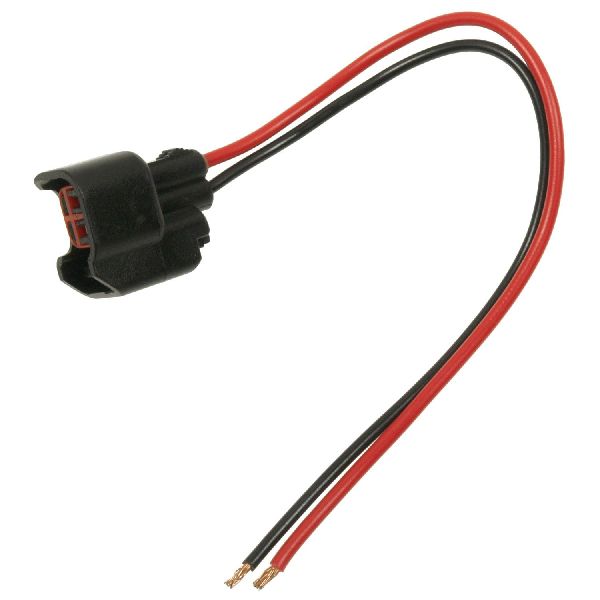
Typical fix: Repair the specific damaged wire(s) using solder and heat-shrink tubing. If a single connector is damaged, a pigtail like a Dorman 85850 can be spliced in. If the damage is extensive or in multiple locations, replace the entire fuel injector wiring harness 🎬 See this walkthrough for 3.6L intake and injector removal (e.g., GM Part #12621095).
Est. part cost: $5-$25 for wire/pigtail repair materials, $160-$300 for a new harness.
Rare But Worth Checking
- Faulty Powertrain Control Module (PCM): → Shop Engine Control Module (ECM) The internal driver circuit for the injector group can fail inside the PCM. This should only be considered after the wiring harness has been thoroughly inspected and tested and found to be in good condition.
- Failed Fuel Injector: → Shop Fuel Injector While possible, it's less common for the injector itself to cause a supply voltage circuit code. This code points to the power feed for the *group*, not an individual injector's control circuit.
Diagnosis Steps
- Read the trouble codes with an OBD-II scanner to confirm P2152 and any other related codes.
- Perform a thorough visual inspection 🎬 Watch: How to diagnose a fuel injector circuit malfunction of the fuel injector wiring harness. Focus on the chafe points mentioned in TSB PIP4924D: against the intake plenum, at valve cover bolts, against the fuel line, and on the side of the head under the plenum.
- Look for any signs of rubbing, exposed wires, or damaged conduit. Gently wiggle the harness in these areas with the engine idling to see if the misfire changes or appears.
- If a short is suspected (e.g., blown fuses), check the ECM1 fuse. A technician on a professional forum noted this fuse blowing on a 2011 Traverse with related injector codes.
- If no visible damage is found, use a digital volt/ohmmeter (DVOM) to check for battery voltage at the supply wire for the Group 'C' injectors. An open circuit will show no voltage.
- Test for continuity on the supply wire from the PCM connector to the injector harness connector to pinpoint the location of the break.
- If the wiring is confirmed to be intact and has proper voltage, the issue may lie with the PCM itself, which would require more advanced diagnostics.
Parts You'll Likely Need
- Fuel Injector Wiring Harness Repair Supplies — The most common fix is repairing a small section of the existing harness that has been damaged.
Trusted brands: 3M, Delphi
OEM price range: $5-$20
Aftermarket price range: $5-$20 - Fuel Injector Connector Pigtail — If the damage is isolated to a single injector connector, splicing in a new pigtail is a viable repair.
Trusted brands: Dorman 85850, ACDelco PT2183
OEM price range: $20-$40
Aftermarket price range: $10-$25 - Engine Wiring Harness
(OEM #12621095 (replaces 12614941 for 3.6L V6))— If the harness is severely damaged or has multiple breaks, replacement is the more reliable option. Part number varies by specific engine and year.
Trusted brands: ACDelco (Genuine GM)
OEM price range: $160-$300
Aftermarket price range: $150-$250
Related Codes That Often Appear With This One
- P2146 — This is the code for Fuel Injector Group 'A' Supply Voltage Circuit. It can appear with P2152 if the wiring damage affects multiple supply circuits within the same harness.
- P2149 — This is the code for Fuel Injector Group 'B' Supply Voltage Circuit. Like P2146, it points to a similar wiring fault and is listed in the same TSB.
- P0201-P0206 — These codes indicate a malfunction in the control circuit for individual injectors. They can be triggered alongside P2152 if the wiring damage is extensive or causes a short.
Technical Service Bulletins (TSBs) & Recalls
- PIP4924D: States that for codes including P2146, P2149, and P2152, technicians should inspect the fuel injector wiring harness for rub through or internal wire opens. It specifically highlights common contact points: against the intake plenum, at valve cover bolts, against the fuel line, and on the side of the cylinder head under the plenum. This TSB applies to a wide range of GM vehicles from 2009-2014 with 2.8L, 3.0L, and 3.6L engines.
Platform-Specific Known Issues
- A known issue documented in GM Technical Service Bulletin #PIP4924D describes the fuel injector wiring harness rubbing through or developing internal opens on 2009-2014 Buick LaCrosse models and many other GM vehicles using the 3.0L and 3.6L V6 engines.
- In a real-world example on a professional technician forum, a 2011 Chevy Traverse (a platform mate) with codes P2152, P2155, and P216d was repeatedly blowing the ECM1 fuse, pointing to a short to ground within the injector power supply circuit.
Mechanic-Grade Diagnostic Values
- Fuel Injector Coil Resistance (2009-2011 3.6L LLT Engine) — expected: 1.5 - 1.6 Ohms. Failure: A reading of OL (open loop/infinite resistance) or near 0 Ohms indicates a failed injector coil.
- Fuel Injector Coil Resistance (2012-2014 3.6L LFX Engine) — expected: 1.9 - 2.3 Ohms at 68°F (20°C). Failure: A reading outside this specified range indicates a failed injector.
- Voltage Drop Test (Injector Supply Circuit) — expected: Less than 0.5 V. Failure: A voltage drop greater than 0.5V between the ECM supply terminal and the injector connector indicates excessive resistance in the wiring.
- Injector Balance Test (Pressure Drop) — expected: Pressure drop across all injectors should be within 1.5-3.0 PSI (10-20 kPa) of each other.. Failure: An injector with a pressure drop significantly different from the others is likely clogged or leaking.
- ECM Ground Circuit Resistance — expected: Less than 5 Ohms after 60 seconds (Ignition OFF). Failure: Resistance above 5-10 Ohms from the ECM housing to a known good ground (engine block, chassis) can cause erratic module behavior.
Scan Tool Commands That Help
- GDS2 (GM Dealer/Professional Scan Tool): Active Fuel Injector Test (AFIT) / Fuel Injector Balance — This is a crucial test to run *after* confirming the wiring is good. It commands each injector to fire and measures the corresponding drop in fuel rail pressure. This can definitively identify a mechanically failed injector (clogged or leaking) that has passed a simple resistance test.
- High-End Bidirectional Scan Tool (e.g., XTOOL D8W, Autel): Active Test > Fuel Injector Cutout — This allows you to disable injectors one by one while the engine is idling. When you cut out a *good* injector, the engine RPM will drop noticeably. If you cut out an injector and there is *no change* in how the engine runs, you've found the cylinder that isn't firing, which helps isolate the problem.
Wiring & Ground Locations
- ECM Connector X1 — The Engine Control Module (ECM) is typically located in the engine bay, near the front of the engine. X1 is one of the large multi-pin connectors.. The supply voltage and control wires for the injector groups originate here. Testing for voltage and continuity at the ECM connector pins can quickly determine if the fault is in the wiring harness downstream or if the ECM itself is not sending the signal.
- Injector Group C Pins (Example: 3.6L LLT) — At the ECM X1 connector. Injector 2 (Dark Blue/White, Dark Blue) may be at pins 53 & 52. Injector 5 (Tan/White, Tan) may be at pins 28 & 29. Pinouts vary by year and engine, so a service manual is critical.. These are the specific pins to probe with a multimeter to test resistance and continuity for the Group C circuit without having to remove the intake manifold first.
- G103 / G107 / G112 — These are primary engine grounds, often located on the cylinder heads or engine block, sometimes near the transmission bellhousing bolts.. The ECM's injector driver circuits require a stable ground reference. A loose, corroded, or oil-soaked ground at these points can cause unstable voltage, leading to intermittent and difficult-to-diagnose injector group fault codes.
Real Owner Repair Stories
- DuramaxDiesels.com forum user (Duramax Diesel (similar injector group fault architecture)) — Code P2152 appeared immediately after power washing the engine bay.
❌ Tried (didn't work) Waiting for the engine bay to dry out over several days., Replacing the pigtail connector for the suspect injector (#2).
✅ What actually fixed it The problem resolved itself after the user disconnected the main multi-pin engine harness connector, tested continuity (which passed), and reconnected it. This suggests the root cause was moisture or a poor pin connection within that main connector, which was resolved by the act of reseating it. - YouTube video by 'Fix It All' (2004 Silverado 2500HD LLY Duramax) — Engine running very rough, codes P0202 (Injector #2 circuit) and P2149 (Group B fault) present.
❌ Tried (didn't work) Clearing codes (they returned immediately).
✅ What actually fixed it The wiring to the injector #2 connector was faulty. Splicing in a new pigtail connector for injector #2 resolved both the individual circuit code (P0202) and the group fault code (P2149).
OEM Part Supersession History
12614941→12621095— This is the OEM part number for the driver's side (Bank 2) fuel injector wiring harness for many 3.6L V6 applications. Part supersession often indicates a revision or improvement by the manufacturer, though the specific reason is not publicly documented.
Model Year Variations Within This Range
- 2009-2011 (approx.): Models in this range primarily used the 3.0L LF1 and 3.6L LLT V6 engines. These engines use a Bosch ECM and have fuel injectors with a resistance of approximately 1.5-1.6 Ohms.
- 2012-2014: These models feature the updated 3.6L LFX V6 engine. The LFX uses a Delphi ECM, has cylinder heads with integrated exhaust manifolds, and uses different fuel injectors with a higher resistance specification of 1.9-2.3 Ohms. The wiring harnesses are not interchangeable between LLT and LFX engines.
Helpful Videos

We Have This Part in Stock


The information in this article is provided for general reference and educational purposes only. Vehicle specifications, procedures, and part compatibility can vary by production date, trim level, and region. Always consult your vehicle's factory service manual and verify part numbers before purchasing or performing repairs. Safety-critical components such as airbags, seat belts, and braking systems should be installed by a qualified professional.
- Buick LACROSSE:
- 🧭 Diagnostic Flowchart
- 🎬 Helpful Videos
- 🛍️ Shop This Part
- What's Unique About the 2009-2014 Buick LACROSSE
- Symptoms You May Notice
- Most Likely Causes
- Rare But Worth Checking
- Diagnosis Steps
- Parts You'll Likely Need
- Related Codes That Often Appear With This One
- Technical Service Bulletins (TSBs) & Recalls
- Platform-Specific Known Issues
- Mechanic-Grade Diagnostic Values
- Scan Tool Commands That Help
- Wiring & Ground Locations
- Real Owner Repair Stories
- OEM Part Supersession History
- Model Year Variations Within This Range
- 🎟️ Get 5% Off