

P2155 on 2009-2010 Saturn OUTLOOK: Fuel Injector Circuit Fault Causes and Fixes
On a 2009-2010 Saturn Outlook, code P2155 is almost always caused by a damaged fuel injector wiring harness. A GM Technical Service Bulletin (PIP4924D) confirms the harness rubs against engine components, causing a short or open circuit. The fix is to inspect, repair, and protect the harness, which is a much more likely solution than replacing fuel injectors. Common chafe points include the intake plenum, valve cover bolts, and a sharp tab on the EGR valve gasket.
- For a P2155 code on a 2009-2010 Saturn Outlook, the cause is overwhelmingly likely to be a damaged fuel injector wiring harness, as documented in GM TSB #PIP4924D.
- Before buying any parts, your first and most important step is to meticulously inspect the wiring harness for signs of rubbing or chafing, especially where it contacts the engine.
- Do not replace fuel injectors or the ECM unless you have proven with testing that the wiring harness is in perfect condition.
- Driving with this code will cause significant performance issues and can lead to expensive catalytic converter damage if not addressed promptly.
What's Unique About the 2009-2010 Saturn OUTLOOK
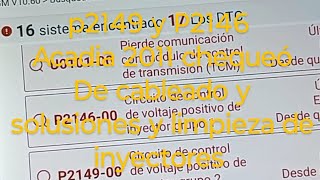
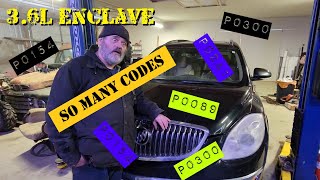
The Saturn Outlook and its GM Lambda platform siblings (GMC Acadia, Buick Enclave, Chevrolet Traverse) are known for a specific wiring harness vulnerability with the 3.6L V6 engine. GM issued Technical Service Bulletin #PIP4924D, which directly addresses that the fuel injector wiring harness is routed in a way that it's prone to chafing against engine components. Common rub points are against the intake plenum, valve cover bolts, fuel lines, the side of the cylinder head, and a sharp metal tab on the EGR valve gasket. 🎬 Watch: Diagnosing injector group codes and harness issues on the 3.6L. This constant rubbing wears through the insulation, causing the exact short-to-ground or open circuit that triggers the P2155 code, making a wiring fault the primary suspect over a bad injector.
Diagnostic Flowchart
Tap your situation to follow the diagnostic path that matches what you're seeing on this vehicle.
Symptoms You May Notice
- Check Engine Light is on (may be flashing)
- Engine running rough and shaking, especially at idle
- Noticeable loss of engine power and acceleration
- Engine misfires, often felt as a shudder or hesitation
- Reduced fuel economy
- The 'Service Stabilitrak', 'Service Traction Control', and/or 'Reduced Engine Power' message may appear on the dash. This is a secondary effect caused by the severe engine misfire.
- Replacing one or more fuel injectors without first performing a thorough inspection of the wiring harness. The harness is the most common failure point for this code on this platform.
- Replacing the Engine Control Module (ECM) before exhaustively testing the wiring and injectors.
Most Likely Causes
- Chafed or Damaged Fuel Injector Wiring Harness 🔴 High Probability → Shop Engine Wiring Harness As documented in GM TSB #PIP4924D, the harness routing on the 3.6L V6 makes it highly susceptible to rubbing against engine components. The most common chafe points are against the intake plenum, valve cover bolts, fuel lines, the side of the cylinder head under the plenum, and a sharp metal tab on the EGR valve gasket.
How to confirm: Perform a detailed visual inspection of the entire fuel injector wiring harness for Bank 2 (front of engine). Look for shiny spots, exposed copper wire, or breaks in the plastic conduit. Pay close attention to any point where the harness touches or runs near a metal edge or bolt. Gently wiggling the harness in suspect areas while the engine is running (if possible) may cause the misfire to change or stall the engine, helping to pinpoint the fault.
Typical fix: Repair the damaged section of wire using solder and heat-shrink tubing. Protect the repair with automotive-grade tape or a new plastic loom. Secure the harness away from the chafe point using zip ties or by ensuring factory harness retainers are properly seated. In some cases, bending the offending metal tab (like on the EGR gasket) can prevent recurrence.
Est. part cost: $5-$50 - Failed Fuel Injector 🟡 Medium Probability → Shop Fuel Injector
How to confirm: After confirming the wiring is intact, use a multimeter to test the resistance of each fuel injector in Group 'B' (front bank, cylinders 2, 4, 6). For the 2009-2010 3.6L LLT engine, the reading should be between 1.5 and 2.5 Ohms. A reading that is significantly different, open (infinite resistance), or shorted (near zero resistance) indicates a failed injector. The value of 11.8-12.6 Ohms from Pass 2 is incorrect for this Direct Injection engine.
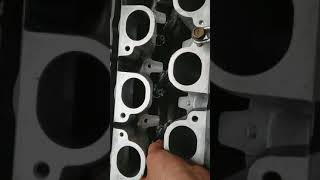
Typical fix: Replace the faulty fuel injector. Since accessing the injectors requires removing the upper intake manifold, it is often recommended to replace all three injectors on that bank 🎬 See this step-by-step guide for replacing the fuel injectors. at the same time, along with the upper intake manifold gaskets.
Est. part cost: $50-$150 per injector - Blown Fuse ⚪ Low Probability
How to confirm: Check the under-hood fuse box for any fuses related to the fuel injectors (often labeled 'INJ' or 'F/INJ') or ECM. A short in the wiring harness can sometimes cause a fuse to blow.
Typical fix: Replace the blown fuse. If the fuse blows again immediately, it confirms a persistent short circuit in the harness that must be found and repaired.
Est. part cost: $1-$5 - Faulty Engine Control Module (ECM) ⚪ Low Probability → Shop Engine Control Module (ECM)
How to confirm: This is a diagnosis of last resort. If the wiring harness, all injectors, and fuses have been tested and are confirmed to be good, the ECM's internal injector driver circuit may be at fault. This requires advanced diagnostics by a professional to verify the ECM is not sending the correct signal.
Typical fix: Replace and reprogram the Engine Control Module. This must be done by a professional shop or dealership with the correct programming tools.
Est. part cost: $400-$800
Rare But Worth Checking
- Loose or Corroded Ground Connection:
Diagnosis Steps
- Scan the ECM for all stored trouble codes. Note all codes present, especially other injector or misfire codes like P0300, P0302, P0304, P0306.
- Perform a thorough visual inspection of the fuel injector wiring harness, as detailed in TSB #PIP4924D. Pay extremely close attention to areas where the harness can rub: against the intake manifold, valve cover bolts, fuel lines, the side of the cylinder head, and especially a sharp metal tab on the EGR valve gasket.
- If damage is found, repair the wires using solder and heat shrink, then protect the harness from future chafing with loom or by re-routing/securing it with zip ties.
- If no visible damage is found, check the 'INJ B' or similar fuse in the under-hood fuse box.
- If fuses are good, disconnect the harness and injectors on the front bank (Bank 2). Use a multimeter to test the resistance of each injector. The specification for the 2009-2010 3.6L LLT direct injection engine is 1.5-2.5 Ohms.
- Test the wiring harness for continuity from the ECM connector to the injector connectors to rule out an internal wire break.
- Test the supply voltage wire in the harness for a short to ground using a multimeter.
- If all wiring and injectors test good, the fault may lie within the ECM's injector driver circuit, which requires professional diagnosis.
Parts You'll Likely Need
- Fuel Injector Wiring Harness Repair Supplies — The most common cause is a chafed wire. Repairing the wire with solder, heat shrink, and protective loom is often all that is needed.
OEM price range: $5-$25
Aftermarket price range: $5-$25 - Fuel Injector
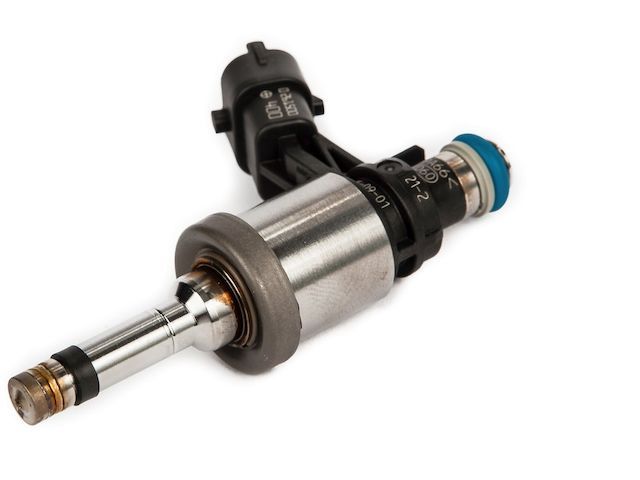
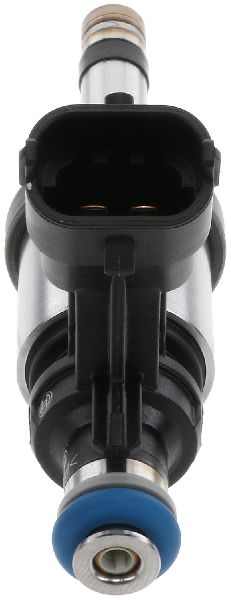
(OEM #12669384)— If the wiring is intact, an injector with a shorted internal coil can cause this group voltage code. The original part 12638530 has been superseded 🎬 Watch: A professional walkthrough of the GM 3.6L injector replacement. by 12669384.
Trusted brands: ACDelco, Bosch
OEM price range: $110-$200
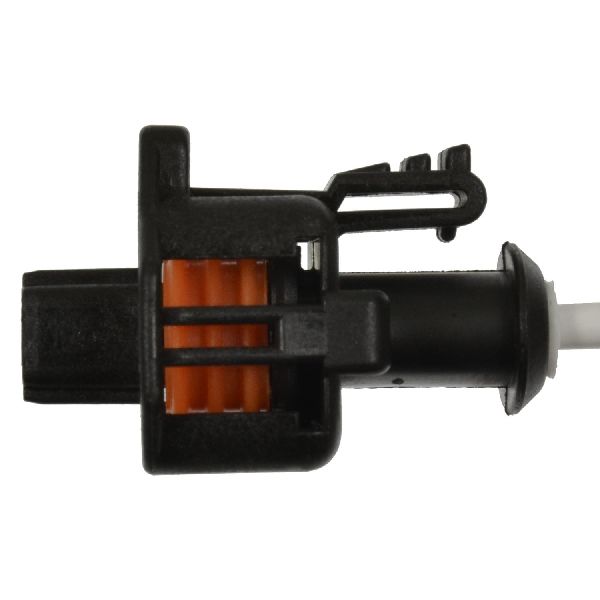
Aftermarket price range: $50-$120 - Fuel Injector Connector Pigtail
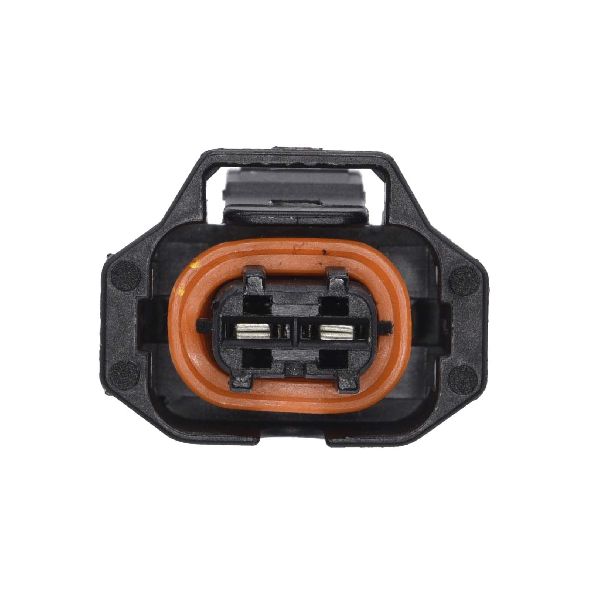
(OEM #ACDelco PT1008)— If the wiring has broken or corroded right at the injector connector, a new pigtail is needed to splice into the harness for a solid repair.
Trusted brands: ACDelco, Dorman
OEM price range: $25-$40
Aftermarket price range: $15-$25
Related Codes That Often Appear With This One
- P2149 — This code is for 'Fuel Injector Group 'B' Supply Voltage Circuit/Open'. P2155 (Circuit Low) and P2149 often appear together as they both point to a fault in the same power supply circuit for the same bank of injectors.
- P0202, P0204, P0206 — These codes represent circuit faults for the individual injectors in Group 'B' (Cylinders 2, 4, and 6). When the main power supply circuit fails, the ECM may also flag codes for each injector in that group.
- P0300, P0302, P0304, P0306 — These are misfire codes. A P0300 indicates a random/multiple cylinder misfire, while P0302, P0304, and P0306 indicate misfires on the specific cylinders whose injectors have lost power.
Technical Service Bulletins (TSBs) & Recalls
- PIP4924D: Diagnostic Tip For SES Light And Injector DTCs P0201 - P0206, P0261, P0262, P0264, P0265, P0267, P0268, P0270, P0271, P0273, P0274, P0276, P0277, P2146
Platform-Specific Known Issues
- TSB #PIP4924D: This GM Technical Service Bulletin is the most critical piece of information for this code. It explicitly states to inspect the fuel injector wiring harness for rubbing through or internal wire opens as the cause for P2155 and a host of other related injector codes.
- EGR Gasket Tab: A preliminary GM bulletin highlights a specific chafe point where the harness rubs on a sharp metal tab of the EGR valve gasket. The recommended fix includes repairing the wire and bending the tab over to prevent it from happening again.
Mechanic-Grade Diagnostic Values
- Direct Injection Fuel Injector Resistance — expected: 1.5 to 2.5 ohms. Failure: A reading near zero ohms indicates a shorted injector coil, while an open (OL) reading indicates a broken coil. Any reading significantly outside the expected range suggests a faulty injector.
- Injector Circuit Voltage (Initial 'Turn On' Pulse) — expected: ~55 to 65 Volts DC. Failure: The absence of this brief high-voltage spike when the injector is commanded ON indicates a problem with the ECM's internal boost capacitor or driver circuit. This requires an oscilloscope to measure.
- Injector Circuit Voltage (Hold Phase) — expected: ~12-14 Volts (Pulse-Width Modulated). Failure: An incorrect or missing 12V PWM signal after the initial opening pulse points to a fault in the ECM driver circuit.
- Scan Tool 'Fuel Injector Balance Test' Pressure Drop — expected: The pressure drop for any single injector should not differ from the average pressure drop of the other injectors by more than 20 kPa (3 psi).. Failure: A significantly smaller or larger pressure drop for one injector compared to the others indicates a malfunctioning (clogged, leaking, or electrically weak) injector.
Scan Tool Commands That Help
- GM Tech 2 / GDS2: Fuel Injector Balance Test — This is a primary diagnostic function to use after confirming wiring integrity. The tool commands each injector to fire for a precise duration and measures the resulting drop in fuel rail pressure. It provides a direct comparison of each injector's mechanical and hydraulic performance to isolate a weak, clogged, or leaking injector.
- GM Tech 2 / GDS2: Cylinder Power Balance — This test allows the technician to disable one cylinder at a time and observe the drop in engine RPM. A cylinder that causes little or no RPM drop when disabled is not contributing power, confirming the location of the misfire caused by the P2155 fault.
- GM Tech 2 / GDS2: Injector Test (AFIT - Active Fuel Injector Tester) — This function allows a technician to command a specific injector to pulse. It is used in conjunction with a noid light or oscilloscope to confirm the ECM is sending a signal down the harness, or with a fuel pressure gauge to observe its effect. This helps isolate the fault between the ECM, wiring, and the injector itself.
Wiring & Ground Locations
- X160 / X161 — At the rear of the intake manifold, where the main engine harness connects to the fuel injector sub-harness.. These are the primary multi-way connectors for the injector banks. Testing for voltage and continuity can be performed here to quickly determine if the fault is in the main engine harness going to the ECM or in the injector-specific harness under the manifold.
- G103 / G104 — G103 is on the front of the passenger side (Bank 1) cylinder head. G104 is on the rear of the driver's side (Bank 2) cylinder head.. These are the main ground points for each cylinder head. A loose or corroded ground on the Bank 2 side (G104) could potentially cause erratic behavior or voltage drops for the injectors on that bank, although the primary cause is typically the harness chafe.
- G112 — Located on the rear of the driver's side cylinder head.. This is another primary engine ground point shown in wiring diagrams for the 3.6L engine. A poor connection at this ground can cause unstable electrical performance for various engine components, including the fuel injection system.
Real Owner Repair Stories
- Synthesized from multiple forum discussions on AcadiaForum.net and EnclaveForum.net (2009 GMC Acadia (Lambda Platform Sibling)) — Sudden onset of rough running, flashing check engine light, 'Service Stabilitrak' and 'Reduced Engine Power' messages. Codes stored were P2155 and P2149, along with misfire codes for cylinders 2, 4, and 6.
❌ Tried (didn't work) The owner initially considered replacing the fuel injectors or the ECM based on generic code definitions.
✅ What actually fixed it Following advice related to TSB PIP4924D, the owner removed the engine cover and intake manifold. A detailed inspection of the Bank 2 (front) injector harness revealed a section where the plastic conduit had worn through. The wires for the injector group power supply had rubbed against a sharp edge on a metal bracket near the cylinder head, exposing the copper and causing a short. The damaged wires were cut, spliced with solder and heat-shrink tubing, wrapped in high-temperature electrical tape, and then covered with a new piece of protective loom. The harness was then secured with a zip tie to pull it away from the sharp edge. After clearing the codes, the engine started and ran smoothly with no returning faults.
OEM Part Supersession History
12638530→12669384— Standard revision and update by the manufacturer, likely for improved reliability or manufacturing process.
Model Year Variations Within This Range
- 2009-2010: No significant variations have been documented between the 2009 and 2010 model years for the Saturn Outlook concerning the 3.6L LLT engine's fuel injection system or wiring that would alter the diagnosis for code P2155. The issue described in TSB PIP4924D is common to both years.
Helpful Videos

We Have This Part in Stock


The information in this article is provided for general reference and educational purposes only. Vehicle specifications, procedures, and part compatibility can vary by production date, trim level, and region. Always consult your vehicle's factory service manual and verify part numbers before purchasing or performing repairs. Safety-critical components such as airbags, seat belts, and braking systems should be installed by a qualified professional.
- Saturn OUTLOOK:
- 🧭 Diagnostic Flowchart
- 🎬 Helpful Videos
- 🛍️ Shop This Part
- What's Unique About the 2009-2010 Saturn OUTLOOK
- Symptoms You May Notice
- Most Likely Causes
- Rare But Worth Checking
- Diagnosis Steps
- Parts You'll Likely Need
- Related Codes That Often Appear With This One
- Technical Service Bulletins (TSBs) & Recalls
- Platform-Specific Known Issues
- Mechanic-Grade Diagnostic Values
- Scan Tool Commands That Help
- Wiring & Ground Locations
- Real Owner Repair Stories
- OEM Part Supersession History
- Model Year Variations Within This Range
- 🎟️ Get 5% Off