

P2172 on 2015 Chrysler 200 2.4L: High Airflow/Vacuum Leak Causes and Fixes
On the 2015 Chrysler 200 with the 2.4L engine, code P2172 is frequently caused by a software issue requiring a PCM update from a dealer, as outlined in TSB #18-023-16 REV. C. This should be the first check. If the software is up to date, the next most likely cause is a physical vacuum leak from a cracked hose, failed intake manifold gasket, or an uncapped vacuum port on an aftermarket throttle body. A smoke test is the best diagnostic tool for finding these leaks.
- For a 2015 Chrysler 200 2.4L, your first step for code P2172 should be to check with a dealer if your vehicle needs a PCM software update per TSB #18-023-16 REV. C.
- If the software is up-to-date, the code is most likely caused by a physical vacuum leak.
- A smoke test is the most efficient way to locate a vacuum leak, which could be a simple cracked hose or a more involved intake gasket.
- Do not replace the throttle body or other sensors until you have ruled out both the software issue and a physical vacuum leak.
What's Unique About the 2015-2015 Chrysler 200
For the 2015 Chrysler 200 with the 2.4L MultiAir engine, this code is uniquely and strongly tied to manufacturer software issues. Chrysler has issued multiple Technical Service Bulletins (TSBs), including #18-023-16 REV. C and #18-022-17 REV. A, indicating that a PCM software update is the primary intended fix for P2172, especially when it appears with a cluster of other codes. This is a critical distinction, as many owners and shops might waste time and money searching for a physical vacuum leak when the root cause is in the vehicle's software logic, which can falsely trigger the code. The 2.4L Tigershark engine is also known for high oil consumption, which can sometimes be linked to PCV issues that may manifest as vacuum-related codes.
Diagnostic Flowchart
Tap your situation to follow the diagnostic path that matches what you're seeing on this vehicle.
Symptoms You May Notice
- Check Engine Light is on
- Electronic Throttle Control (red lightning bolt) light may be illuminated
- Engine stalling, especially when braking or at low speeds
- Rough, unstable, or very high idle
- Hesitation or lack of throttle response
- Engine may enter 'limp mode' with reduced power
- A hissing sound from the engine bay indicating a vacuum leak
- Car won't stay running after starting
- Replacing the throttle body or MAP sensor without first checking for applicable software updates or performing a thorough smoke test to rule out a simple vacuum leak.
- Mistaking a software issue for a physical parts failure, leading to unnecessary repairs.
- Replacing the throttle body when the actual problem is an uncapped vacuum port on the newly installed part.
Most Likely Causes
- Powertrain Control Module (PCM) Software Update Needed 🔴 High Probability → Shop Engine Control Module (ECM) Chrysler released TSBs #18-023-16 REV. C and #18-022-17 REV. A specifically for the 2015 Chrysler 200 2.4L, which list P2172 as a code that can be resolved by reprogramming the PCM. The updates address faulty logic that can misinterpret sensor data and falsely trigger the code, often along with others.
How to confirm: Contact a Chrysler dealership with the vehicle's VIN. They can check their system to see if the software updates from TSBs #18-023-16 REV. C or #18-022-17 REV. A (or any superseding TSB) have been performed.
Typical fix: A Chrysler dealer reprograms the PCM with the latest available software using the wiTECH diagnostic tool. This is typically a labor-only charge of around one hour if the vehicle is out of warranty.
Est. part cost: $0 - Vacuum Leak 🔴 High Probability Hoses and gaskets made of plastic and rubber can become brittle and crack over time due to heat and age. A very specific issue noted by mechanics is the installation of an aftermarket throttle body that has an extra, uncapped vacuum nipple not present on the OEM part, creating a massive vacuum leak. The intake manifold gasket is another common failure point.
How to confirm: The most effective method is a smoke test, which involves injecting smoke into the intake system and watching for where it escapes. A visual inspection of all vacuum lines (PCV, brake booster) and listening for hissing noises can also find obvious leaks. Pay special attention to the rear of the throttle body for any uncapped ports, especially after a recent replacement. 🎬 Watch: How to fix the common uncapped vacuum port issue.
Typical fix: Replace the cracked hose or leaking gasket (e.g., intake manifold gasket). If an aftermarket throttle body has an open port, it must be capped off. Following the repair, an Electronic Throttle Control (ETC) relearn procedure may be necessary.
Est. part cost: $10-$150 - Dirty or Faulty Throttle Body 🟡 Medium Probability → Shop Fuel Injection Throttle Body Carbon can build up around the throttle plate, preventing it from closing completely. This allows extra air to leak past, which the PCM can interpret as a vacuum leak. The electronic components of the throttle body can also fail, causing it to stick or report incorrect positions.
How to confirm: Remove the air intake tube connected to the throttle body and visually inspect the throttle bore and plate for heavy carbon buildup. Check if the plate moves smoothly and returns to its closed position properly.
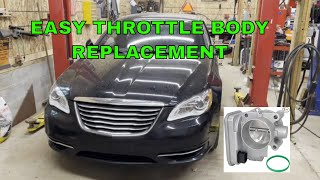
Typical fix: Clean the throttle body bore and plate with a dedicated throttle body cleaner and a soft cloth. If cleaning doesn't resolve the issue or the internal electronics have failed, the entire throttle body assembly must be replaced. 🎬 See this step-by-step guide for replacing the throttle body. An ETC relearn is often required after cleaning or replacement.
Est. part cost: $150-$300
Rare But Worth Checking
- Faulty Manifold Absolute Pressure (MAP) Sensor: → Shop Manifold Absolute Pressure Sensor The MAP sensor measures pressure in the intake manifold. If it provides an inaccurate reading to the PCM, it can cause the computer to misinterpret the amount of air entering the engine, potentially triggering P2172.
- Failed PCV Valve/System: → Shop PCV Valve The PCV valve is integrated into the valve cover on the 2.4L engine. If it fails by sticking open, it can create a significant internal vacuum leak, leading to a rough idle and codes like P2172. This may also contribute to the engine's known oil consumption issues.
- Leaking Mechanical Vacuum Pump O-Rings: The 2.4L MultiAir engine uses a camshaft-driven mechanical vacuum pump for the brake booster. This pump is sealed to the cylinder head with O-rings that can fail. While primarily causing oil leaks or a hard brake pedal, a significant failure could potentially impact engine vacuum.
Diagnosis Steps
- Check for TSBs: Contact a Chrysler dealership with your VIN. Ask if TSB #18-023-16 REV. C, #18-022-17 REV. A, or any superseding bulletin applies and if the update has been performed. This is the most critical first step for this specific vehicle.
- Visual Inspection & Smoke Test: If software is not the cause, perform a thorough smoke test. This is the most reliable way to find a vacuum leak. 🎬 Watch: How to perform a smoke test to find leaks. Introduce smoke into the intake system and look for smoke escaping from gaskets (intake manifold, throttle body), hoses (PCV, brake booster), or an uncapped port on the throttle body itself.
- Inspect Throttle Body: Remove the intake duct and inspect the throttle body for heavy carbon buildup that could prevent the plate from closing fully. Check for an uncapped vacuum nipple, especially on aftermarket units.
- Test MAP Sensor: Using a capable scan tool, monitor the MAP sensor reading at idle and with the engine off. Compare the readings to specified values (typically around 1.0V at idle, rising to over 3.5V at wide-open throttle) to ensure the sensor is reporting pressure correctly.
- Check Wiring: Inspect the wiring harnesses and connectors for the throttle body and MAP sensor for any signs of damage, corrosion, or loose connections.
- Perform ETC Relearn: After cleaning/replacing the throttle body or fixing a major vacuum leak, perform an Electronic Throttle Control (ETC) relearn procedure using a capable scan tool to reset learned throttle values.
Parts You'll Likely Need
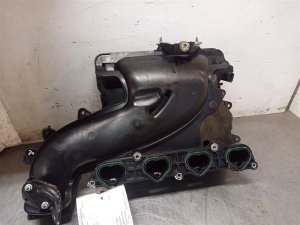
- Intake Manifold Gasket Set
(OEM #04892990AC)— A common source of vacuum leaks on higher-mileage vehicles. If a smoke test reveals a leak at the intake manifold, these gaskets must be replaced.
Trusted brands: Mopar, Fel-Pro, Mahle
OEM price range: $20-$40
Aftermarket price range: $15-$30 - PCV Hose — This hose is under constant vacuum and exposed to engine heat, making it prone to cracking and causing a significant vacuum leak. The PCV valve itself is integrated into the valve cover.
Trusted brands: Mopar, Gates
OEM price range: $25-$50
Aftermarket price range: $10-$25 - Throttle Body Assembly
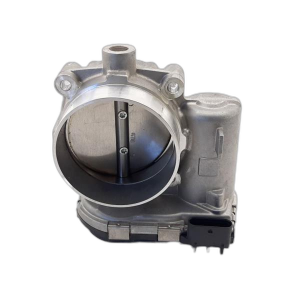
(OEM #56028338AC)— Internal electronic failure or a sticking throttle plate that cannot be fixed by cleaning will require replacement. Also, an aftermarket part may be the source of the problem if it has an uncapped vacuum port.
Trusted brands: Mopar, Hitachi, Standard Motor Products
OEM price range: $200-$300
Aftermarket price range: $120-$220
Related Codes That Often Appear With This One
- P1D73 — AGS (Active Grille Shutter) Performance. Often listed together with P2172 in Chrysler TSBs for a PCM reflash.
- P0456 — EVAP System Small Leak. Also listed in the same TSBs, suggesting a software logic connection.
- P0133 — O2 Sensor 1/1 Slow Response. A vacuum leak creates a lean air/fuel mixture, which can affect O2 sensor readings and trigger this code. It is also listed in the TSBs.
- U0140 — Lost Communication With Body Control Module. Another code addressed by the same PCM software update.
- P0441 — EVAP Purge System Performance. Included in the group of codes fixed by the PCM reflash mentioned in TSBs.
- P0302 — Cylinder 2 Misfire. A significant vacuum leak can lean out the air/fuel mixture enough to cause misfires. One owner reported this code alongside P2172.
Technical Service Bulletins (TSBs) & Recalls
- 18-022-17 REV. A: Lists P2172 - High Airflow/Vacuum Leak Detected as one of several codes addressed by a PCM software update for 2015 Chrysler 200 models.
- 18-023-16 REV. C: Explicitly states that for 2015 (UF) Chrysler 200 vehicles with the 2.4L engine, a PCM reflash can correct false P2172 codes, along with other symptoms like engine startup flare and idle surge.
- 18-006-15 REV. A: An earlier TSB for the 2014 Dodge Dart with the 2.4L engine also addresses P2172 with a PCM flash, showing a history of this issue on the platform.
Platform-Specific Known Issues
- A primary issue for the 2015 Chrysler 200 with the 2.4L engine is the need for a PCM software update. TSB #18-023-16 REV. C and #18-022-17 REV. A were released to address P2172 and a host of other codes being set erroneously. The fix is to reflash the PCM, not necessarily replace any parts.
- A specific repair story involves a mechanic discovering an uncapped vacuum nipple on a recently replaced aftermarket throttle body, which was the sole cause of the P2172 code and high idle. Capping the port and performing an ETC relearn fixed the issue.
- The 2.4L Tigershark engine is known for excessive oil consumption issues, which can be related to PCV system problems or piston rings. While not a direct cause of P2172, a faulty PCV system (stuck open) can create a vacuum leak.
Mechanic-Grade Diagnostic Values
- MAP Sensor Voltage (Key On, Engine Off) — expected: Signal wire: 0.5V - 1.5V; Reference wire: 4.5V - 5.0V; Ground wire: 0V.. Failure: Readings outside the expected range indicate a sensor or wiring issue.
- MAP Sensor Voltage (Live Data, Engine Running) — expected: Approx. 1.0V at idle, rising to over 3.5V - 4.0V at Wide-Open Throttle (WOT).. Failure: Voltage that is stuck, slow to respond, or doesn't change with engine load suggests a faulty sensor.
- Engine Vacuum (Live Data, At Idle) — expected: Approximately 20-21 in-Hg (inches of Mercury).. Failure: Significantly lower vacuum at idle is a strong indicator of a vacuum leak.
- Throttle Position Sensor 1 Voltage (TP1) — expected: Sweeps from approx. 0.3V at closed throttle to over 4.7V at WOT.. Failure: Voltage that is erratic, has dead spots, or does not sweep smoothly.
- Throttle Position Sensor 2 Voltage (TP2) — expected: Sweeps inversely to TP1, from approx. 4.7V at closed throttle to approx. 0.3V at WOT.. Failure: Voltage that does not mirror TP1's sweep or shows erratic behavior.
Scan Tool Commands That Help
- wiTECH or equivalent professional scan tool: ETC Relearn / Learn Electronic Throttle Body — This procedure is required after replacing the throttle body, cleaning the throttle body, or fixing a significant vacuum leak. It resets the PCM's learned values for the throttle plate's idle and off-idle positions, which is critical for proper idle speed and throttle response.
Wiring & Ground Locations
- Throttle Body Connector (C1) — 6-pin connector directly on the electronic throttle body assembly.. Provides power, ground, and signal lines for the throttle motor and dual throttle position sensors. A bad connection here can directly cause throttle control faults. Pinout: TP SENSOR RETURN, CAN C (+), CAN C (-), 5 VOLT SUPPLY, ETC MOTOR (+), ETC MOTOR (-), TP 2 SIGNAL, TP 1 SIGNAL.
- MAP Sensor Connector — 3-wire connector on the MAP sensor, which is located on the intake manifold.. Provides the PCM with critical data on intake manifold pressure. Incorrect readings can cause the PCM to misinterpret airflow. Wire colors: Pink (Signal), Green (Ground), Yellow (5V Supply).
- G302 / G303 — G302 is typically located at the left kick panel. G303 is often at the left 'B' pillar.. These are main body ground points. A poor ground connection at these locations can cause a variety of seemingly unrelated electrical issues, including erratic sensor readings that could potentially trigger a P2172 code.
- Ground Stud Under Battery Tray — Underneath the vehicle's battery and battery tray in the engine compartment.. This is a primary grounding point for engine and body harnesses. Corrosion or a loose connection here is a known cause of various electrical faults on Chrysler vehicles.
Real Owner Repair Stories
- YouTube channel 'Online Mechanic Tips' (2015 Chrysler 200) — Check Engine Light on, Electronic Throttle Control light on, very high idle.
❌ Tried (didn't work) The vehicle was brought from another shop that had already replaced the throttle body, but the problem persisted.
✅ What actually fixed it The technician discovered the new aftermarket throttle body had an extra vacuum nipple that was not present on the OEM part. This port was uncapped, creating a massive vacuum leak. The fix was to place a vacuum cap over the unused nipple to seal the leak, clear the codes, and perform an 'ETC Relearn' procedure with a scan tool.
OEM Part Supersession History
56028338AB→56028338AC— Unknown, likely a minor revision for reliability or manufacturing improvement.
Helpful Videos
Used OEM Parts in Stock
New Aftermarket Parts Available


The information in this article is provided for general reference and educational purposes only. Vehicle specifications, procedures, and part compatibility can vary by production date, trim level, and region. Always consult your vehicle's factory service manual and verify part numbers before purchasing or performing repairs. Safety-critical components such as airbags, seat belts, and braking systems should be installed by a qualified professional.
- Chrysler 200:
- 🧭 Diagnostic Flowchart
- 🎬 Helpful Videos
- 🛍️ Shop This Part
- What's Unique About the 2015-2015 Chrysler 200
- Symptoms You May Notice
- Most Likely Causes
- Rare But Worth Checking
- Diagnosis Steps
- Parts You'll Likely Need
- Related Codes That Often Appear With This One
- Technical Service Bulletins (TSBs) & Recalls
- Platform-Specific Known Issues
- Mechanic-Grade Diagnostic Values
- Scan Tool Commands That Help
- Wiring & Ground Locations
- Real Owner Repair Stories
- OEM Part Supersession History
- 🎟️ Get 5% Off