

P2176 on 2006-2013 Chevrolet Corvette: Causes and Fixes for Throttle Position Errors
On a C6 Corvette, P2176 almost always means the throttle body is dirty with carbon buildup. This prevents the throttle plate from closing properly, triggering a 'Reduced Engine Power' warning. A thorough cleaning of the throttle body and a specific Idle Relearn Procedure usually fixes the issue for under $20. Failure to perform the relearn is a common reason for the code to return immediately after cleaning.
- P2176 on a C6 Corvette is a strong indicator of a dirty throttle body.
- A simple cleaning is often the fix, but it MUST be followed by an Idle Relearn Procedure.
- Failure to perform the relearn procedure is a primary reason for the code returning after a cleaning.
- While less common, wiring issues at the throttle body connector should be inspected before replacing the part.
What's Unique About the 2006-2013 Chevrolet CORVETTE
The C6 Corvette's electronic throttle control system is known to be sensitive to carbon buildup in the throttle body, especially on higher-mileage vehicles. As carbon accumulates, the ECM learns to compensate by commanding a slightly different throttle angle to maintain a stable idle. As noted in GM Technical Service Bulletin #PIP4578B, this buildup can eventually cause idle surges, trigger the P2176 code, and force the car into 'Reduced Engine Power' mode. Crucially, if the throttle body is cleaned but the ECM's learned compensation is not reset, the engine will run poorly and may set new codes like P0506 or P0507, as the computer is still trying to correct for carbon that is no longer there.
Diagnostic Flowchart
Tap your situation to follow the diagnostic path that matches what you're seeing on this vehicle.
Generation note: This year range covers the entire C6 generation of the Chevrolet Corvette (2005-2013). The issue is common across all engines used in this generation (LS2, LS3, LS7, LS9) as they all utilize a similar electronic throttle body design. The specific part number for the throttle body differs between the 2005-2008 models (LS2/LS7) and 2009-2013 models (LS3/LS7/LS9).
Symptoms You May Notice
- "Reduced Engine Power" message displayed on the instrument cluster
- Check Engine Light is on
- Unstable, surging, or high idle.
- Engine may stall when coming to a stop.
- Noticeable hesitation or lack of throttle response.
- Engine runs rough, particularly during a hot restart after a short stop (e.g., at a gas station).
- Replacing the accelerator pedal position (APP) sensor. While part of the throttle control system, P2176 specifically points to a problem at the throttle body itself, not the pedal.
Most Likely Causes
- Dirty Throttle Body 🔴 High Probability → Shop Fuel Injection Throttle Body As mentioned in TSB #PIP4578B, carbon and oil deposits from the PCV system accumulate in the throttle body bore over time, physically obstructing the throttle plate from closing completely.
How to confirm: Remove the air intake tube connected to the throttle body and visually inspect the throttle plate and bore for a black, sticky film of carbon. A scan tool may show an idle throttle position percentage higher than the typical 3-9% range, such as 16%.
Typical fix: Clean the throttle body bore and plate thoroughly with a dedicated throttle body cleaner and a soft cloth. Afterwards, an Idle Relearn Procedure must be performed.
Est. part cost: $5-$15 - Failed or Skipped Idle Relearn Procedure 🟡 Medium Probability This code is often triggered immediately after maintenance like cleaning the throttle body, disconnecting the battery, or reprogramming the ECM. The ECM's learned values for idle airflow are no longer valid, and it fails to adapt to the new, clean throttle body state without a proper reset.
How to confirm: This is the likely cause if the code appeared directly after servicing the throttle body, disconnecting the battery, or flashing the ECM.
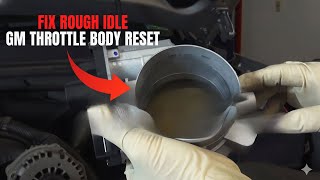
Typical fix: Perform the manufacturer's specified Idle Relearn Procedure. A diagnostic scan tool (like a GM Tech 2 or Snap-on Solus Pro) is the most reliable method to perform an 'Idle Learn Reset'. A manual relearn may also be possible. 🎬 See how to manually reset and relearn your GM throttle body.
Est. part cost: $0 - Faulty Throttle Body Assembly ⚪ Low Probability → Shop Fuel Injection Throttle Body The internal electronic motor (Throttle Actuator) or position sensors can fail over time. On highly modified, forced-induction engines, high boost pressure can sometimes overpower the throttle motor, causing a deviation between the commanded and actual position and triggering P2176.
How to confirm: After cleaning the throttle body and attempting a relearn, if the code persists, use a scan tool to monitor the throttle position sensor voltage. If the readings are erratic or do not respond smoothly to pedal input, the unit is likely faulty.
Typical fix: Replace the entire throttle body assembly. These are typically sold as a single, sealed unit. The TPS is not sold separately for the C6.
Est. part cost: $150-$450
Rare But Worth Checking
- Wiring Harness Issue: A broken or corroded wire at the throttle body connector can cause intermittent signal loss. A known diagnostic technique is to gently tug on each individual wire at the back of the connector to check for breaks inside the insulation. Fretting corrosion on connector pins is also a possibility.
- Heat Soak Affecting Electronics: In some cases, particularly on LS-swapped vehicles, owners have reported P2176 appearing only on hot restarts. This suggests that heat from the engine could be affecting the throttle body's internal electronics, causing a temporary fault. If the code only appears after stopping for a few minutes and restarting a hot engine, this could be the cause.
- Binding in Extreme Cold: Owners of other GM vehicles with similar systems have reported P2176 only appearing in very cold weather (e.g., below 10°F). The theory is that the grease inside the throttle body's actuator gears becomes too stiff, preventing the plate from moving as commanded on a cold start.
- Faulty Engine Control Module (ECM): → Shop Engine Control Module (ECM) This is extremely rare. The ECM should only be considered a potential cause after all other possibilities, including wiring, have been exhaustively checked and ruled out.
Diagnosis Steps
- Scan for all DTCs and confirm P2176 is present. Note any other codes, especially P1516, P2135, P0506, or P0507.
- Remove the air intake duct from the throttle body.
- Visually inspect the throttle body plate and bore for carbon buildup.
- If dirty, clean the throttle body thoroughly using a dedicated cleaner and a lint-free rag. Do not move the plate by hand aggressively.
- Reconnect the intake ducting.
- Perform the Idle Relearn Procedure. A scan tool ('Idle Learn Reset' function) is the most reliable method. A common DIY method is: let the car idle for 3 minutes to reach operating temp, turn off for 60 seconds, restart and idle for another 3 minutes. A drive cycle may be required for the ECM to fully adapt.
- Clear the codes and perform a test drive. If the code returns, the issue may be the throttle body itself or wiring.
- Inspect the wiring and connector at the throttle body. Gently tug on each wire at the back of the connector to feel for any looseness or breaks within the insulation.
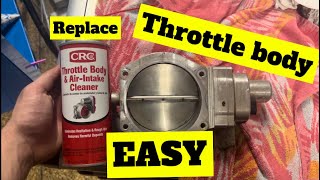
- If wiring is intact and the code persists after cleaning and relearning, replacement of the throttle body assembly is the next logical step. 🎬 Watch: A simple walkthrough on replacing your Corvette throttle body.
Parts You'll Likely Need
- Throttle Body Assembly (2005-2008 LS2/LS7)
(OEM #12570790)— This is the complete 'Silver Blade' 90mm unit for early C6 models. It is replaced if cleaning fails or the internal electronics have failed.
Trusted brands: ACDelco, Soler Performance
OEM price range: $250-$500+
Aftermarket price range: $150-$350 - Throttle Body Assembly (2009-2013 LS3/LS7/LS9)
(OEM #19420707 (supersedes 12601387))— This is the complete 'Gold Blade' unit for later C6 models. It is replaced if cleaning fails or the internal electronics have failed.
Trusted brands: ACDelco, Bosch
OEM price range: $250-$450
Aftermarket price range: $150-$300 - Throttle Body Cleaner — This specialized solvent is required to safely dissolve carbon buildup without damaging electronic components or coatings.
Trusted brands: CRC, Gumout
OEM price range: $10-$15
Aftermarket price range: $5-$10
Related Codes That Often Appear With This One
- P1516 — This GM-specific code relates to a Throttle Actuator Control (TAC) module performance issue, often triggered by the same conditions as P2176.
- P2135 — This code indicates a correlation error between the two throttle position sensors. It can be caused by a failing throttle body, which would also trigger P2176.
- P0068 — Indicates a mismatch between the MAP sensor, MAF sensor, and throttle position. A throttle plate that isn't where it's supposed to be (due to carbon) can cause this correlation fault.
- P0506 / P0507 — These codes for 'Idle Air Control System RPM Lower/Higher Than Expected' can appear after cleaning a throttle body if the idle learn procedure is not performed. The ECM is still using learned values for a dirty throttle body, resulting in an incorrect idle speed.
Technical Service Bulletins (TSBs) & Recalls
- PIP4578B: Addresses customer concerns of idle surge, reduced engine power, and DTCs including P2176 on high mileage vehicles, pointing towards throttle body issues. It explicitly states that an 'idle learn reset' via scan tool is necessary after cleaning.
Platform-Specific Known Issues
- As documented in TSB #PIP4578B, P2176 is a known issue on high-mileage Corvettes, often accompanied by an idle surge, and is directly linked to the throttle body's condition.
- On highly modified cars with forced induction (superchargers/turbos), high boost pressure can overpower the throttle body motor, causing a deviation between commanded and actual throttle position, which can trigger P2176 and P2135.
Mechanic-Grade Diagnostic Values
- Throttle Position Sensor 1 (TPS1) Voltage (Key On, Engine Off) — expected: Approx. 0.13V - 0.67V at closed throttle (idle), rising to ~4.45V at Wide Open Throttle (WOT).. Failure: A closed throttle voltage significantly higher than 0.7V (e.g., 1.35V) indicates a fault or obstruction.
- Throttle Position Sensor 2 (TPS2) Voltage (Key On, Engine Off) — expected: Approx. 4.30V - 4.80V at closed throttle (idle), falling to ~0.57V at Wide Open Throttle (WOT).. Failure: A closed throttle voltage significantly lower than 4.3V (e.g., 3.67V) indicates a fault. The two sensors should have opposing voltage sweeps.
- Scan Tool Throttle Position Percentage at Idle — expected: Typically 3-9%.. Failure: A reading significantly higher than normal, such as 16%, suggests the throttle plate is being held open by carbon buildup.
Scan Tool Commands That Help
- GM Tech 2 / Snap-on Solus Pro / GDS2: Idle Learn Reset — This function should be used immediately after cleaning or replacing the throttle body to force the ECM to relearn the new minimum idle position. Failure to use this is a primary cause of the P2176 code returning after a repair.
Wiring & Ground Locations
- Throttle Body Connector (X105 on some diagrams) — Directly on the throttle body assembly.. This 6-pin connector carries power, ground, and signal wires for both internal TPS sensors and the throttle actuator motor. Wires can break internally near the connector from vibration, and pins can suffer from fretting corrosion, leading to intermittent signals that trigger P2176.
- Engine Block Grounds (e.g., G103, G104, G105, G106) — Bolted to the engine block and cylinder heads, typically near the front of the engine or behind the cylinder heads.. The ECM and its related sensors rely on clean, secure ground connections. A loose or corroded engine ground strap or bolt, especially one disturbed during other maintenance (like a harmonic balancer replacement), can cause erratic sensor readings and trigger various throttle-related codes, including P2176.
Real Owner Repair Stories
- Reddit user in r/LSSwapTheWorld ('64 Corvette with a stock 430hp LS3 crate engine and GM controller.) — P2176 code sets only on a hot restart (e.g., stopping for gas). The engine runs rough and is undrivable until the code is cleared. Cold starts are always fine.
❌ Tried (didn't work) Performing the throttle learn and idle learn procedure many times., Replacing the new stock GM throttle body with another new stock GM throttle body.
✅ What actually fixed it The user was advised to perform a load test on all Throttle Actuator Control (TAC) wiring and the ECM power/ground wires while the components were hot to identify a potential heat-induced high-resistance failure in a wire or connection. This points towards a wiring or connector issue exacerbated by heat soak, rather than a faulty component. - CorvetteForum user (2006 Z06) — Car would not start and threw code P2176.
❌ Tried (didn't work) Spraying cleaner into the throttle body., Clearing the code (it would return immediately).
✅ What actually fixed it The problem was ultimately traced to a wiring issue. Another user in the same thread with a 2007 Z06 and P2176 confirmed their issue was a broken wire at the throttle body connector, a known early C6 problem. The diagnostic advice was to physically tug on each wire at the back of the connector to check for internal breaks.
OEM Part Supersession History
12601387→19420707— Standard part revision and replacement by the manufacturer.
Model Year Variations Within This Range
- 2005-2008 (LS2/LS7): Uses the 'Silver Blade' 90mm throttle body (PN 12570790). The wiring connector and pinout are specific to this earlier C6 range.
- 2009-2013 (LS3/LS7/LS9): Uses the 'Gold Blade' throttle body (PN 19420707, supersedes 12601387). This unit has a different connector and internal electronics compared to the earlier version.
Helpful Videos


Used OEM Parts in Stock
New Aftermarket Parts Available


The information in this article is provided for general reference and educational purposes only. Vehicle specifications, procedures, and part compatibility can vary by production date, trim level, and region. Always consult your vehicle's factory service manual and verify part numbers before purchasing or performing repairs. Safety-critical components such as airbags, seat belts, and braking systems should be installed by a qualified professional.
- Chevrolet CORVETTE:
- 🧭 Diagnostic Flowchart
- 🎬 Helpful Videos
- 🛍️ Shop This Part
- What's Unique About the 2006-2013 Chevrolet CORVETTE
- Symptoms You May Notice
- Most Likely Causes
- Rare But Worth Checking
- Diagnosis Steps
- Parts You'll Likely Need
- Related Codes That Often Appear With This One
- Technical Service Bulletins (TSBs) & Recalls
- Platform-Specific Known Issues
- Mechanic-Grade Diagnostic Values
- Scan Tool Commands That Help
- Wiring & Ground Locations
- Real Owner Repair Stories
- OEM Part Supersession History
- Model Year Variations Within This Range
- 🎟️ Get 5% Off