

P2181 on 2015 Volkswagen Beetle TDI: Cooling System Performance Causes and Fixes
On a 2015 VW Beetle TDI, code P2181 almost always means the thermostat is stuck open. The fix is to replace the integrated water pump and thermostat assembly, which is a labor-intensive job costing between $800-$1800 at a shop. A faulty coolant temperature sensor is a much less common but possible cause.
- P2181 means your Beetle TDI's engine is running too cool, most likely due to a thermostat that is stuck open.
- The most probable fix is replacing the entire integrated water pump and thermostat assembly, not just a simple thermostat.
- Before buying parts, confirm the diagnosis by using a scan tool to watch the coolant temperature. If it drops at highway speeds, the thermostat is the culprit.
- This is a complex repair best left to a professional or experienced DIYer due to the location of the assembly.
- Always use the correct VW-specific G12 or G13 coolant when refilling the system to prevent damage.
What's Unique About the 2015-2015 Volkswagen BEETLE TDI
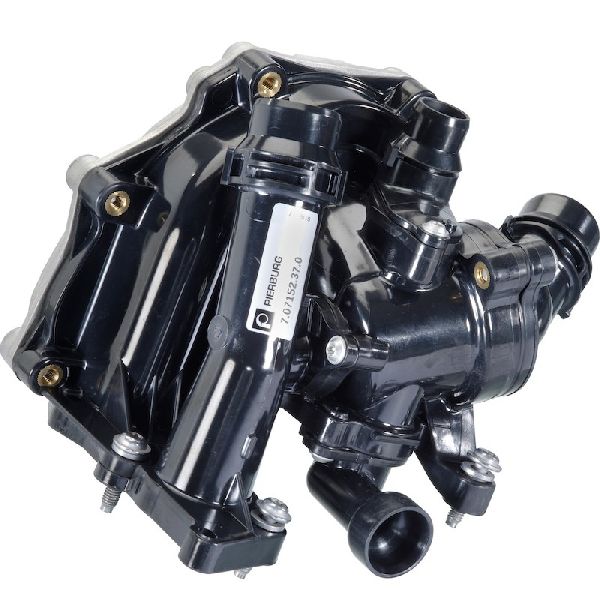
On the 2015 Beetle's EA288 TDI engine, the thermostat is not a simple, standalone part. It is integrated into a larger, complex assembly with the water pump, often called a 'thermal management module'. This module has multiple electronically controlled valves to manage coolant flow to the head and block separately for faster warm-ups. The P2181 code is triggered when the primary thermostat within this module fails open. This design means that a common thermostat failure requires the replacement of the entire unit, making the repair significantly more labor-intensive and costly than on older vehicles with separate components. These plastic housings are also known to be a potential source of coolant leaks over time.
Diagnostic Flowchart
Tap your situation to follow the diagnostic path that matches what you're seeing on this vehicle.
Symptoms You May Notice
- Check Engine Light is on
- Engine temperature gauge takes a very long time to reach the middle (90°C / 195°F) or never gets there
- Engine temperature gauge drops at highway speeds when the engine is under light load.
- Heater blows lukewarm or cold air, especially when the temperature gauge is low
- Reduced fuel economy
- Replacing only the coolant temperature sensor when the thermostat is actually the problem. It's crucial to diagnose by observing the temperature behavior (dropping at speed) before replacing parts, as this symptom strongly points to the thermostat.
Most Likely Causes
- Faulty Thermostat (Stuck Open) 🎬 See these 5 common signs of a stuck open thermostat. 🔴 High Probability The thermostat is a common wear item designed to fail in the open position as a fail-safe against overheating. On the EA288 engine, it is part of a complex integrated housing that is a known failure point.
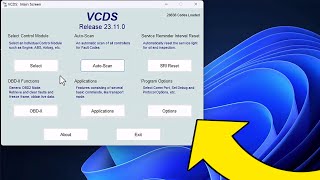
How to confirm: Use a scan tool to monitor coolant temperature while driving. If the temperature takes an excessively long time to warm up, struggles to get above 80°C (176°F), or drops significantly at highway speeds, the thermostat is almost certainly stuck open. A more advanced check with VCDS involves graphing the engine outlet sensor (G62) and radiator outlet sensor (G83); if both temperatures rise together from a cold start, the thermostat is confirmed to be stuck open.
Typical fix: Replace the integrated thermostat and water pump assembly. The system must be drained, refilled with VW-specific G12/G13 coolant, and properly bled of air.
Est. part cost: $150-$400 - Faulty Engine Coolant Temperature (ECT) Sensor 🟡 Medium Probability → Shop Engine Coolant Temperature Sensor ECT sensor failure is a known issue on many Volkswagen models. It provides the temperature data to the ECU, so a faulty sensor giving an incorrectly low reading can trigger the code. VW has released updated versions of this sensor over the years.
How to confirm: With the engine cold, use a scan tool to compare the Engine Coolant Temperature (ECT) and Intake Air Temperature (IAT) readings. They should be within a few degrees of each other. If the ECT reading is illogical (e.g., -40°F), the sensor is bad. You can also test the sensor's resistance; it should be around 2000-3000 ohms at room temperature (20°C / 68°F).
Typical fix: Replace the engine coolant temperature sensor. It is often replaced as a preventative measure during a thermostat and water pump job due to its low cost and the labor overlap.
Est. part cost: $20-$50 - Low Engine Coolant Level ⚪ Low Probability → Shop Engine Coolant / Antifreeze The plastic thermostat/water pump housings on these engines are known to develop hairline cracks and leaks over time, which can lead to a low coolant level.
How to confirm: Visually inspect the coolant reservoir to see if the level is below the minimum mark. Check for pink or white crusty residue around the water pump housing, hoses, and radiator, which indicates a leak. A cooling system pressure test can confirm a leak if it's not visible.
Typical fix: Find and repair the source of the leak, then top off or refill the system with the correct G12/G13 coolant and bleed any trapped air.
Est. part cost: $20-$40 for coolant, plus cost of leaking part
Rare But Worth Checking
- Air Pockets in Cooling System: If the cooling system was recently serviced and not bled properly, trapped air can cause erratic temperature readings and trigger P2181. The EA288 engine requires a specific scan tool procedure 🎬 Watch: How to use VCDS to bleed your cooling system. to bleed correctly.
- Wiring or Connector Issues: A damaged wire or corroded connector for the ECT sensor can cause incorrect signals to be sent to the ECM, triggering the code even if the sensor itself is good. VW specifies using only gold-plated terminals when servicing the G62 sensor connector, highlighting its sensitivity.
Diagnosis Steps
- Check for other DTCs: Use an OBD-II scanner to see if any other codes are present that could point to a specific component, such as P0128.
- Inspect Coolant Level and Condition: With the engine cool, check the coolant reservoir. Ensure the level is between the MIN and MAX marks and that the correct pink/purple G12/G13 coolant is being used.
- Visually Inspect for Leaks: Look for signs of coolant leaks (pink residue), especially around the water pump/thermostat housing under the intake manifold, radiator, and hose connections.
- Analyze Live Data: Use a scan tool to monitor the Engine Coolant Temperature (ECT) sensor data from a cold start. The temperature should rise steadily to around 90°C (195°F) and stabilize. A very slow warm-up is a key indicator.
- Test Drive Analysis: During a test drive, watch the ECT data. If the temperature drops significantly when driving at highway speeds (e.g., from 90°C down to 75°C), it's a classic sign of a thermostat stuck open.
- Test the ECT Sensor: On a cold engine, compare the ECT reading to the Intake Air Temperature (IAT) reading. They should be nearly identical. If not, the ECT sensor is likely faulty. Check the Freeze Frame data; a temperature of -40°C or +140°C strongly suggests a sensor or wiring fault.
Parts You'll Likely Need
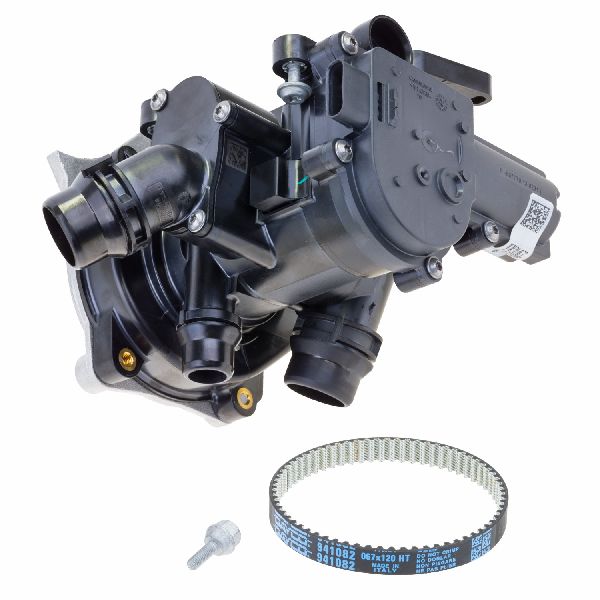
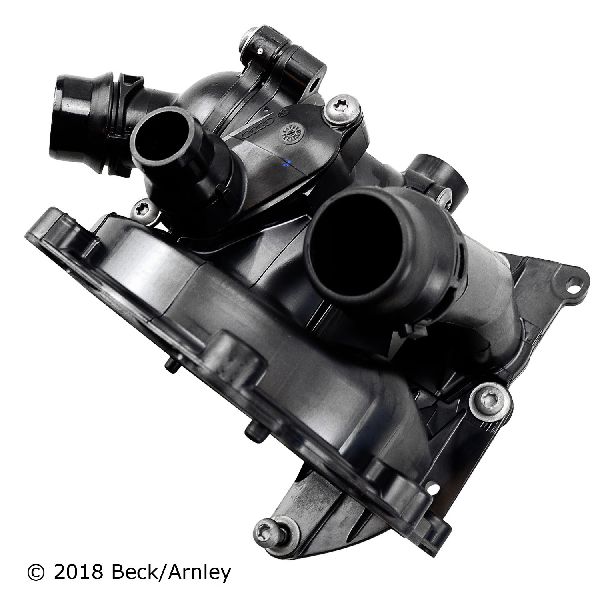
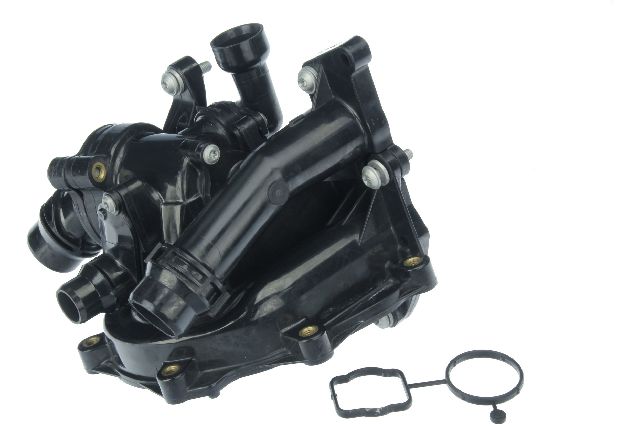
- Water Pump and Thermostat Assembly
(OEM #04L121026AH)— This is the most common failure. The internal thermostat gets stuck open, preventing the engine from warming up correctly. The part is sold as an integrated unit. Always confirm the part number with the vehicle's VIN as revisions exist.
Trusted brands: Volkswagen Genuine, INA, Continental, Mahle
OEM price range: $250-$400
Aftermarket price range: $150-$250 - Engine Coolant Temperature (ECT) Sensor
(OEM #06A919501A)— This sensor provides the temperature data to the computer. A faulty sensor can send incorrect signals, triggering the code. It's a common failure point and often replaced with the thermostat.
Trusted brands: Bosch, Delphi, Volkswagen Genuine, Febi
OEM price range: $30-$50
Aftermarket price range: $15-$30 - Volkswagen G13 Coolant
(OEM #G013A8J1G)— The correct coolant is required when refilling the system after replacing parts to prevent corrosion and damage. G12evo is the newer, compatible replacement.
Trusted brands: Volkswagen Genuine, Pentosin Pentofrost E
OEM price range: $25-$35 per gallon
Aftermarket price range: $20-$30 per gallon
Related Codes That Often Appear With This One
- P0128: Coolant Thermostat (Coolant Temperature Below Thermostat Regulating Temperature) - This code is very similar and points more directly to a stuck-open thermostat.
Technical Service Bulletins (TSBs) & Recalls
- VIN-4-A-PIN APRI (2015 ENGINE, dated 2016-04-21): Lists P2181 as a possible fault in the ECM. Note: This is a generic bulletin for tracking field issues, not a specific repair procedure.
- VIN-4-A-PIN APRI (2015 EQUIPMENT, dated 2016-04-13): Lists P2181 as a possible fault in the ECM. Note: This is a generic bulletin for tracking field issues, not a specific repair procedure.
Platform-Specific Known Issues
- Real-World Repair Story: An owner of a 2015 VW Golf Sportwagen with the same EA288 engine on TDIClub reported getting code P2181. Their symptoms were classic: the temperature gauge would not go past the halfway mark and would drop on the highway. The coolant temperature, monitored via a scan tool, hovered around 70-75°C. The confirmed fix was the replacement of the entire thermostat/water pump assembly. The owner noted the repair was labor-intensive and that an independent VW specialist was significantly cheaper than the dealer, which quoted over $1500 for the job.
Mechanic-Grade Diagnostic Values
- Engine Coolant Temperature (G62) Sensor Resistance — expected: Approx. 2000-3000 Ω at 20°C (68°F). At 80°C (176°F), the resistance should be between 275-375 Ω.. Failure: An open circuit (infinite resistance) or a short (near zero resistance). Readings significantly outside the expected range for a given temperature indicate a faulty sensor.
- VCDS Live Data Graph: G62 vs. G83 — expected: From a cold start, the Engine Coolant Temperature (G62) should rise steadily while the Radiator Outlet Temperature (G83) remains cool and stable. G83 should only begin to rise sharply after G62 reaches operating temperature (approx. 85-90°C) and the thermostat opens.. Failure: If both G62 and G83 rise together at a similar rate from a cold start, it is a definitive sign that the thermostat is stuck open, allowing coolant to circulate through the radiator immediately.
- Freeze Frame Data Interpretation — expected: For a P2181 code, the freeze frame data will likely show a coolant temperature below the target of 80°C after a significant engine run time.. Failure: If the freeze frame temperature is an illogical value like -40°C or +140°C, it strongly points to an electrical fault with the ECT sensor or its wiring, not a mechanical thermostat issue.
Scan Tool Commands That Help
- VCDS (VAG-COM) or ODIS: Basic Settings: 'IDE08087-Control – cooling circuit air purge' — This is a mandatory step after replacing the water pump/thermostat assembly and refilling the coolant. The EA288 engine's complex system cannot be bled by simply idling the engine. This function cycles the various pumps and valves to purge trapped air from the main high-temperature circuit while the engine is running.
- VCDS (VAG-COM) or ODIS: Basic Settings: 'IDE04795-Control – low-temperature circuit air purge' — This function is used with the engine off after running the main bleed procedure. It specifically purges air from the low-temperature circuit, which includes the charge air cooler. This is often run multiple times to ensure all air is evacuated.
- VCDS (VAG-COM) or ODIS: Adaptation: 'IDE08287-Cooling circuit air purge control' — This adaptation channel must be set to 'Enabled' or 'Active' before initiating the basic settings bleed procedures. It puts the engine control module into the service mode required to run the bleed tests.
Wiring & Ground Locations
- G1 / G12 / G15 — G1 is typically below the battery tray, G12 is on the left side of the engine compartment, and G15 is on the cylinder head.. A poor engine ground can cause erratic sensor readings. The ECM relies on a stable ground reference for all its sensors, including the ECT sensor (G62). Verifying these main grounds are clean and tight is a crucial step in diagnosing any electrical fault.
- ECT Sensor (G62) Connector — On the EA288, the primary G62 sensor is located in the integrated thermostat and water pump housing, under the intake manifold.. This is the direct electrical connection for the sensor that provides the temperature reading to the ECM. Damage, corrosion, or coolant contamination in this connector can mimic a sensor failure. VW service information notes that only gold-plated terminals should be used for repairs, indicating the connection's sensitivity.
- Water Pump Actuator (N489) Connector — This connector is on the integrated water pump/thermostat assembly and controls the internal shroud that makes the pump 'switchable'.. While not a direct cause of P2181, a fault here can cause other cooling system issues. An open circuit here will log a different fault (P199E). Knowing its location is useful for advanced diagnostics of the thermal management module.
Real Owner Repair Stories
- Ross-Tech Forums user (2008 VW Jetta 2.5L (similar diagnostic principles)) — Persistent P2181 code, temperature gauge only reaching ~140°F. Also had an intermittent P0116 for the G62 sensor.
❌ Tried (didn't work) Replacing the thermostat, Verifying coolant was bled properly
✅ What actually fixed it The final cause was a wiring harness problem. This highlights that if a new thermostat and sensor do not fix the issue, the wiring between the sensor and the ECM is the next logical place to inspect for intermittent shorts or opens. - Ross-Tech Forums user (VW with EA288 engine) — Engine overheating from a cold start, with stop engine warnings.
❌ Tried (didn't work) Normal diagnostic procedures for overheating.
✅ What actually fixed it The user diagnosed a stuck internal shroud on the switchable water pump. When the N489 actuator was plugged in, the shroud would stick closed, blocking coolant flow and causing an overheat. Unplugging the actuator caused the shroud to default open, preventing the overheat. The diagnostic involved using a 1K ohm resistor to trick the ECU into thinking the actuator was connected, proving the pump itself was the mechanical failure point. This is an edge case showing a different failure mode of the complex water pump assembly.
When the Usual Fixes Don't Work
- While the vast majority of P2181 codes on the EA288 engine are caused by a stuck-open thermostat within the main housing, it is not the only possibility. In one documented case, an owner replaced the thermostat but the code persisted. The ultimate fix was repairing a fault in the wiring harness leading to the ECT sensor. This serves as a reminder to always perform due diligence on the electrical system (checking for good ground, reference voltage, and signal continuity back to the ECM) if replacing the common parts does not resolve the issue.
OEM Part Supersession History
04L121026AE, 04L121026F, 04L121026Q→04L121026AH— Standard part revision and improvement by the manufacturer.
Heads up: The newest part number should always be used when replacing. While older versions may fit, the latest revision typically contains design improvements to address known failure modes.06A919501A→05C919501— Part revision and update.
Heads up: The part06A919501Ais a widely used sensor. While it may still be sold,05C919501is listed as a newer revision. Always confirm fitment with VIN, but be aware that an updated part number exists.
Helpful Videos
We Have This Part in Stock


The information in this article is provided for general reference and educational purposes only. Vehicle specifications, procedures, and part compatibility can vary by production date, trim level, and region. Always consult your vehicle's factory service manual and verify part numbers before purchasing or performing repairs. Safety-critical components such as airbags, seat belts, and braking systems should be installed by a qualified professional.
- Volkswagen BEETLE TDI:
- 🧭 Diagnostic Flowchart
- 🎬 Helpful Videos
- 🛍️ Shop This Part
- What's Unique About the 2015-2015 Volkswagen BEETLE TDI
- Symptoms You May Notice
- Most Likely Causes
- Rare But Worth Checking
- Diagnosis Steps
- Parts You'll Likely Need
- Related Codes That Often Appear With This One
- Technical Service Bulletins (TSBs) & Recalls
- Platform-Specific Known Issues
- Mechanic-Grade Diagnostic Values
- Scan Tool Commands That Help
- Wiring & Ground Locations
- Real Owner Repair Stories
- When the Usual Fixes Don't Work
- OEM Part Supersession History
- 🎟️ Get 5% Off