

P2181 on 2016 Volkswagen GTI: Cooling System Performance Causes and Fixes
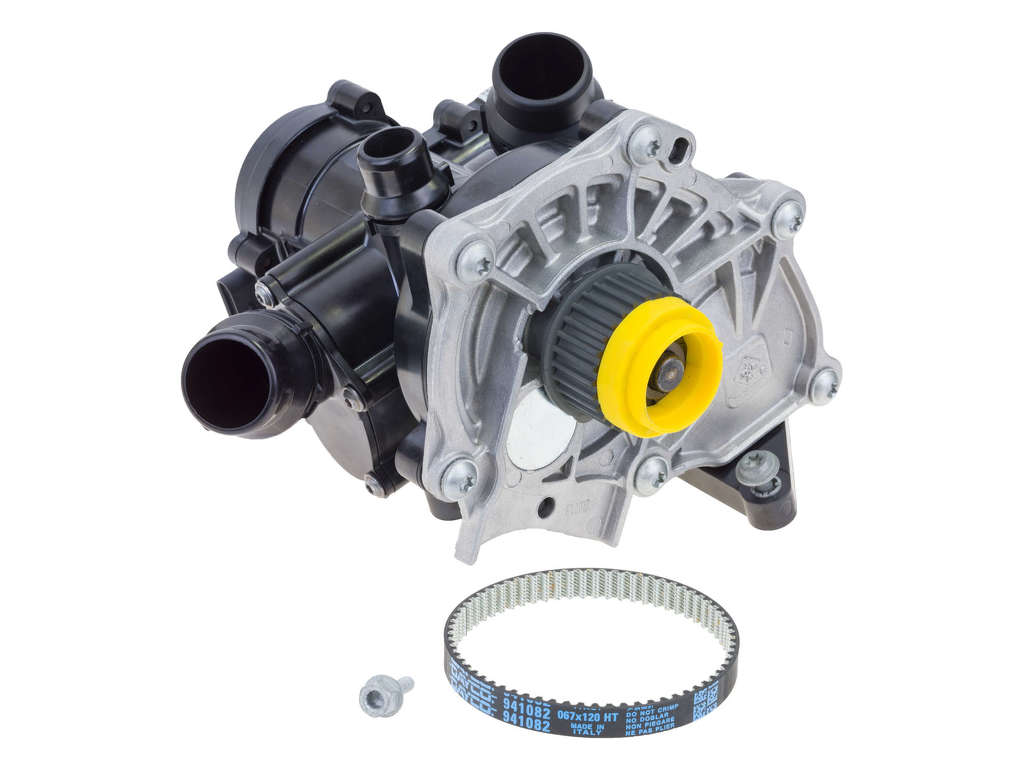
On a 2016 VW GTI, code P2181 almost always means the integrated thermostat and water pump assembly has failed. The thermostat typically sticks open, preventing the engine from warming up properly. The fix is to replace the entire plastic assembly, a 4+ hour job. Upgraded metal-housing aftermarket parts are available but have mixed long-term reliability reviews.
- P2181 on a 2016 GTI is almost certainly a failed water pump and/or thermostat.
- Look for a temperature gauge that won't stay at the middle mark or for signs of a pink coolant leak below the intake manifold.
- The correct fix is to replace the entire water pump and thermostat assembly, not just a sensor.
- Due to the labor involved (4-6 hours), this is an expensive repair ($800-$1400), but a necessary one.
- Opt for a replacement part with an aluminum housing to prevent the issue from recurring.
What's Unique About the 2016-2016 Volkswagen GTI
The 2016 GTI uses the EA888 Gen3 2.0T engine, which features a water pump and thermostat integrated into a single plastic housing. This component is a notorious failure point across many VW and Audi models. The plastic can become brittle from heat cycles and exposure to oil, leading to cracks, coolant leaks, or internal thermostat failure. The failure is so common that multiple class-action lawsuits resulted in an extended warranty for this specific part, though it has likely expired for most 2016 models. When P2181 appears, this assembly is the primary suspect.
Diagnostic Flowchart
Tap your situation to follow the diagnostic path that matches what you're seeing on this vehicle.
Symptoms You May Notice
- Check Engine Light is on
- Engine temperature gauge takes a very long time to reach the center (190°F/90°C)
- Temperature gauge drops below normal operating temperature while driving, especially at highway speeds or in cold weather
- Noticeable coolant leak (smell of sweet coolant, or visible pink/purple dried crust) on the passenger side of the engine, below the intake manifold
- Low coolant warning light on the dashboard
- Poor heater performance in the cabin
- Reduced fuel economy
- On some tuned cars, a noticeable loss of power as the ECU may restrict performance until the engine is perceived to be at full operating temperature
- Replacing only the Engine Coolant Temperature (ECT) sensor. While it's a cheap and easy part to replace, it is rarely the cause of P2181 on the Mk7 GTI. Owners often replace it first, only to have the code return, indicating the real problem is the thermostat. 🎬 See why you shouldn't just swap parts without testing first.
Most Likely Causes
- Failed Thermostat / Water Pump Assembly 🔴 High Probability → Shop Integrated Thermostat Housing Assembly The original equipment (OEM) assembly uses a plastic housing that is well-known for cracking, warping, and leaking over time. The thermostat, which is integrated into this housing, can also fail by sticking open or closed. A stuck-open thermostat is the most common failure leading to P2181.
How to confirm: Visually inspect the area under the intake manifold for signs of a coolant leak (pink/purple residue). A cooling system pressure test will confirm an external leak. If there are no leaks but the temperature gauge won't stay at the 190°F/90°C mark during normal driving, the thermostat is almost certainly stuck open. Using an OBD-II scanner with live data, you can watch the coolant temperature; if it rises to operating temp at idle but then drops significantly while driving, it confirms a stuck-open thermostat.
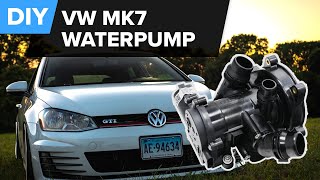
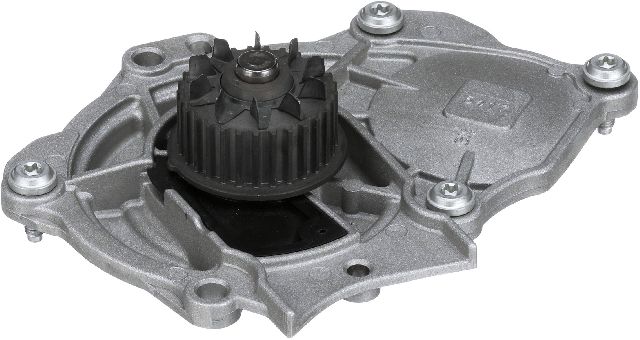
Typical fix: Replace the entire water pump and thermostat assembly as one unit. It is highly recommended to use a new OEM or OEM-supplier (e.g., INA) part. Aftermarket versions with aluminum housings (e.g., Graf) exist, but forum discussions show mixed long-term reliability, with some users reporting premature failure. The job requires removing the intake manifold. 🎬 Watch: This detailed walkthrough shows the full replacement process.
Est. part cost: $150-$400 - Faulty Engine Coolant Temperature (ECT) Sensor ⚪ Low Probability → Shop Engine Coolant Temperature Sensor While any sensor can fail, on this platform it is a much less common cause for P2181 than the water pump/thermostat assembly. Owners often replace it as a first step due to its low cost, but the code usually returns.
How to confirm: Compare the ECT sensor reading on a scan tool with the ambient temperature on a cold engine (they should be close). Watch the live data as the engine warms up; the reading should be smooth and steady. If the reading is erratic, jumps, or is completely flatlined (e.g., stuck at -40°C or +140°C), the sensor or wiring is likely bad. A multimeter can also be used to test the sensor's resistance, which should be between 1500 and 2000 ohms at 30°C (86°F) and 275 to 375 ohms at 80°C (176°F).
Typical fix: Replace the engine coolant temperature sensor and o-ring. The Gen3 EA888 has two ECT sensors: the G62 on the thermostat housing and the G83 at the radiator outlet. P2181 is most often related to the G62 or the thermostat it monitors.
Est. part cost: $20-$50 - Low Engine Coolant Level ⚪ Low Probability → Shop Engine Coolant / Antifreeze This is not a root cause itself, but a symptom of another problem, almost always a leak from the water pump/thermostat housing.
How to confirm: Check the coolant level in the expansion tank when the engine is cold. If it is below the 'MIN' line, there is a leak in the system that must be found and repaired.
Typical fix: Find and repair the source of the coolant leak (most likely the water pump assembly), then top off and bleed the cooling system with the correct G13/G12evo coolant.
Est. part cost: $25 for coolant
Diagnosis Steps
- Scan for any other stored trouble codes. P2181 usually appears by itself, but other codes could point to related sensor issues.
- Check the coolant level in the expansion tank (when cold). If low, suspect a leak.
- With a cold engine, start the car and monitor the temperature gauge. Note how long it takes to reach the center mark (190°F / 90°C). A very long warm-up time points to a stuck-open thermostat.
- Once warm, drive the vehicle at a steady speed (e.g., on the highway). Observe if the temperature gauge drops from the center mark. If it does, the thermostat is stuck open.
- Use an OBD-II scanner to monitor live coolant temperature data. Confirm if the temperature drops at speed, which corroborates the gauge reading. Using a tool like VCDS, graph the G62 (engine outlet) and G83 (radiator outlet) sensors. If both rise at the same rate from a cold start, the thermostat is stuck open.
- Carefully inspect the area under the intake manifold on the passenger side of the engine bay. Use a flashlight and mirror to look for signs of pink or purple dried coolant residue on the engine block, which indicates a leak from the water pump/thermostat housing.
- If a leak is suspected but not visible, a cooling system pressure test should be performed to confirm the leak's location.
- If no leak is found and the temperature gauge behaves erratically or is dead, test the ECT sensor's circuit and resistance before condemning the water pump assembly.
Parts You'll Likely Need
- Water Pump and Thermostat Assembly
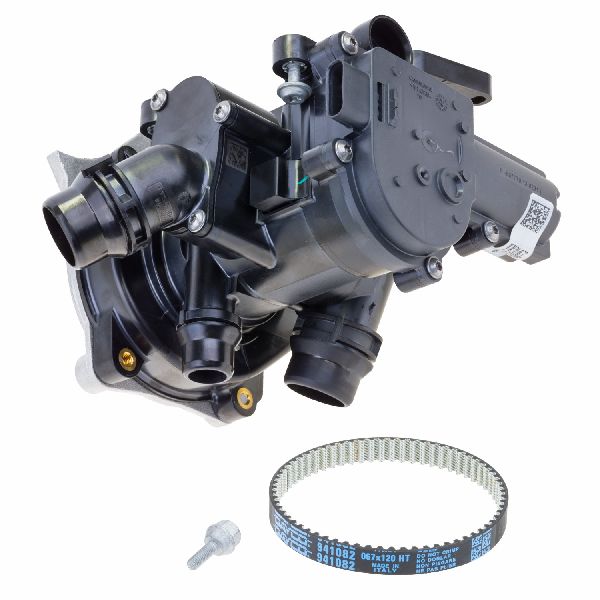
(OEM #06L121111H / 06L121111M / 06L121111P (latest revisions))— This is the root cause of P2181 in the vast majority of cases for the 2016 GTI. The original plastic housing fails, causing leaks or thermostat malfunction. Part numbers have been superseded several times; it is critical to install the latest available revision, 06L121111P.
Trusted brands: Genuine Volkswagen, INA (OEM supplier), Graf (with metal housing, mixed reviews), Vaico
OEM price range: $250-$400
Aftermarket price range: $150-$300 - Intake Manifold Gasket
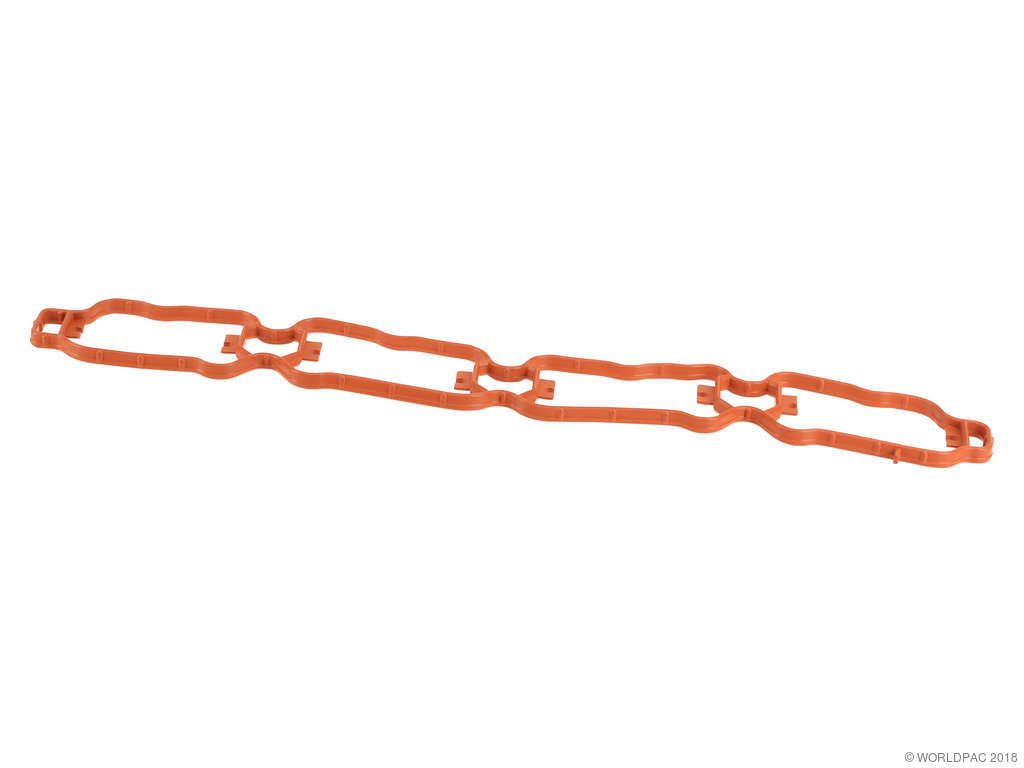
(OEM #06L103483)— The intake manifold must be removed to access the water pump, and the gasket is a single-use item that should always be replaced to prevent vacuum leaks.
Trusted brands: Victor Reinz, Elring, Genuine Volkswagen
OEM price range: $20-$40
Aftermarket price range: $10-$25 - Engine Coolant (G13/G12evo/G12++)
(OEM #G013A8J1G (G13), G12E050A2 (G12evo))— The cooling system must be drained for the repair and refilled with VW-specific coolant to prevent corrosion and damage. G13 is pink/purple, and G12evo is the newer compatible replacement.
Trusted brands: Pentofrost E (G13), Genuine Volkswagen
OEM price range: $25-$35 per gallon
Aftermarket price range: $20-$30 per gallon
Technical Service Bulletins (TSBs) & Recalls
- VIN-4-A-PIN APRI (2016 EQUIPMENT, dated 2016-04-21): Mentions 'MIL ON, FAULT P2181 IN THE ECM' as a known issue for investigation on 2016 models.
- VIN-4-A-PIN APRI (2016 POWER TRAIN, dated 2016-04-13): Also lists 'MIL ON, FAULT P2181 IN THE ECM' among potential customer complaints for this vehicle.
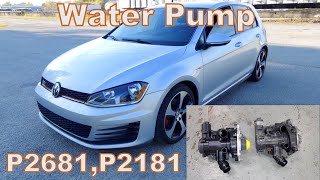
- VW TSB 20-14-03: While for a Passat, this TSB directly addresses DTC P2181 and advises technicians to replace the Coolant Thermostat, confirming the part as the primary failure point 🎬 Watch: A mechanic's guide to fixing P2181 on a 2016 GTI. from the manufacturer's perspective.
Platform-Specific Known Issues
- The primary issue is the OEM water pump/thermostat assembly's plastic construction, which is prone to failure from heat cycles and oil contamination. This is a widely documented problem for the EA888 engine family.
- A class-action lawsuit, *Coffing, et al. v. Volkswagen Group of America, Inc.* (Civ. Action No.: 3:17-cv-01825-JD), led to an extended warranty (8 years/80,000 miles) for this part on many affected vehicles, highlighting the prevalence of the issue. Another relevant case is *Zhao, et al. v. Volkswagen Group of America, Inc.* (Civil Action No. 2:21-cv-11251). Most 2016 models are now outside this warranty period by time.
- While replacing the water pump, it is a common time to perform carbon cleaning on the intake valves, as the intake manifold is already removed.
Mechanic-Grade Diagnostic Values
- Engine Coolant Temperature (ECT) Sensor G62 Resistance — expected: Approx. 1500-2000 Ω at 30°C (86°F); Approx. 275-375 Ω at 80°C (176°F).. Failure: Readings significantly outside these ranges indicate a faulty sensor.
- Freeze Frame Data Coolant Temperature — expected: A plausible warm-up temperature, typically between 68°C and 80°C.. Failure: A stored temperature of -40°C or +140°C strongly suggests an electrical fault (open or short circuit) in the ECT sensor or wiring, not a mechanical thermostat issue.
- Live Data Graph of G62 vs. G83 Sensors (VCDS) — expected: From a cold start, the G62 (engine outlet) temperature should rise steadily first. The G83 (radiator outlet) temperature should remain low and then rise sharply only after the G62 reaches operating temperature (approx. 80-90°C) and the thermostat opens.. Failure: If both G62 and G83 temperatures rise together from a cold start, the thermostat is stuck open, allowing coolant to circulate through the radiator prematurely.
Scan Tool Commands That Help
- VCDS or ODIS: Basic Settings: "Control - cooling circuit air purge" (e.g., IDE08087) — After replacing the water pump/thermostat assembly and refilling coolant. The EA888 Gen3 engine has a complex cooling system with multiple pumps and valves that cannot be bled properly by just idling the engine. This function cycles the pumps and valves to purge trapped air.
- VCDS or ODIS: Basic Settings: "Control - low-temperature circuit air purge" (e.g., IDE04795) — Used in conjunction with the main circuit air purge. This function specifically bleeds the low-temperature side of the cooling system. This step is typically repeated 2-3 times.
- VCDS: Adaptation: "IDE08287-Cooling circuit air purge control" — This adaptation channel must be set to 'Enabled' or 'Active' before running the basic settings for bleeding the cooling circuit. It prepares the system for the purge procedure.
Real Owner Repair Stories
- YouTube user comment on video "2009 vw passat 2.0T TSI thermostat replacement code=P2181" (2009 VW Passat 2.0T TSI (CCTA engine)) — Check Engine Light with code P2181 would appear 10-15 minutes after a cold start, especially when going directly onto the highway. The live data temperature reading (via Torque app) was unstable, ranging from upper 70s°C to 90°C.
❌ Tried (didn't work) Resetting the code with a scan tool; the code would always return.
✅ What actually fixed it Replacing the thermostat assembly. After replacement, the live data temperature became very stable at 97-98°C, and the Check Engine Light did not return for over 3 months. - GOLFMKV.com forum user (2006 MKV GTI (BPY engine)) — Check Engine Light with code P2181.
❌ Tried (didn't work) Replacing the Engine Coolant Temperature (ECT) sensor. The code returned two days later.
✅ What actually fixed it The user concluded from forum research that the thermostat was the actual problem, acknowledging it was a more involved and expensive repair than the ECT sensor.
OEM Part Supersession History
06L121111F, 06L121111G, 06L121111H, 06L121111J, 06L121111K, 06L121111L, 06L121111M→06L121111P— Progressive updates to improve the durability of the plastic housing and thermostat reliability to address the high failure rate.
Heads up: All previous versions are failure-prone and should be replaced with the latest 'P' revision. Using an older revision is not recommended.
Helpful Videos

We Have This Part in Stock


The information in this article is provided for general reference and educational purposes only. Vehicle specifications, procedures, and part compatibility can vary by production date, trim level, and region. Always consult your vehicle's factory service manual and verify part numbers before purchasing or performing repairs. Safety-critical components such as airbags, seat belts, and braking systems should be installed by a qualified professional.
- Volkswagen GTI:
- 🧭 Diagnostic Flowchart
- 🎬 Helpful Videos
- 🛍️ Shop This Part
- What's Unique About the 2016-2016 Volkswagen GTI
- Symptoms You May Notice
- Most Likely Causes
- Diagnosis Steps
- Parts You'll Likely Need
- Technical Service Bulletins (TSBs) & Recalls
- Platform-Specific Known Issues
- Mechanic-Grade Diagnostic Values
- Scan Tool Commands That Help
- Real Owner Repair Stories
- OEM Part Supersession History
- 🎟️ Get 5% Off