

OBD-II Code P2183: Engine Coolant Temperature Sensor 2 Circuit Range/Performance
The Ultimate Guide to Diagnosing and Fixing P2183
- Diagnose P2183 by comparing live data from ECT Sensor #1, ECT Sensor #2, and the IAT sensor on a cold engine; all three must read within 5.4°F (3°C) of each other.
- Check the coolant level first, as a drop of just a few ounces exposes ECT Sensor #2 to air and triggers this code, especially on 2020-2022 Ram EcoDiesel models.
- Do not replace the sensor if codes P2181 or P0128 are also present; these codes confirm a stuck-open thermostat is the actual root cause.
- Search for Technical Service Bulletins (TSBs) before buying parts; software updates fix false P2183 codes on Land Rover and Ram models, while Mazda covers sensor water intrusion under the Federal Emission Warranty.
What Does P2183 Mean?
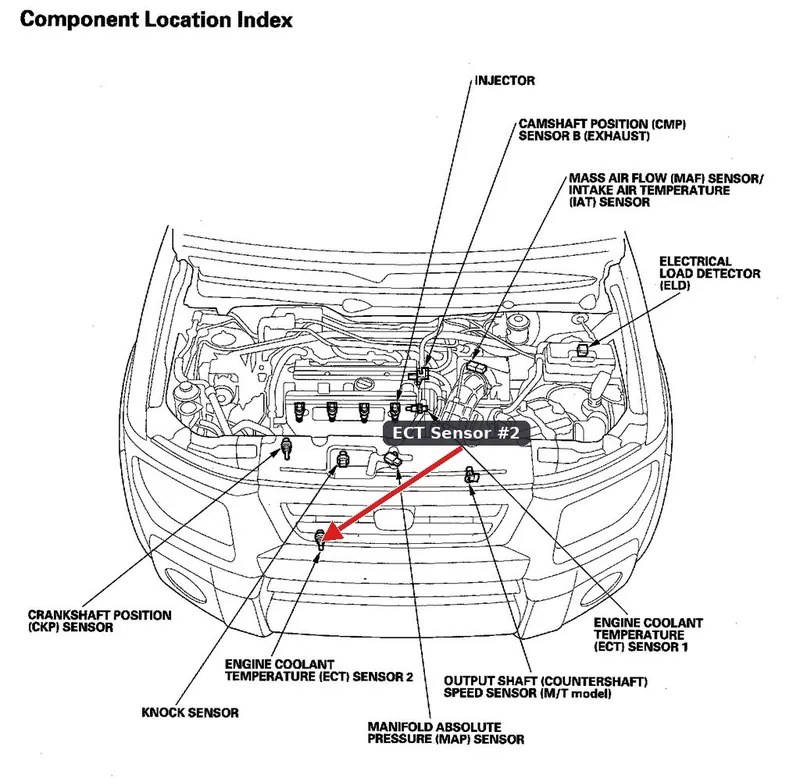
Your car's Powertrain Control Module (PCM) is getting conflicting engine temperature data. It uses two Engine Coolant Temperature (ECT) sensors. Code P2183 means ECT Sensor #2's reading contradicts ECT Sensor #1, especially during a cold start when both must read close to ambient air temperature.
Technical definition: SAE/OBD-II defines P2183 as "Engine Coolant Temperature Sensor 2 Circuit Range/Performance". The PCM detects the voltage signal from the #2 ECT sensor is outside its expected range or fails to correlate with the #1 ECT sensor. The PCM performs this check on a cold start by comparing ECT #1, ECT #2, and the Intake Air Temperature (IAT) sensor; all three must be within 5.4°F (3°C) of each other.
Can I Drive With P2183?
Yes, But With Caution. Short trips are safe if the temperature gauge is stable. Ignoring the code causes a failed emissions test and reduces fuel economy. If the underlying issue prevents cooling fans from activating, prolonged driving risks catastrophic engine overheating. A flashing check engine light signals extreme coolant temperatures; pull over immediately and tow the vehicle to a repair shop.
Common Causes

- Faulty Engine Coolant Temperature (ECT) Sensor #2 (Very Common) — The sensor fails internally, its resistance drifts, or water intrusion 🎬 Watch: Three simple DIY methods to fix code P2183. corrodes the connector. Mazda issued a specific TSB for water intrusion causing this exact failure.
- Stuck-Open Thermostat (Common) — A stuck-open thermostat prevents the engine coolant from warming up at the expected rate. ECT #1 (engine) warms up while ECT #2 (radiator) stays cool for too long, triggering the correlation mismatch.
- Low Coolant Level or Air Pockets (Common) — Low coolant or trapped air pockets leave the sensors unsubmerged, causing inaccurate readings. Ram 3.0L EcoDiesel engines are highly sensitive to even slightly low coolant levels.
- Wiring Harness or Connector Damage (Common) — Corrosion on the pins, a loose connection, a broken wire, or a short circuit alters the voltage signal the PCM receives from ECT Sensor #2.
- PCM Software Calibration Error (Less Common) — The PCM's software logic is overly sensitive on specific Land Rover and Ram models, triggering a false P2183 code. A dealer-installed software update fixes this calibration issue.
- Uneven Heating from Engine Block Heater (Less Common) — Using a block heater pre-heats the engine coolant (ECT #1) but not the radiator coolant (ECT #2). At startup, the PCM sees an instant temperature gap and flags the code. Software updates exist to correct this.
- Incorrect Coolant Concentration (Uncommon) — Using the wrong coolant type or an improper water-to-coolant ratio changes the fluid's thermal properties, causing the engine to warm up at an unexpected rate.
- Faulty Cooling Fan Control Module (Uncommon) — A malfunctioning module causes cooling fans to run constantly, over-cooling the radiator and creating a massive temperature difference between ECT #1 and ECT #2.
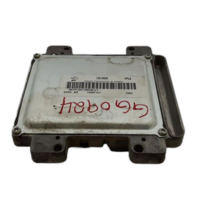
- Faulty Powertrain Control Module (PCM) (Rare) — The PCM misinterprets a perfectly good signal due to an internal fault in its analog-to-digital converter or reference voltage circuit.
Symptoms
- Check Engine Light is On — This is the first and often only symptom you notice.
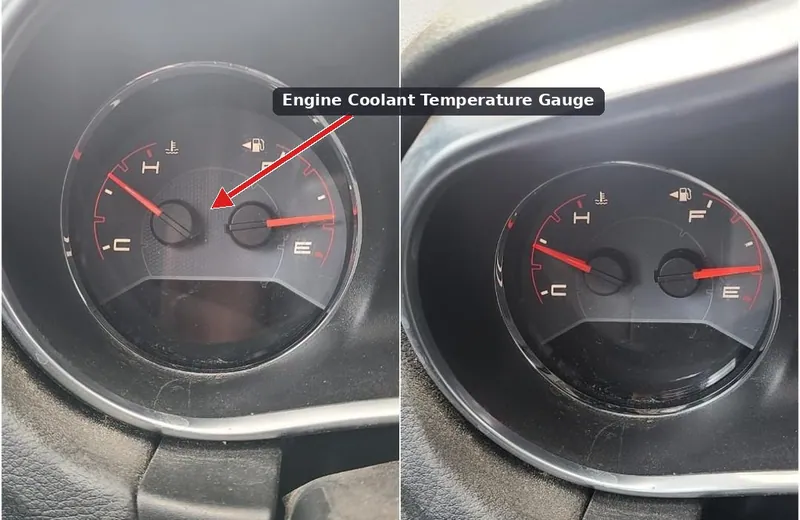
- Erratic Temperature Gauge — The dashboard temperature gauge jumps between hot and cold, gets stuck, or reads inaccurately.
- Engine Overheating or Poor Cabin Heater Performance — A faulty sensor prevents cooling fans from activating, causing overheating. Conversely, a stuck-open thermostat prevents the cabin heater from blowing hot air.
- Remote Start Disabled — The PCM disables convenience features like remote start when P2183 is active, a confirmed safety feature on Ram trucks.
- Reduced Fuel Economy — The vehicle burns more fuel because the PCM commands a rich fuel mixture to compensate for incorrect temperature data.
- Rough Idle or Stalling — The engine runs unevenly or stalls during warm-up as the PCM struggles with conflicting temperature inputs.
Diagnostic Flowchart
Tap your situation to follow the diagnostic path that matches what you're seeing on this code.
Common Fixes & Costs
- Replace Engine Coolant Temperature (ECT) Sensor #2 — Parts: $20-$80, Labor: $80-$200, ~0.5 hr book time (DIY)
- Replace the Thermostat — Parts: $30-$150, Labor: $150-$600, ~2.5 hr book time (Intermediate)
- Perform a Coolant System Flush and Refill — Parts: $30-$70, Labor: $120-$250, ~1.5 hr book time (DIY)
- Repair Wiring or Connector — Parts: $10-$50, Labor: $120-$300, ~1.5 hr book time (Intermediate)
- Update Powertrain Control Module (PCM) Software — Parts: $0, Labor: $120-$250, ~1 hr book time (Dealership)
Used vs. New Parts: Buying Guide
When a used part is worth it: Never buy a used ECT sensor; the cost savings are minimal and failure modes are invisible. A used OEM thermostat is acceptable only if budget is the absolute primary concern.
Donor-vehicle mileage cap: roughly under 50000 miles for the part to have meaningful remaining life.
Donor quality checklist:
- Verify the part number exactly.
- Avoid thermostats from vehicles in regions with harsh climates.
Decision logic:
- If The part is an electronic sensor (ECT sensor) → Always buy new. The risk of getting a faulty part is too high.
- If The part is a thermostat and the vehicle is >10 years old → Buy a new aftermarket or OEM thermostat. The original is near the end of its service life.
Warranty tradeoff: Used parts have a 30-90 day warranty. New aftermarket parts carry a 1-year to limited lifetime warranty.
Worst-case if a used part fails: $200-$800 if a used thermostat fails, requiring repeat labor.
What Happens If You Wait — Timeline
- 0-1 month: Code P2183 sets, Check Engine Light illuminates. Remote start is disabled. Vehicle fails emissions testing. (MPG impact: 0-5%% · Added cost: $0-25 in wasted fuel.)
- 1-4 months: If caused by a stuck-open thermostat, the engine runs too cool. The PCM stays in 'open loop' mode, running a rich fuel mixture. Heater performance drops. (MPG impact: 5-10%% · Added cost: $50-150 in wasted fuel and increased engine wear.)
- 4-12 months: Prolonged rich running contaminates engine oil with unburnt fuel. Carbon deposits build up on spark plugs and oxygen sensors. (MPG impact: 7-15%% · Added cost: $200-500 for potential O2 sensor replacement and fuel waste.)
- 12+ months: If cooling fans fail to activate, catastrophic engine overheating occurs. Long-term rich conditions permanently destroy the catalytic converter. (MPG impact: 10-20%% · Added cost: $1200-$3500 for catalytic converter replacement or $3000+ for engine damage.)
Cost of Not Fixing It
- 0-1 month: Guaranteed failure of an emissions test and a 5-10% drop in fuel economy as the engine runs rich. (Added cost: $20-$50 per month in wasted fuel.)
- 1-6 months: Increased engine wear due to improper fuel mixture. Oil contamination occurs as unburnt fuel bypasses piston rings. (Added cost: Contributes to reduced engine life.)
- 6+ months: A stuck-open thermostat destroys the catalytic converter. Failed cooling fans cause catastrophic engine overheating. (Added cost: $1200-$3500 for catalytic converter replacement; $3000+ for engine damage.)
Diagnosis Steps
- Check for Other Trouble Codes & TSBs
Read all stored codes. Codes like P2181 or P0128 point directly to a stuck thermostat. Check for Technical Service Bulletins (TSBs) for your specific vehicle, as a software update is a common fix.
Tools: ['OBD-II Scanner'] - Inspect Coolant Level and Condition
With the engine cold, verify the coolant level in the reservoir and radiator. Low coolant exposes the sensor to air, causing this code. Ensure the coolant is clean and at the maximum fill line.
Tools: ['Flashlight', 'Rag'] - Compare Live Sensor Data on a Cold Engine (Pro Tip)
After the vehicle sits overnight, use a scanner with live data. Compare ECT Sensor #1, ECT Sensor #2, and the Intake Air Temperature (IAT) sensor. All three must read within 5.4°F (3°C) of each other. The sensor reading significantly different from ambient temperature is the faulty component.
Tools: ['OBD-II Scanner with Live Data'] - Visually Inspect the Sensor and Wiring
Locate ECT Sensor #2 (usually on the radiator outlet hose). Inspect for cracked wires, loose connections, green corrosion on the pins, or coolant leaks.
Tools: ['Flashlight'] - Test for a Stuck Thermostat via Live Data
Start the cold engine and monitor both ECT sensors. ECT #1 rises steadily. ECT #2 must stay cool until the engine reaches operating temp (195°F), then jump up as the thermostat opens. If ECT #2 warms up gradually alongside ECT #1 from the start, the thermostat is stuck open.
Tools: ['OBD-II Scanner with Live Data'] - Test the Sensor Circuit Voltage
Unplug the sensor. Turn the key 'ON' (engine off). Test the harness connector. One wire must have a 5-volt reference signal from the PCM; the other is ground. Missing 5V indicates a wiring or PCM failure.
Tools: ['Multimeter', 'Back-probe pins'] - Test the ECT Sensor's Resistance
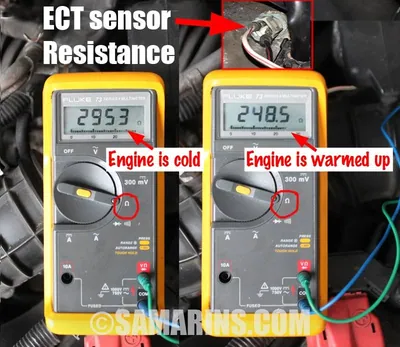
Disconnect the sensor and measure resistance across its terminals. Compare to the manufacturer's chart. A typical sensor reads 2,000-3,500 ohms at 68°F (20°C). An infinite (Open Loop) or near-zero reading confirms a dead sensor.
Tools: ['Multimeter'] - Perform a Coolant System Pressure Test
Pressurize the cooling system to check for leaks. Slow leaks introduce air pockets over time, causing erratic sensor readings. This is mandatory if the coolant level was low in Step 2.
Tools: ['Coolant System Pressure Tester'] - Advanced Resistance-to-Temperature Curve Test
Remove the sensor. Submerge the tip in water with a thermometer. Measure resistance while heating the water. Compare readings at 20°F intervals to a known-good chart. Significant deviation confirms a faulty sensor.
Tools: ['Multimeter', 'Thermometer', 'Water container', 'Heat source'] (Advanced)
When This Code Triggers (Freeze-Frame Conditions)
- Engine Coolant Temp: varies (The fault sets during a cold start after the vehicle sits for 6-8 hours, when ECT1, ECT2, and IAT must be identical.)
- RPM: 0 (pre-start) or Idle (700-900) (The PCM performs the rationality check immediately upon ignition.)
- Engine Load: < 25% (The code sets under no-load or very low-load conditions during the initial warm-up phase.)
- Vehicle Speed: 0 mph (The sensor comparison occurs before the vehicle is driven.)
Related Codes
- P2181 — Indicates the engine is not reaching operating temperature within a specified time. If present with P2183, diagnose the stuck-open thermostat first.
- P0117 — Indicates a direct electrical fault where the sensor's signal wire is shorted to ground, unlike P2183 which is a logic/correlation fault.
- P0118 — Indicates an electrical fault where the signal voltage is too high, caused by an unplugged sensor or broken wire.
- P0128 — Triggered when the PCM determines the engine hasn't reached its required temperature. If present with P2183, the thermostat is the root cause.
Climate & Environmental Factors
- Cold Climates / Block Heater Use: Using an engine block heater triggers a false P2183 code at startup. The heater warms the engine block (ECT1) but leaves the radiator coolant cold (ECT2). The PCM flags this instantaneous temperature difference. TSBs exist for Ram and Land Rover models to recalibrate the PCM.
- High Humidity / Water Exposure: Moisture penetrates poorly sealed sensor connectors, causing pin corrosion. This increases resistance and leads to false low-temperature readings, the specific cause identified in Mazda TSB #01-011-17-3364a.
How to Talk to a Mechanic About This Code
Say this: "I have an OBD-II code P2183. Please start by checking the coolant level and comparing the live data from ECT Sensor 1, ECT Sensor 2, and the Intake Air Temp sensor on a cold start. Also, check if there are any Technical Service Bulletins for this issue on my vehicle before replacing parts."
This signals you understand the correct diagnostic procedure. It steers the technician away from guessing and toward a logical, evidence-based diagnosis. Mentioning TSBs is crucial, as software updates are a common fix.
Avoid saying:
- 'My check engine light is on, can you look at it?'
- 'The code is P2183, just replace the sensor.'
- 'Just fix whatever is wrong.'
Questions to ask before authorizing the repair:
- What were the temperature readings from both ECT sensors and the IAT sensor on the cold engine?
- If recommending a thermostat replacement, what did the live data show that points to it being stuck open?
- Did you inspect the wiring and connector for corrosion or damage first?
- Did you check for any available PCM software updates from the manufacturer?
Where to Take It: Dealer vs Independent vs Chain
- Dealer:
Best for: Vehicles where a software update (TSB) is a known fix (Ram, Land Rover)., Vehicles under a powertrain or emissions warranty., Complex models with integrated thermal management modules (Hyundai/Kia).
Downsides: Highest labor rates, typically 1.5-2x more than independent shops., Recommends large, expensive assembly replacements when a smaller component fails. (Typical cost: +50% vs. baseline) - Independent Shop:
Best fit for straightforward sensor or thermostat replacements. If your vehicle has a TSB for a software fix, you must go to a dealer.
Best for: Out-of-warranty vehicles., Common failures like a bad sensor or stuck thermostat on well-known models., Cost-conscious owners with a trusted local mechanic.
Downsides: Diagnostic capability varies widely., Lacks access to proprietary software for required PCM updates. (Typical cost: +0% vs. baseline) - Chain Shop:
Use with caution. Acceptable for a simple sensor swap, but risky for comprehensive diagnostics.
Best for: Simple, clear-cut repairs like a sensor replacement where access is easy.
Downsides: Technician skill varies dramatically., Lacks advanced diagnostic tools to differentiate between a sensor, thermostat, or wiring issue., High pressure to upsell unnecessary services. (Typical cost: -10% vs. baseline)
When to Walk Away From the Repair
If the estimated repair cost exceeds 40-50% of the car's private-party value, pause and consider if the investment is worthwhile.
- Car worth $4000, fix is $800: Fix it. The repair cost is 20% of the car's value.
- Car worth $12000, fix is $900: Fix it. This is a minor repair cost compared to the vehicle's value.
- Car worth $2500, fix is $1500: Walk away. The repair cost is 60% of the car's value. It is not financially sensible.
What Scan Tool You Need for This Code
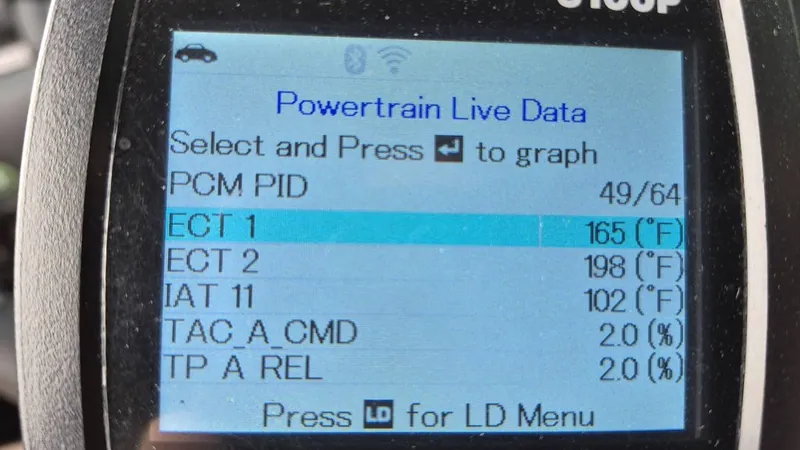
Minimum: A scanner that reads and graphs live data streams for multiple sensors simultaneously. A basic code reader is insufficient.
You must compare live temperature readings from ECT Sensor #1, ECT Sensor #2, and the IAT sensor. A $20 reader hides this data, forcing you to guess and waste money on parts.
Budget: BlueDriver Pro or Ancel BD310 (~$60-120) — Connects to your smartphone and provides excellent live data streaming and graphing to compare sensor readings on a cold start.
Mid-range: Foxwell NT604 Elite or ThinkScan 662 (~$140-200) — Offers robust live data and graphing with a traditional, faster interface without relying on a phone.
Professional: Autel MaxiCOM MK808S or Innova 5610 (~$350-500) — Provides full system diagnostics and bidirectional controls to actively test cooling fans, offering a complete diagnostic picture.
Rent vs buy: For a one-time diagnosis, borrow a live-data scanner from an auto parts store loaner program. Buy a scanner only if you perform diagnostics multiple times a year.
How to Clear the Code After You Fix It
- Use an OBD-II scan tool to clear the P2183 code.
- Perform a complete OBD-II drive cycle to ensure the fault does not return and to set readiness monitors.
Drive cycle (~30 minutes): A generic drive cycle involves a cold start (engine off for 8+ hours), idling for 3 minutes, followed by mixed city and highway driving, including steady 55 mph cruising for 5 minutes.
Readiness monitors affected: Catalyst Monitor, Evaporative System Monitor, Oxygen Sensor Monitor
Before emissions retest: drive at least 100 miles to fully set monitors.
Watch out for:
- Clearing the code without fixing the underlying issue guarantees the code returns.
- Disconnecting the battery erases all OBD-II readiness monitors, causing an automatic emissions test failure until reset through driving.
Will This Fail Emissions / State Inspection?
Yes — this code typically fails an OBD-II emissions inspection.
- California: An illuminated Check Engine Light results in an automatic failure. A full drive cycle must be completed to set all readiness monitors before a re-test.
- New York: The presence of code P2183 causes an automatic failure. The code must be cleared and readiness monitors set to 'Ready' to pass.
- Texas: Vehicles with an active P2183 code fail the OBD-II portion of the inspection.
Most Commonly Affected Vehicles
- Honda Accord, Civic, CR-V, Element (2001-2011) — ECT Sensor #2, located on the bottom of the radiator, is a very common failure part. OEM part is 37870-RTA-005.
- Hyundai / Kia Elantra, Sonata, Tucson, Sportage (2017-2023) — Often related to a faulty thermostat or the integrated thermal management module. TSB SA463 addresses ECM logic updates for this issue on 2020-2021 models.
- Land Rover LR4, Range Rover Sport (2014-2015) — A software glitch in the PCM is a frequent cause on 3.0L V6 models. A dealer software update is required per TSB LTB00759NAS1.
- Audi/Volkswagen A4, Q5, Jetta, Golf (2008-2016) — Usually caused by a failed ECT sensor (G83) on the lower radiator hose or a stuck thermostat.
- Ford C-MAX Energi (2013-2017) — TSB SSM 47347 points to incorrectly installed coolant hoses at the lower bulkhead as a primary cause. Check hose routing before replacing parts.
- Ram 1500 (3.0L EcoDiesel) (2020-2022) — Highly susceptible to P2183 from slightly low coolant levels or block heater use. A PCM software update per TSB #18-002-23 is often required.
- Mazda Mazda3 (2014-2017) — TSB #01-011-17-3364a specifies replacing ECT Sensor #2 with an improved part (PE18-18-840) due to water intrusion. Covered under Federal Emission Warranty.
- BMW 3-Series (E90, E92), X3, X5 (2006-2013) — Often appears after a water pump or thermostat replacement. Using OEM sensors is highly recommended as aftermarket versions are poorly calibrated.
- Chevrolet Cruze, Sonic (2011-2016) — Known for cooling system issues, including faulty thermostats and sensors. The thermostat housing is a common failure point.
Manufacturer-Specific Notes
- Hyundai / Kia: The thermostat is part of an electronically controlled 'Integrated Thermal Management Module'. If the thermostat fails, the entire expensive assembly requires replacement.
- Land Rover: A software calibration error in the PCM falsely triggers P2183 on 3.0L V6 models. A dealer-installed software update is the required fix.
- Ford: On the C-MAX Energi hybrid, a common cause is coolant hoses being swapped at the bulkhead during previous service.
- Ram (EcoDiesel): Using an engine block heater causes a false P2183 code on startup due to uneven coolant heating. TSB #18-002-23 provides a software update to correct this.
- Mazda: Water intrusion into the original ECT Sensor #2 is the primary cause. This repair is often covered under the Federal Emission Warranty.
Real Owner Stories
2021 Ram 1500 EcoDiesel with P2183
The Check Engine Light illuminated and remote start failed in 10°F weather after using the block heater. The coolant tank was slightly low.
What they tried:
- Scanned the code, confirming P2183.
- Replaced the ECT sensor on the water pump.
- Topped off the coolant with the correct Mopar 50/50 mix.
Outcome: Topping off the coolant and replacing the sensor cleared the code permanently. Remote start functionality returned immediately.
Lesson: On Ram EcoDiesel trucks, check the coolant level first. The system is highly sensitive; a low level exposes ECT Sensor #2, causing a false reading. Block heater usage also triggers false codes fixable via PCM updates.
2016 Mazda 3 with P2183 and P0126
The Check Engine Light appeared immediately after installing an aftermarket air intake. The coolant level was perfect.
What they tried:
- Scanned codes P2183 and P0126.
- Questioned if the new intake caused the issue.
Outcome: Forum experts pointed to TSB #01-011-17-3364a for water intrusion in ECT Sensor #2. The owner replaced the sensor with the updated OEM part, resolving both codes.
Lesson: Do not blame recent modifications for unrelated codes. For 2014-2017 Mazda3s, P2183 is almost exclusively caused by a faulty ECT Sensor #2 due to water intrusion. Replace it with the updated part first.
2006 Honda Civic with P2183 and communication codes
A scan revealed primary code P2183 alongside communication codes U0155 and U0028.
What they tried:
- Posted the scan results online asking for diagnostic direction.
Outcome: Mechanics advised ignoring the 'U' codes, explaining they are secondary effects of the primary sensor fault. Diagnosing and replacing the faulty ECT sensor resolved all codes.
Lesson: Ignore secondary communication ('U') codes when a primary sensor ('P') code is present. Address the direct, plausible cause first.
How to Prevent This Code From Triggering
- Perform coolant flushes at manufacturer-recommended intervals. (Every 30,000 to 100,000 miles.) — Removes contaminants and scale that clog radiators and cause thermostats to stick. Replenishes corrosion inhibitors.
- Use only the manufacturer-specified coolant type and concentration. (Every time coolant is added or changed.) — Mixing coolant types causes gelling. Plain water introduces minerals that cause scale buildup and lowers the boiling point.
- Inspect coolant hoses and the radiator cap. (During every oil change.) — A weak radiator cap fails to hold pressure, lowering the coolant's boiling point and creating air pockets.
- Apply dielectric grease to sensor connectors. (During any sensor replacement.) — Seals out moisture and oxygen, preventing the pin corrosion that causes sensor circuit faults.
- Allow the engine to idle for 30-60 seconds before shutting down after a hard drive. (Daily habit.) — Prevents 'heat soak,' where coolant stops circulating but engine temperatures continue to rise, stressing plastic components.
Frequently Asked Questions
What is ECT Sensor #2 and where is it?
ECT Sensor #2 is a secondary engine coolant temperature sensor. It is most often located in the lower radiator hose or on the radiator outlet tank. It measures the temperature of the coolant after it has been cooled by the radiator.
What are the most common misdiagnosis mistakes for P2183?
A common mistake is immediately replacing ECT Sensor #2 without checking for a stuck thermostat. Another pitfall is clearing codes before checking the 'freeze frame' data to see engine conditions when the fault occurred. Always verify coolant levels and wiring integrity before buying parts.
Can I just replace the sensor to fix P2183?
Replacing the sensor fixes the issue if the sensor itself failed, but it is not a guaranteed cure. The root cause is often a stuck thermostat, damaged wiring, low coolant, or a PCM software glitch. Perform a cold-start live data comparison before replacing any components.
My remote start stopped working after the P2183 code appeared. Is that related?
Yes, many modern vehicles disable non-essential features like remote start when an active powertrain fault code is stored. Ram TSB #S2218000009 confirms P2183 disables remote start on specific trucks. Restoring the function requires fixing the root cause and clearing the code.
What happens if I ignore the P2183 code?
Ignoring P2183 guarantees a failed emissions test and reduces fuel economy by up to 10%. If the underlying cause prevents cooling fans from activating, the engine will overheat and suffer catastrophic damage. Fix the code promptly to avoid thousands in secondary repair costs.
My P2183 code appeared right after a thermostat replacement. What happened?
An air pocket trapped in the cooling system during the refill process is the most likely culprit; the system requires proper 'burping'. Alternatively, the new thermostat is faulty out of the box, or an incorrectly calibrated aftermarket sensor was installed.
What temperature should ECT sensor #2 read?
On a cold engine, ECT #2 must read within 5.4°F of the ambient air temperature and ECT #1. While driving, it reads lower than ECT #1 until the thermostat opens. Once the system stabilizes, ECT #2 typically reads 10-30°F cooler than ECT #1.
Does a flashing check engine light with P2183 mean it's serious?
Yes, a flashing check engine light indicates a severe condition that causes immediate engine or catalytic converter damage. With P2183, the PCM has detected extreme overheating risks. Pull over safely, turn off the engine, and tow the vehicle to a shop.
How do I clear the P2183 code?
Clear the code using an OBD-II scanner after completing the repair. Disconnecting the battery for 30 minutes also clears it but resets all readiness monitors, causing an automatic emissions test failure. Drive a complete OBD-II drive cycle to verify the fix.
Key Takeaways
- Diagnose P2183 by comparing live data from ECT Sensor #1, ECT Sensor #2, and the IAT sensor on a cold engine; all three must read within 5.4°F (3°C) of each other.
- Check the coolant level first, as a drop of just a few ounces exposes ECT Sensor #2 to air and triggers this code, especially on 2020-2022 Ram EcoDiesel models.
- Do not replace the sensor if codes P2181 or P0128 are also present; these codes confirm a stuck-open thermostat is the actual root cause.
- Search for Technical Service Bulletins (TSBs) before buying parts; software updates fix false P2183 codes on Land Rover and Ram models, while Mazda covers sensor water intrusion under the Federal Emission Warranty.
Helpful Videos
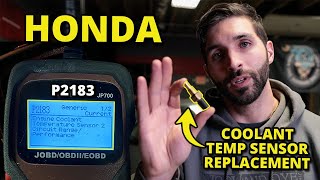
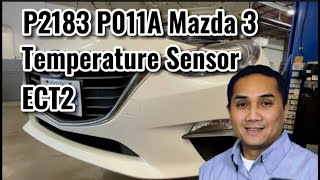
![How to Fix P2183 Engine Code in 4 Minutes [3 DIY Methods / Only $7.38]](https://img.youtube.com/vi/q-ErQPuWngI/mqdefault.jpg)
Shop the Parts Behind P2183
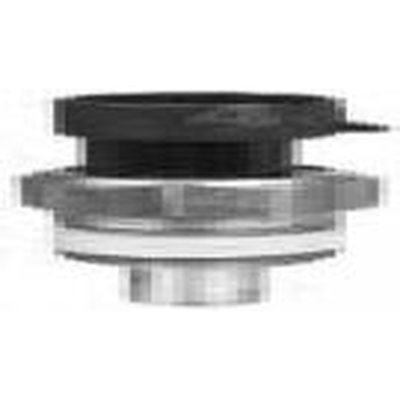
Below are the parts most often responsible for code P2183, ranked by how frequently each one is the actual culprit (per the diagnosis above). Tap any to see what we have for your vehicle.


The information in this article is provided for general reference and educational purposes only. Vehicle specifications, procedures, and part compatibility can vary by production date, trim level, and region. Always consult your vehicle's factory service manual and verify part numbers before purchasing or performing repairs. Safety-critical components such as airbags, seat belts, and braking systems should be installed by a qualified professional.
- 🧭 Diagnostic Flowchart
- 🎬 Helpful Videos
- 🛍️ Shop This Part
- What Does P2183 Mean?
- Can I Drive With P2183?
- Common Causes
- Symptoms
- Common Fixes & Costs
- Used vs. New Parts: Buying Guide
- What Happens If You Wait — Timeline
- Cost of Not Fixing It
- Diagnosis Steps
- When This Code Triggers (Freeze-Frame Conditions)
- Related Codes
- Climate & Environmental Factors
- How to Talk to a Mechanic About This Code
- Where to Take It: Dealer vs Independent vs Chain
- When to Walk Away From the Repair
- What Scan Tool You Need for This Code
- How to Clear the Code After You Fix It
- Will This Fail Emissions / State Inspection?
- Most Commonly Affected Vehicles
- Manufacturer-Specific Notes
- Real Owner Stories
- 2021 Ram 1500 EcoDiesel with P2183
- 2016 Mazda 3 with P2183 and P0126
- 2006 Honda Civic with P2183 and communication codes
- How to Prevent This Code From Triggering
- Frequently Asked Questions
- What is ECT Sensor #2 and where is it?
- What are the most common misdiagnosis mistakes for P2183?
- Can I just replace the sensor to fix P2183?
- My remote start stopped working after the P2183 code appeared. Is that related?
- What happens if I ignore the P2183 code?
- My P2183 code appeared right after a thermostat replacement. What happened?
- What temperature should ECT sensor #2 read?
- Does a flashing check engine light with P2183 mean it's serious?
- How do I clear the P2183 code?
- Key Takeaways
- 🎟️ Get 5% Off