

P2183 on 2013-2017 Ford C-MAX ENERGI: Causes and Fixes for Coolant Sensor Faults
On a 2013-2017 C-MAX Energi, code P2183 is most often caused by incorrectly installed coolant hoses at the lower bulkhead, per Ford TSB SSM 47347. Before replacing any parts, inspect the hose routing. If hoses are correct, the next most likely causes are low coolant or a faulty ECT Sensor #2, which provides a rationality check for the main cooling system.
- For the 2013-2017 C-MAX Energi, the first step for P2183 is to check the coolant hoses at the lower bulkhead to ensure they are not swapped, as per TSB SSM 47347.
- If the hoses are correct, check the coolant level in both the engine and hybrid inverter reservoirs. Low coolant is the next most likely cause.
- Only after confirming hose routing and coolant level should you consider replacing the ECT Sensor #2.
- Always use the specified Motorcraft Orange Prediluted Coolant (or an equivalent meeting spec WSS-M97B44-D2) for top-offs or refills.
What's Unique About the 2013-2017 Ford C-MAX ENERGI
The Ford C-MAX Energi is a Plug-in Hybrid (PHEV) with a more complex cooling system than a standard gasoline car, featuring separate loops for the engine and the high-voltage battery electronics. This complexity is central to code P2183. Ford issued a Technical Service Bulletin (SSM 47347) specifically for this vehicle (and its platform mates), noting that coolant hoses at the lower bulkhead are often installed incorrectly, causing this exact code. The two hoses share identical female connectors, making them easy to swap during service. This mechanical fault is far more common on this platform than an actual sensor failure.
Diagnostic Flowchart
Tap your situation to follow the diagnostic path that matches what you're seeing on this vehicle.
Symptoms You May Notice
- Check Engine Light is on
- Overheating warning light or message on the dashboard
- Temperature gauge behaving erratically or reading incorrectly
- Reduced fuel economy
- Engine may idle roughly
- Vehicle may enter a reduced-power 'limp mode'
- Inability to enter or sustain EV (electric vehicle) mode
- Replacing ECT Sensor #2 without first checking for the swapped coolant hoses per TSB SSM 47347.
- Replacing the wrong temperature sensor (e.g., the main ECT sensor #1 on the cylinder head instead of the #2 sensor on the heater hose).
- Unnecessarily replacing the thermostat when the issue is sensor or wiring related.
Most Likely Causes
- Incorrectly Installed Coolant Hoses 🔴 High Probability This is a documented issue specific to the C-MAX PHEV and its platform mates, as stated in Ford TSB #SSM 47347. The complex routing of hoses for the engine and hybrid system cooling loops makes them easy to swap during service, especially at the lower bulkhead where two hoses have identical connectors.
How to confirm: Visually inspect the two coolant hoses at the lower bulkhead connections, located deep on the firewall side of the engine bay. Compare their routing to the official Ford service manual diagram to ensure they are not crossed. This is the first check that should be performed.
Typical fix: Correct the hose positions and ensure they are securely connected. Top off coolant if any was lost during the process. Clear the code and perform a cold start to verify the fix.
Est. part cost: $0 - Low Coolant Level or Air in the System 🟡 Medium Probability A slow leak can cause the coolant level to drop, introducing air into the system. This causes erratic temperature readings as sensors are exposed to air pockets instead of fluid. One owner with both P2183 and P2601 found the cause was a loose upper radiator hose clamp that was not properly secured after a transmission swap, leading to a slow leak.
How to confirm: Check the coolant levels in both the engine (MEG) and electronics (PEG) coolant reservoirs when the vehicle is cold. Look for signs of coolant leaks (white, orange, or yellow residue) around hoses, the radiator, and water pump. Using a UV dye in the coolant can help pinpoint slow leaks.
Typical fix: Find and repair the source of the leak. Refill the system with the correct coolant (Ford Spec WSS-M97B44-D2 or the newer WSS-M97B57-A2) and properly bleed it to remove all air, which is a critical procedure on these hybrid systems. 🎬 Watch: How to properly drain and bleed the cooling system.
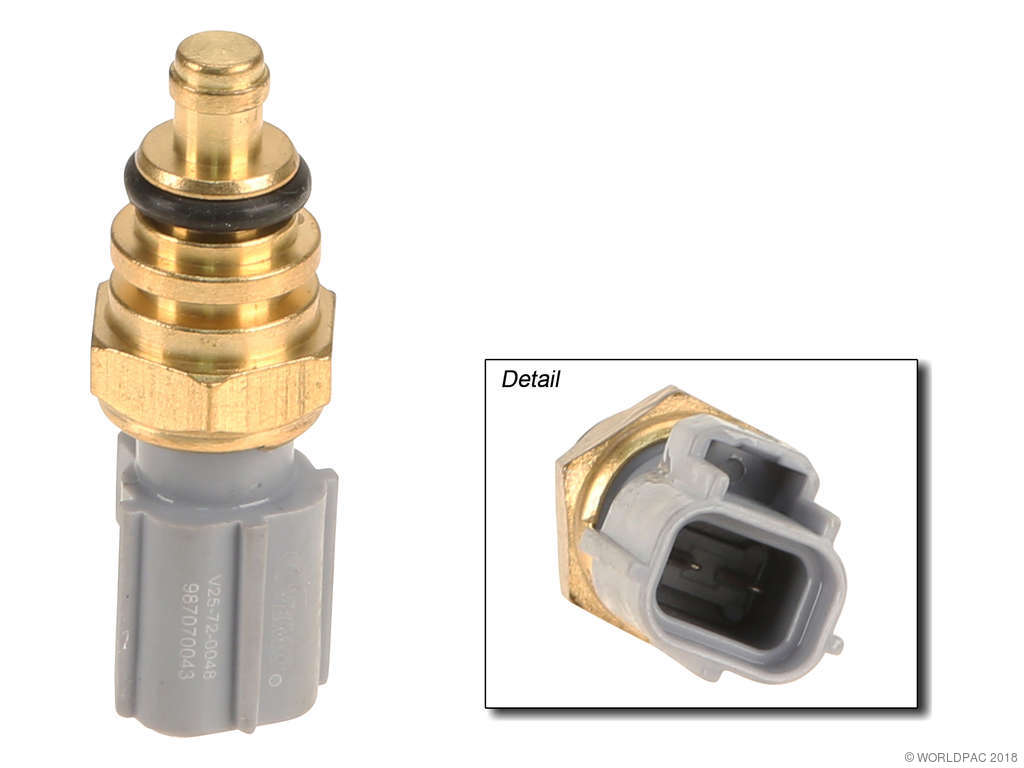
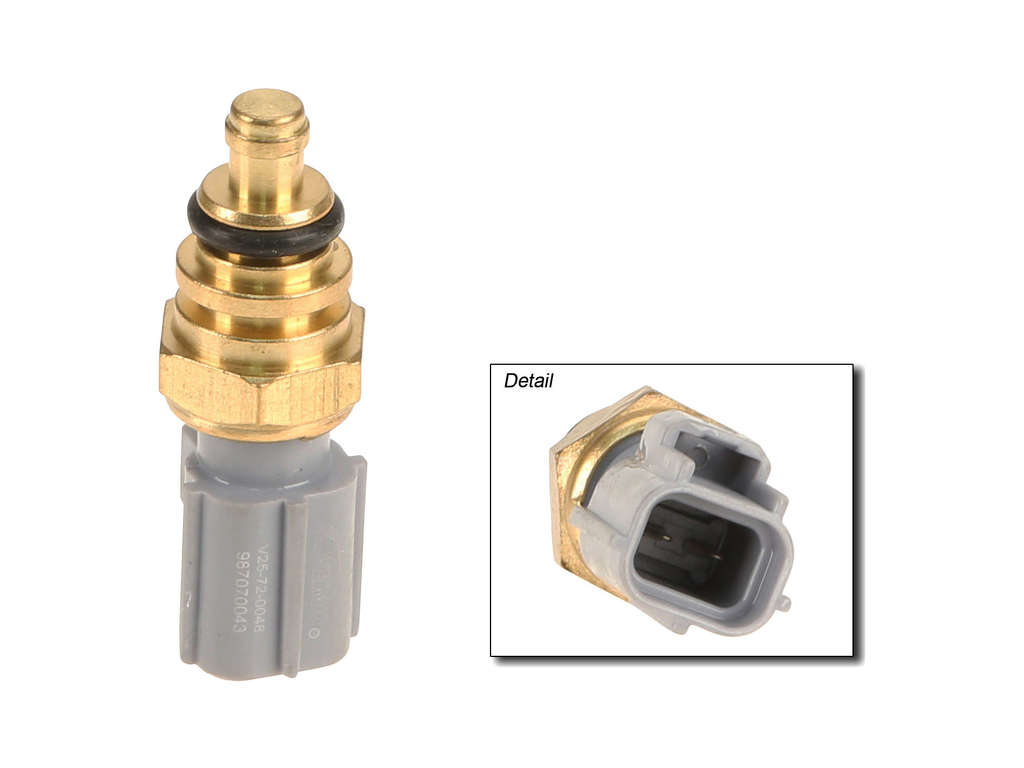
Est. part cost: $25-$40 for coolant - Faulty Engine Coolant Temperature (ECT) Sensor #2 🟡 Medium Probability → Shop Engine Coolant Temperature Sensor
How to confirm: Use an OBD-II scanner to monitor live data from ECT1 and ECT2. On a cold engine, they should read within a few degrees of each other and the ambient air temp. If ECT2 is stuck or reads illogically as the engine warms up (and hoses/coolant level are confirmed correct), the sensor is likely bad. You can also test the sensor's resistance with a multimeter; at 68°F (20°C), resistance should be between 2,000 and 3,000 ohms.
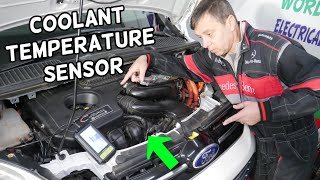
Typical fix: Replace the ECT #2 sensor. On the C-MAX Energi (PHEV), it is located on the right side of the engine 🎬 See this video to find the exact sensor location. in the coolant tubing that goes towards the heater core. The sensor is held in by a clip.
Est. part cost: $25-$70 - Wiring or Connector Issue ⚪ Low Probability
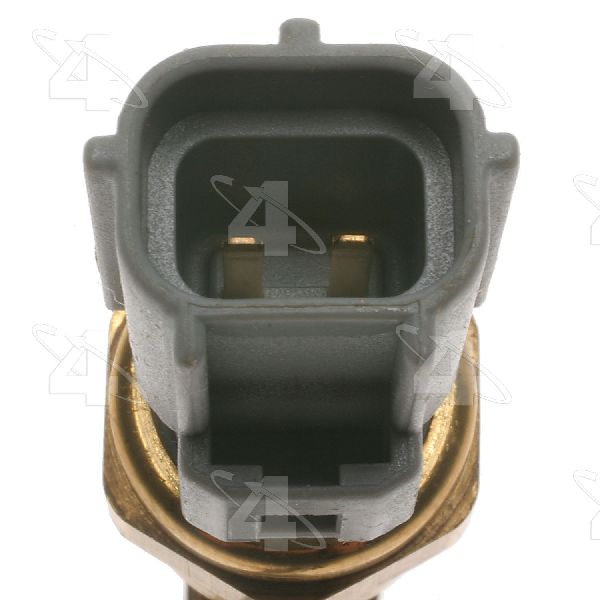
How to confirm: Visually inspect the wiring harness and connector for ECT Sensor #2 for any signs of damage, corrosion, or loose pins. The connector is often a grey, 2-pin connector. Use a multimeter to check for proper voltage and ground at the connector. The sensor signal wire runs to the PCM connector C175B.
Typical fix: Repair the damaged wire or clean/replace the connector pigtail.
Est. part cost: $15-$50
Rare But Worth Checking
- Stuck Thermostat: → Shop Integrated Thermostat Housing Assembly A thermostat stuck open can cause the engine to warm up too slowly, which might create a large enough discrepancy between the two ECT sensors over time to trigger the code, though this is less common than other causes.
- Faulty Powertrain Control Module (PCM): → Shop Engine Control Module (ECM) This is very rare. Before condemning the PCM, all other possibilities (hoses, coolant, sensor, wiring) must be exhaustively ruled out. TSB 13-6-22 does note that a PCM reprogram could fix this code on some 2013 models, suggesting a software logic issue rather than a hardware failure.
Diagnosis Steps
- Check for Technical Service Bulletins (TSBs). Immediately reference TSB SSM 47347 regarding swapped coolant hoses at the lower bulkhead.
- With the engine cold and off for several hours, visually inspect the coolant hoses at the lower bulkhead on the firewall. Verify their routing is correct according to the service manual.
- Check the coolant level in both the engine (Motor Electronics Cooling) and inverter (Power Electronics Cooling) system reservoirs. Top off if low and inspect for leaks.
- Connect an OBD-II scanner and view live data for ECT Sensor 1, ECT Sensor 2, and Ambient Air Temperature.
- On a cold start, verify all three sensors read within a few degrees of each other. A significant deviation in ECT2 points to a problem in its circuit. 🎬 Watch: Diagnosing P2183 and testing the coolant temperature sensor.
- Start the engine and monitor the sensor readings as it warms up. Note any erratic behavior, spikes, or flat-lining from ECT Sensor #2.
- If the hose routing and coolant level are correct but ECT Sensor #2 provides an illogical reading, inspect its wiring and connector for damage or corrosion.
- If the wiring is intact, test the sensor's resistance with a multimeter. A reading outside the expected range (e.g., 2000-3000 Ω at 20°C) suggests a faulty sensor.
- If the sensor and wiring are good, consider a stuck thermostat or, as a last resort, a PCM software issue as noted in TSB 13-6-22 for 2013 models.
- After any repair, clear the codes, perform the specific hybrid coolant bleeding procedure if the system was opened, and perform a drive cycle to ensure the fault does not return.
Parts You'll Likely Need
- Engine Coolant Temperature Sensor (ECT #2)
(OEM #7M5Z-12A648-A)— If the cause is not the common swapped-hose issue, the sensor itself is the next most likely part to have failed. This is the sensor located on the heater core return hose.
Trusted brands: Motorcraft (DY-1187), Standard Motor Products, Delphi
OEM price range: $40-$70
Aftermarket price range: $25-$50 - Engine Coolant / Antifreeze
(OEM #VC-3DIL-B (Orange) or VC-13-G (Yellow))— The system must be topped off or refilled after correcting hoses or replacing a sensor. It's critical to use the correct type to protect the engine and hybrid components. The original spec is Motorcraft Orange (WSS-M97B44-D2), which has been superseded by Motorcraft Yellow (WSS-M97B57-A2). They are compatible and can be mixed.
Trusted brands: Motorcraft Orange Antifreeze/Coolant Prediluted, Motorcraft Yellow Antifreeze/Coolant Prediluted
OEM price range: $25-$35 per gallon
Aftermarket price range: $20-$30 per gallon (must meet Ford WSS-M97B44-D2 or WSS-M97B57-A2 spec)
Related Codes That Often Appear With This One
- P2601 — This code relates to the 'Coolant Pump 'A' Control Circuit Range/Performance'. A problem with coolant circulation, such as a significant air pocket or low fluid level, can cause a performance issue for the pump and a rationality fault for the temp sensors, triggering both P2183 and P2601 simultaneously.
Technical Service Bulletins (TSBs) & Recalls
- SSM 47347: Notes that incorrectly installed coolant hoses on 2013-2017 C-Max PHEV vehicles can cause code P2183. This is the most critical TSB for this issue.
- TSB 13-6-22: Lists P2183 as one of several codes that may be resolved by reprogramming the PCM on 2013 C-MAX, Fusion, and MKZ Hybrid/Energi models.
Platform-Specific Known Issues
- A primary issue for this code is documented in Ford Technical Service Bulletin SSM 47347, which states that coolant hoses at the lower bulkhead may be incorrectly installed, directly causing a P2183 code. The hoses have identical connectors, making this a common mistake during any service that requires their disconnection.
Mechanic-Grade Diagnostic Values
- ECT Sensor Resistance vs. Temperature — expected: Approximately 2000-3000 Ω at 20°C (68°F), decreasing to 200-300 Ω at 90°C (194°F).. Failure: Readings significantly outside this range, an open circuit (infinite resistance), or a short circuit (near-zero resistance) indicate a faulty sensor.
- ECT Sensor Signal Voltage (at sensor connector) — expected: On a typical 5V reference circuit, voltage should be high when cold (e.g., 2.0-3.0V) and decrease as the engine warms up (e.g., ~0.5V at operating temperature).. Failure: Voltage stuck at 5V (open circuit), 0V (short to ground), or a value that does not change as the engine warms up.
Scan Tool Commands That Help
- Ford IDS / Professional Scan Tool: PCM Communication Test / Module Test — Use this function when the sensor and wiring have been tested and appear to be good, but the code persists. The tool forces a known voltage into the sensor circuit, and if the PCM fails to acknowledge the correct input, it suggests an internal PCM fault.
- Ford IDS / Professional Scan Tool: Sensor Re-calibration — This function may be required after a PCM software update or replacement to ensure the module is correctly interpreting the sensor's signal range.
Wiring & Ground Locations
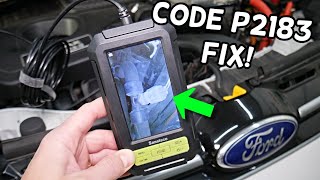
- ECT Sensor #2 — On the C-MAX Energi (PHEV), the sensor is located on the right side of the engine, installed in the coolant tubing that runs toward the heater core.. This is the physical location of the component that needs to be tested and potentially replaced. It is often difficult to see without an inspection camera.
- PCM Connector C175B — This is one of the main connectors on the Powertrain Control Module (PCM).. The wiring for ECT Sensor #2 terminates at this connector. Checking for continuity and voltage at the corresponding pins on this connector can help determine if a wiring fault exists between the sensor and the PCM.
- Ground Point G105 — Located on the left side of the engine compartment.. This is a key ground point for various engine management components, including the cooling fan relay. A poor ground here could potentially cause erratic behavior in the cooling system, although it's not a direct cause of P2183.
OEM Part Supersession History
7M5Z-12A648-A (Ford OEM)→DY-1187 (Motorcraft)— Branding/Packaging
Heads up: DY-1187 is the Motorcraft service part number for the Ford OEM part 7M5Z-12A648-A. They are the same part and are fully compatible.
Model Year Variations Within This Range
- 2013-2017: The location of ECT Sensor #2 differs between the standard Hybrid (HEV) and the Plug-in Hybrid (PHEV/Energi). For the C-MAX Energi (PHEV), the sensor is on the right side of the engine in coolant tubing. For the standard C-MAX Hybrid (HEV), it is at the end of the coolant manifold assembly.
Helpful Videos

We Have This Part in Stock


The information in this article is provided for general reference and educational purposes only. Vehicle specifications, procedures, and part compatibility can vary by production date, trim level, and region. Always consult your vehicle's factory service manual and verify part numbers before purchasing or performing repairs. Safety-critical components such as airbags, seat belts, and braking systems should be installed by a qualified professional.
- Ford C-MAX ENERGI:
- 🧭 Diagnostic Flowchart
- 🎬 Helpful Videos
- 🛍️ Shop This Part
- What's Unique About the 2013-2017 Ford C-MAX ENERGI
- Symptoms You May Notice
- Most Likely Causes
- Rare But Worth Checking
- Diagnosis Steps
- Parts You'll Likely Need
- Related Codes That Often Appear With This One
- Technical Service Bulletins (TSBs) & Recalls
- Platform-Specific Known Issues
- Mechanic-Grade Diagnostic Values
- Scan Tool Commands That Help
- Wiring & Ground Locations
- OEM Part Supersession History
- Model Year Variations Within This Range
- 🎟️ Get 5% Off