

P2187 on 2018-2019 Land Rover Range Rover Velar: Lean at Idle Causes and Fixes
On a 2018-2019 Range Rover Velar, code P2187 is almost always caused by a vacuum leak from a failed PCV (Positive Crankcase Ventilation) valve diaphragm. This results in a rough idle, a hissing sound from the engine, and a check engine light. Replacing the PCV diaphragm repair kit or the full assembly is the most common and effective fix.
- P2187 on a 2018-2019 Velar means there's a vacuum leak that is most noticeable at idle.
- The most likely cause is a torn diaphragm in the PCV valve, also known as the engine breather box.
- A professional smoke test is the fastest way to confirm the exact source of the leak.
- Do not replace oxygen sensors for this code until all possible vacuum leaks have been ruled out.
What's Unique About the 2018-2019 Land Rover RANGE ROVER VELAR
Like many modern Jaguar Land Rover (JLR) engines, the Ingenium I4 and Supercharged V6 in the Velar are highly prone to PCV system failures. The rubber diaphragm inside the PCV valve assembly (sometimes called an engine breather box or pressure control valve) becomes brittle from engine heat and oil vapor, causing it to tear. This creates a significant unmetered vacuum leak that the engine's computer cannot compensate for at idle, directly causing the P2187 code. 🎬 Watch: A breakdown of common P2187 engine error code causes. This issue is so common that Land Rover has issued technical service bulletin SSM74374, which explicitly names a split diaphragm in the pressure control valve as the cause for P2187 and related codes.
Diagnostic Flowchart
Tap your situation to follow the diagnostic path that matches what you're seeing on this vehicle.
Symptoms You May Notice
- Check Engine Light is on
- Rough or unstable idle, sometimes with RPMs surging
- Engine stumbling or hesitating
- Loud hissing or whistling noise from the engine bay, especially at idle, near the passenger-side valve cover.
- Poor fuel economy.
- Engine may stall when coming to a stop
- Excessive vacuum in the crankcase, making the oil filler cap difficult to remove while the engine is running.
- Replacing oxygen sensors. O2 sensors are often replaced mistakenly when they are accurately reporting the lean condition caused by a vacuum leak. Always rule out vacuum leaks before replacing sensors for this code.
- Replacing the Mass Airflow (MAF) sensor. While a possible cause, it is far less frequent than a simple vacuum leak from the PCV system.
Most Likely Causes
- Ruptured PCV Valve / Breather Box Diaphragm 🔴 High Probability → Shop PCV Valve The rubber diaphragm in the PCV assembly is a known weak point on JLR engines, failing due to heat and age. This is the most common cause of unmetered air leaks leading to P2187. TSB SSM74374 specifically identifies a split diaphragm as the cause and provides a lower-level repair kit as the solution.
How to confirm: With the engine running, listen for a distinct hissing sound from the PCV valve area on the passenger-side valve cover. A definitive test is to perform a smoke test on the intake system, which will show smoke leaking from the failed diaphragm or assembly. A common DIY check involves locating a small port on the round PCV valve cover; if you can feel strong vacuum with your finger over this port at idle, the diaphragm is torn. Blocking this port with your finger may cause the engine idle to change or stumble, further confirming the leak.
Typical fix: Replace the PCV diaphragm and cover using a repair kit. Land Rover offers an official kit for the V6/V8 engines. Be cautious during removal, as the plastic tabs holding the cap on can be brittle and break. After replacement, clear the codes and reset the PCM adaptations.
Est. part cost: $40-$90 - Leaking Intake Manifold Gaskets 🟡 Medium Probability → Shop Engine Intake Manifold While less common than the PCV failure, intake gaskets can dry out and crack over time, creating a vacuum leak.
How to confirm: A smoke test is the most effective way to confirm a leak at the intake manifold gaskets. Sometimes, spraying brake cleaner or a combustible fluid near the gasket sealing surfaces will cause a momentary change in engine RPM, indicating a leak.
Typical fix: Replace the intake manifold gaskets. This is more labor-intensive than a PCV valve replacement.
Est. part cost: $50-$120 - Cracked or Loose Vacuum Hoses ⚪ Low Probability → Shop Vacuum Hose Rubber and plastic hoses in the engine bay can become brittle and crack over time, especially those connected to the intake system.
How to confirm: Visually inspect all vacuum lines connected to the intake manifold for cracks, brittleness, or loose connections. A smoke test will also quickly identify any leaking hoses.
Typical fix: Replace the damaged hose.
Est. part cost: $10-$50 - Cracked Air Intake Resonator/Pipe (2.0L Ingenium) ⚪ Low Probability On the 2.0L turbocharged engine, the plastic air intake resonator pipe is known to develop cracks, particularly along the seams, causing an unmetered air leak.
How to confirm: A loud hissing or sucking sound that increases with engine RPM is a primary symptom. A visual inspection may reveal a crack, but a smoke test is the most reliable method to confirm the leak.
Typical fix: Replace the cracked air intake resonator pipe assembly.
Est. part cost: $100-$250
Rare But Worth Checking
- Faulty Mass Airflow (MAF) Sensor: → Shop Fuel Injection Air Flow Meter A dirty or failing MAF sensor can under-report the amount of air entering the engine, causing the PCM to command too little fuel. This is less common than a vacuum leak, as MAF issues often affect performance across all RPM ranges, not just at idle, and may set other codes.
- Leaking Fuel Injector: An injector that is clogged or failing to deliver the proper amount of fuel can cause a lean condition in one cylinder, contributing to a Bank 1 lean code. This is usually accompanied by misfire codes for a specific cylinder.
- Exhaust Leak (before O2 sensor): If there is a crack or leak in the exhaust manifold or downpipe before the upstream oxygen sensor, outside air can be drawn in. This causes the O2 sensor to incorrectly read a lean condition and trigger the code.
Diagnosis Steps
- Scan the vehicle's computer for P2187 and any other stored codes. Note the long-term fuel trim (LTFT) values at idle; high positive values (e.g., >25%) strongly suggest a vacuum leak.
- With the engine running, listen carefully for any hissing or whistling sounds around the top of the engine, particularly near the PCV valve/breather box on the passenger-side valve cover.
- Perform the 'finger test': Locate the small vent hole on the round PCV valve cap. If you feel suction at idle, the diaphragm is confirmed to be torn.
- Perform a smoke test. This is the most reliable professional method. Introduce smoke into the intake system via a vacuum hose and watch for smoke escaping from the PCV diaphragm, cracked hoses, intake gaskets, or the intake resonator pipe.
- If no vacuum leaks are found, inspect the exhaust system for any leaks between the cylinder head and the primary oxygen sensor.
- As a final step, monitor the live data from the Mass Airflow (MAF) sensor and oxygen sensors to ensure they are reading within their expected ranges and responding correctly.
Parts You'll Likely Need
- PCV Valve Diaphragm Repair Kit (3.0L V6)
(OEM #LR133579)— This is the official Land Rover repair kit for the most frequent failure point causing code P2187 on the V6 engine. It contains the new diaphragm, spring, and cap to fix the vacuum leak.
Trusted brands: Land Rover (OEM), URO Parts, RKX
OEM price range: $60-$90
Aftermarket price range: $30-$50 - PCV Valve / Engine Breather Assembly (2.0L I4)
(OEM #LR182553)— For the 2.0L Ingenium engine, this is the most frequent failure point causing code P2187 due to a torn internal diaphragm creating a vacuum leak. Often the entire assembly is replaced. The OEM part number is 109123504, which supersedes LR172826.
Trusted brands: Land Rover (OEM)
OEM price range: $50-$150
Aftermarket price range: $30-$80
Related Codes That Often Appear With This One
- P2189 — This is the code for "System Too Lean at Idle, Bank 2." A major vacuum leak, like a failed PCV valve diaphragm, is a central component that affects the entire crankcase and therefore both engine banks, causing both codes to appear together.
- P0171 — This code is "System Too Lean (Bank 1)" but is not restricted to idle. A significant vacuum leak can cause fuel trims to be high enough to trigger both P2187 at idle and P0171 across the RPM range.
- P0507 — This code means "Idle Control System RPM Higher Than Expected." A vacuum leak allows extra, unmetered air into the engine, which can cause the idle speed to be higher than the target set by the computer. TSB SSM74374 links this code directly to the PCV diaphragm failure.
Technical Service Bulletins (TSBs) & Recalls
- SSM74374: Mentions P2187 as a possible DTC resulting from an air intake system leak from the pressure control valve.
- SFCC-14MAR19-Sli: Links P2187-00 to rough running and fuel trims at their limit during idle.
Platform-Specific Known Issues
- TSB #SSM74374 notes that codes P2187, P2189, P0505, or P0507 can be stored due to an air intake system leak related to a split diaphragm within the pressure control valve. It specifies that a repair kit (LR133579) is available for the V6/V8 engines as an alternative to replacing the entire camshaft cover.
- TSB #SFCC-14MAR19-Sli connects P2187-00 with a rough running condition and fuel trims being near their limit at idle, confirming the lean-at-idle symptom.
Mechanic-Grade Diagnostic Values
- Long Term Fuel Trim (LTFT) at Idle — expected: Close to 0% (+/- 5%). Failure: High positive numbers, often exceeding +15% and reaching the PCM's limit around +25%, confirm the computer is compensating for a large vacuum leak.
- Low-Pressure Fuel Line Pressure (Key On, Engine Off) — expected: Approximately 1359 PSI (value observed on a scanner before startup, may vary).. Failure: Significantly lower pressure could indicate a fuel delivery issue, though this is a less common cause for P2187 than vacuum leaks.
Hidden / Shadow Codes Worth Checking
- P2187-00: This is a more specific version of the code, often seen on dealer-level scanners like JLR SDD or Pathfinder. The '-00' suffix generally indicates a generic or non-specific fault type within the primary code's definition, reinforcing that the 'System Too Lean at Idle' condition is present without pointing to a specific sub-component failure. It is mentioned directly in TSB #SFCC-14MAR19-Sli. (see via JLR SDD, Pathfinder, or other advanced diagnostic scan tools.)
Scan Tool Commands That Help
- JLR SDD / Pathfinder: Reset Fuel Trim Adaptations / Clear Adaptations — This function should be performed after replacing a component that caused the vacuum leak, such as the PCV valve or an intake gasket. It forces the Engine Control Module (ECM) to immediately relearn the base fuel map with the leak fixed. Failing to do this can cause the engine to run poorly or set temporary rich/lean codes after the physical repair is complete.
Real Owner Repair Stories
- rangerovers.net / Reddit user (2019 Range Rover Velar 2.0L Petrol) — Check engine light with code P2187, Long Term Fuel Trim (LTFT) at +25% or higher, very poor fuel economy (12-13 MPG city).
❌ Tried (didn't work) Checking O2 sensor voltage, MAP, and MAF sensor readings, which all appeared to be within normal range.
✅ What actually fixed it The owner confirmed a vacuum leak at the PCV breather box using the 'finger test' on the small vent hole. Replacing the PCV breather box assembly and performing a PCM reset resolved the issue, bringing the LTFT back close to zero and smoothing the idle. - YouTube video (2016 Range Rover Sport 3.0L V6 Supercharged (AJ126 engine, same as Velar)) — Check Engine Light with codes P2187 and P2189 (lean at idle on both banks).
❌ Tried (didn't work) Initially suspected O2 sensors or a loose gas cap, but neither was the cause.
✅ What actually fixed it A professional shop performed a smoke test and confirmed the leak was from the PCV valve diaphragm. The final repair was the replacement of the PCV valve diaphragm kit, which resolved the codes. The owner noted the failure occurred around 67,000 miles.
"I Checked Everything" — The Actual Cause
- In one documented case for a 2014 Range Rover V6, a mechanic performed a smoke test that reportedly showed no leaks, yet the P2187 and P2189 codes persisted after replacing the PCV valve, throttle body, and other modules. A responding technician emphasized that the torn PCV diaphragm is the most common cause and suggested re-checking the work, as an improperly installed diaphragm or a secondary leak at the clean air inlet pipe could be missed. This highlights that even with a 'clean' smoke test, the PCV system remains the primary suspect and requires meticulous inspection.
OEM Part Supersession History
Not specified→LR133579— This is the current service kit specified by Land Rover for repairing the PCV diaphragm on the 3.0L V6 and 5.0L V8 engines, as noted in TSBs, to avoid replacing the entire valve cover.LR172826→109123504— Part number update for the PCV valve assembly on the 2.0L Ingenium gas engine.Not specified→LR113201 / LR109354— These are part numbers for the complete right-side valve cover assembly for the 3.0L V6 engine, which the LR133579 repair kit is designed to service.
Heads up: The repair kit LR133579 is the cost-effective alternative to replacing these entire valve cover assemblies.
Helpful Videos
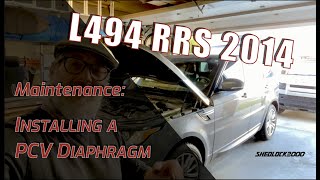

We Have This Part in Stock



The information in this article is provided for general reference and educational purposes only. Vehicle specifications, procedures, and part compatibility can vary by production date, trim level, and region. Always consult your vehicle's factory service manual and verify part numbers before purchasing or performing repairs. Safety-critical components such as airbags, seat belts, and braking systems should be installed by a qualified professional.
- Land Rover RANGE ROVER VELAR:
- 🧭 Diagnostic Flowchart
- 🎬 Helpful Videos
- 🛍️ Shop This Part
- What's Unique About the 2018-2019 Land Rover RANGE ROVER VELAR
- Symptoms You May Notice
- Most Likely Causes
- Rare But Worth Checking
- Diagnosis Steps
- Parts You'll Likely Need
- Related Codes That Often Appear With This One
- Technical Service Bulletins (TSBs) & Recalls
- Platform-Specific Known Issues
- Mechanic-Grade Diagnostic Values
- Hidden / Shadow Codes Worth Checking
- Scan Tool Commands That Help
- Real Owner Repair Stories
- "I Checked Everything" — The Actual Cause
- OEM Part Supersession History
- 🎟️ Get 5% Off