

P2189 on 2017-2019 Land Rover Discovery: System Too Lean at Idle (Bank 2) Causes and Fixes
On a 2017-2019 Land Rover Discovery with the 3.0L V6, code P2189 almost always indicates a vacuum leak from a ruptured PCV diaphragm. This diaphragm is located on the passenger-side (Bank 1) valve cover, but the leak is large enough to affect both banks, often triggering P2187 as well. A diaphragm repair kit (OEM part LR133579) costs around $40-$60, which is much cheaper than replacing the entire valve cover.
- P2189 on a 2017-2019 Discovery almost always points to a vacuum leak, not a bad sensor.
- The most likely culprit is a torn PCV diaphragm on the valve cover, a well-documented issue with a specific TSB.
- A smoke test is the fastest and most accurate way to confirm the location of the vacuum leak.
- Always use the PCV diaphragm repair kit (Part No. LR133579) before considering a costly replacement of the entire valve cover.
- This code is often paired with P2187 (Bank 1 Lean), which further points to a central vacuum leak like the PCV system.
What's Unique About the 2017-2019 Land Rover DISCOVERY
The 3.0L supercharged V6 (AJ126) engine used in the Discovery 5 is well-known for this specific issue. The Positive Crankcase Ventilation (PCV) system uses a rubber diaphragm that is prone to tearing or rupturing due to heat and oil vapor exposure over time. This creates a significant vacuum leak that the engine's computer cannot compensate for at idle, directly causing the P2189 (and often P2187 for the other bank) code. The problematic PCV valve is located on the Bank 1 (passenger-side) valve cover, but the resulting vacuum leak is so large that it affects the entire crankcase, causing a lean condition on Bank 2 as well. Land Rover acknowledged this common failure and issued a Technical Service Bulletin (TSB SSM74374) with a specific repair kit, making this a well-documented and understood problem for this platform and its relatives.
Diagnostic Flowchart
Tap your situation to follow the diagnostic path that matches what you're seeing on this vehicle.
Symptoms You May Notice
- Check Engine Light is on
- Rough or unstable idle, sometimes with RPMs fluctuating
- Hissing or whistling noise from the engine bay, particularly from the passenger-side valve cover area near the firewall.
- Engine may stall at stops
- Hesitation when accelerating from a stop.
- Strong vacuum suction when trying to remove the oil filler cap while the engine is running.
- Replacing the oxygen (O2) sensor without first performing a smoke test to check for vacuum leaks. The O2 sensor is usually just accurately reporting the problem caused by the PCV leak. 🎬 See how one owner diagnosed and fixed these lean error codes.
- Replacing the entire valve cover assembly. TSB #SSM74374 specifically authorizes the use of a much cheaper diaphragm repair kit (LR133579) instead of the whole cover. Some shops may propose replacing the cover out of convenience or lack of awareness of the kit.
- Replacing the Mass Airflow (MAF) sensor. While possible, a vacuum leak is far more probable for this specific code combination and symptoms on this engine.
Most Likely Causes
- Ruptured PCV Valve Diaphragm 🔴 High Probability → Shop PCV Valve The rubber diaphragm in the PCV assembly on the AJ126 engine's right-hand (passenger side) valve cover is a known failure point. It becomes brittle from constant exposure to engine heat and oil vapor, causing it to tear. Land Rover issued TSB #SSM74374 specifically for this issue, which affects the 3.0L V6 and 5.0L V8 engines across many JLR models.
How to confirm: The most definitive method is a smoke test, which will show smoke exiting the round PCV cap on the passenger-side valve cover. A simple and highly effective preliminary test is the 'oil cap test': with the engine idling, carefully try to remove the oil filler cap. If there is very strong suction holding it down, this almost certainly confirms a large crankcase vacuum leak from the PCV diaphragm. You may also hear a distinct hissing sound from that area.
Typical fix: Replace the PCV diaphragm, spring, and cap using a dedicated repair kit (part number LR133579). This avoids the much more expensive and unnecessary replacement of the entire valve cover assembly. 🎬 Watch this detailed DIY guide to replace the PCV diaphragm yourself. The old cap can be brittle and may break during removal, but the kit includes a new one.
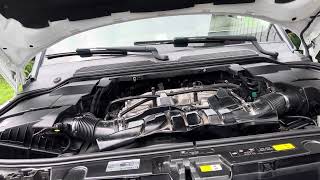
Est. part cost: $40-$60 for OEM, $25-$45 for aftermarket. - Vacuum Leak (Other) 🟡 Medium Probability Beyond the PCV valve, other plastic and rubber components like vacuum hoses, intake air ducts, and intake gaskets can degrade and crack over time, leading to unmetered air entering the engine. A loose clamp on the air intake tube after the MAF sensor can also cause this issue. 🎬 Watch this walkthrough for fixing lean codes and checking for leaks.
How to confirm: Perform a smoke test to check all vacuum lines, the intake manifold gaskets, and the air intake tube for leaks. Visually inspect all accessible hoses for cracks or loose connections.
Typical fix: Replace the cracked hose or leaking gasket that is identified during the smoke test. Tighten any loose clamps found.
Est. part cost: $20-$200 - Faulty Mass Airflow (MAF) Sensor ⚪ Low Probability → Shop Fuel Injection Air Flow Meter
How to confirm: Inspect the sensor for contamination. Clean it with dedicated MAF sensor cleaner. If the problem persists, monitor the sensor's readings with a scan tool to see if they are within the expected range for the given engine speed. A dirty MAF sensor is a more likely culprit than a completely failed one.
Typical fix: Clean the MAF sensor first. If cleaning doesn't resolve the issue, replace the sensor. This should only be done after ruling out vacuum leaks.
Est. part cost: $100-$250 - Faulty Upstream Oxygen (O2) Sensor ⚪ Low Probability → Shop Oxygen Sensor
How to confirm: The O2 sensor is what reports the lean condition, but it is rarely the cause. Before replacing it, rule out all possible vacuum leaks via a smoke test. If no leaks are found, the sensor's performance can be checked using a scan tool to observe its voltage switching; a lazy or biased sensor may be faulty.
Typical fix: Replace the Bank 2, Sensor 1 (upstream) oxygen sensor. This is located on the driver's side exhaust manifold, before the catalytic converter.
Est. part cost: $80-$200
Rare But Worth Checking
- Exhaust Leak: An exhaust leak before the upstream O2 sensor can draw in outside air, causing the sensor to incorrectly report a lean condition.
- Low Fuel Pressure or Faulty Fuel Injector: A clogged fuel injector on Bank 2 or a failing fuel pump could cause a lean condition, but this is less likely to only appear at idle and would typically present with other symptoms or codes.
Diagnosis Steps
- Connect an OBD-II scanner to confirm the P2189 code and check for any other codes, especially P2187.
- Observe live data on the scanner. Look at the Long Term Fuel Trim (LTFT) for Bank 1 and Bank 2 at idle. Values significantly higher than 15-20% (often approaching +25% or more) confirm the lean condition.
- With the engine running at idle, listen for a distinct hissing or whistling sound from the passenger side of the engine, near the firewall.
- Perform the 'oil cap test': While the engine is idling, carefully attempt to remove the oil filler cap. If you feel strong suction pulling it down, this is a very strong indication of a failed PCV diaphragm.
- Perform a smoke test. This is the most effective way to find the source of a vacuum leak. Feed smoke into the intake system and watch for where it escapes. Pay close attention to the round PCV valve cap on the passenger-side valve cover.
- If the smoke test confirms a leak at the PCV valve, replace the diaphragm using the appropriate repair kit (LR133579).
- If no vacuum leaks are found, inspect and clean the Mass Airflow (MAF) sensor using a dedicated cleaner.
- If the issue persists after ruling out all air leaks, test the functionality of the Bank 2 upstream O2 sensor using a scan tool to observe its voltage readings and switching frequency.
Parts You'll Likely Need
- PCV Valve Diaphragm Repair Kit
(OEM #LR133579)— This is the most common failure part causing code P2189 on this vehicle, as documented in TSB #SSM74374. The rubber diaphragm tears, creating a large vacuum leak. The kit contains the new diaphragm, spring, and cap.
Trusted brands: Land Rover (Genuine), URO Parts, Vaico, RKXtech, Britpart
OEM price range: $40-$60
Aftermarket price range: $25-$45
Related Codes That Often Appear With This One
- P2187 — This is the identical code ('System Too Lean at Idle') for Bank 1. A large vacuum leak, like a failed PCV diaphragm, affects the entire crankcase and will cause both banks to run lean, triggering both codes together.
- P0507 — This code means 'Idle Air Control System RPM Higher Than Expected'. A vacuum leak allows extra, unmetered air into the engine, causing the idle speed to be higher than what the computer is commanding. TSB #SSM74374 lists this as a possible companion code.
- P0505 — This code for 'Idle Air Control System' is also listed in TSB #SSM74374 as a potential companion code caused by the PCV diaphragm leak.
Technical Service Bulletins (TSBs) & Recalls
- SSM74374: V6 3.0L + V8 5.0L Petrol Right Hand Camshaft Cover Lower Level Repair. Confirms a split PCV diaphragm causes air leaks resulting in codes P2187 and P2189, and provides part number LR133579 for the repair kit.
- SFCC-14MAR19-Sli: Mentions P2189-00 in relation to a rough running condition where fuel trims are near their limit at idle.
Platform-Specific Known Issues
- TSB #SSM74374: Land Rover identifies that an air leak from the right-hand camshaft cover assembly, due to a split diaphragm in the pressure control valve, can cause codes P2187, P2189, P0505, and P0507. It authorizes a repair using kit LR133579 instead of replacing the entire camshaft cover.
- TSB #SFCC-14MAR19-Sli: Notes that the Check Engine Lamp may be on with a rough running condition and codes including P2189-00. It confirms that fuel trims will be near their limit when the engine is at idle speed.
Mechanic-Grade Diagnostic Values
- Long Term Fuel Trim (LTFT) at Idle — expected: Ideally close to 0%, but within +/- 10%.. Failure: Values consistently above +20% to +25% indicate the PCM is adding the maximum amount of fuel to compensate for a large vacuum leak.
- Mass Airflow (MAF) Sensor Reading at Warm Idle — expected: Approximately 3.0 grams/second (g/s). A general rule for JLR engines is that the g/s value should roughly match the engine displacement in liters.. Failure: A significantly lower reading suggests the sensor is under-reporting air, while a higher reading could indicate a wiring issue or a large post-sensor air leak.
Scan Tool Commands That Help
- JLR SDD/Pathfinder or advanced aftermarket scanner (e.g., GAP IID): Reset Fuel Trim Adaptations / Clear Adaptive Values — This function should be performed after replacing a component that affects the air-fuel mixture, such as the PCV diaphragm, MAF sensor, or O2 sensors. It forces the Powertrain Control Module (PCM) to erase the long-term learned adjustments it made to compensate for the old, faulty part. Failing to reset adaptations can result in poor fuel economy or the code returning as the PCM continues to operate on incorrect learned values.
- N/A - Manual Procedure: ECU Reset via Battery Disconnect — If a proper scan tool is unavailable, disconnecting the negative battery terminal for 15-30 minutes can clear the PCM's volatile memory, which includes fuel trims on many vehicles. After reconnection, a drive cycle is required for the system to relearn. This is less precise than a scan tool command but is often effective.
- N/A - Manual Procedure: Fuel Adaptation Drive Cycle — After clearing adaptations with a scan tool or battery disconnect, a drive cycle is mandatory for the PCM to relearn correct values. The cycle should include letting the engine warm up to operating temperature, idling, stop-and-go city driving, and steady-state highway cruising. This allows the PCM to gather data across various loads and RPMs to build new, accurate fuel trim tables.
Real Owner Repair Stories
- Reddit user on r/RangeRover (2014 Range Rover HSE (L494 with 3.0L V6 AJ126 engine)) — Check Engine Light with codes P2187 and P2189. High RPM (3000) on startup before settling down.
❌ Tried (didn't work) Smoke test (initially found no leak), New auxiliary battery, New car control modules, New throttle body, MAF sensor replacement
✅ What actually fixed it The issue was finally confirmed to be a torn PCV diaphragm on the right-hand valve cover. Replacing the diaphragm resolved the codes and symptoms. - YouTube user 'Range Rover Sport P2189 and P2187 error codes (running too lean!) - what fixed it?' (2016 Land Rover Range Rover Sport with 3.0L V6 Supercharged engine, ~67,000 miles) — Check Engine Light with P2187 and P2189.
❌ Tried (didn't work) Owner initially suspected O2 sensors or a loose gas cap.
✅ What actually fixed it A smoke test performed by an independent shop confirmed the leak was from the PCV valve. The fix was replacing the PCV diaphragm kit (a $44 part), which took about one hour of labor. - Land Rover Forums user (2015 Land Rover) — Codes P2187 and P2189.
❌ Tried (didn't work) Multiple unsuccessful diagnostic attempts by the dealer.
✅ What actually fixed it After six separate trips to the dealership, the cause was finally identified as a vacuum leak at the PCV valve diaphragm.
"I Checked Everything" — The Actual Cause
- In a documented case on a 2016 Land Rover with codes P2187, P2189, and P0507, an initial smoke test revealed no leaks. Acting on common knowledge for this engine, the mechanic proceeded to replace the PCV diaphragm kit. Upon removal, the old diaphragm was found to be broken internally. This suggests that a tear may only open under specific engine vacuum conditions at idle, which are not always replicated during a static, un-powered smoke test, allowing the leak to go undetected.
- A Reddit user with a 2014 Range Rover V6 also reported that their initial smoke test found no leaks, yet the ultimate cause was proven to be the PCV diaphragm. This reinforces that a clean smoke test does not definitively rule out a failed diaphragm as the root cause.
When the Usual Fixes Don't Work
- While the vast majority of P2189 cases on this platform are resolved by replacing the PCV diaphragm, there are documented instances where this does not fix the issue. In one case involving a Discovery 5, the owner performed a smoke test, an exhaust leak test, and visually inspected the PCV diaphragm, finding no faults. Their next diagnostic step was to investigate the O2 sensors, suspecting them of failure. This highlights that while the PCV is the primary suspect, if replacing it (and resetting adaptations) does not resolve the code, further diagnosis of the MAF sensor, other vacuum lines, or the O2 sensors themselves is required.
OEM Part Supersession History
LR010780, LR041443, LR051835→LR133579— Part consolidation and potential minor revisions by the manufacturer for the PCV diaphragm repair kit.
Helpful Videos
We Have This Part in Stock



The information in this article is provided for general reference and educational purposes only. Vehicle specifications, procedures, and part compatibility can vary by production date, trim level, and region. Always consult your vehicle's factory service manual and verify part numbers before purchasing or performing repairs. Safety-critical components such as airbags, seat belts, and braking systems should be installed by a qualified professional.
- Land Rover DISCOVERY:
- 🧭 Diagnostic Flowchart
- 🎬 Helpful Videos
- 🛍️ Shop This Part
- What's Unique About the 2017-2019 Land Rover DISCOVERY
- Symptoms You May Notice
- Most Likely Causes
- Rare But Worth Checking
- Diagnosis Steps
- Parts You'll Likely Need
- Related Codes That Often Appear With This One
- Technical Service Bulletins (TSBs) & Recalls
- Platform-Specific Known Issues
- Mechanic-Grade Diagnostic Values
- Scan Tool Commands That Help
- Real Owner Repair Stories
- "I Checked Everything" — The Actual Cause
- When the Usual Fixes Don't Work
- OEM Part Supersession History
- 🎟️ Get 5% Off