

P2198 on 2007-2014 Ford Edge 3.5L: Causes for Stuck Rich Signal on Bank 2
Code P2198 on a Ford Edge 3.5L means the upstream O2 sensor on Bank 2 is stuck reading a rich fuel mixture. The most common causes are a faulty EVAP purge valve or a leaking fuel injector, not necessarily the O2 sensor itself. A new purge valve is around $30-$60, while a fuel injector is more.
- P2198 means the O2 sensor on Bank 2 (radiator side) is stuck reading rich.
- Do NOT immediately replace the O2 sensor. The most common cause on this vehicle is a stuck-open EVAP purge valve.
- If codes for both banks (P2196 & P2198) are present, the EVAP purge valve is the number one suspect.
- If only P2198 is present and the purge valve is good, suspect a leaking fuel injector on Bank 2 or a faulty O2 sensor.
- Ignoring this code can lead to catalytic converter damage, a significantly more expensive repair.
What's Unique About the 2007-2014 Ford Edge
On the Ford 3.5L V6 engine, P2198 (and its Bank 1 counterpart, P2196) is frequently caused by components other than the oxygen sensor itself. A stuck-open EVAP purge solenoid is a very common culprit on many Ford vehicles, allowing un-metered fuel vapors to enter the intake manifold and create a genuinely rich condition that often affects both banks. Leaking fuel injectors are another known issue that can lead to this code. Therefore, it's crucial to diagnose the system rather than immediately replacing the O2 sensor, a common misstep.
Generation note: The 2007-2014 year range covers the entire first generation of the Ford Edge, including the 2011-2014 facelift. The 3.5L V6 engine was used throughout this period, and the common causes and fixes for P2198 are consistent across these years.
Symptoms You May Notice
- Check Engine Light is on
- Reduced fuel economy
- Rough or fluctuating idle, sometimes stalling at stops
- Engine may occasionally stall at stops
- Sluggish acceleration or loss of power
- Smell of gasoline or black smoke from the exhaust
- Difficulty starting after refueling (points strongly to EVAP purge valve)
- Replacing the oxygen sensor without testing it or other components first. The O2 sensor is often just accurately reporting a rich condition caused by another part, like the EVAP purge valve or a leaky injector.
Most Likely Causes
- Stuck-Open EVAP Purge Valve/Solenoid 🔴 High Probability → Shop Vapor Canister This is a widely reported issue on many Ford vehicles, including the Edge. The valve fails and allows a constant flow of fuel vapors into the intake manifold, creating a rich condition that often triggers both P2198 and P2196.
How to confirm: With the engine off, unplug the electrical connector and the vacuum lines from the purge valve. Try to blow through it. If air passes through, the valve is stuck open and needs to be replaced. A properly functioning valve is closed when not powered. Difficulty starting immediately after filling the gas tank is another classic symptom.
Typical fix: Replace the EVAP canister purge valve.
Est. part cost: $30-$60 - Leaking Fuel Injector(s) on Bank 2 🟡 Medium Probability → Shop Fuel Injector Leaking injectors are a known potential issue on the 3.5L engine family, causing excess fuel to enter one or more cylinders on Bank 2.
How to confirm: This is more difficult to confirm. A mechanic can perform a fuel pressure leak-down test or remove the fuel rail and injectors to visually inspect for drips after the system is pressurized. An advanced scan tool may also show fuel trim data that points to specific cylinders. A gasoline film inside the intake manifold can also be an indicator.
Typical fix: Replace the faulty fuel injector(s) on Bank 2. It is often recommended to replace all three on that bank at the same time.
Est. part cost: $50-$150 per injector - Faulty Bank 2, Sensor 1 Oxygen Sensor 🟡 Medium Probability → Shop Oxygen Sensor O2 sensors are wear items and can fail over time, sending an incorrect, fixed-rich signal to the PCM. They can also become contaminated or 'fouled' by a persistent rich condition caused by another component.
How to confirm: Use a scan tool to monitor the live voltage data from the Bank 2, Sensor 1 O2 sensor. A healthy sensor's voltage fluctuates rapidly between approximately 0.1V and 0.9V. If the voltage is stuck high (e.g., >0.8V), the sensor may be faulty. A good diagnostic step is to swap the Bank 1 and Bank 2 upstream sensors. If the code changes to P2196 (Bank 1 Stuck Rich), the sensor is confirmed to be bad.
Typical fix: Replace the Bank 2, Sensor 1 (upstream) oxygen sensor.
Est. part cost: $50-$120 - Wiring or Connector Issue ⚪ Low Probability
How to confirm: Visually inspect the wiring harness and connector for the Bank 2 O2 sensor. Look for any signs of melting, corrosion, chafing, or loose pins. A short to voltage on the signal wire can cause a constant rich reading.
Typical fix: Repair or replace the damaged section of the wiring harness or the connector.
Est. part cost: $10-$50 for repair materials
Rare But Worth Checking
- High Fuel Pressure: A faulty fuel pressure regulator or a problem with the fuel pump can cause system-wide high fuel pressure, leading to a rich condition on both banks. If you also have code P2196, this is a more likely cause.
- Powertrain Control Module (PCM) Fault: → Shop Engine Control Module (ECM) In very rare cases, the PCM itself can have an internal fault, causing it to misinterpret the O2 sensor signal. This should only be considered after all other possibilities have been exhaustively ruled out.
Diagnosis Steps
- Read all stored trouble codes with an OBD-II scanner. Note any other codes that are present.
- If codes P2196 (Bank 1 Rich) and/or P0456 (EVAP Leak) are also present, immediately suspect a faulty EVAP purge valve.
- Inspect and test the EVAP purge valve. Disconnect it and try to blow through it. If air passes, it's faulty and needs replacement. Also note if you have trouble starting the car after refueling.
- If the purge valve is good, use the scanner to view live data for the upstream O2 sensors (Bank 1 Sensor 1 and Bank 2 Sensor 1).
- Observe the voltage for Bank 2, Sensor 1. Is it stuck above 0.8V while Bank 1, Sensor 1 is fluctuating normally? If so, a rich condition or faulty sensor is confirmed.
- To isolate the sensor, swap the upstream O2 sensors between Bank 1 and Bank 2. Clear the codes and drive the vehicle. If the code returns as P2196, the O2 sensor you moved is faulty.
- If the code remains P2198 after the swap, the O2 sensor is likely good. The problem is a true rich condition on Bank 2.
- Investigate causes for a rich condition on Bank 2, with the primary suspect being one or more leaking fuel injectors.
- Inspect the O2 sensor wiring and connector for any visible damage, corrosion, or melting.
- If all else fails, consider checking fuel pressure to rule out a faulty regulator.
Parts You'll Likely Need
- EVAP Canister Purge Valve
(OEM #CX-2349 (Motorcraft), AU5Z-9C915-B)— A very common failure point on Ford vehicles that directly causes a rich condition and often triggers this code.
Trusted brands: Motorcraft, Bosch, Standard Motor Products (SMP), Dorman
OEM price range: $40-$60
Aftermarket price range: $25-$45 - Upstream Oxygen Sensor (Bank 2, Sensor 1)
(OEM #DY-1123 (Motorcraft))— This is the sensor that triggers the code. It can fail and get stuck on a rich reading, or it may be replaced after being fouled by a persistent rich condition. Bank 2 Sensor 1 is located on the front exhaust manifold, before the catalytic converter.
Trusted brands: Motorcraft, Bosch, Denso, NTK
OEM price range: $80-$120
Aftermarket price range: $50-$90 - Fuel Injector — A leaking fuel injector is a common cause of a rich condition isolated to one bank.
Trusted brands: Motorcraft, Bosch
OEM price range: $100-$150
Aftermarket price range: $50-$100
Related Codes That Often Appear With This One
- P2196 — O2 Sensor Signal Stuck Rich (Bank 1). If both P2196 and P2198 are present, it points to a problem affecting the entire engine, such as a faulty EVAP purge valve or a fuel pressure issue.
- P0175 — System Too Rich (Bank 2). This is a more general code indicating a rich condition on Bank 2. P2198 is more specific, indicating the sensor signal itself is stuck. They often appear together and point to the same set of causes.
- P0456 — EVAP System Small Leak Detected. This code, when seen with P2198/P2196, is a strong indicator that the EVAP purge valve is stuck open, causing both the EVAP leak and the rich condition.
Technical Service Bulletins (TSBs) & Recalls
- TSB 19-2017: Addresses a dark black fluid leak from the right side transfer case (PTU) intermediate shaft seal, a related major issue for AWD models.
Mechanic-Grade Diagnostic Values
- EVAP Purge Valve Solenoid Resistance — expected: 20-35 Ohms. Failure: A reading of infinity (OL) indicates an open coil; a reading near zero indicates a shorted coil.
- Fuel Injector Resistance — expected: 11-18 Ohms. Failure: A reading outside this range indicates a faulty injector coil.
- Long Term Fuel Trim (LTFT) at Idle — expected: -10% to +10%. Failure: A P2198 code is often associated with LTFT values more negative than -20%, indicating the PCM is removing the maximum amount of fuel to compensate for a rich condition.
- Upstream O2 Sensor (Bank 2, Sensor 1) Voltage — expected: Rapidly fluctuating between ~0.1V and ~0.9V on a warm, closed-loop engine.. Failure: A flat, steady reading near or above 0.9V indicates a stuck rich signal, which could be the sensor itself or a true rich condition.
- Fuel Pressure (KOER - Key On, Engine Running) — expected: ~65 PSI (448 kPa). Failure: Significantly high fuel pressure can cause a rich condition on both banks. Low pressure is not a cause for a rich code.
Hidden / Shadow Codes Worth Checking
- Mode $06: Mode $06 is not a specific code but a diagnostic mode that shows results from the PCM's non-continuous self-tests before a fault is bad enough to set a standard DTC. For P2198, you can check the test results for the O2 sensors (MID $01, $02) and catalyst efficiency (MID $21, $22). A value approaching the maximum failure limit can indicate a sensor is becoming slow or biased, even without a code. (see via Requires a scan tool that can access and properly interpret Mode $06 data. The data is presented as Test IDs (TID) and Component IDs (CID), which need to be cross-referenced with manufacturer charts for specific meaning.)
Scan Tool Commands That Help
- Ford IDS (or FORScan): Output State Control: EVAPCP Duty Cycle — This bidirectional command allows a technician to manually command the EVAP purge valve's opening percentage (e.g., 0%, 50%, 100%). It is used to verify the entire circuit, from the PCM to the valve, is functioning correctly by observing changes in fuel trims and fuel tank pressure.
- Ford IDS (or FORScan): EVAP System Test — This is an automated test that commands the purge and vent solenoids to seal the EVAP system and check for leaks. While primarily for leak codes, running this can help verify the functionality of the solenoids involved.
- Advanced Scan Tool: Fuel Injector Balance Test — This test measures the pressure drop across each injector as it's fired. It can help identify a leaking or faulty injector on Bank 2 that is causing the localized rich condition, without having to physically remove the injectors first.
Wiring & Ground Locations
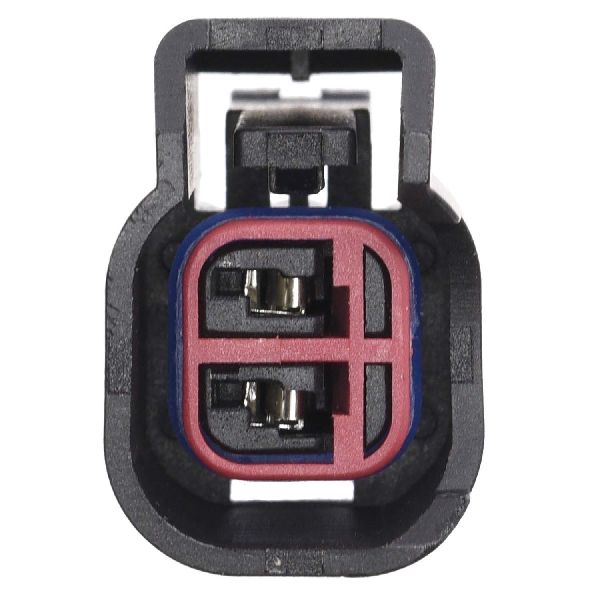
- EVAP Purge Valve Connector — On the purge valve itself, which is mounted on the firewall behind the intake manifold on the 3.5L V6.. This is a primary test point. Pin 1 (often a Red wire) should have battery voltage with the key on. Pin 2 (often Gray with a Yellow stripe) is the control wire that is ground-pulsed by the PCM. A short to ground on this control wire could hold the valve open, causing a rich condition.
- Bank 2 O2 Sensor Connector — On the wiring pigtail for the upstream O2 sensor, located in the front exhaust manifold (near the radiator).. Inspect for corrosion, melting from exhaust heat, or chafing. A short to voltage on the signal wire can mimic a stuck-rich sensor, while a damaged heater circuit wire can cause the sensor to perform poorly.
- PCM Connector — The Powertrain Control Module is typically located in the engine bay, near the firewall or inner fender.. This is the final test point to confirm wiring integrity. A continuity test between the control pin at the purge valve connector and the corresponding pin at the PCM can definitively rule out a broken wire in the harness.
Real Owner Repair Stories
- YouTube video by 'g automotive' (2013 Ford Mustang V6 (demonstrates a common Ford 3.5L/3.7L issue)) — Check Engine Light with codes P2196 and P2198 (Stuck Rich on both banks).
❌ Tried (didn't work) The video focused on direct diagnosis rather than documenting failed attempts.
✅ What actually fixed it The EVAP purge valve was stuck open. The mechanic confirmed this by unplugging the valve's electrical connector and feeling for vacuum suction on the inlet port with the engine running. The presence of suction confirmed it was stuck open. Replacing the valve resolved the rich condition. - Ford Edge Forum user 'Kleber' (Ford Edge 3.5L) — P2196 and P2198 codes appeared after an oil change.
❌ Tried (didn't work) Initial diagnosis was uncertain.
✅ What actually fixed it The owner took the vehicle to a dealership, which performed a PCM software update. The codes did not return, suggesting the root cause was a software calibration issue misinterpreting sensor data. - NHTSA ODI #11378332 — An owner reported that their check engine light came on and a repair shop identified codes P2196 and P2198, indicating a malfunctioning heated oxygen sensor. The owner was informed that thousands of similar reports existed for this issue.
"I Checked Everything" — The Actual Cause
- A very common scenario for P2198 (especially when paired with P2196) is a stuck-open EVAP purge valve. A technician might perform a smoke test on the intake system to find a vacuum leak, and the test will come back clean. This is because the 'leak' is internal to the purge valve, which is allowing un-metered fuel vapor from the charcoal canister into the intake. The definitive test, which does not require a smoke machine, is to disconnect the purge valve electrically, start the engine, and then physically check for vacuum at the valve's inlet port (the side coming from the canister). If any suction is felt, the valve is mechanically stuck open and must be replaced.
OEM Part Supersession History
9U5Z-9C915-A→AU5Z-9C915-B— Part revision by the manufacturer, likely to improve durability or address a known failure mode in the EVAP purge valve.
Heads up: The new part number is a direct replacement for the old one.
Model Year Variations Within This Range
- 2007-2010 vs 2011-2014: The 2011 model year brought a significant mid-cycle refresh. The 3.5L V6 engine was updated with Twin Independent Variable Camshaft Timing (Ti-VCT), boosting power from 265 hp to 285 hp. The earlier 2007-2010 models used a version with variable timing on the intake cam only (iVCT). While the fundamental causes of P2198 remain the same, PCM software and some engine management specifics may differ between these two versions.
Diagnostic Flowchart
Other Known Issues on This Vehicle
Issues unrelated to this code that are worth knowing about as an owner of this generation:
- Internal Water Pump Failure 🔴 High — Common in higher mileage (80k-150k miles) engines. Failure often leads to coolant contaminating the engine oil, destroying the timing chain and causing catastrophic engine damage. (Ref: No recall, but it is a widely documented failure.)
- Power Transfer Unit (PTU) Failure (AWD Models) 🔴 High — Very common. The PTU is located next to the hot catalytic converter, which cooks the 'lifetime' fluid, leading to lubrication failure and gear destruction. Recommended fluid change every 30,000 miles. (Ref: TSB 19-2017 was issued for fluid leaks from the PTU seal.)
- Electronic Throttle Body (ETB) Failure 🟠 Medium — Widespread issue on 2011-2014 models, causing the vehicle to suddenly enter 'limp mode' with reduced power. The wrench light is often illuminated. (Ref: Ford issued Customer Satisfaction Program 16B23 for 2011-2012 models, which extended the warranty for this part, but the program has since expired.)
- Door Ajar Switch Failure 🟡 Low — Common on 2011-2013 models. The sensor within the door latch fails, causing the 'Door Ajar' light to stay on and potentially draining the battery. (Ref: TSB 18-2013 addresses this issue.)
Used vs. New Parts: Buying Guide for This Vehicle
When a used part is the smart pick: Used parts are generally not recommended for the common fixes of P2198, as they involve electronic sensors and valves with a finite lifespan. However, if on a strict budget, a fuel injector from a low-mileage, documented donor vehicle could be considered, but it should be professionally cleaned and tested before installation.
Donor-vehicle mileage cap: roughly under 50000 miles for the part to have meaningful remaining life.
What to inspect on the donor part:
- For fuel injectors, ask for the mileage of the donor vehicle.
- Avoid parts from vehicles with signs of front-end collision or fire.
- Inspect electrical connectors for corrosion, cracks, or broken locking tabs.
OEM-only on this vehicle (don't cheap out):
- Sensors (Oxygen, MAF): It is strongly recommended to use OEM (Motorcraft) or the original OE supplier (like Bosch or NTK) for sensors. Many forum and professional sources state that aftermarket sensors can have different response rates or calibrations, leading to persistent codes or poor performance, even if they are brand new.
Aftermarket brands forum-validated for this vehicle:
- Oxygen Sensors: Bosch, Denso, and NTK are the most frequently recommended aftermarket brands, as they are often the OE supplier for Ford and other manufacturers.
- EVAP Purge Valve: Dorman is a widely available aftermarket option that generally works, though some users on other Ford models have reported issues with the fit of their connector clips compared to OEM.
Brands owners have reported issues with on this vehicle:
- Generic 'No-Name' Brands: Avoid unbranded, deeply discounted electronic parts from online marketplaces. The failure rate is high, and they can introduce new, hard-to-diagnose problems. A part with no manufacturer name stamped on it is a red flag.
Real Owner Stories
Aggregated from forums and TSBs cited above. Mileages and costs reflect what owners reported in those sources.
2008 Ford Edge 3.5L V6 — ~150000 miles
Symptoms: Owner of a high-mileage vehicle chased the P2198 code by replacing the O2 sensors, MAF, PCV, and the EVAP purge canister. The discussion noted the complexity of the code and the potential for even new O2 sensors to be faulty or for wiring issues to persist.
What fixed it: The owner replaced the O2 sensors, MAF, PCV, and EVAP purge canister (though the thread highlights the difficulty in isolating the final fix among these components).
Source hint: Reddit r/AskAMechanic thread titled '2008 ford edge 3.5l v6 p2198 dtc'
2010 Ford Edge V6
Symptoms: After replacing spark plugs, coils, and fuel injectors to address misfires, the owner then encountered codes P2196 and P2198 indicating a rich condition on both banks.
What fixed it: The story illustrates how prior repairs (plugs/coils/injectors) can lead into new fuel trim codes like P2198.
Source hint: Reddit r/CarRepair thread titled '2010 ford edge v6 codes p2196 and p2198 rich'
Ford Edge (3.5L Cyclone V6)
Symptoms: The user experienced an abnormal engine rotation, rough idle, and stalling specifically after refueling the vehicle.
What fixed it: The symptoms pointed directly to a faulty EVAP purge valve as the culprit for the P2196 and P2198 codes.
Source hint: FordEdgeForum.org thread titled 'Abnormal engine rotation changes P2196 and P2198'
Related OBD-II Codes
Frequently Asked Questions
Why does my Ford Edge have trouble starting only after I fill up the gas tank?
Does TSB 19-2017 relate to my P2198 code on my AWD Ford Edge?
Can I just swap the oxygen sensors to see if the sensor itself is bad?
Is there a specific part I should check if I have both P2198 and P2196 codes?
How much should I expect to pay for a new EVAP purge valve for my 3.5L Edge?
My 2011 Edge is in 'limp mode' with a wrench light; is this caused by P2198?
Helpful Videos

![How to Fix P2198 Engine Code in 5 Minutes [4 DIY Methods / Only $8.76]](https://img.youtube.com/vi/xmUc-qXmeK8/mqdefault.jpg)
Used OEM Parts in Stock
New Aftermarket Parts Available


The information in this article is provided for general reference and educational purposes only. Vehicle specifications, procedures, and part compatibility can vary by production date, trim level, and region. Always consult your vehicle's factory service manual and verify part numbers before purchasing or performing repairs. Safety-critical components such as airbags, seat belts, and braking systems should be installed by a qualified professional.
- Ford Edge:
- 🧭 Diagnostic Flowchart
- 🎬 Helpful Videos
- 🛍️ Shop This Part
- What's Unique About the 2007-2014 Ford Edge
- Symptoms You May Notice
- Most Likely Causes
- Rare But Worth Checking
- Diagnosis Steps
- Parts You'll Likely Need
- Related Codes That Often Appear With This One
- Technical Service Bulletins (TSBs) & Recalls
- Mechanic-Grade Diagnostic Values
- Hidden / Shadow Codes Worth Checking
- Scan Tool Commands That Help
- Wiring & Ground Locations
- Real Owner Repair Stories
- "I Checked Everything" — The Actual Cause
- OEM Part Supersession History
- Model Year Variations Within This Range
- Other Known Issues on This Vehicle
- Used vs. New Parts: Buying Guide for This Vehicle
- Real Owner Stories
- 2008 Ford Edge 3.5L V6 — ~150000 miles
- 2010 Ford Edge V6
- Ford Edge (3.5L Cyclone V6)
- Related OBD-II Codes
- Frequently Asked Questions
- 🎟️ Get 5% Off