

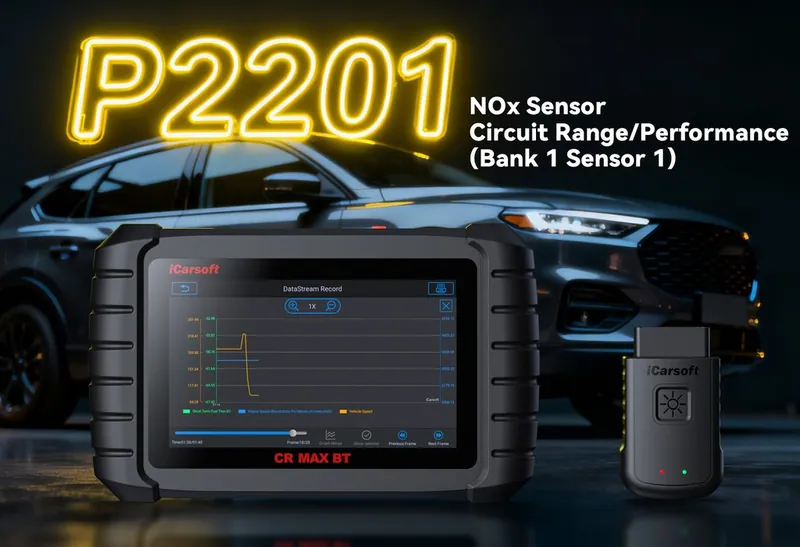
OBD-II Code P2201: NOx Sensor Circuit Range/Performance
The Ultimate Guide: What P2201 means, why it triggers, and how to fix it for good
- Code P2201 indicates the Bank 1 upstream NOx sensor is sending an irrational signal, causing an automatic emissions test failure and a potential 5 MPH limp mode.
- Always check for Technical Service Bulletins (TSBs) before buying parts; dealership software updates resolve a massive percentage of P2201 codes on Ford and Ram trucks.
- Verify the sensor is dead by checking live data on a scan tool; a healthy sensor fluctuates between 200-800 ppm and drops to 0 ppm during deceleration.
- Never buy a used NOx sensor to fix this code; invest $250-$800 in a new OEM sensor to avoid repeat failures and ensure electronic compatibility.
What Does P2201 Mean?

P2201 means the Powertrain Control Module (PCM) detects an irrational signal from the Bank 1 Nitrogen Oxide (NOx) sensor. The sensor's reading falls outside the expected range calculated from other engine parameters. This indicates a failed sensor, a wiring issue, or a software glitch in the emissions system.
Technical definition: The official SAE/OBD-II definition is "NOx Sensor Circuit Range/Performance Bank 1". The PCM continuously compares the upstream NOx sensor's live readings to an expected value calculated from the Mass Airflow (MAF) and oxygen sensors. If the reading is stuck, erratic, or fails to drop during a zero-fueling deceleration, the PCM sets this code.
Can I Drive With P2201?
Yes, But With Caution. You can drive with this code, but address it promptly. Ignoring it causes an automatic emissions test failure and triggers reduced power ('limp mode'). On Ram trucks, this enforces a severe 5 MPH speed limit after a dashboard countdown. Continued driving causes secondary damage to the Diesel Particulate Filter (DPF) and Selective Catalytic Reduction (SCR) system, adding $1,500-$3,000 to repair costs.
Common Causes

- Outdated PCM/ECM Software (Very Common) — Manufacturers frequently release software updates to fix overly sensitive emissions parameters. On Ford, Ram, and Mercedes-Benz vehicles, outdated software incorrectly flags a P2201 code even when the sensor works perfectly.
- Faulty NOx Sensor (Very Common) — The NOx sensor probe or its attached control module fails from constant exposure to extreme exhaust heat, vibration, and internal electrical shorts.
- Damaged Wiring or Connectors (Common) — Located under the vehicle, the sensor's wiring harness is exposed to road debris and moisture. Melted wires, chafing, or water-filled connectors disrupt the signal.
- Excessive Soot Buildup on Sensor (Common) — Soot from diesel exhaust coats the sensor tip, insulating it and preventing accurate readings of the exhaust gases.
- Exhaust System Leaks (Less Common) — A leak in the exhaust pipes, gaskets, or flex pipe upstream of the NOx sensor pulls fresh oxygen into the system, skewing the sensor's readings.
- DEF Contamination or Crystallization (Less Common) — Degraded or contaminated Diesel Exhaust Fluid (DEF) crystallizes on exhaust components. These crystals foul the NOx sensing element.
- Clogged Crankcase Ventilation (CCV) Filter (Less Common) — On Ram 6.7L Cummins engines, a clogged CCV filter alters crankcase pressure and combustion byproducts, fooling the NOx sensor into providing out-of-range readings.
- Fouled or Sticking EGR Valve (Less Common) — A carbon-fouled Exhaust Gas Recirculation (EGR) valve alters exhaust gas composition, creating abnormal mixtures that trigger a false P2201 code.
- Faulty Powertrain Control Module (PCM) (Rare) — The PCM itself fails, misinterpreting sensor data. Consider this only after ruling out the sensor, wiring, software, and exhaust leaks.
Symptoms

- Check Engine Light On — The dashboard light illuminates, often accompanied by a 'Service Emissions System' message.
- Reduced Engine Power ('Limp Mode') — The vehicle's computer severely limits engine power and speed to protect the emissions system from damage.
- Decreased Fuel Economy — Fuel efficiency drops by 1-3 MPG because the engine defaults to a less efficient fueling strategy.
- Erratic Idle — The engine runs rough or stumbles at low speeds or when stopped.
- Increased DEF Consumption (also visible on scanner) — The PCM over-injects Diesel Exhaust Fluid (DEF) to compensate for falsely reported high NOx levels, requiring frequent refills.
Diagnostic Flowchart
Tap your situation to follow the diagnostic path that matches what you're seeing on this code.
Common Fixes & Costs
- Update PCM/ECM Software — Parts: $0, Labor: $100-$250, ~1 hr book time (Professional)
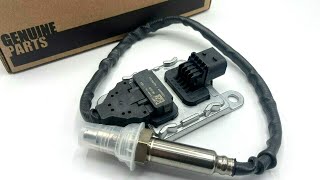
- Replace NOx Sensor — Parts: $250-$800, Labor: $100-$250, ~1.2 hr book time (Intermediate)
- Repair Damaged Wiring or Connector — Parts: $20-$100, Labor: $150-$300, ~1.8 hr book time (Intermediate)
- Repair Exhaust Leak — Parts: $10-$150, Labor: $100-$250, ~1.5 hr book time (Intermediate)
- Clean Soot from NOx Sensor — Parts: $5-$20, Labor: $50-$100, ~0.5 hr book time (Beginner)
Used vs. New Parts: Buying Guide
When a used part is worth it: Buying a used NOx sensor is highly discouraged. These are sensitive electronic components with a finite lifespan. Used sensors have a massive failure rate.
Donor-vehicle mileage cap: roughly under 20000 miles for the part to have meaningful remaining life.
Donor quality checklist:
- Must be from an extremely low-mileage wrecked vehicle.
- Avoid parts from rust-belt states due to module corrosion.
- Part numbers must match exactly.
Decision logic:
- If The part is a NOx sensor. → Buy a new OEM part. The risk of repeat labor costs outweighs any savings.
- If Budget is extremely tight. → Purchase a high-quality new aftermarket sensor with a warranty, but expect a shorter lifespan than OEM.
Warranty tradeoff: Used parts offer a 30-day warranty at best. New OEM parts carry a 1-2 year manufacturer warranty, protecting you against premature failure.
Worst-case if a used part fails: $500 if a used sensor fails, requiring repeat labor and the purchase of a new sensor anyway.
What Happens If You Wait — Timeline
- 0-1 month: Code P2201 is stored, and the Check Engine Light is on. The vehicle automatically fails OBD-II emissions tests. (MPG impact: 0-3%% · Added cost: $0-$50 in wasted fuel.)
- 1-3 months: The engine enters a less efficient fueling strategy. The SCR system over-injects DEF. The vehicle intermittently enters 'limp mode'. (MPG impact: 5-10%% · Added cost: $50-$150 in wasted fuel and excess DEF.)
- 3-8 months: The DPF becomes prematurely loaded with soot because the PCM cannot accurately run regeneration cycles. The SCR catalyst becomes contaminated. (MPG impact: 10-15%% · Added cost: $1,500-$3,500 for professional DPF cleaning or replacement.)
- 8+ months: Catastrophic failure of the aftertreatment system. Extreme exhaust backpressure damages the turbocharger. The vehicle becomes undrivable. (MPG impact: 15-25%+% · Added cost: $4,000-$8,000+ for complete DPF and SCR system replacement.)
Cost of Not Fixing It
- Immediate (0-1 Month): Guaranteed emissions test failure, a 1-3 MPG drop, and the constant threat of the vehicle entering limp mode. (Added cost: $50-$150 in wasted fuel per month.)
- Medium Term (1-6 Months): Premature soot-loading of the DPF and contamination of the SCR catalyst due to incorrect DEF injection. (Added cost: $1,500-$3,000 for DPF replacement.)
- Long Term (6+ Months): A completely clogged DPF creates excessive backpressure, destroying turbocharger seals and ruining the SCR system. (Added cost: $4,000-$8,000+ for a complete aftertreatment overhaul.)
Diagnosis Steps
- Read Codes and Check TSBs
Use an OBD-II scanner to confirm P2201 and check for related codes (P20EE, U029D). Immediately search for Technical Service Bulletins (TSBs) for your specific VIN. Software updates resolve this code so frequently that checking TSBs first prevents wasting hundreds of dollars on unnecessary parts.
Tools: OBD-II Scanner, Internet access (Beginner) - Analyze Live Sensor Data
Use an advanced scan tool to monitor 'NOx Sensor Bank 1' live data at operating temperature. The reading must fluctuate between 200-800 ppm with engine load. During a zero-fueling deceleration, the reading must drop to zero. Stuck values (e.g., 0 or 65,535 ppm) confirm a dead sensor.
Tools: Advanced OBD-II Scan Tool (Advanced) - Visually Inspect the Sensor and Wiring
Locate the Bank 1 NOx sensor (upstream, before the SCR catalyst). Inspect the sensor, pigtail, control module, and wiring harness for melting, chafing, corrosion, or loose connections. Check where the harness secures to the frame for rub marks.
Tools: Flashlight, safety glasses (Intermediate) - Inspect for Exhaust Leaks
With the engine running, check for leaks upstream of the NOx sensor at gaskets and flex pipes. Listen for hissing or look for black soot trails at joints. Spray soapy water on cold exhaust joints to reveal bubbling leaks.
Tools: Safety glasses, soapy water spray bottle (Intermediate) - Test Sensor Power and Ground Circuits
Disconnect the NOx sensor module and turn the ignition 'On' (engine off). Use a multimeter on the vehicle-side connector to verify battery voltage (>12V) at the power pin. Check resistance between the ground pin and chassis ground; it must be under 5 ohms. High resistance indicates a wiring fault, not a bad sensor.
Tools: Multimeter, vehicle-specific wiring diagram (Advanced) - Test CAN Bus Communication Circuit
With the ignition off and sensor disconnected, measure resistance across the two CAN bus pins on the vehicle-side connector. A healthy circuit reads approximately 60 Ω. A reading of 120 Ω indicates a broken wire or faulty terminating resistor. A reading of 0 Ω indicates a short.
Tools: Multimeter, vehicle-specific wiring diagram (Advanced) - Pro Tip: Forced DPF Regeneration
If you suspect heavy soot buildup, command a forced DPF regeneration with a scan tool. The extreme heat burns soot off the NOx sensor tip. Clear the codes and drive; if the code stays off, soot was the root cause.
Tools: Advanced OBD-II Scan Tool (Professional)
When This Code Triggers (Freeze-Frame Conditions)
- Engine Coolant Temp: 180-210°F (82-99°C) (The engine must be fully warmed up to operating temperature.)
- RPM: 1500-2500 (The code sets during steady-state cruising or light acceleration, not at idle.)
- Vehicle Speed: 45-65 mph (72-105 km/h) (The PCM runs the NOx sensor rationality check during highway driving.)
- Deceleration Events: 0% throttle (The PCM expects NOx readings to drop to zero during a 'zero fueling event'. Failure to drop triggers the code.)
Related Codes
- P2200 — P2200 is a general electrical circuit fault (open or short). If you find a complete lack of voltage, P2200 is likely. If the circuit is intact but live data is irrational, it points to P2201.
- P2209 — Points specifically to a failure in the NOx sensor's internal heater circuit. Because the heater is integral to the sensor, you must replace the entire assembly.
- P20EE — Means 'SCR NOx Catalyst Efficiency Below Threshold'. A faulty P2201 upstream sensor causes the PCM to falsely calculate that the SCR catalyst is failing. Always fix P2201 first.
- U029D — Means 'Lost Communication With NOx Sensor A'. Indicates a complete breakdown in communication, usually due to a severed wire or a completely dead sensor module.
Climate & Environmental Factors
- Cold Weather: Driving through icy puddles causes thermal shock to the hot sensor, fracturing its internal ceramic element. Repeated freeze-thaw cycles also promote DEF crystallization.
- High Humidity and Moisture: Driving in heavy rain forces moisture into the sensor's electrical connector, leading to corrosion and short circuits.
- High Ambient Temperature: Sustained heat evaporates the water component of DEF in the tank, increasing urea concentration and forming crystals that foul the sensor.
How to Talk to a Mechanic About This Code
Say this: "I have a P2201 code on my vehicle. Before replacing the NOx sensor, please check for any open TSBs or required PCM software updates for my VIN. Also, perform a full diagnostic that includes inspecting the sensor wiring and checking the live NOx PPM data."
This directs the shop to perform a thorough diagnosis, potentially identifying a cheaper software or wiring fix and preventing an unnecessary $700 sensor replacement.
Avoid saying:
- 'My check engine light is on, can you look at it?'
- 'I think I need a new NOx sensor.'
- 'Just fix whatever you think is wrong.'
Questions to ask before authorizing the repair:
- Did you find any Technical Service Bulletins for this code?
- What were the live NOx sensor readings (in PPM) during your tests? Were they stuck?
- Did you test the sensor's wiring harness for power, ground, and continuity?
- Does your quoted price include the 'NOx sensor adaptation' procedure required by the manufacturer?
- What is the warranty on the recommended repair and the new part?
Where to Take It: Dealer vs Independent vs Chain
- Dealer:
Recommended First Stop. Due to the high probability of needing a manufacturer-specific software update, starting at the dealer prevents misdiagnosis at other shops.
Best for: Vehicles where a software update is a known TSB fix (Ford and Ram)., Vehicles under an emissions warranty., Complex diagnostics on Mercedes-Benz, VW, or Audi.
Downsides: Highest labor rate., May recommend replacing parts even when a software update alone is the fix. (Typical cost: +50% vs. baseline) - Independent Shop:
Good, IF they are a reputable diesel specialist with OEM-level diagnostic and programming tools. Ask if they can perform PCM reflashes before booking.
Best for: Out-of-warranty vehicles where the cause is confirmed to be a physical part., Shops you have a trusted relationship with.
Downsides: May lack the OEM tools to perform a required PCM software update or NOx sensor adaptation., Diesel emissions expertise varies widely. (Typical cost: +0% vs. baseline) - Chain Shop:
Not Recommended. The complexity of the P2201 code makes chain shops a poor choice. There is a high risk of paying for a sensor you do not need.
Best for: Simple maintenance like oil changes or tires.
Downsides: Technicians lack specialized training for complex diesel emissions diagnostics., Will not have the tools for PCM software updates., High pressure to sell parts leads to replacing the sensor without proper diagnosis. (Typical cost: -10% vs. baseline)
When to Walk Away From the Repair
If the estimated repair cost exceeds 40-50% of the vehicle's current private-party value, seriously consider selling or trading it in.
- Car worth $20000, fix is $1200: Fix it. The repair cost is only 6% of the truck's value, making it a clear investment.
- Car worth $8000, fix is $3500: Borderline. The repair is 44% of the vehicle's value. Get a second opinion and consider the truck's overall condition.
- Car worth $5000, fix is $3000: Walk away. The repair cost is 60% of the vehicle's value. It is not financially sound to invest this much into an aging vehicle.
What Scan Tool You Need for This Code
Minimum: A scanner that reads and graphs live sensor data, specifically the NOx sensor readings in parts-per-million (PPM).
A basic $20 code reader only shows the P2201 code. It cannot display live sensor data to verify if the sensor is stuck, forcing you to guess at the cause.
Budget: BlueDriver Pro Scan Tool (~$100) — Connects to your smartphone to read codes and display live NOx sensor data (PPM), which is crucial for diagnosing P2201.
Mid-range: Foxwell NT510 Elite (~$180) — Offers OEM-level diagnostics. It displays live data and performs bidirectional commands like forced DPF regenerations and NOx Sensor Adaptations.
Professional: Autel MaxiCOM MK808 (~$500) — Provides full bidirectional control for nearly all makes. Reliably performs required NOx sensor resets, adaptations, and forced regenerations.
Rent vs buy: For a one-time diagnosis, use the AutoZone 'Loan-A-Tool' program to borrow a scanner for free. Only buy a scanner if you perform your own diagnostics regularly.
How to Clear the Code After You Fix It
- Use an OBD-II scan tool to clear the P2201 code.
- Perform a specific drive cycle to set the readiness monitors.
- On Ram and GM vehicles, perform a 'NOx Sensor Adaptation' or 'SCR System Service Regeneration' with a scan tool.
Drive cycle (~30 minutes): Start with a cold engine. Idle for 3 minutes. Drive in stop-and-go traffic for 15 minutes. Accelerate to highway speed (55-65 mph) and maintain for 10 minutes. Perform 3-5 smooth decelerations from highway speed to 20 mph without touching the brake pedal.
Readiness monitors affected: Catalyst Monitor, NOx/SCR System Monitor, Oxygen Sensor Monitor
Before emissions retest: drive at least 100 miles to fully set monitors.
Watch out for:
- Clearing the code without performing the drive cycle results in a 'Not Ready' status and an emissions test failure.
- Failing to perform the scan-tool adaptation on required vehicles causes the code to return immediately.
- Not letting the vehicle cool down completely prevents the cold-start monitors from running.
Will This Fail Emissions / State Inspection?
Yes — this code typically fails an OBD-II emissions inspection.
- California: An active P2201 is an automatic smog check failure. After repairs, a full drive cycle must set all monitors to 'Ready' before retesting.
- New York: NYS inspections include an OBD-II scan on 1997 and newer diesel vehicles under 8,501 lbs. P2201 causes an immediate failure.
- Texas: In emissions-testing counties, the Check Engine Light must be off and readiness monitors set to pass the OBD-II test.
Most Commonly Affected Vehicles
- Ford F-250/F-350 with 6.7L Power Stroke (2011-2024) — Extremely prone to P2201. TSB 24-2136 for 2020-2024 models explicitly requires replacing the upstream NOx sensor AND reprogramming the PCM.
- Ram 2500/3500 with 6.7L Cummins (2013-2022) — A dealer software update is frequently required to prevent the code from returning. A clogged CCV filter is a known secondary cause.
- Chevrolet/GMC Silverado/Sierra 2500/3500 with 6.6L Duramax (2012-2020) — Typically points to a failed upstream sensor. Requires an 'SCR System Service Regeneration' with a GM scan tool after replacement.
- Volkswagen Touareg TDI, Jetta TDI, Passat TDI (2015-2020) — Commonly caused by wiring damage from exhaust heat or an exhaust leak near the low-pressure EGR flap.
- Mercedes-Benz Sprinter, E350 BlueTEC, GL350 BlueTEC (2014-2021) — Frequently stems from ECM software glitches, making a dealer software update the mandatory first step.
- BMW 335d, X5 xDrive35d (2009-2013) — Often related to internal NOx sensor failure. Thorough circuit diagnosis is required due to the high cost of BMW sensors.
Manufacturer-Specific Notes
- Ford: Ford has numerous TSBs for P2201. Warranty Extension 21N02 covers replacements on some 2011-2015 models. Newer models often require a combined sensor replacement and PCM reflash.
- Ram (Cummins): Ram trucks enforce a severe limp mode, displaying a '5 MPH Max Speed on Next Restart' message if the fault is ignored. A scan tool reset is mandatory after repair.
- Volkswagen/Audi: Exhaust leaks at the low-pressure EGR system flap allow oxygen into the exhaust, causing a false P2201 code. Check this gasket before replacing the sensor.
- Mercedes-Benz: On BlueTEC models, this code is frequently triggered by software calibration errors. A dealer software update is the required first step.
Real Owner Stories
2016 Ram 6.7L Cummins - The Software Fix
P2201 code appeared without any noticeable symptoms or driveability issues.
What they tried:
- Checked online forums and discovered Technical Service Bulletin 18-057-15 Rev. A addressing false P2201 codes.
Outcome: Instead of replacing parts, the owner visited the dealer for a PCM software update. The reflash resolved the problem entirely by adjusting the sensor's monitoring parameters.
Lesson: Always check for TSBs before buying parts. Manufacturers frequently release software updates that are the intended fix, saving hundreds of dollars on unnecessary sensor replacements.
2014 Ram 2500 Cummins - The Aftermarket Trap
Check Engine Light with code P2201 appeared intermittently. The truck had 64,000 miles.
What they tried:
- Replaced the CCV filter, but the code returned.
- Cleaned the original NOx sensor, providing only a temporary fix.
- Installed a cheap aftermarket NOx sensor. The code returned after 300 miles.
Outcome: The owner finally purchased a genuine OEM NOx sensor from the dealership for $450. After installation and clearing codes, the readiness monitors set correctly and the code never returned.
Lesson: Aftermarket NOx sensors are notoriously unreliable in modern diesels. Starting with a genuine OEM sensor saves significant time, money, and frustration.
2014 Ram 2500 - The Unusual Cause
A pending P2201 code prevented the truck from passing a smog test.
What they tried:
- Performed a visual inspection and found the EGR valve heavily caked with carbon.
Outcome: The owner removed and thoroughly cleaned the EGR valve. The pending P2201 code cleared on its own, and the truck passed the smog test.
Lesson: A sticking EGR valve alters exhaust gas composition enough to fool the PCM into thinking the NOx sensor is faulty. Inspect related emissions components before assuming the sensor is dead.
How to Prevent This Code From Triggering
- Avoid frequent short trips. (Daily habit) — Short drives prevent the exhaust from reaching operating temperature, allowing moisture to corrode sensors and preventing passive DPF regeneration, which leads to soot fouling.
- Use high-quality Diesel Exhaust Fluid (DEF). (Every fill-up) — Contaminated or expired DEF crystallizes in the exhaust, fouling the NOx sensor tip. Always check the expiration date and store DEF away from direct sunlight.
- Replace the Crankcase Ventilation (CCV) filter. (Every 67,500 miles (Ram Cummins)) — A clogged CCV filter increases crankcase pressure and allows oily vapor into the intake, altering combustion and causing false NOx sensor readings.
- Perform a sustained highway drive. (Twice a month) — Driving at highway speeds for 30+ minutes heats the DPF to perform a regeneration, burning off accumulated soot from the entire exhaust system, including the NOx sensor.
Frequently Asked Questions
What is the most common misdiagnosis for P2201?
The biggest mistake is replacing the NOx sensor without checking for TSBs. A cheaper software update is often the correct fix. The second error is ignoring damaged wiring harnesses, which perfectly mimic sensor failure.
Can I clean a P2201 NOx sensor?
You can try, but success is rare. If the sensor is merely coated in soot, gently cleaning the tip with electrical contact cleaner might restore function temporarily. However, most P2201 codes stem from internal electronic failure, which cleaning cannot fix.
Why did the code come back after I replaced the sensor?
This usually means the sensor was not the root cause. The actual problem is likely a missed software update, an intermittent wiring fault, or a small exhaust leak. On some vehicles, you must also perform a specific NOx sensor reset procedure with a scan tool after replacement.
How is P2201 different from a downstream NOx code like P229F?
P2201 refers to the upstream sensor (Bank 1, Sensor 1), which measures NOx levels entering the SCR system. P229F refers to the downstream sensor, which measures the SCR system's effectiveness. Always diagnose and fix an upstream P2201 fault first, as it causes false downstream codes.
Can I fix P2201 myself?
Replacing the NOx sensor is a manageable DIY job if you have a 22mm oxygen sensor wrench and penetrating oil. However, diagnosing the root cause correctly is the hard part. If the fix requires a software update or a scan-tool adaptation, you must visit a properly equipped shop.
Will P2201 clear itself?
No, this is a hard emissions fault and will not clear on its own. You must diagnose and repair the underlying issue. Afterward, clear the code with an OBD-II scanner and perform a full drive cycle.
What is 'Bank 1'?
Bank 1 is the side of the engine containing cylinder #1. On an inline engine like a Cummins, there is only one bank. On a V-style engine like a Power Stroke or Duramax, locate cylinder #1 to find the correct sensor bank.
Does bad diesel exhaust fluid (DEF) cause a P2201 code?
Indirectly, yes. Contaminated or expired DEF damages the SCR system and alters exhaust chemistry. This confuses the upstream NOx sensor and triggers a P2201 code, usually alongside a P20EE efficiency code.
Key Takeaways
- Code P2201 indicates the Bank 1 upstream NOx sensor is sending an irrational signal, causing an automatic emissions test failure and a potential 5 MPH limp mode.
- Always check for Technical Service Bulletins (TSBs) before buying parts; dealership software updates resolve a massive percentage of P2201 codes on Ford and Ram trucks.
- Verify the sensor is dead by checking live data on a scan tool; a healthy sensor fluctuates between 200-800 ppm and drops to 0 ppm during deceleration.
- Never buy a used NOx sensor to fix this code; invest $250-$800 in a new OEM sensor to avoid repeat failures and ensure electronic compatibility.
Helpful Videos


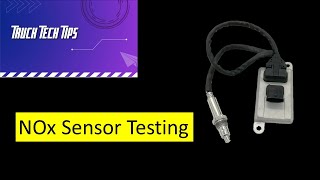
Shop the Parts Behind P2201
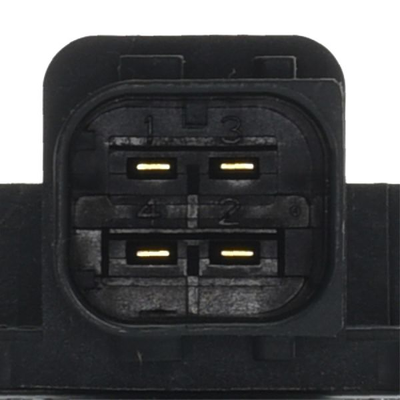
Below are the parts most often responsible for code P2201, ranked by how frequently each one is the actual culprit (per the diagnosis above). Tap any to see what we have for your vehicle.


The information in this article is provided for general reference and educational purposes only. Vehicle specifications, procedures, and part compatibility can vary by production date, trim level, and region. Always consult your vehicle's factory service manual and verify part numbers before purchasing or performing repairs. Safety-critical components such as airbags, seat belts, and braking systems should be installed by a qualified professional.
- 🧭 Diagnostic Flowchart
- 🎬 Helpful Videos
- 🛍️ Shop This Part
- What Does P2201 Mean?
- Can I Drive With P2201?
- Common Causes
- Symptoms
- Common Fixes & Costs
- Used vs. New Parts: Buying Guide
- What Happens If You Wait — Timeline
- Cost of Not Fixing It
- Diagnosis Steps
- When This Code Triggers (Freeze-Frame Conditions)
- Related Codes
- Climate & Environmental Factors
- How to Talk to a Mechanic About This Code
- Where to Take It: Dealer vs Independent vs Chain
- When to Walk Away From the Repair
- What Scan Tool You Need for This Code
- How to Clear the Code After You Fix It
- Will This Fail Emissions / State Inspection?
- Most Commonly Affected Vehicles
- Manufacturer-Specific Notes
- Real Owner Stories
- 2016 Ram 6.7L Cummins - The Software Fix
- 2014 Ram 2500 Cummins - The Aftermarket Trap
- 2014 Ram 2500 - The Unusual Cause
- How to Prevent This Code From Triggering
- Frequently Asked Questions
- What is the most common misdiagnosis for P2201?
- Can I clean a P2201 NOx sensor?
- Why did the code come back after I replaced the sensor?
- How is P2201 different from a downstream NOx code like P229F?
- Can I fix P2201 myself?
- Will P2201 clear itself?
- What is 'Bank 1'?
- Does bad diesel exhaust fluid (DEF) cause a P2201 code?
- Key Takeaways
- 🎟️ Get 5% Off