

P2227 on 2012-2018 Ford Focus 1.0L EcoBoost: Barometric Pressure Sensor Causes and Fixes
On a 2012-2018 Ford Focus with the 1.0L EcoBoost engine, code P2227 is almost always caused by a faulty Manifold Absolute Pressure (MAP) sensor. This engine uses two MAP/Boost sensors, and replacing the correct one is the most common fix. Expect to pay $40-$90 for an aftermarket sensor or $90-$160 for an OEM part.
- The P2227 code on a 1.0L EcoBoost Focus does not mean you have a separate Barometric Pressure sensor; the issue lies with one of the two Manifold Absolute Pressure (MAP) sensors.
- The most common fix is to replace the faulty MAP/boost sensor, most frequently the one located on the intake manifold.
- Symptoms often include stalling at idle, hesitation when accelerating, and a rough idle.
- Before replacing parts, use a scanner's live data to check the sensor readings with the key on and engine off to help identify the faulty component.
- Always inspect the wiring and connectors to the sensors for damage before buying new parts.
What's Unique About the 2012-2018 Ford Focus
Unlike the non-turbo Ford Focus engines which have one MAP sensor, the 1.0L EcoBoost engine has two pressure sensors that perform this function, often called MAP sensors or boost pressure sensors. One is located before the throttle body (on the charge pipe) and one is on the intake manifold itself. The P2227 code is triggered when the initial pressure reading from one of these sensors at key-on doesn't make sense to the computer, or doesn't correlate with other sensor readings once the engine is running. The problem is almost never a separate 'BARO sensor' because one does not exist on this specific vehicle; its function is integrated into the MAP sensors or the PCM itself.
Symptoms You May Notice
- Check Engine Light is on
- Engine stalling, especially when coming to a stop or at idle
- Stumbling or hesitation during acceleration
- Rough or erratic idle
- Reduced engine power and sluggish performance
- Decreased fuel economy
- Difficulty with gear shifting on automatic transmission models
- Replacing the Mass Airflow (MAF) sensor. While MAF issues can cause similar symptoms, the P2227 code specifically points to a fault in the barometric pressure circuit, which is directly related to the MAP sensors on this engine.
- Searching for a non-existent standalone Barometric Pressure (BARO) sensor. Mechanics unfamiliar with this Ford platform may waste time and money trying to locate a part that is not present.
Most Likely Causes
- Faulty Manifold Absolute Pressure (MAP) / Boost Sensor 🔴 High Probability → Shop Manifold Absolute Pressure Sensor The 1.0L EcoBoost relies on two of these sensors for accurate engine operation. Contamination from oil vapor in the intake system can lead to sensor failure over time. Given the turbocharged nature of the engine, these sensors are critical and subject to harsh conditions.
How to confirm: Using an OBD-II scanner with live data, turn the key on without starting the engine (KOEO). The 'MAP' and 'BARO' PID values should be nearly identical and match the local atmospheric pressure. If they differ significantly, or if one sensor's reading is erratic while the engine is running, it is likely faulty. 🎬 See how to easily diagnose a faulty MAP sensor A user on the Ford Owners Club forum with a 1.0L EcoBoost reported a MAP sensor reading of 111.0 kPa at KOEO, which may be high depending on altitude, indicating a potential sensor issue.
Typical fix: Replace the faulty MAP/Boost sensor. Since there are two, proper diagnosis is needed to identify which one has failed. Many owners choose to replace both as a preventative measure. 🎬 Watch this walkthrough on cleaning and replacing the manifold sensor The sensor on the intake manifold is often the primary culprit for BARO-related readings.
Est. part cost: $40-$160 per sensor - Damaged Wiring or Loose Connector 🟡 Medium Probability Engine vibrations and heat can cause wiring to become brittle or connectors to loosen over time. Ford has issued TSBs for wiring harness chafing issues on other EcoBoost platforms (like the EcoSport with the same 1.0L engine), indicating a potential weak point in harness routing near heat shields or the transmission.
How to confirm: Visually inspect the wiring harnesses and connectors for both MAP sensors. Look for any signs of chafing, corrosion, burnt spots, or loose pins. Use a multimeter to check for proper voltage (typically a 5V reference) and ground at the sensor connector.
Typical fix: Repair the damaged section of the wiring harness or replace the connector pigtail. Ensure the harness is routed away from sharp edges or hot exhaust components.
Est. part cost: $15-$50 for a connector pigtail
Rare But Worth Checking
- Vacuum Leak: A significant leak in the intake system (e.g., a cracked hose or bad gasket) can throw off pressure readings and potentially trigger a P2227 code, though it would often be accompanied by other codes like P0171 (System Too Lean).
- Faulty Powertrain Control Module (PCM): → Shop Engine Control Module (ECM) This is the least likely cause. On some Ford models, the BARO sensor is internal to the PCM. If this is the case and the internal sensor fails, the entire PCM would need replacement. However, on the 1.0L EcoBoost, the PCM infers BARO from the external MAP sensors, making PCM failure a very rare cause for this specific code. All other possibilities must be exhaustively ruled out before considering PCM replacement.
Diagnosis Steps
- Connect an OBD-II scanner and verify that P2227 is the primary code. Note any other codes present.
- Using the scanner's live data function, observe the 'MAP' and 'BARO' Parameter IDs (PIDs) with the Key On, Engine Off (KOEO). They should read very close to each other and correspond to your local atmospheric pressure (e.g., around 101 kPa or 14.7 PSI at sea level).
- Start the engine. The intake manifold MAP sensor reading should drop significantly at idle (e.g., to 30-50 kPa) and change instantly with throttle input. The charge pipe MAP/Boost sensor reading will react differently, showing vacuum at idle and positive pressure under boost.
- If a sensor reading is stuck, doesn't change, or is clearly incorrect at KOEO, suspect that sensor is faulty.
- Turn off the vehicle and locate both MAP/boost sensors. One is on the intake manifold, easily accessible on top of the engine. The other is on the charge pipe leading from the intercooler to the throttle body.
- Inspect the electrical connectors and wiring to both sensors for any visible damage, corrosion, or loose connections.
- If wiring looks good, the most likely cause is one of the sensors. Replace the sensor that provided suspect readings during the live data test. If unable to determine which is at fault, the intake manifold MAP sensor is the more common failure point for this code.
- Clear the codes and perform a test drive to see if the P2227 code returns.
Parts You'll Likely Need
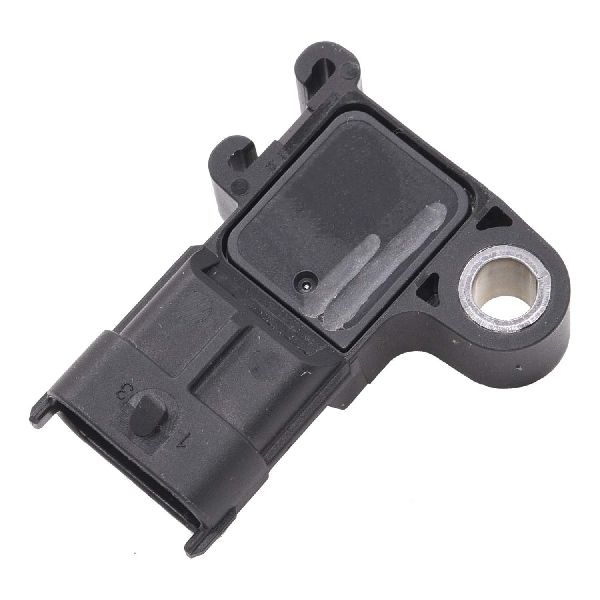
- Manifold Absolute Pressure (MAP) Sensor / Boost Pressure Sensor
(OEM #AG9Z-9F479-B (replaces AG9Z-9F479-A). Another possible part number is PV4Z-9F479-A. It is crucial to verify the correct part for your specific vehicle's VIN.)— This is the sensor the PCM uses to infer barometric pressure. A failure or incorrect reading from this component is the most common trigger for P2227 on this engine. The two sensors on the engine may have different part numbers.
Trusted brands: Motorcraft, Bosch, NGK, Standard Motor Products
OEM price range: $90-$160
Aftermarket price range: $40-$90
Related Codes That Often Appear With This One
- P0106 — This code directly relates to 'MAP/Barometric Pressure Circuit Range/Performance,' indicating the same sensor is providing irrational data while the engine is running.
- P0420 — Incorrect air/fuel mixtures caused by a bad MAP sensor can lead to inefficient catalytic converter operation, triggering the P0420 code over time. A user on 2CarPros reported this exact combination of codes.
- P0299 — This code indicates a turbocharger/supercharger underboost condition. Since one of the MAP sensors is also a boost pressure sensor, a fault in this sensor can lead to incorrect boost readings and trigger P0299 alongside P2227.
Technical Service Bulletins (TSBs) & Recalls
- TSB 19-2168: While for the 2018-2019 EcoSport with the same 1.0L engine, this TSB is relevant as it addresses an illuminated MIL with various DTCs caused by the engine control harness chafing between the transmission and exhaust heat shield. This highlights a known potential for wiring issues on this powertrain.
Platform-Specific Known Issues
- Which Sensor to Replace?: Owners often struggle to identify which of the two MAP sensors is causing the P2227 code. The sensor located on the plastic intake manifold is the one the PCM primarily uses for the KOEO (Key On, Engine Off) barometric reading. Therefore, it is the most likely culprit. The second sensor, located on the charge air cooler pipe before the throttle body, primarily measures turbo boost pressure.
Mechanic-Grade Diagnostic Values
- MAP Sensor 5V Reference Wire Voltage — expected: 4.8V to 5.2V (Key On, Engine Off, measured at the sensor connector harness side). Failure: Voltage below 4.8V or above 5.2V indicates a problem with the wiring harness or the PCM.
- MAP Sensor Ground Circuit Resistance — expected: < 0.5 Ohms (measured between the ground pin on the connector and a known good chassis ground). Failure: Resistance higher than 0.5 Ohms points to a corroded or loose ground connection.
- MAP Sensor Signal Voltage (Key On, Engine Off) — expected: ~4.5V at sea level. This voltage should correspond directly to the local barometric pressure.. Failure: A voltage that is significantly different from the expected value for the current altitude, or is stuck high or low, indicates a faulty sensor.
- MAP Sensor Signal Voltage (Engine Idling, Warm) — expected: 1.0V to 1.5V. The voltage should respond instantly to throttle changes.. Failure: Voltage that does not drop from the KOEO reading, or is unresponsive to throttle input, points to a failed sensor or a vacuum leak.
Scan Tool Commands That Help
- Ford IDS / FORScan: Live Data / Datalogger — This is the primary diagnostic function. Monitor the 'MAP' and 'BARO' PIDs to compare their readings at KOEO and to observe the MAP sensor's response to throttle input while the engine is running. This is the fastest way to identify an illogical sensor reading.
- Ford IDS: Reset All Adaptations — After replacing a MAP sensor that has caused long-term incorrect fuel trims, it can be beneficial to reset the PCM's adaptive learning tables to force it to relearn values with the new, accurate sensor data.
Wiring & Ground Locations
- MAP Sensor Connector (Intake Manifold) — On top of the plastic intake manifold, easily visible after removing the engine cover. It is a 3-pin connector.. This is the primary connection point for the sensor that provides the BARO reading. All electrical tests (power, ground, signal) should start here. The typical pinout is Pin A: Ground, Pin B: Signal, Pin C: +5V Reference.
- Engine Bay Chassis Ground — A common ground point for the engine harness is located on the chassis frame rail, often under or near the airbox/battery tray.. A loose or corroded ground at this location can create a high-resistance path for multiple sensors, including the MAP sensor, leading to erratic readings and fault codes.
- Cylinder Head Ground — A main ground strap for the engine harness bolts to the rear, right, lower corner of the cylinder head.. This is a critical engine ground. If it was not properly re-secured after previous engine work, it can cause unstable sensor reference voltages and trigger various difficult-to-diagnose electrical faults, including P2227.
Real Owner Repair Stories
- 2CarPros.com Forum User (2016 Ford Focus 1.0L Turbo) — Stalling at idle, Check Engine Light with codes P2227 and P0420.
❌ Tried (didn't work) Cleaning the MAF sensor, Cleaning the throttle body
✅ What actually fixed it The user reported that the P2227 code stopped appearing after they cleaned both MAP sensors (the one on the intake manifold and the one on the charge pipe). While this is not a part replacement, it suggests that contamination on the sensor element was the root cause in this case. - NHTSA ODI #11219158 — An owner reported that while attempting to figure out an issue, they plugged a reader into the car to test for error codes and found P0100, P2227, and P0456 were all present.
OEM Part Supersession History
Multiple (DV2Z-9F479-C, DV2Z-9F479-D, GV2Z-9F479-D, CX2494, CX2657)→PV4Z-9F479-A— Standard part consolidation and potential design revisions by Ford.
Heads up: Always verify the correct part number using the vehicle's VIN. While these parts may be physically similar, internal calibration could differ. Using an incorrect sensor can lead to persistent performance issues even if the code is cleared.AG9Z-9F479-A→AG9Z-9F479-B— Revision of the part by the manufacturer.
Heads up: AG9Z-9F479-B is the direct replacement for -A. These may be specific to one of the two sensor locations (intake manifold vs. charge pipe).
Model Year Variations Within This Range
- 2015-2018 (North America): The 1.0L EcoBoost engine was only offered in the North American Ford Focus from the 2015 model year onward, which coincided with the mid-generation facelift. While minor engine changes occurred during this period, such as the addition of a cylinder head temp sensor, the dual MAP sensor strategy and the diagnostic approach for P2227 remained consistent.
Diagnostic Flowchart
Other Known Issues on This Vehicle
Issues unrelated to this code that are worth knowing about as an owner of this generation:
- Timing Belt-in-Oil ('Wet Belt') Degradation 🔴 High — Can occur as early as 60,000-80,000 miles, despite a much longer recommended service interval. Risk increases with missed or incorrect oil changes. (Ref: Ford has issued recalls and revised service intervals in some regions. Failure to replace it can lead to the belt disintegrating, clogging the oil pump pickup tube, and causing catastrophic engine failure.)
- DPS6 'PowerShift' Automatic Transmission Failure 🔴 High — Extremely common on 2012-2018 Focus models with automatic transmissions. Problems include shuddering, hesitation, slipping, and complete failure to engage. (Ref: Subject of multiple class-action lawsuits and numerous TSBs (e.g., TSB 16-0129). Ford extended the warranty on certain components for affected vehicles.)
- Coolant System Leaks & Overheating 🔴 High — Particularly prevalent in earlier models (approx. 2012-2015). The plastic 'degas' hose from the coolant reservoir was prone to cracking, leading to rapid coolant loss and engine overheating. (Ref: A recall was issued to replace the faulty hose with an updated part.)
- Carbon Buildup on Intake Valves 🟠 Medium — Common to all direct-injection engines, including the 1.0L EcoBoost. Over time, carbon deposits can build up on the intake valves, leading to rough idling, misfires, and reduced performance.
Used vs. New Parts: Buying Guide for This Vehicle
When a used part is the smart pick: For this specific repair, buying a used MAP sensor is not recommended. These are relatively low-cost electronic components that are prone to failure from heat and oil vapor contamination. The potential savings are minimal compared to the risk of receiving a part that is already failing or has a short remaining lifespan.
Donor-vehicle mileage cap: roughly under 30000 miles for the part to have meaningful remaining life.
What to inspect on the donor part:
- Ensure the donor vehicle was not in a front-end collision.
- Inspect the sensor's plastic housing for any cracks or heat damage.
- Check the electrical connector pins for any signs of corrosion or moisture intrusion.
- Ask for the donor vehicle's mileage; lower is always better for electronic sensors.
Aftermarket brands forum-validated for this vehicle:
- Bosch
- NGK / NTK
- Standard Motor Products (SMP)
Brands owners have reported issues with on this vehicle:
- No-name, unbranded sensors from online marketplaces should be avoided, as their calibration and longevity are often questionable.
Real Owner Stories
Aggregated from forums and TSBs cited above. Mileages and costs reflect what owners reported in those sources.
2016 Ford Focus 1.0L EcoBoost
Symptoms: Stalling at idle and an illuminated check engine light.
What fixed it: The owner attempted cleaning the throttle body, turbo, and MAP sensors, but the BARO-related issue persisted as the sensor is an inferred value from the MAP sensors.
Source hint: 2CarPros - '2016 Ford Focus Code P2227, Barometric Pressure Sensor Causing Stalling at Idle'
Ford Focus 1.0L EcoBoost
Symptoms: Stumbling on acceleration and difficulty with gear shifting on the automatic transmission.
What fixed it: Diagnosis via OBD-II scanner showed a MAP sensor reading of 111.0 kPa at KOEO, indicating a faulty sensor.
Source hint: Ford Owners Club - 'P2227 error code on ford focus ecoboost 1.0 engine'
2013 Ford Focus
Symptoms: Multiple error codes appearing simultaneously during a diagnostic check.
What fixed it: According to NHTSA ODI #11219158, an owner discovered codes P0100, P2227, and P0456 while testing for issues with a code reader.
Source hint: NHTSA ODI #11219158
Related OBD-II Codes
Frequently Asked Questions
Where is the barometric pressure sensor located on my 2012-2018 Ford Focus 1.0L EcoBoost?
Which of the two MAP sensors is most likely causing the P2227 code?
Could my Focus's stalling at idle be related to P2227?
Does TSB 19-2168 apply to my Ford Focus?
How can I use a scanner to confirm if a sensor is bad on my 1.0L EcoBoost?
Is there a known issue with the wiring harness on this engine?
Helpful Videos
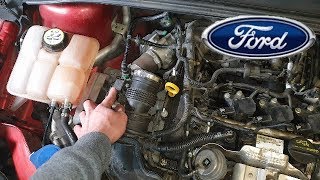
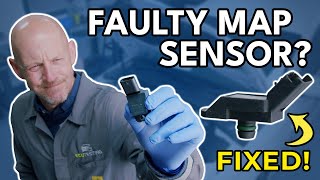

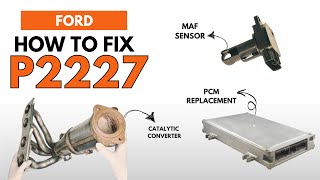
We Have This Part in Stock


The information in this article is provided for general reference and educational purposes only. Vehicle specifications, procedures, and part compatibility can vary by production date, trim level, and region. Always consult your vehicle's factory service manual and verify part numbers before purchasing or performing repairs. Safety-critical components such as airbags, seat belts, and braking systems should be installed by a qualified professional.
- Ford Focus:
- 🧭 Diagnostic Flowchart
- 🎬 Helpful Videos
- 🛍️ Shop This Part
- What's Unique About the 2012-2018 Ford Focus
- Symptoms You May Notice
- Most Likely Causes
- Rare But Worth Checking
- Diagnosis Steps
- Parts You'll Likely Need
- Related Codes That Often Appear With This One
- Technical Service Bulletins (TSBs) & Recalls
- Platform-Specific Known Issues
- Mechanic-Grade Diagnostic Values
- Scan Tool Commands That Help
- Wiring & Ground Locations
- Real Owner Repair Stories
- OEM Part Supersession History
- Model Year Variations Within This Range
- Other Known Issues on This Vehicle
- Used vs. New Parts: Buying Guide for This Vehicle
- Real Owner Stories
- 2016 Ford Focus 1.0L EcoBoost
- Ford Focus 1.0L EcoBoost
- 2013 Ford Focus
- Related OBD-II Codes
- Frequently Asked Questions
- 🎟️ Get 5% Off