

OBD-II Code P2261: Turbocharger/Supercharger Bypass Valve 'A' Mechanical
What P2261 means, why it triggers, and how to fix it
- Code P2261 flags a mechanical failure where the turbo's bypass valve is physically stuck open, stuck closed, or leaking.
- Expect an immediate 50% or greater loss of engine power, 'Limp Mode' activation, and a distinct fluttering noise when lifting off the throttle.
- Stop driving immediately to prevent a stuck valve from destroying the turbocharger bearings, which costs $1,500 to $3,000 to replace.
- Test the $50 control solenoid and inspect vacuum lines for cracks before authorizing a $2,000 turbocharger replacement.
What Does P2261 Mean?

The P2261 code means the Powertrain Control Module (PCM) detects a mechanical failure in the turbocharger or supercharger bypass valve. This valve manages boost pressure by opening to release excess pressure when you lift off the accelerator, protecting the turbo from damaging surges. When the PCM detects the valve is stuck open, stuck closed, or moving too slowly, it triggers P2261 and illuminates the Check Engine Light.
Technical definition: The SAE/OBD-II definition is "Turbocharger/Supercharger Bypass Valve 'A' – Mechanical". The PCM diagnoses this by comparing expected boost pressure and airflow against actual readings from the Manifold Absolute Pressure (MAP) and Mass Airflow (MAF) sensors. When the valve's actual position fails to match its commanded position, resulting in an unexpected pressure reading, the PCM logs a mechanical fault rather than an electrical circuit error.
Can I Drive With P2261?
No — Do Not Drive. Do not drive the vehicle. The car will have severely reduced power and enter 'Limp Mode.' Continuing to drive with a faulty bypass valve causes serious, expensive damage. A stuck-closed valve causes turbo over-speed and dangerous overboost conditions, destroying engine internals. A stuck-open valve causes the turbo to freewheel without load, leading to rapid bearing failure. Both scenarios destroy the turbocharger, requiring a $1,500 to $3,000 repair.
Common Causes

- Faulty or sticking turbocharger bypass valve (Very Common) — The valve's diaphragm tears or the piston seizes due to carbon buildup, internal spring failure, or oil contamination, physically preventing it from moving.
- Faulty bypass valve control solenoid (Common) — The electronic solenoid fails mechanically or electrically, preventing it from directing the necessary vacuum to open or close the valve.
- Cracked or disconnected vacuum lines (Common) — Rubber hoses supplying vacuum crack, disconnect, or leak, preventing the actuator from receiving the vacuum signal needed to operate the valve.
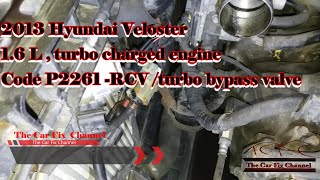
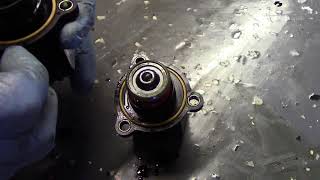
- Contaminated charge air system (Common) — In cold weather, ice, water, and oil sludge accumulate in the charge air cooler or bypass valve, freezing it shut. This is a documented issue on GM 1.4L engines. 🎬 See this quick fix for the Veloster P2261 code
- Incorrectly installed aftermarket blow-off valve (BOV) (Less Common) — Aftermarket BOVs with incorrect spring tension open too soon or leak, causing the ECU to detect a deviation from expected boost parameters.
- Cracked intake manifold (Less Common) — A cracked intake manifold creates a vacuum leak that mimics a bypass valve issue, often triggering P2261 alongside a P0171 lean code.
- Faulty Powertrain Control Module (PCM) (Rare) — The PCM fails and logs false codes. GM TSB #23-NA-033 notes a faulty ECM causes P2261 on some 2023-2024 models due to repetitive back voltages.
Symptoms

- Significant loss of engine power — The vehicle accelerates very slowly because the turbo fails to provide the correct amount of boost.
- Vehicle enters 'Limp Mode' — The PCM restricts engine RPM and vehicle speed to prevent engine damage from overboost or underboost.
- Unusual fluttering noises — A stuck-closed valve causes a fluttering or chattering sound on throttle lift-off, known as compressor surge.
- Hissing sounds — A hissing noise from the engine bay indicates a leak in the vacuum lines controlling the bypass valve or a leak in the intake tract.
- Smoke from exhaust — Increased crankcase pressure forces oil past seals or into the combustion chamber, resulting in visible exhaust smoke.
- Check Engine Light is on (also visible on scanner) — The Malfunction Indicator Lamp (MIL) illuminates on the dashboard.
Diagnostic Flowchart

Tap your situation to follow the diagnostic path that matches what you're seeing on this code.
Common Fixes & Costs
- Replace the Bypass Valve Control Solenoid — Parts: $35-$120, Labor: $50-$150, ~0.8 hr book time (DIY)
- Replace the Turbocharger Bypass Valve (Diverter Valve) — Parts: $40-$150, Labor: $150-$300, ~1.5 hr book time (Intermediate)
- Repair or Replace Leaking Vacuum Hoses — Parts: $10-$40, Labor: $50-$125, ~0.5 hr book time (DIY)
- Clean Contaminated Bypass Valve and Charge Air System — Parts: $15, Labor: $150-$300, ~1.5 hr book time (Intermediate)
- Replace Cracked Intake Manifold — Parts: $150-$400, Labor: $250-$450, ~3.5 hr book time (Advanced)
DIY vs Professional
- Replace Leaking Vacuum Hoses — Beginner: Yes
Tools: Pliers, hose cutters. - Replace the Bypass Valve Control Solenoid — Beginner: Yes
Tools: Basic socket/ratchet set, pliers. - Replace the Turbocharger Bypass Valve — Beginner: No, Intermediate skill recommended.
Tools: Socket set, Torx/E-Torx sockets, extensions, jack and jack stands. - Replace Cracked Intake Manifold — Beginner: No, Advanced skill required.
Tools: Extensive socket set, E-Torx sockets, torque wrench, fuel line disconnect tools.
Used vs. New Parts: Buying Guide
When a used part is worth it: Buying used rarely makes sense. These parts fail due to wear (torn diaphragms) or electrical faults. A used part has an unknown history and a high likelihood of early failure.
Donor-vehicle mileage cap: roughly under 40000 miles for the part to have meaningful remaining life.
Donor quality checklist:
- Match the part number exactly, especially for VW/Audi parts with multiple revisions.
- Avoid parts from high-mileage vehicles or regions with extreme temperatures.
- Ensure the part comes with at least a 90-day warranty.
Decision logic:
- If The part is a diaphragm-style diverter valve → Always buy new, specifically the latest upgraded piston-style revision. A used diaphragm valve is a ticking time bomb.
- If The part is an electronic control solenoid → Buy new OEM or a reputable aftermarket brand. The failure is electronic and invisible, making used parts a gamble.
- If The cost of a new part is less than $150 → Buy new. The cost of re-doing the labor ($150-$300) outweighs any savings from a used part.
Warranty tradeoff: Used parts offer a 30-90 day warranty. New aftermarket parts come with a 1-year to limited lifetime warranty. New OEM parts carry a 1-2 year warranty.
Worst-case if a used part fails: $200-$400 if a used part fails shortly after installation, primarily due to repeated labor costs.
What Happens If You Wait — Timeline
- 0-1 month: Intermittent fault. Check Engine Light turns on and off. A 'pending' code is stored. No noticeable symptoms, or a slight hesitation on throttle lift-off. (MPG impact: 0-2%% · Added cost: $0)
- 1-3 months: Consistent fault. Check Engine Light stays on. Vehicle enters 'Limp Mode' under hard acceleration. Noticeable loss of power and audible fluttering noises occur. (MPG impact: 5-10%% · Added cost: $50-$150 in wasted fuel.)
- 3-6 months: Component damage begins. Repeated compressor surge causes severe stress on turbocharger bearings. Limp mode is constant, and the car is sluggish. (MPG impact: 10-20%% · Added cost: $250-$500 (Cost of the initial repair) + increasing risk of turbo damage.)
- 6+ months: Catastrophic turbocharger failure. Turbo bearings fail completely. The compressor wheel shatters, sending metal fragments into the engine cylinders. (MPG impact: >25% (if drivable)% · Added cost: $2,000-$7,000+ (Cost of a new turbocharger and potential engine replacement).)
Cost of Not Fixing It
- Immediate (0-1 month): Severe loss of power and vehicle in 'limp mode.' A stuck-closed valve causes dangerous compressor surge, putting immediate stress on turbo bearings. (Added cost: Negligible, but the car is borderline undrivable.)
- Short-Term (1-3 months): Continued operation destroys the turbocharger. Compressor surge hammers the bearings, or a stuck-open valve causes the turbo to overspeed with no load. Oil seals fail, leaking oil into the intake. (Added cost: $1,500-$4,000 for a replacement turbocharger assembly, plus labor.)
- Long-Term (3+ months): Catastrophic turbo failure. The compressor wheel shatters, sending metal fragments into the intercooler and engine cylinders, destroying the engine. (Added cost: $4,000-$8,000+ for a replacement engine and turbocharger.)
Diagnosis Steps
- Scan for Codes and Review Live Data
Use an OBD-II scanner to confirm P2261 and record related codes. Monitor live data PIDs for Boost Pressure Command vs. Actual Boost Pressure. At idle, boost should be near 0 PSI. When driving, actual boost must closely follow commanded boost. A large discrepancy confirms the mechanical fault.
Tools: OBD-II Scanner (Beginner) - Thorough Visual Inspection
Inspect all vacuum lines running to and from the bypass valve solenoid and actuator. Look for cracks, kinks, or disconnections. Check the electrical connector on the control solenoid for corrosion.
Tools: Flashlight, Inspection Mirror (Beginner) - Audible 'Snap Throttle' Test
With the vehicle in park and the engine running, quickly rev the engine to 3,000 RPM and snap the throttle closed. Listen for a distinct fluttering or chattering sound. This noise confirms compressor surge caused by a stuck-closed bypass valve.
Tools: None (Beginner) - Test Vacuum System with a Gauge
Connect a vacuum pump to the line going to the bypass valve actuator. Apply vacuum; the actuator rod must move and hold 15-20 inHg steadily. If it bleeds down, the internal diaphragm is torn. Test the vacuum supply line from the solenoid for a strong pulse when the throttle snaps shut.
Tools: Vacuum Gauge and Pump (Intermediate) - Test Control Solenoid Functionality
Use a bi-directional scanner to command the bypass solenoid on and off; listen for an audible click. Alternatively, apply 12V directly to the solenoid's terminals. No click confirms a mechanically failed solenoid.
Tools: Advanced Bi-Directional OBD-II Scanner or 12V Power Probe (Intermediate) - Test Solenoid Electrical Resistance
Disconnect the solenoid and set a multimeter to Ohms (Ω). Measure the resistance between the two terminals. Compare this to the manufacturer's specification (typically 20-60 Ohms). A reading that is significantly higher, lower, or open ('OL') confirms a faulty internal coil.
Tools: Multimeter (Advanced) - Remove and Inspect the Bypass Valve
Remove the valve from the turbocharger. Inspect for a torn diaphragm, heavy carbon buildup, or physical damage. Manually push the valve piston; it must move smoothly and return instantly under spring pressure.
Tools: Socket set, Torx bits/Allen keys (Advanced) - Check for Boost Leaks
If all components pass testing, a boost leak is causing the PCM to misinterpret the bypass valve's function. Fill the intake and charge pipes with pressurized smoke to reveal hidden leaks.
Tools: Smoke Machine (Advanced)
When This Code Triggers (Freeze-Frame Conditions)
- Engine Coolant Temp: 180-210°F (The engine is fully warmed up to normal operating temperature.)
- RPM: 2000-3000 RPM (The fault is detected during steady-state cruising or light acceleration/deceleration events where the PCM expects a specific valve response.)
- Engine Load: 25-50% (The code sets under partial load conditions, not necessarily full throttle, as the PCM tests the valve's transitional movement.)
- Vehicle Speed: 45-65 mph (Highway driving conditions provide a stable environment for the PCM to run its diagnostic tests on the boost control system.)
Related Codes
- P0299 — This 'Underboost' code is a common partner to P2261. It logs when the bypass valve is stuck open, causing boost pressure to continuously leak out. P2261 is the cause, P0299 is the effect.
- P0234 — This 'Overboost' code triggers if the bypass valve is stuck closed. The valve fails to vent excess pressure, causing a dangerous spike in boost.
- P0033, P0034, P0035 — These codes point to an electrical fault in the bypass valve control solenoid circuit. If you have these WITH P2261, the problem is electrical. If you ONLY have P2261, the problem is mechanical.
- P0171 — This 'System Too Lean' code often appears on the Chevy Cruze 1.4T due to a cracked intake manifold. The resulting vacuum leak affects the bypass valve supply, triggering P2261 as a secondary code.
Climate & Environmental Factors
- Cold Weather: In freezing temperatures, condensation mixed with oil vapor forms an icy sludge in the charge air cooler and bypass valve. This freezes the valve shut, directly triggering P2261. GM issued TSB #22-NA-067 to address this specific issue.
- High Altitude: Turbocharged engines spin the turbo faster at high altitudes to compensate for lower air density. This forces the bypass valve to work harder and more frequently, making the symptoms of a pre-existing fault much more noticeable.
How to Talk to a Mechanic About This Code
Say this: "I have an OBD-II code P2261 for a mechanical turbo bypass valve fault, and I'm experiencing a loss of power. Please start by inspecting the vacuum lines, control solenoid, and the bypass valve itself before recommending a full turbo replacement."
This directs the technician to perform a logical, cost-effective diagnosis instead of jumping to the most expensive conclusion (replacing the turbo).
Avoid saying:
- 'My turbo is broken.'
- 'My check engine light is on, can you look at it?'
- 'Just replace whatever is needed.'
Questions to ask before authorizing the repair:
- Did you test the bypass valve actuator with a vacuum pump? Did it hold vacuum?
- Did you test the control solenoid? Does it click when activated and is the resistance within spec?
- Can you show me the failed part and explain why it needs to be replaced?
- Is this repair covered by any warranty or Technical Service Bulletin (TSB)?
- What is the warranty on the new parts and your labor?
Where to Take It: Dealer vs Independent vs Chain
- Dealer:
Best for: Vehicles still under powertrain or emissions warranty., Newer vehicles with known TSBs., Complex diagnostics on German brands (VW, Audi, BMW) requiring specialized tools.
Downsides: Significantly higher labor rates, often 1.5-2x that of an independent shop., May be quicker to recommend replacing the entire turbo assembly. (Typical cost: +50% vs. baseline) - Independent Shop:
Best fit for most out-of-warranty scenarios. A reputable independent shop diagnoses this cost-effectively by focusing on the likely culprits (valve, solenoid, hoses) first.
Best for: Out-of-warranty vehicles where cost is a major factor., Common turbo vehicles (Cruze, Veloster, GTI) where mechanics have seen the fault many times., Finding a shop that specializes in turbo systems.
Downsides: Quality and experience vary widely., May lack access to the very latest TSBs or brand-specific software. (Typical cost: +0% vs. baseline) - Chain Shop:
AVOID for P2261 diagnosis. The risk of misdiagnosis (recommending a new turbo for a simple vacuum leak) is very high.
Best for: Simple jobs like oil changes and tire rotations.
Downsides: Technician skill for complex diagnostics is highly variable., Lack specialized tools and experience required for turbo system diagnosis., High pressure to upsell leads to misdiagnosis and unnecessary repairs. (Typical cost: -10% vs. baseline)
When to Walk Away From the Repair
If the total estimated repair cost for the P2261 fault exceeds 50% of your car's current private-party market value, seriously consider selling the car as-is rather than repairing it.
- Car worth $5000, fix is $2500: Walk away. The repair cost is half the car's value, and you will not recoup that investment.
- Car worth $15000, fix is $1800: Fix it. The repair cost is a small fraction of the vehicle's value and is necessary for it to run properly.
- Car worth $3000, fix is $800: Borderline. The repair is a significant percentage of the car's value. Get a second opinion to confirm the diagnosis.
What Scan Tool You Need for This Code
Minimum: A scanner that reads live data for boost pressure and commands the bypass valve solenoid (bi-directional control).
A basic $20 code reader only shows the P2261 code. It cannot display live boost pressure readings to see if the valve is stuck, nor can it test the control solenoid.
Budget: BlueDriver Pro (~$100) — Reads and clears the code, and displays live data for boost pressure, engine RPM, and throttle position to observe system behavior.
Mid-range: Foxwell NT510 Elite (~$180) — Includes full live data capabilities plus bi-directional control. This allows you to command the bypass valve solenoid on and off directly from the scanner.
Professional: Autel MaxiCOM MK808S (~$450-550) — Offers robust bi-directional control, comprehensive OE-level diagnostics, and access to all vehicle modules to diagnose complex scenarios.
Rent vs buy: Auto parts stores scan codes for free, but their tools are basic. To properly diagnose P2261, buy at least a mid-range scanner with live data and bi-directional control.
How to Clear the Code After You Fix It
- Use an OBD-II scan tool to clear the P2261 code and any related fault codes.
- Perform a complete drive cycle to allow the vehicle's onboard computer to re-run its readiness monitors.
- Do not disconnect the battery, as this clears all readiness monitors and requires a much longer drive cycle to reset them.
Drive cycle (~20 minutes): Start with a cold engine. Idle for 3 minutes with electrical loads on. Accelerate to 55 mph and hold steady for 5 minutes. Decelerate to 20 mph without braking. Accelerate to 60 mph and hold for 5 minutes. Finish with 5 minutes of stop-and-go city driving.
Readiness monitors affected: Catalyst Monitor, Evaporative System (EVAP) Monitor, Oxygen (O2) Sensor Monitor, Comprehensive Component Monitor
Before emissions retest: drive at least 50 miles to fully set monitors.
Watch out for:
- Clearing the code without fixing the mechanical problem causes the code to return immediately.
- Failing to complete a full drive cycle results in a 'Not Ready' status, causing an automatic smog test failure.
- The EVAP monitor requires the fuel tank to be between 1/4 and 3/4 full to run.
Will This Fail Emissions / State Inspection?
Yes — this code typically fails an OBD-II emissions inspection.
- California: An active P2261 code is an automatic smog check failure. After repair, a complete drive cycle must set all readiness monitors before a re-test.
- New York: An illuminated MIL for P2261 results in an immediate NYS DMV safety/emissions inspection failure.
- Texas: In the 17 emissions-testing counties, an active P2261 code causes the vehicle to fail the OBD-II portion of the annual inspection.
Most Commonly Affected Vehicles
- Hyundai Veloster Turbo, Elantra Sport, Genesis Coupe (2012-2019) — The electronic control solenoid is a frequent point of failure, with many owners upgrading to aftermarket MAC valves.
- Chevrolet Cruze, Sonic, Trax & Buick Encore (2011-2020) — Very common on the 1.4L engine. GM TSB #22-NA-067 points to ice/sludge contamination. A cracked intake manifold or failed PCV check valve are also frequent root causes.
- Volkswagen/Audi GTI, A4, Passat, A3 (2.0T TSI/FSI) (2008-2015) — The original diaphragm-style diverter valve is notoriously prone to tearing. Replace with the upgraded piston-style 'Revision D' valve (part #06H145710D).
- Ford Focus ST, Fiesta ST, Mustang EcoBoost (2013-Present) — A frequent cause of P2261 is the installation of an aftermarket blow-off valve (BOV) whose operation differs from the stock unit, which the ECU flags as a mechanical fault.
- Honda Civic (Si, Type R), Accord (1.5T/2.0T) (2017-Present) — This code appears due to a stuck bypass control valve. Recurring issues have led to the replacement of the entire turbocharger assembly under warranty.
- Subaru Impreza WRX (2008-2014) — The high-performance nature of these vehicles leads to frequent issues with the bypass valve struggling to handle higher-than-stock boost levels.
- BMW Various models with N20/N55 engines (2011-2017) — Failures are usually caused by torn diaphragms or electrical issues within the electronic diverter valve motor, leading to underboost conditions.
- Chevrolet Equinox, Malibu (2023-2024) — GM TSB #23-NA-033 identifies a faulty Engine Control Module (ECM) as a cause for P2261, covered under the federal emissions warranty.
Manufacturer-Specific Notes
- Hyundai/Kia: The electronic control solenoid is a major failure point, often more so than the valve itself. Owners frequently fix the code permanently by installing a robust aftermarket MAC valve solenoid kit.
- Volkswagen/Audi: Original diaphragm-style diverter valves are a wear item. Upgrading to the durable piston-style design (Revision 'D' #06H145710D) is critical to prevent future failure.
- General Motors (Chevrolet/Buick): GM has multiple TSBs for P2261. TSB #22-NA-067 addresses system icing in cold weather. TSB #23-NA-033 points to a faulty ECM on 2023-24 models. Older models suffer from cracked intake manifolds causing the code.
- Ford (EcoBoost): The PCM expects a closed-loop system. Installing an aftermarket blow-off valve (BOV) that vents to the atmosphere triggers P2261 because the ECU flags the atmospheric venting as a mechanical fault.
Real Owner Stories
2013 Chevy Cruze 1.4T with 110K miles
Check Engine Light on with P2261 and P0299 (Underboost). Car felt sluggish and jerked when the A/C was on.
What they tried:
- Replaced the bypass control solenoid twice.
- Replaced the entire intake manifold assembly.
- Installed a PCV fix kit.
Outcome: The issue was a tiny, cracked rubber 90-degree elbow on the vacuum line running from the intake manifold to the bypass valve. Replacing this $15 hose resolved the code.
Lesson: Always start with the cheapest potential failures. A tiny vacuum hose causes the same codes as a major component. Inspect all vacuum lines before replacing expensive parts.
2017 VW GTI with aftermarket tune
Car drove perfectly fine, but a routine scan revealed a stored P2261 fault code with no Check Engine Light.
What they tried:
- Initially suspected a cracked OEM diverter valve.
Outcome: The owner discovered that aftermarket Blow-Off Valves (BOVs) or tunes cause a 'soft' P2261 code. The ECU detects the valve operates differently from stock parameters and logs the fault, even if working correctly.
Lesson: If you have an aftermarket BOV or engine tune, a P2261 code without symptoms is likely a 'ghost' code caused by the modification, not a true failure.
2014 Hyundai Veloster Turbo
Sudden loss of power, limp mode, and P2261 code. The car barely accelerated.
What they tried:
- Suspected the mechanical diverter valve on the turbo failed.
Outcome: The problem was a failed electronic bypass control solenoid. The owner replaced the OEM solenoid with a robust aftermarket MAC solenoid, permanently fixing the issue.
Lesson: On Hyundai/Kia vehicles, the control solenoid fails more often than the mechanical valve. Test the solenoid's function before assuming the labor-intensive diverter valve needs replacement.
2024 Chevrolet Equinox with 15K miles
Check Engine Light came on with P2261, accompanied by a rattling noise during a cold start.
What they tried:
- Dealership initially considered replacing the turbocharger bypass valve.
Outcome: The technician referenced GM TSB #23-NA-033, identifying a faulty Engine Control Module (ECM) as the root cause. The ECM was replaced under the federal emissions warranty, resolving the code and rattle.
Lesson: For newer vehicles, always check for Technical Service Bulletins (TSBs). A known software defect is often covered by warranty, saving thousands in unnecessary repairs.
How to Prevent This Code From Triggering
- Use high-quality, Top Tier gasoline (Every fill-up) — Top Tier fuels contain detergents that prevent carbon deposits. Cleaner combustion reduces soot that contaminates the PCV and turbo systems.
- Perform regular oil changes with the correct spec oil (Every 5,000-7,500 miles) — Fresh oil is essential for turbocharger bearing life. Old oil contributes to sludge that clogs PCV passages and causes the bypass valve to stick.
- Inspect or replace the PCV valve/system (Inspect every 30,000 miles, replace by 60,000 miles) — A failing PCV system allows excessive oil vapor into the intake, leading to carbon buildup that directly causes the bypass valve to stick.
- Perform periodic 'Italian tune-ups' (Once or twice a month) — Driving at higher RPMs increases temperatures in the intake and exhaust, burning off soft carbon deposits before they cause parts to seize.
- Install an oil catch can (One-time installation) — An oil catch can intercepts oil vapor from the PCV system, significantly reducing the oil that bakes onto the bypass valve.
Frequently Asked Questions
What is a turbo bypass valve?
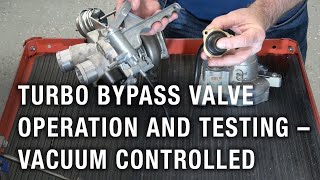
A turbo bypass valve is a pressure relief device. When you suddenly close the throttle, the valve opens to reroute pressurized air back to the turbo's inlet. This prevents a pressure wave from surging back and damaging the turbo's bearings.
What's the difference between a bypass valve and a blow-off valve?
A bypass valve recirculates air back into the intake system, keeping it quiet and metered. A blow-off valve (BOV) vents air to the atmosphere, creating a loud 'pssssh' sound. Most factory cars use recirculating bypass valves.
Can I just clear the code and keep driving?
No. The code will return immediately, and ignoring it risks catastrophic turbocharger failure that costs thousands to repair.
Is a P2261 repair expensive?
A professional diagnosis costs $100-$200, while replacing the valve or solenoid ranges from $250 to $500. Avoid the common mistake of replacing the entire $1,500-$3,000 turbocharger without testing these smaller components first.
What are the most common misdiagnosis mistakes for P2261?
The biggest mistake is replacing the entire turbocharger assembly when only an inexpensive control solenoid or vacuum line failed. On GM vehicles, mechanics often replace the valve when the true cause is a cracked intake manifold.
I installed an aftermarket blow-off valve (BOV) and now I have this code. Why?
The car's computer is calibrated for the precise flow characteristics of the factory valve. An aftermarket BOV operates differently, causing the ECU to detect an unexpected pressure drop and flag it as a mechanical failure.
What does a failing bypass valve sound like?
A stuck-closed valve causes a repetitive fluttering noise (compressor surge) when you let off the gas. A torn diaphragm causes a sound like a 'honking seagull' under light throttle.
Can a bad PCV valve cause P2261?
Yes. A failed PCV check valve allows excessive oil vapor into the intake, leading to sludge buildup that physically jams the bypass valve, triggering P2261.
Key Takeaways
- Code P2261 flags a mechanical failure where the turbo's bypass valve is physically stuck open, stuck closed, or leaking.
- Expect an immediate 50% or greater loss of engine power, 'Limp Mode' activation, and a distinct fluttering noise when lifting off the throttle.
- Stop driving immediately to prevent a stuck valve from destroying the turbocharger bearings, which costs $1,500 to $3,000 to replace.
- Test the $50 control solenoid and inspect vacuum lines for cracks before authorizing a $2,000 turbocharger replacement.
Helpful Videos


Shop the Parts Behind P2261
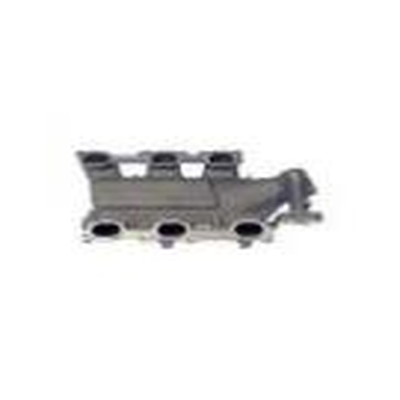
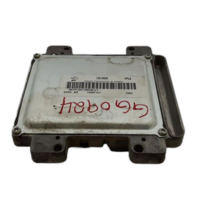
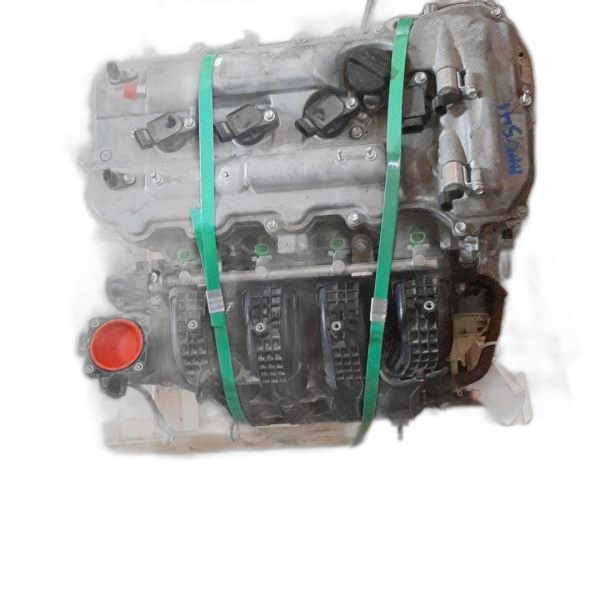
Below are the parts most often responsible for code P2261, ranked by how frequently each one is the actual culprit (per the diagnosis above). Tap any to see what we have for your vehicle.



The information in this article is provided for general reference and educational purposes only. Vehicle specifications, procedures, and part compatibility can vary by production date, trim level, and region. Always consult your vehicle's factory service manual and verify part numbers before purchasing or performing repairs. Safety-critical components such as airbags, seat belts, and braking systems should be installed by a qualified professional.
- 🧭 Diagnostic Flowchart
- 🎬 Helpful Videos
- 🛍️ Shop This Part
- What Does P2261 Mean?
- Can I Drive With P2261?
- Common Causes
- Symptoms
- Common Fixes & Costs
- DIY vs Professional
- Used vs. New Parts: Buying Guide
- What Happens If You Wait — Timeline
- Cost of Not Fixing It
- Diagnosis Steps
- When This Code Triggers (Freeze-Frame Conditions)
- Related Codes
- Climate & Environmental Factors
- How to Talk to a Mechanic About This Code
- Where to Take It: Dealer vs Independent vs Chain
- When to Walk Away From the Repair
- What Scan Tool You Need for This Code
- How to Clear the Code After You Fix It
- Will This Fail Emissions / State Inspection?
- Most Commonly Affected Vehicles
- Manufacturer-Specific Notes
- Real Owner Stories
- 2013 Chevy Cruze 1.4T with 110K miles
- 2017 VW GTI with aftermarket tune
- 2014 Hyundai Veloster Turbo
- 2024 Chevrolet Equinox with 15K miles
- How to Prevent This Code From Triggering
- Frequently Asked Questions
- What is a turbo bypass valve?
- What's the difference between a bypass valve and a blow-off valve?
- Can I just clear the code and keep driving?
- Is a P2261 repair expensive?
- What are the most common misdiagnosis mistakes for P2261?
- I installed an aftermarket blow-off valve (BOV) and now I have this code. Why?
- What does a failing bypass valve sound like?
- Can a bad PCV valve cause P2261?
- Key Takeaways
- 🎟️ Get 5% Off