

OBD-II Code P2280: Air Flow Restriction / Air Leak Between Air Filter and MAF
The Ultimate Expert Guide to Diagnosing and Fixing P2280
- Inspect the engine air filter and intake hose first, as a clogged filter or cracked rubber boot causes over 80% of P2280 codes.
- Never replace the $150+ Mass Airflow (MAF) sensor without first performing a smoke test to rule out unmetered vacuum leaks.
- On 2013-2018 Ram 6.7L Cummins trucks, resolve this code by replacing both the engine air filter and the CCV filter (TSB #9003821) to fix oil saturation.
- Fix P2280 within 30 days to prevent a lean running condition from destroying your catalytic converter, which adds $1,000 to $3,000 in repair costs.
What Does P2280 Mean?
P2280 means your car's Powertrain Control Module (PCM) detected a significant leak or blockage in the air intake path specifically between the engine air filter and the Mass Airflow (MAF) sensor. This unmetered or restricted air disrupts the calculated air-fuel mixture, causing severe engine performance issues.
Technical definition: The SAE/OBD-II definition is "Air Flow Restriction / Air Leak Between Air Filter and MAF". This indicates the PCM detected an unexpected, sudden drop in airflow or a discrepancy between expected and actual airflow readings from the MAF sensor. The fault is isolated to the intake section upstream of the MAF sensor.
Can I Drive With P2280?
Yes, But With Caution. Yes, but address it immediately. Driving with P2280 causes poor fuel economy, reduces engine power, and forces the vehicle into a low-power 'limp mode'. Over time, it leads to expensive damage, including oil contamination of the turbo, blown engine seals from excess pressure, and catalytic converter failure, adding $1,000-$3,000 to repair costs.
Common Causes
- Clogged, dirty, or collapsed engine air filter. (Very Common) — A severely dirty air filter acts as a major restriction, starving the engine of air. Cheap filters collapse on themselves under engine suction, causing a complete blockage. This also includes foreign objects like rodent nests in the airbox.
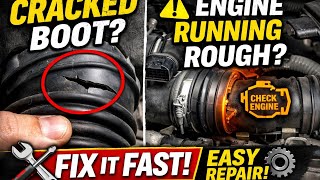
- Cracked, loose, or disconnected air intake hose/boot. (Very Common) — The flexible rubber tube connecting the air filter box to the MAF sensor cracks or comes loose from heat and vibration. This allows unmetered air to leak into the system. Loose hose clamps are a frequent culprit.
- Oil-saturated air filter (Ram 6.7L Cummins). (Common) — On 6.7L Cummins diesels, a clogged crankcase ventilation (CCV) filter vents an oily mist that soaks the engine air filter. This oil-saturated paper severely restricts airflow (TSB #9003821).
- Collapsed or blocked air intake snorkel. (Common) — The plastic tube drawing fresh air from the fender into the airbox gets blocked by debris. On Ram trucks, this flexible snorkel collapses internally, creating a massive restriction.
- Malfunctioning Ram 'Active Air' System. (Less Common) — Ram trucks feature an 'Active Air' door inside the airbox. If the actuator fails or the linkage disconnects, the door sticks partially closed, restricting airflow.
- Aftermarket Intake Modifications / Over-Oiled Filters. (Less Common) — Poorly fitting cold air intakes create leaks. Reusable air filters that are over-oiled contaminate the MAF sensor, causing incorrect readings the PCM interprets as a restriction.
- Faulty or Outdated PCM Software. (Rare) — The PCM firmware misinterprets normal MAF sensor signals and triggers P2280 erroneously. Manufacturers release updates to reduce code sensitivity.
- Poor electrical ground or wiring issue. (Rare) — A poor ground connection for the PCM or a damaged wire in the MAF sensor harness causes erratic sensor readings, falsely triggering P2280.
Symptoms
- Check Engine Light is on — The PCM illuminates the Malfunction Indicator Lamp (MIL) on the dashboard.
- Reduced engine power and acceleration — The engine lacks the correct air volume, making it feel sluggish and weak during acceleration.
- Poor fuel economy — The PCM compensates for incorrect air readings by dumping excess fuel, drastically lowering MPG.
- Rough idle or stalling — The engine shakes, shudders, or stalls completely when stopped at a light due to the skewed air-fuel mixture.
- Hissing or whistling sound from the engine bay — An air leak in the intake hose creates a noticeable sucking noise that gets louder as you press the gas pedal.
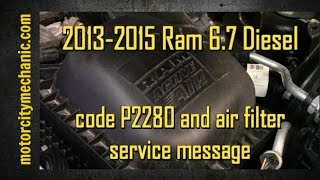
- 'Service Air Filter' Message — On Ram trucks, this code triggers a specific instrument cluster message instructing the driver to service the air filter. 🎬 Watch: Troubleshooting the Ram 6.7L Cummins air filter service message.
Diagnostic Flowchart
Tap your situation to follow the diagnostic path that matches what you're seeing on this code.
Common Fixes & Costs
- Replace Engine Air Filter — Parts: $20-$60, Labor: $0-$30, ~0.2 hr book time (DIY)
- Replace Air Intake Hose/Boot — Parts: $40-$150, Labor: $50-$120, ~0.5 hr book time (DIY)
- Replace CCV Filter (Ram 6.7L Cummins) — Parts: $90-$160, Labor: $80-$150, ~0.8 hr book time (DIY)
- Clean Mass Airflow (MAF) Sensor — Parts: $10-$15, Labor: $30-$50, ~0.3 hr book time (DIY)
- Replace Mass Airflow (MAF) Sensor — Parts: $150-$350, Labor: $50-$125, ~0.5 hr book time (Intermediate)
- Update PCM Software — Parts: $0, Labor: $100-$200, ~1.0 hr book time (Professional)
DIY vs Professional
- Replace Engine Air Filter — Beginner:
- Replace Air Intake Hose/Boot — Beginner:
- Replace CCV Filter (Ram 6.7L Cummins) — Beginner:
- Clean Mass Airflow (MAF) Sensor — Beginner:
- Replace Mass Airflow (MAF) Sensor — Beginner:
- Update PCM Software — Beginner:
Used vs. New Parts: Buying Guide
When a used part is worth it: Never buy used parts for this code. The common fixes are inexpensive wear items (filters, rubber hoses) or sensitive electronics (MAF sensor). A salvage yard intake hose has the same age-related degradation as your failed part.
Donor-vehicle mileage cap: roughly under 20000 miles for the part to have meaningful remaining life.
Donor quality checklist:
- Only consider a used MAF sensor from a wrecked vehicle with under 20,000 miles.
- Verify the part number matches exactly; electronic components are not interchangeable.
Decision logic:
- If The part is an air filter, CCV filter, or rubber intake hose. → Always buy new. These are wear items designed to degrade over time.
- If The MAF sensor is confirmed bad through proper diagnosis. → Buy a new OEM or high-quality aftermarket sensor. A used sensor is a gamble that forces repeat labor.
Warranty tradeoff: Salvage yard parts carry a 30-day warranty. New aftermarket parts offer 1-year to lifetime warranties. New OEM parts carry the manufacturer's standard warranty.
Worst-case if a used part fails: $100-$250 if a used MAF sensor is dead on arrival, requiring repeat labor and a second part purchase.
What Happens If You Wait — Timeline
- 0-2 weeks: Check Engine Light illuminates. You experience a very slight drop in fuel economy with no major performance changes. (MPG impact: 0-5%% · Added cost: $0-$20 in wasted fuel.)
- 2 weeks - 3 months: Noticeable hesitation during acceleration, a rough idle, and a clear drop in MPG. On Ram trucks, the 'Service Air Filter' message appears. (MPG impact: 5-15%% · Added cost: $50-$150 in wasted fuel.)
- 3-6 months: The lean or rich condition stresses the catalytic converter. On Cummins diesels, prolonged restriction increases crankcase pressure, risking oil blow-by at the turbo seals. (MPG impact: 10-20%% · Added cost: $500-$1,500 (Early damage to catalytic converter or turbo seals becomes irreversible).)
- 6+ months: Severe damage occurs. The catalytic converter fails completely from overheating ($1,000-$3,000). On diesel trucks, high crankcase pressure blows engine seals, destroying the turbocharger ($2,000-$5,000+). (MPG impact: 15-25%% · Added cost: $1,000-$5,000+)
Cost of Not Fixing It
- 0-1 month: Noticeable drop in fuel economy (5-15%), reduced engine power, and stalling at idle. (Added cost: $20-$60 in wasted fuel.)
- 1-6 months: An incorrect air-fuel ratio causes the catalytic converter to overheat from unburnt fuel, leading to internal damage and failure. (Added cost: $1,200-$3,400 for catalytic converter replacement.)
- 6+ months: On turbo-diesel trucks, prolonged restriction causes excessive crankcase pressure, blowing engine seals. Oil is forced past seals into the turbocharger, destroying it. (Added cost: $2,000-$5,000+ for turbocharger and engine seal replacement.)
Diagnosis Steps
- Confirm Code and Review Freeze Frame Data
Confirm P2280 is active. Review 'freeze frame' data to see engine speed, RPM, and temperature at the exact moment the code set.
Tools: OBD-II Scanner (Beginner) - Inspect the Engine Air Filter and Airbox
Remove the air filter. If it is excessively dirty, clogged with debris, or saturated with oil, replace it. Look inside the airbox and intake snorkel for foreign objects or internal collapse.
Tools: Screwdriver or socket set, Flashlight (Beginner) - Visually Inspect the Air Intake System
Examine the air intake path from the airbox to the MAF sensor. Look for cracks in the plastic, tears in rubber boots, and loose clamps. Squeeze rubber hoses to reveal hidden cracks.
Tools: Flashlight (Beginner) - [PRO TIP] Analyze Live MAF Sensor Data and Fuel Trims
View live data. At warm idle, gas engines read 2-7 g/s; 6.7L Cummins diesels read 5-10 g/s. Readings below 2 g/s indicate a restriction. Check Long-Term Fuel Trims (LTFT); values > +10% confirm an unmetered air leak.
Tools: Advanced OBD-II Scanner (Advanced) - Perform a Smoke Test
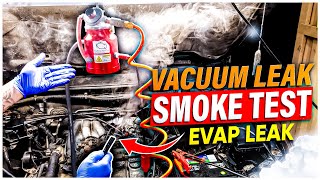
Force low-pressure, vapor-filled smoke into the intake system. Smoke pours out of cracks or loose clamps, pinpointing the exact location of vacuum leaks.
Tools: Automotive Smoke Machine (Intermediate) - Inspect and Clean the MAF Sensor
If no leaks or restrictions exist, remove the MAF sensor. Inspect wires for dust or oil. Clean ONLY with dedicated MAF sensor cleaner spray; never touch the wires.
Tools: Screwdriver/Torx driver, MAF Sensor Cleaner (Intermediate) - [PRO TIP] Manually Test MAF Sensor Voltage and Resistance
Back-probe the MAF signal wire. At warm idle, voltage is typically 0.5V-0.8V, rising smoothly to 2.0V+ as you rev the engine. Erratic voltage or infinite heater resistance (OL) confirms a failed sensor.
Tools: Multimeter, Wiring Diagram, Back-probe kit (Advanced)
When This Code Triggers (Freeze-Frame Conditions)
- Engine Coolant Temp: 180-200°F (80-110°C) (The engine must be at full operating temperature for the diagnostic to run.)
- RPM: 1500-2500 (The code sets during steady-state cruising or light acceleration, rarely at idle.)
- Engine Load: 30-60% (This corresponds to moderate engine effort, such as maintaining speed on a flat road or slight incline.)
- Vehicle Speed: 35-55 mph (Highway or expressway driving conditions are present when the fault is detected.)
Related Codes
- P0101 — MAF Sensor Circuit Range/Performance. P2280 is the physical leak/restriction, while P0101 is the resulting electronic fault. Diagnosing P2280 resolves P0101.
- P0171 — System Too Lean (Bank 1). An air leak before the MAF allows unmetered air in, creating a lean condition. P2280 is a common cause of P0171.
- P0174 — System Too Lean (Bank 2). If the leak is large enough on a V-style engine, you see both P0171 and P0174 alongside P2280.
- P2281 — Air Leak Between MAF and Throttle Body. P2280 points to a leak *before* the MAF sensor; P2281 points to a leak *after* the MAF sensor. A smoke test differentiates them.
Climate & Environmental Factors
- Extreme Cold: Cold temperatures make rubber and plastic intake components brittle, increasing the likelihood of cracks forming in the intake boot or airbox.
- Extreme Heat: Prolonged high under-hood temperatures accelerate 'dry rot', causing the intake hose to harden, lose its seal, or crack when flexed.
- High Altitude: Thinner air density naturally lowers MAF sensor readings, making the system more sensitive to minor restrictions or leaks that wouldn't trigger a code at sea level.
How to Talk to a Mechanic About This Code
Say this: "I have a P2280 code and need a diagnostic. I suspect an air leak or restriction between the air filter and the MAF sensor. Please perform a visual inspection of the intake system and a smoke test to check for leaks."
This directs the mechanic to the most common causes and specifically requests a smoke test, preventing them from guessing or immediately replacing the expensive MAF sensor.
Avoid saying:
- 'Just fix whatever's wrong'
- 'My check engine light is on, can you look at it?' (invites upsells)
- 'Whatever you recommend'
Questions to ask before authorizing the repair:
- Did the smoke test reveal a leak? If so, show me exactly where it is.
- If no leak was found, what caused the restriction? Was the air filter clogged or the intake snorkel collapsed?
- If you recommend a MAF sensor replacement, what live data (g/s) did you pull to confirm the sensor is faulty?
- What is the warranty on this specific repair for both parts and labor?
Where to Take It: Dealer vs Independent vs Chain
- Dealer:
Recommended only for warranty claims or complex, model-specific issues (e.g., PCM updates) that independent shops cannot perform.
Best for: Vehicles under powertrain or emissions warranty., Known manufacturer-specific quirks, like the Ram 'Active Air' system or required PCM software updates.
Downsides: Labor rates are $150-$250+ per hour, significantly higher than independent shops., Defaults to replacing entire assemblies instead of smaller failed components. (Typical cost: +50% vs. baseline) - Independent Shop:
Best fit for most situations. A reputable independent shop has the smoke machine and experience to diagnose and repair P2280 efficiently.
Best for: Out-of-warranty vehicles where cost is a factor., Diagnosing common codes like P2280, which have straightforward physical causes.
Downsides: Quality varies; vet the shop through reviews and ASE certifications., May lack proprietary software for PCM updates. (Typical cost: +0% vs. baseline) - Chain Shop:
Avoid for initial diagnosis. Acceptable only for a simple air filter change if you are certain that is the sole problem.
Best for: Simple, clear-cut part replacements like an engine air filter.
Downsides: Technician diagnostic skill is inconsistent., High pressure to upsell; quick to recommend an expensive MAF sensor replacement without proper diagnosis. (Typical cost: -10% vs. baseline)
When to Walk Away From the Repair
If the estimated repair cost exceeds 40-50% of the car's Kelley Blue Book (KBB) private-party value, sell the vehicle as-is.
- Car worth $4000, fix is $350: Fix it. Replacing an intake hose or MAF sensor is well below the threshold and restores vehicle function.
- Car worth $5000, fix is $2800: Walk away. If ignoring P2280 destroyed the catalytic converter and turbo, the repair exceeds 50% of the car's value.
- Car worth $2500, fix is $1500: Walk away. The repair cost is over 50% of the vehicle's value.
What Scan Tool You Need for This Code
Minimum: A scanner that reads codes, clears codes, and displays live data streams for the MAF sensor (g/s) and Fuel Trims (STFT/LTFT).
A $20 code reader only confirms P2280 exists. It cannot show the live data needed to determine if you have a leak (high fuel trims) or a restriction (low MAF g/s reading).
Budget: BlueDriver Pro or OBDLink MX+ (~$100-120) — These Bluetooth dongles provide essential live data (MAF g/s, Fuel Trims) and freeze-frame data needed to diagnose P2280. Excellent for DIY use.
Mid-range: Foxwell NT510 Elite or Ancel FX2000 (~$150-250) — Handheld scanners with dedicated screens for faster live data graphing. They diagnose P2280 and access ABS/SRS systems.
Professional: Autel MaxiCOM MK808S or XTOOL D7 (~$400-550) — Full-tablet, bidirectional scanners. Overkill for basic P2280 diagnosis, but they perform active tests to command the Ram 'Active Air' system door to check for function.
Rent vs buy: AutoZone rents live-data scanners for free (with a refundable deposit). Buy a budget pick like BlueDriver if you perform DIY maintenance annually.
How to Clear the Code After You Fix It
- Use an OBD-II scan tool to clear the diagnostic trouble codes.
- Ensure the fuel tank is between 1/4 and 3/4 full.
- Perform a complete drive cycle to allow the readiness monitors to reset.
Drive cycle (~30 minutes): From a cold start (vehicle sat for 8+ hours), idle for 2-3 minutes. Drive at a steady 55 mph for 5-10 minutes on the highway. Then, perform 15-20 minutes of mixed stop-and-go city driving. Allow the vehicle to cool down completely afterward.
Readiness monitors affected: Catalyst Monitor, Evaporative System (EVAP) Monitor, O2 Sensor Monitor
Before emissions retest: drive at least 100 miles to fully set monitors.
Watch out for:
- Disconnecting the battery clears the code but resets all readiness monitors, guaranteeing an emissions test failure until a full drive cycle is completed.
- The code returns within 10 miles if the underlying physical leak or restriction is not fixed.
Will This Fail Emissions / State Inspection?
Yes — this code typically fails an OBD-II emissions inspection.
- California: Automatic smog check failure if the Check Engine Light is on for P2280. All OBD readiness monitors must be 'Ready' to pass.
- New York: The NYS DMV emissions inspection includes an OBD-II scan. An active P2280 code is an automatic failure.
- Texas: In the 17 counties requiring emissions testing, an illuminated Check Engine Light for P2280 fails the OBD-II inspection.
Most Commonly Affected Vehicles
- Ram 2500/3500 with 6.7L Cummins (2013-2018) — Extremely prone to P2280. The primary cause is a clogged CCV filter leading to an oil-soaked air filter. Secondary causes include a collapsed fender snorkel and disconnected 'Active Air' door linkage.
- Ford F-150 (2004-2014) — Rubber and plastic intake components degrade and crack over time. The PCV hose connection point on the intake manifold is a frequent leak source.
- Subaru Outback/Forester/Impreza (2005-2012) — Rubber intake ducts tear in the accordion-like flex section or near the throttle body clamp, leading to unmetered air leaks.
- Chevrolet / GMC Silverado / Sierra 1500 (2007-2013) — The intake tube becomes brittle and cracks. A faulty PCV system integrated into the valve cover causes abnormal intake vacuum.
- Volkswagen / Audi Various with 2.0T engine (2008-2015) — A torn diaphragm within the PCV assembly is a frequent culprit for air leak-related codes.
- Toyota Hilux, Prado, Fortuner with 2.8L 1GD-FTV Diesel (2015-2019) — An airbox design flaw allows fine dust to bypass the filter, contaminating the MAF sensor.
- Nissan Rogue (2021-2025) — On 1.5L turbo models, a dirty MAF sensor or clogged air filter are common culprits for airflow codes.
- BMW Various Models (e.g., X5, 335i with N55 engine) (2010-2015) — Prone to air mass fault codes caused by dry-rotted vacuum hoses and cracked plastic intake components.
Manufacturer-Specific Notes
- Ram (Cummins): TSB #9003821 addresses P2280 on 6.7L Cummins engines. The cause is an oil-soaked air filter from the CCV system. The fix requires replacing both the air filter and the CCV filter.
- Ram: A flexible, corrugated air snorkel inside the driver's side fender collapses internally, triggering P2280 even with a clean air filter. Mechanics permanently fix this by cutting off the collapsed portion.
- Ram: For 2016+ models, Ram released software updates (TSB #18-092-17) changing the P2280 fault from a one-trip to a two-trip fault to reduce sensitivity.
- Ram (Cummins): The 'Ram Active Air' system actuator motor or plastic linkage breaks, causing a door to stick partially closed and restrict airflow. Inspect this during every air filter change.
- All: As of late 2024, there are no active safety recalls or emissions-related extended warranty programs specifically for DTC P2280.
Real Owner Stories
2018 Ram 5500 with 6.7L Cummins
Check Engine Light illuminated with P2280 and a 'Service Air Filter' message. The truck felt sluggish.
What they tried:
- Observed live MAF sensor data was very low, confirming an airflow restriction.
- Inspected the engine air filter, finding it in perfect condition.
Outcome: The technician found the plastic linkage for the 'Active Air' system door inside the airbox had disconnected. Reconnecting the linkage restored airflow, normalized MAF readings, and resolved the code.
Lesson: On Ram trucks, always inspect the 'Active Air' system inside the airbox for disconnected linkages or a stuck door, even if the air filter is clean.
2014 Ram 6.7L Cummins with P2280
Owner experienced P2280 and an 'Air Filter Service' message despite installing a brand new air filter.
What they tried:
- Confirmed the air filter was clean and the 'Active Air' linkage was intact.
- Removed the driver's side fender liner to inspect the fresh air intake path.
Outcome: The corrugated plastic snorkel running through the fender well had completely collapsed, causing a major restriction. The mechanic permanently fixed it by cutting off the collapsed flexible portion.
Lesson: A collapsed intake snorkel in the fender is a frequent, hidden cause of P2280 on Ram trucks. If the filter is clean, remove the fender liner and inspect this tube.
2016 Ram 3500 6.7L Hotshot Truck
Truck repeatedly entered limp mode with P2281 (Air Leak Between MAF and Throttle Body) when pulling heavy loads uphill. Dealers misdiagnosed the issue multiple times.
What they tried:
- Dealer #1 replaced the EGR valve for $1,400; code returned.
- Dealer #2 replaced the EGR cooler for $2,600; code returned.
- The owner replaced the MAF sensor as a last resort.
Outcome: Replacing the MAF sensor resolved the issue. The sensor was failing under heavy load conditions, mimicking a physical leak that the dealers failed to properly diagnose.
Lesson: Faulty sensors mimic physical leaks. If a code appears intermittently under specific loads, test the sensor's live data before approving thousands of dollars in mechanical repairs.
How to Prevent This Code From Triggering
- Replace engine air filter at recommended intervals. (Every 12,000-15,000 miles, or annually.) — Prevents a clogged filter from restricting airflow. Using an OEM-spec filter prevents premature codes caused by cheap materials collapsing.
- Replace the CCV filter on Ram 6.7L Cummins engines. (Every 67,500 miles (or 75,000 miles for 2019+ models).) — Prevents the CCV filter from clogging and venting oily mist onto the engine air filter, which is the primary cause of P2280 on these trucks.
- Visually inspect intake hoses and clamps during oil changes. (Every 5,000-7,500 miles.) — Heat and oil vapors degrade rubber hoses, causing them to soften, swell, and crack. Catching cracks early prevents leaks.
- Install an oil catch can (direct-injection or turbo engines). (One-time modification.) — Separates oil vapors from the PCV/CCV system before they enter the intake tract. This keeps intake hoses and the MAF sensor clean, preventing oil-related damage.
Frequently Asked Questions
Can a dirty air filter really cause a Check Engine Light?
Yes, absolutely. If the air filter is severely clogged, the engine works so hard to pull air through it that the PCM detects a major restriction and triggers code P2280.
What is the most common misdiagnosis for P2280?
The most common mistake is replacing the Mass Airflow (MAF) sensor without performing a thorough inspection first. Always check for simple fixes like a clogged filter, a collapsed snorkel, or a cracked intake boot before condemning an expensive sensor.
Can an aftermarket air intake or filter cause code P2280?
Yes. Aftermarket cold air intakes create leaks if they do not seal as well as factory components. Furthermore, over-oiled reusable filters contaminate the MAF sensor element, causing it to read incorrectly.
What is a smoke test and can I do it myself?
A smoke test involves feeding harmless, vaporous smoke into the engine's intake system to make leaks instantly visible. While DIY smoke machines exist, having a shop with a professional-grade machine perform the test is often more effective.
How do I know if it's a leak or a bad MAF sensor?
A smoke test or high positive fuel trims (>+10%) confirm a leak. If no leaks exist and the intake path is clear, analyze the MAF sensor's live data (g/s) and voltage readings to confirm if the sensor itself is faulty.
Why does this code happen so often on Ram diesel trucks?
The crankcase ventilation (CCV) system has a filter that clogs and vents oily vapor back into the intake. Over time, this oil soaks the paper air filter, choking off airflow. Ram has issued service bulletins (TSB #9003821) about this exact issue.
Will clearing the P2280 code fix the problem?
No. Clearing the code only turns off the check engine light temporarily. If the underlying physical leak or restriction remains, the PCM will trigger the code again within a short drive.
Can a bad PCV valve cause P2280?
Indirectly, yes. A faulty PCV valve causes abnormal vacuum levels throughout the entire intake system. This leads to erratic MAF readings or failed intake gaskets, creating a leak that sets P2280.
Key Takeaways
- Inspect the engine air filter and intake hose first, as a clogged filter or cracked rubber boot causes over 80% of P2280 codes.
- Never replace the $150+ Mass Airflow (MAF) sensor without first performing a smoke test to rule out unmetered vacuum leaks.
- On 2013-2018 Ram 6.7L Cummins trucks, resolve this code by replacing both the engine air filter and the CCV filter (TSB #9003821) to fix oil saturation.
- Fix P2280 within 30 days to prevent a lean running condition from destroying your catalytic converter, which adds $1,000 to $3,000 in repair costs.
Helpful Videos
Shop the Parts Behind P2280
Below are the parts most often responsible for code P2280, ranked by how frequently each one is the actual culprit (per the diagnosis above). Tap any to see what we have for your vehicle.





The information in this article is provided for general reference and educational purposes only. Vehicle specifications, procedures, and part compatibility can vary by production date, trim level, and region. Always consult your vehicle's factory service manual and verify part numbers before purchasing or performing repairs. Safety-critical components such as airbags, seat belts, and braking systems should be installed by a qualified professional.
- 🧭 Diagnostic Flowchart
- 🎬 Helpful Videos
- 🛍️ Shop This Part
- What Does P2280 Mean?
- Can I Drive With P2280?
- Common Causes
- Symptoms
- Common Fixes & Costs
- DIY vs Professional
- Used vs. New Parts: Buying Guide
- What Happens If You Wait — Timeline
- Cost of Not Fixing It
- Diagnosis Steps
- When This Code Triggers (Freeze-Frame Conditions)
- Related Codes
- Climate & Environmental Factors
- How to Talk to a Mechanic About This Code
- Where to Take It: Dealer vs Independent vs Chain
- When to Walk Away From the Repair
- What Scan Tool You Need for This Code
- How to Clear the Code After You Fix It
- Will This Fail Emissions / State Inspection?
- Most Commonly Affected Vehicles
- Manufacturer-Specific Notes
- Real Owner Stories
- 2018 Ram 5500 with 6.7L Cummins
- 2014 Ram 6.7L Cummins with P2280
- 2016 Ram 3500 6.7L Hotshot Truck
- How to Prevent This Code From Triggering
- Frequently Asked Questions
- Can a dirty air filter really cause a Check Engine Light?
- What is the most common misdiagnosis for P2280?
- Can an aftermarket air intake or filter cause code P2280?
- What is a smoke test and can I do it myself?
- How do I know if it's a leak or a bad MAF sensor?
- Why does this code happen so often on Ram diesel trucks?
- Will clearing the P2280 code fix the problem?
- Can a bad PCV valve cause P2280?
- Key Takeaways
- 🎟️ Get 5% Off