

P2281 on 2011-2019 Ford Explorer 3.5L: Air Leak Between MAF and Throttle Body Causes and Fixes
For a 2011-2019 Ford Explorer with the 3.5L V6, code P2281 is almost always caused by a physical air leak. The most common culprit is a cracked main air intake hose or a small, broken plastic nipple on that same hose. This often happens during an air filter change. Inspect the entire intake tube assembly (Part No. BB5Z-9B659-D) carefully for any cracks or breaks before replacing any sensors.
- P2281 on this Explorer almost always indicates a physical air leak, not a bad sensor.
- Before buying any parts, carefully inspect the entire black plastic air intake tube for cracks, loose clamps, and especially a small broken nipple on the side.
- Do NOT replace the MAF sensor as a first step; it is rarely the cause of this specific code.
- A smoke test is the best way for a mechanic (or a well-equipped DIYer) to find a leak that isn't visually obvious.
- The fix is often simple, involving tightening a clamp or replacing the main intake hose, and can be done with basic hand tools.
What's Unique About the 2011-2019 Ford Explorer
While P2281 is a generic code, the 3.5L Cyclone V6 in the Explorer and its platform mates (Flex, Taurus) has a specific, well-known weak point that frequently causes it. The main plastic air intake duct has a small nipple for a PCV or vapor line connection that is notoriously brittle. This nipple often breaks during routine service like an air filter change, creating a significant vacuum leak that immediately triggers this code. Owners should check this specific point before suspecting any other component, as it's the most probable cause.
Symptoms You May Notice
- Check Engine Light is on
- Rough, fluctuating, or surging idle.
- Engine stalling, especially at low speeds or when stopped.
- Hesitation or lack of power during acceleration.
- Audible hissing or whistling sound from the engine bay, particularly near the air filter box.
- Poor fuel economy.
- Accompanying lean codes like P0171 and P0174.
- Replacing the Mass Airflow (MAF) sensor. This code indicates a leak *after* the sensor, not a problem with the sensor itself. The MAF sensor is usually correctly reporting lower airflow because of the leak. Do not replace the MAF sensor until all possible physical leaks have been ruled out 🎬 See how to diagnose and fix a P2281 air leak by a thorough inspection and smoke test.
Most Likely Causes
- Broken PCV Nipple on Air Intake Duct 🔴 High Probability The plastic used for the nipple on the main intake duct becomes very brittle with age and heat cycles. It is easily snapped off during air filter changes or other routine maintenance. Many owners report the code appearing immediately after servicing the air filter.
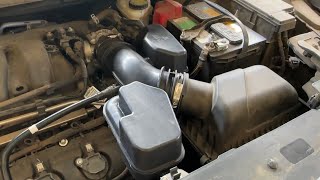
How to confirm: Visually inspect the large black plastic air intake tube that runs from the air filter box to the throttle body. Locate the small port on its side where a smaller vacuum hose connects and check if it is cracked or has broken off completely. The break can be clean, making it look like a hose is simply disconnected.
Typical fix: The entire air intake duct assembly must be replaced, as the nipple is molded into the part. Temporary fixes with epoxy or glue are not recommended as they often fail due to engine vibration and heat.
Est. part cost: $70-$150 - Cracked or Torn Air Intake Duct 🔴 High Probability The flexible, ribbed sections of the intake duct can develop cracks or tears over time due to engine vibration and heat. These cracks can be difficult to see without removing the part.
How to confirm: With the engine off, carefully remove and flex the intake duct, inspecting all ribbed areas and connection points for splits or holes. A smoke test is the most definitive way to find a leak if it's not visually obvious. Pay close attention to the underside, which is a common place for cracks to form.
Typical fix: Replace the entire air intake duct assembly. 🎬 Watch this step-by-step air intake hose replacement video
Est. part cost: $70-$150 - Loose Clamp on Air Intake Duct 🟡 Medium Probability Vibrations can cause the hose clamps at the throttle body or the MAF sensor housing to loosen over time, allowing the duct to partially or fully disconnect. This can also happen if they are not properly tightened after service.
How to confirm: Physically check that the clamps at both ends of the main intake duct are secure and that the duct is fully seated on the throttle body and MAF sensor housing. Tug on the connections to ensure they are tight.
Typical fix: Tighten the loose clamp(s) with a screwdriver or socket. If the clamp is stripped or damaged, replace it.
Est. part cost: $2-$10 - Cracked PCV or Vacuum Hose ⚪ Low Probability The smaller rubber and plastic hoses connected to the intake system, particularly for the PCV (Positive Crankcase Ventilation) system, become brittle and can crack.
How to confirm: Visually inspect all vacuum lines connected to the intake manifold and intake duct. Listen for hissing sounds. A smoke test is the most reliable method to find small hose leaks.
Typical fix: Replace the specific cracked hose.
Est. part cost: $15-$50
Rare But Worth Checking
- Leaking Throttle Body Gasket: → Shop Fuel Injection Throttle Body The gasket between the throttle body and the intake manifold can fail, creating a vacuum leak. This is less common than a torn intake boot but is a possible cause if no other leaks are found.
- Stuck-Open PCV Valve: → Shop PCV Valve The PCV valve itself can fail and stick open, creating a constant vacuum leak. It's an inexpensive part to check and replace if it doesn't rattle when shaken.
Diagnosis Steps
- Read the trouble codes with an OBD-II scanner and record the freeze-frame data. Note if P0171 and P0174 are also present.
- Perform a thorough visual inspection of the entire air intake system, from the air filter box to the throttle body.
- Pay extremely close attention to the large black plastic intake duct. Check for loose clamps at both ends.
- Specifically inspect the small plastic nipple on the side of the intake duct for cracks or complete breakage. This is the most common failure point on this engine. Check if the connected hose is loose.
- Remove the intake duct and carefully inspect the flexible, ribbed sections for hidden tears or cracks, especially on the bottom side.
- Inspect all smaller vacuum and PCV hoses connected to the intake system for brittleness and cracks.
- If no leak is obvious, perform a smoke test. 🎬 Watch this quick test to find vacuum leaks Introduce smoke into the intake system *after* the MAF sensor and watch for where it escapes. This is the most reliable method for finding small, hard-to-see leaks.
- Only after confirming there are absolutely no air leaks should you consider issues with sensors like the MAF. Even then, cleaning it with dedicated MAF cleaner is the first step before replacement.
Parts You'll Likely Need
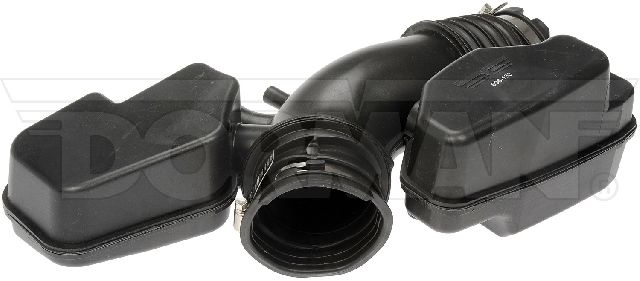
- Engine Air Intake Hose
(OEM #BB5Z-9B659-D)— This is the most common failure. It either cracks on its own or the integrated PCV nipple breaks off, requiring replacement of the entire assembly. Ford has revised this part, with 'D' being a later version.
Trusted brands: Motorcraft (OEM), Dorman (696-133)
OEM price range: $85-$130
Aftermarket price range: $70-$120 - Hose Clamp — If the cause is simply a loose or stripped clamp, this is an inexpensive and easy fix.
OEM price range: $5-$10
Aftermarket price range: $2-$5
Related Codes That Often Appear With This One
- P0171 — System Too Lean (Bank 1) - This code often appears with P2281 because the unmetered air leak creates an air-fuel mixture with too much air (a lean condition) that the oxygen sensors detect.
- P0174 — System Too Lean (Bank 2) - Similar to P0171, this indicates a lean condition on the second cylinder bank. If both P0171 and P0174 are present, it strongly points to a large vacuum leak affecting the entire engine, such as a torn intake boot or broken PCV nipple.
Technical Service Bulletins (TSBs) & Recalls
- TSB 15-0149: Some 2013-2015 Explorer 3.5L Ti-VCT vehicles may exhibit a rolling/surging or low idle during A/C operation, addressed by a PCM reprogram.
Platform-Specific Known Issues
- TSB 15-0149: Rolling/Surging Idle with A/C On: TSB 15-0149 was issued for 2013-2015 models with the 3.5L Ti-VCT engine for a rolling/surging idle specifically when the A/C is on. The fix is a PCM reprogram. While not a direct fix for a P2281 leak, it addresses overlapping symptoms. The TSB notes the PCM logic struggles to manage engine torque load when the A/C compressor engages under high pressure, causing the idle to dip and surge. If your P2281 symptoms only occur with the A/C running, this TSB could be relevant after confirming no leaks are present.
Mechanic-Grade Diagnostic Values
- Mass Airflow (MAF) Sensor Reading at Idle — expected: Approximately 3-5 g/s for a fully warmed-up 3.5L V6 engine at idle.. Failure: A reading that is stuck, erratic, or does not increase smoothly with RPM. Because P2281 is a leak *after* the sensor, the MAF reading will be lower than the actual air ingested, but the reading itself should be stable.
- Long Term Fuel Trim (LTFT) — expected: Between -10% and +10% at idle on a warm engine.. Failure: With a vacuum leak causing P2281, LTFT for both banks will be highly positive (e.g., +15% to +25%) as the PCM tries to compensate for the lean condition by adding more fuel.
- MAF Sensor Voltage (Key On, Engine Off) — expected: Close to 0V.. Failure: Any significant voltage reading with the engine off points to an electrical fault in the sensor or its circuit.
Scan Tool Commands That Help
- Ford IDS / FORScan: Reset KAM (Keep Alive Memory) — After replacing the air intake hose or fixing any vacuum leak, a KAM reset should be performed. This clears the old learned fuel trim adaptations that were compensating for the leak, allowing the PCM to relearn the correct values for the sealed system faster. Failure to do so may result in a temporary rough idle or poor running condition until the PCM adapts on its own.
- Ford IDS / FORScan: Throttle Body Relearn — If the throttle body was cleaned or replaced during diagnosis, a relearn procedure is necessary to recalibrate the closed-throttle position and idle airflow. This can also be initiated by a KAM reset followed by a specific key-on/idle procedure.
Wiring & Ground Locations
- G104 — A wiring diagram shows a ground point G104 near the front of the vehicle, which serves as a ground for multiple engine components. Another source suggests a primary body-to-engine ground is typically on the passenger side near the back of the 3.5L V6 engine.. The MAF sensor and other engine sensors rely on a clean ground path to send accurate signals to the PCM. A corroded or loose engine ground can cause erratic sensor readings, potentially confusing the PCM's airflow calculations, although a physical leak is far more probable for P2281.
- MAF Sensor Connector — On the MAF sensor, located on the air intake tube just after the air filter box.. The connector has a red lock tab that must be pulled back before the connector can be unplugged. The MAF sensor signal wire can be traced from this connector back to the PCM to check for damage or corrosion, which could cause incorrect readings.
OEM Part Supersession History
DA8Z-9B659-A→BB5Z-9B659-D— The part was likely revised to improve the durability of the plastic, specifically addressing the brittle nipple and cracking issues that are the primary cause of code P2281. The 'D' revision is the later, more commonly available part.
Model Year Variations Within This Range
- 2013-2019: For the 2013 model year, the standard 3.5L Cyclone V6 was updated, increasing horsepower from 263 to 288. While the physical intake design and failure points for P2281 remain the same, the PCM's software calibration and expected airflow (g/s) values may differ slightly from the 2011-2012 models.
Diagnostic Flowchart
Other Known Issues on This Vehicle
Issues unrelated to this code that are worth knowing about as an owner of this generation:
- Internal Water Pump Failure 🔴 High — Commonly occurs between 80,000-150,000 miles. Failure can be catastrophic, as a coolant leak will contaminate the engine oil, leading to major engine damage or complete failure. (Ref: No recall, but subject of a Canadian class-action lawsuit.)
- Power Transfer Unit (PTU) Failure (AWD Models) 🔴 High — Widespread issue, often appearing from 80,000-120,000 miles. The gear oil is cooked by the adjacent exhaust, leading to breakdown and failure. Symptoms start with a burning/propane smell and progress to grinding noises. (Ref: TSB 19-2017 for leaking seals. Ford considers the fluid 'lifetime,' which is the root cause of the problem.)
- Cracked Exhaust Manifold / Broken Studs 🟠 Medium — Common on both the naturally aspirated and EcoBoost 3.5L engines. Presents as a loud ticking noise, especially when the engine is cold, which may disappear as it warms up. Can lead to exhaust fumes in the cabin. (Ref: Part of a NHTSA investigation for exhaust odors, but no general recall was issued for civilian models.)
- Electronic Throttle Body Malfunction 🟠 Medium → Shop Fuel Injection Throttle Body — Affects many 5th generation Explorers, causing sudden power loss, hesitation, and the vehicle entering 'limp mode'. Often triggers codes P2111 or P2112.
- Rear Suspension Toe Link Fracture 🔴 High — Primarily affects 2011-2017 models, causing symptoms from wandering steering to a complete loss of steering control. (Ref: Subject of multiple recalls.)
Used vs. New Parts: Buying Guide for This Vehicle
When a used part is the smart pick: For the primary fix (the air intake hose), buying a used part from a junkyard is NOT recommended. The failure is caused by age and heat cycles making the plastic brittle. A used part will have similar age and exposure, making it likely to fail soon after installation, if it isn't already broken.
What to inspect on the donor part:
- If forced to consider a used part, inspect the PCV nipple for any hairline cracks.
- Flex the ribbed sections of the hose to check for brittleness or hidden tears.
- Verify it is a later revision part (e.g., ending in 'D') if possible, as it may be made of improved material.
OEM-only on this vehicle (don't cheap out):
- While not strictly OEM-only, using a Motorcraft (OEM) or a reputable aftermarket brand like Dorman for the air intake hose is highly advised over a used part to ensure a long-lasting repair.
Aftermarket brands forum-validated for this vehicle:
- Dorman (Part #696-133) is a widely available and commonly used aftermarket replacement for the OEM air intake hose.
Brands owners have reported issues with on this vehicle:
- Unbranded, no-name air intake hoses from online marketplaces may have poor fitment or use lower-quality plastic that becomes brittle even faster than the original part.
Real Owner Stories
Aggregated from forums and TSBs cited above. Mileages and costs reflect what owners reported in those sources.
2011-2019 Ford Explorer 3.5L V6
Symptoms: Check engine light came on with codes P2281, P0171, and P0174 immediately after changing the air filter. Initially suspected the MAF sensor.
What fixed it: Discovered the small nipple on the air duct had snapped off. Replaced the entire duct (part BB5Z-9B659-D), which resolved all codes.
Source hint: explorerforum.com
2013-2015 Ford Explorer 3.5L Ti-VCT
Symptoms: Rolling, surging, or low idle specifically when the A/C compressor engages under high pressure.
What fixed it: PCM reprogram as per TSB 15-0149.
Source hint: TSB 15-0149
Related OBD-II Codes
Frequently Asked Questions
I just changed my air filter and now I have a P2281 code. What happened?
Can I just glue the broken plastic nipple back onto the intake duct?
My 2014 Explorer has a surging idle only when the A/C is on. Is this related to P2281?
What is the specific replacement part number for the intake hose on a 3.5L Cyclone V6?
Does the Ford Police Interceptor Utility with the 3.7L engine have this same P2281 issue?
Where is the most common place for the intake duct to crack besides the nipple?
Helpful Videos
We Have This Part in Stock


The information in this article is provided for general reference and educational purposes only. Vehicle specifications, procedures, and part compatibility can vary by production date, trim level, and region. Always consult your vehicle's factory service manual and verify part numbers before purchasing or performing repairs. Safety-critical components such as airbags, seat belts, and braking systems should be installed by a qualified professional.
- Ford Explorer:
- 🧭 Diagnostic Flowchart
- 🎬 Helpful Videos
- 🛍️ Shop This Part
- What's Unique About the 2011-2019 Ford Explorer
- Symptoms You May Notice
- Most Likely Causes
- Rare But Worth Checking
- Diagnosis Steps
- Parts You'll Likely Need
- Related Codes That Often Appear With This One
- Technical Service Bulletins (TSBs) & Recalls
- Platform-Specific Known Issues
- Mechanic-Grade Diagnostic Values
- Scan Tool Commands That Help
- Wiring & Ground Locations
- OEM Part Supersession History
- Model Year Variations Within This Range
- Other Known Issues on This Vehicle
- Used vs. New Parts: Buying Guide for This Vehicle
- Real Owner Stories
- 2011-2019 Ford Explorer 3.5L V6
- 2013-2015 Ford Explorer 3.5L Ti-VCT
- Related OBD-II Codes
- Frequently Asked Questions
- 🎟️ Get 5% Off