

P2299 on 2015-2019 Ram 3500: Brake and Accelerator Pedal Conflict Causes and Fixes
This code is almost always caused by the driver pressing the brake and accelerator pedals at the same time ('two-footed driving'). Before replacing any parts, confirm the driver's habits and check for floor mat obstructions. This is a safety feature, not usually a part failure.
- P2299 is a safety feature, not a critical failure. It's the truck's way of saying it's receiving conflicting commands.
- Do not buy any parts first. The most likely cause is driving with one foot on the brake and the other on the gas. The fix is to change this habit.
- Always check the driver's floor mat to ensure it is not bunched up and interfering with pedal operation.
- Only after confirming proper driving habits and checking for obstructions should you investigate a potential faulty brake light switch or, much more rarely, the accelerator pedal assembly.
What's Unique About the 2015-2019 Ram 3500
On this generation of Ram Heavy Duty trucks, the manufacturer has explicitly stated in multiple Technical Service Bulletins (TSBs) that code P2299 is overwhelmingly caused by driver habit, not part failure. The TSBs serve as a strong warning to technicians and owners not to immediately replace the expensive accelerator pedal assembly. This indicates the system's calibration is particularly sensitive to 'two-footed driving' compared to other vehicles where a part failure might be the more common assumption. This is especially noted by owners who plow snow or tow heavy loads, where simultaneous pedal use is more common.
Diagnostic Flowchart
Tap your situation to follow the diagnostic path that matches what you're seeing on this vehicle.
Symptoms You May Notice
- Check Engine Light is on
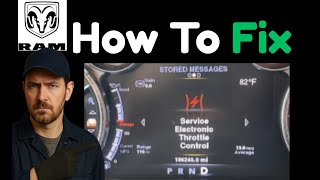
- "Service Electronic Throttle Control" warning message on the dashboard
- Vehicle enters "limp mode" with drastically reduced engine power and acceleration
- Unresponsive or "dead" accelerator pedal
- Cruise control is disabled or will not activate
- Engine hesitates or stumbles during acceleration 🎬 Watch: Understanding the causes of the Service Electronic Throttle message.
- Replacing the accelerator pedal assembly. Manufacturer TSBs for the 2015-2019 Ram 3500 specifically state that the accelerator pedal should not be replaced for this fault until driver habit has been ruled out.
Most Likely Causes
- Driver Habit ('Two-Footed Driving') 🔴 High Probability The vehicle's Brake-Throttle Override system is designed to trigger this code as a safety measure. Multiple manufacturer TSBs confirm this is the most frequent cause, especially during activities like towing or snow plowing where a driver might cover both pedals.
How to confirm: Question the driver(s) about their driving style, specifically if they rest their left foot on the brake pedal while their right foot is on the accelerator. This can be unintentional. Clearing the code and test driving with a conscious effort to use only the right foot can confirm the diagnosis.
Typical fix: Advise the driver to change their habit. Ensure only one foot is used for both pedals. After correcting the driving style, clear the code with a scan tool. Often, just stopping the conflicting input allows the system to reset 🎬 See how to clear the P2299 code using a scanner. to normal operation on its own.
Est. part cost: $0 - Obstructed Pedal Path 🟡 Medium Probability Thick or improperly placed aftermarket floor mats can get bunched up behind or under the pedals, preventing them from returning to their resting position. This can cause a pedal to send a slight 'pressed' signal when it is not.
How to confirm: Visually inspect the driver's footwell. Remove the floor mat entirely and check if the pedals can move freely through their full range of motion without any binding.
Typical fix: Remove, reposition, or replace the floor mat. Ensure the pedals can move freely through their full range of motion. Secure the mat using the factory retention hooks.
Est. part cost: $0-$150 - Faulty Brake Light Switch (Brake Pedal Position Sensor) ⚪ Low Probability → Shop Brake Light Switch While less common than driver habit, the brake switch can fail and send a constant "brake applied" signal to the PCM, even when the pedal is not pressed. This plastic switch is located at the top of the brake pedal arm and can become internally worn or stuck.
How to confirm: Use an OBD-II scan tool with live data capability. Monitor the brake switch status (PID for BPP). It should read "Off" or "Released" when the pedal is not touched and change to "On" or "Applied" when pressed. If it's stuck "On" or flickers without pedal input, the switch is likely faulty.
Typical fix: Replace the brake light switch. This is typically a simple, quarter-turn installation at the top of the brake pedal support bracket.
Est. part cost: $25-$70
Rare But Worth Checking
- Faulty Accelerator Pedal Position (APP) Sensor: → Shop Accelerator Pedal Assembly While TSBs #9004225, #9003413, and #53034160A explicitly warn against replacing the pedal for this code, a genuine internal failure of the sensor can cause it to send incorrect voltage signals, triggering P2299 when the brake is pressed. This should only be considered after ruling out all other causes and if other APP-specific codes (like P2122, P2127, P2138) are present.
- Wiring or Connector Issue: TSB #53034160A advises checking wiring and connectors. Damage, corrosion, or a loose connection at the brake switch or accelerator pedal harness can cause erratic signals, leading to the code. Pay close attention to the harnesses under the dash near the pedals where they can be kicked or stressed.
- Aftermarket Throttle Controller: Devices that modify the signal from the accelerator pedal can fail or be improperly installed. If they send erroneous signals that conflict with the brake pedal input, it can cause a P2299 code.
Diagnosis Steps
- Discuss driving habits with the vehicle operator. Ask if they drive with two feet, resting one on the brake. This is the most common cause. Inquire about specific situations like maneuvering a trailer or wearing heavy work boots.
- Inspect the driver's side floor mat. Remove it completely to ensure it is not interfering with the accelerator or brake pedal.
- Connect an OBD-II scanner and check for any other codes that may be present, such as P2122, P2127, or P2138, which would point towards the accelerator pedal sensor.
- Use the scanner's live data function to monitor the status of the Brake Pedal Position (BPP) sensor and the Accelerator Pedal Position (APP) sensor percentages.
- With the engine on and the vehicle in park, observe the live data. The APP sensor should show 0% or a very low voltage (typically under 1.0V). The BPP sensor should show 'Off' or 'Released'.
- Press each pedal individually and observe the data. The values should change smoothly and return to their resting state when released. The APP sensor voltage should rise to ~3.5-4.8V at full throttle.
- If the BPP sensor reads 'On' when the pedal is not being touched, suspect a faulty or misadjusted brake light switch.
- If the APP sensor shows a percentage greater than zero when the pedal is not being touched, or its signal is erratic, suspect a faulty accelerator pedal assembly.
- If the sensors appear to be working correctly, inspect the wiring and connectors for both the accelerator pedal and brake switch for any signs of damage, corrosion, or looseness.
- If any aftermarket throttle controllers are installed, disconnect them entirely to see if the problem resolves.
Parts You'll Likely Need
- Brake Light Switch / Brake Pedal Position Sensor
(OEM #68163999AB)— If a part has failed, it is most likely the brake switch sending a false 'brake applied' signal. This is an inexpensive and relatively easy part to replace.
Trusted brands: Mopar, Standard Motor Products (SLS577)
OEM price range: $40-$60
Aftermarket price range: $25-$40
Related Codes That Often Appear With This One
- P2122 — This code ('Accelerator Pedal Position Sensor Circuit Low') can indicate a problem with the APP sensor itself, which could be a root cause of the P2299 if the sensor is failing.
- P2127 — Similar to P2122, this code ('Accelerator Pedal Position Sensor Circuit Low') points to a fault in the second signal from the APP sensor, reinforcing the possibility of a pedal assembly failure.
- P2138 — This code ('APP Sensor 1/2 Correlation') indicates a mismatch between the two redundant sensors within the accelerator pedal assembly, pointing directly to a faulty pedal.
Technical Service Bulletins (TSBs) & Recalls
- 9004225: States P2299 is usually caused by a 'two footed driver' and the accelerator pedal should not be replaced for this fault.
- 9003413: Also states P2299 is usually caused by a 'two footed driver' and the accelerator pedal should not be replaced.
- 53034160A: Warns that P2299 is usually caused by a 'two footed driver' and to check wiring and connectors before replacing the pedal.
- 18-049-16: For 2016 Jeep Grand Cherokee and Dodge Durango, a PCM flash was issued to address P2299, indicating a potential software sensitivity issue on related platforms.
- 18-103-16 REV. B: For 2014-2015 Ram 1500, a PCM software update was released to address several codes, including P2299, indicating a history of software sensitivity.
Platform-Specific Known Issues
- Multiple Technical Service Bulletins (TSBs) have been issued by the manufacturer specifically identifying 'two-footed driving' as the primary cause for P2299 on this platform, and warning against unnecessarily replacing the accelerator pedal. (Bulletins #9004225, #9003413, #53034160A)
- Owners on forums frequently report this code appearing while performing specific maneuvers like backing up a trailer or plowing snow, where fine control using both pedals is common.
- Some 2016 models had a PCM software update available (TSB 18-006-16 REV. B) that could address instances of this code setting improperly.
Mechanic-Grade Diagnostic Values
- Accelerator Pedal Position (APP) Sensor 5-Volt Supply — expected: 4.5 to 5.2 Volts at the APP sensor harness connector (ignition on, engine off).. Failure: Voltage outside this range suggests an open or short in the power supply circuit from the PCM.
- Brake Pedal Position (BPP) Sensor Voltage — expected: Approximately 0.5V with the pedal released to approximately 4.5V when fully pressed.. Failure: Voltage that is stuck high, does not change smoothly with pedal travel, or is present without the pedal being pressed indicates a faulty switch or circuit.
- Accelerator Pedal Position (APP) Sensor Resistance — expected: Typically between 1.5 kΩ and 3.5 kΩ across specified pins (varies by circuit).. Failure: Readings outside the manufacturer's specified range, or an open/infinite reading, suggest a faulty sensor.
Scan Tool Commands That Help
- wiTECH (or equivalent professional scanner): PCM Reprogram/Flash — Used to apply software updates as specified in TSBs like 18-006-16 REV. B for 2016 models, which can resolve P2299 if it's caused by overly sensitive software parameters.
- N/A - Manual Procedure: Throttle Body Relearn / Reset — After cleaning or replacing the throttle body, or disconnecting the battery, a relearn procedure may be needed. A common manual method involves disconnecting the negative battery cable for over 90 seconds, reconnecting, turning the ignition ON (without starting) for at least 10 seconds, then turning it off before starting the engine.
Wiring & Ground Locations
- Accelerator Pedal Connector — Directly on the accelerator pedal assembly, mounted to the firewall in the driver's footwell.. This is the primary connection point for the APP sensor. A loose connection, corrosion, or damaged pins here will directly cause erratic pedal signals and can trigger P2299, often with other APP codes.
- Brake Light Switch Connector — At the top of the brake pedal arm, under the driver's side dashboard.. A poor connection at the brake switch can cause the PCM to think the brake is applied when it is not, creating the conflict with the accelerator signal that sets P2299.
- Ground Points (General) — Forum discussions for similar generation Ram trucks mention key ground points near the passenger side wheel well/fender, near the battery negative terminal, and to the right of the steering column under the dash.. A poor ground for the PCM or related sensor circuits can introduce electrical noise and voltage discrepancies, potentially leading to false P2299 codes. Verifying chassis and engine grounds are clean and tight is a crucial step when diagnosing persistent, unexplained electrical faults.
Real Owner Repair Stories
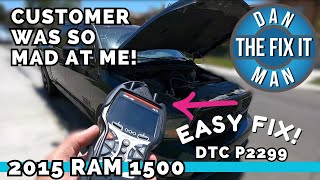
- Dan the Fix it Man YouTube Channel (2015 Ram 1500) — Engine revving while braking, "Service Electronic Throttle" warning message, P2299 code stored.
❌ Tried (didn't work) The owner suspected a major component failure and was about to take it to a shop.
✅ What actually fixed it The floor mat had been pushed up against the accelerator pedal, causing it to be partially depressed at all times. Repositioning the floor mat and clearing the code resolved the issue completely. - Dodge Diesel - Diesel Truck Resource Forums (2007+ Ram (3rd Gen, but relevant principle)) — Hesitation on the freeway, throttle control valve light illuminated, P2299 code found by dealer.
❌ Tried (didn't work) The driver confirmed they were not a 'left-foot braker'.
✅ What actually fixed it The dealer performed a PCM software flash (reprogram) which was intended to fix the issue, along with a hard transmission shift and a delayed alternator reading. This indicates a known software sensitivity was the likely cause.
Model Year Variations Within This Range
- 2016: A specific PCM software update, outlined in TSB 18-006-16 REV. B, was released for 2016 models equipped with the 3.6L or 5.7L gas engines to address "Powertrain Diagnostic And System Enhancements." P2299 is listed as a code that this flash may resolve, suggesting these models had a higher likelihood of a software-related trigger for the fault.
- 2013-2018: The accelerator pedal assembly for models without power-adjustable pedals may have a different part number or design than those with power-adjustable pedals. While the function is the same, the physical mounting and harness may differ, making them non-interchangeable.
Helpful Videos

The information in this article is provided for general reference and educational purposes only. Vehicle specifications, procedures, and part compatibility can vary by production date, trim level, and region. Always consult your vehicle's factory service manual and verify part numbers before purchasing or performing repairs. Safety-critical components such as airbags, seat belts, and braking systems should be installed by a qualified professional.
- Ram 3500:
- 🧭 Diagnostic Flowchart
- 🎬 Helpful Videos
- What's Unique About the 2015-2019 Ram 3500
- Symptoms You May Notice
- Most Likely Causes
- Rare But Worth Checking
- Diagnosis Steps
- Parts You'll Likely Need
- Related Codes That Often Appear With This One
- Technical Service Bulletins (TSBs) & Recalls
- Platform-Specific Known Issues
- Mechanic-Grade Diagnostic Values
- Scan Tool Commands That Help
- Wiring & Ground Locations
- Real Owner Repair Stories
- Model Year Variations Within This Range
- 🎟️ Get 5% Off