

OBD-II Code P2304: Ignition Coil 'B' Primary Circuit High
An Expert Guide to Diagnosing and Fixing P2304
- Code P2304 indicates a high-voltage fault in cylinder #2's ignition coil control circuit, causing an immediate and noticeable engine misfire.
- A failed ignition coil causes over 80% of P2304 codes, making a direct coil replacement the most statistically likely fix.
- Swap the ignition coil from cylinder #2 to cylinder #1; if the code changes to P2301, you have definitively proven the coil is defective.
- Stop driving immediately if the Check Engine Light flashes, as raw fuel entering the exhaust will destroy a $1,500+ catalytic converter in under 50 miles.
- Inspect the spark plug well for oil pooling before replacing parts on Ford and Subaru engines, as leaking valve cover gaskets frequently ruin the coil.
What Does P2304 Mean?
The Powertrain Control Module (PCM) detected abnormally high voltage in the control circuit for ignition coil 'B' (cylinder #2). This means the PCM cannot properly ground the coil to fire the spark plug, resulting in a dead cylinder and an immediate engine misfire.
Technical definition: Ignition Coil 'B' Primary Control Circuit High. The PCM controls the ignition coil's primary (low-voltage) circuit by pulsing the ground connection via an internal transistor driver. When the PCM commands the coil to fire, it expects the circuit voltage to drop near 0V. Code P2304 sets when the PCM detects the voltage remains unexpectedly high, indicating an open circuit, a short to power, or a failed PCM driver.
Can I Drive With P2304?
Yes, But With Caution. You can drive short distances, but it is strongly discouraged. The engine misfires, causing poor performance and stalling. If the Check Engine Light flashes, unburned fuel enters the exhaust and destroys the catalytic converter in under 50 miles, adding $1,500+ to the repair cost.
Common Causes
- Failed Ignition Coil 'B' (Very Common) — The ignition coil fails internally due to heat stress and vibration, causing a short or open in its primary winding. This causes over 80% of P2304 codes.
- Wiring or Connector Damage (Common) — The wiring harness to the coil shorts to a power source, or chafed insulation makes contact with another wire. Corroded, bent, or loose connector pins also create high resistance.
- Worn or Fouled Spark Plug (Common) — A bad spark plug in cylinder #2 creates excessive resistance in the secondary ignition circuit. The engine management system interprets this electrical feedback as a primary circuit fault.
- Valve Cover Gasket or Spark Plug Tube Seal Leak (Less Common) — Oil leaks from the valve cover gasket or spark plug tube seals and pools in the spark plug wells. This oil saturates the coil boot, degrades the rubber, and destroys the coil.
- Loose or Corroded Ground Connection (Less Common) — The ignition system requires a solid ground. A loose or corroded main engine ground strap creates unwanted resistance, causing incorrect voltage readings at the PCM.
- Faulty Powertrain Control Module (PCM) (Very Rare) — The internal driver transistor within the PCM that controls the ignition coil fails and gets stuck, sending continuous voltage. Exhaust all other possibilities before replacing the PCM.
Symptoms
- Rough Idle and Engine Misfire — The engine runs unevenly and shakes or vibrates violently, especially when stopped or at low speeds, because cylinder #2 is dead.
- Loss of Power and Hesitation — The vehicle feels sluggish and struggles to accelerate. It stumbles when you press the gas pedal, especially under load.
- Engine Stalling — The engine stalls intermittently when coming to a stop or accelerating from a standstill.
- Decreased Fuel Economy — Because one cylinder pumps unburned fuel into the exhaust, overall gas mileage drops by 10% to 25%.
- Check Engine Light is On or Flashing (also visible on scanner) — The Malfunction Indicator Lamp illuminates. A flashing light indicates a severe, catalyst-damaging misfire.
Diagnostic Flowchart
Tap your situation to follow the diagnostic path that matches what you're seeing on this code.
Common Fixes & Costs
- Replace Ignition Coil 'B' — Parts: $50-$200, Labor: $75-$175, ~0.5 hr book time (DIY)
- Replace Spark Plugs — Parts: $20-$120, Labor: $100-$250, ~1.2 hr book time (DIY)
- Repair Wiring Harness or Connector — Parts: $15-$50, Labor: $150-$400, ~2.5 hr book time (Intermediate)
- Clean or Replace Engine Ground Straps — Parts: $20-$60, Labor: $50-$150, ~0.8 hr book time (Intermediate)
- Replace Powertrain Control Module (PCM) — Parts: $600-$1200, Labor: $200-$300, ~1.5 hr book time (Professional)
Used vs. New Parts: Buying Guide
When a used part is worth it: Buying a used OEM ignition coil from a low-mileage wrecked vehicle is a cost-effective alternative to a new aftermarket part. However, given the low cost of new premium coils, buying new is the safer choice.
Donor-vehicle mileage cap: roughly under 60000 miles for the part to have meaningful remaining life.
Donor quality checklist:
- Verify the donor vehicle's mileage.
- Avoid parts from flood-damaged vehicles.
- Match the part number exactly to ensure correct internal resistance.
Decision logic:
- If The new OEM or premium aftermarket part is under $100 → Buy new. The warranty and longevity outweigh the small savings of a used part.
- If The vehicle is older and budget is the primary concern → A used OEM coil is often more reliable than a cheap, no-name new coil. Be prepared for premature failure.
- If The coil is difficult to access (e.g., under the intake manifold) → Always buy a new, high-quality OEM part to avoid repeating extensive labor.
Warranty tradeoff: Used parts carry a 30-90 day warranty. New aftermarket parts offer 1-year to limited lifetime warranties. New OEM parts usually have a 1-year warranty.
Worst-case if a used part fails: $150-$400 if a used part fails shortly after installation, factoring in repeat labor and a replacement part.
What Happens If You Wait — Timeline
- 0-2 weeks: Solid Check Engine Light appears. A slight rough idle is felt when stopped. No major performance loss is noticeable. (MPG impact: 0-5%% · Added cost: $0-$25 in wasted fuel)
- 2 weeks - 2 months: Misfire becomes consistent. Engine stumbles during acceleration. Rough idle is constant. Fuel economy drops noticeably. (MPG impact: 10-25%% · Added cost: $50-$150 in wasted fuel and stress on the catalytic converter)
- 2-4 months (with flashing CEL): Check Engine Light flashes frequently. The catalytic converter overheats from raw fuel, melting its internal ceramic honeycomb structure. (MPG impact: 25-40%% · Added cost: $1500-$3400 for catalytic converter replacement)
- 4+ months: The catalytic converter clogs the exhaust. The engine loses severe power and cannot accelerate past 40 mph. Unburned fuel washes oil off cylinder walls, accelerating piston ring wear. (MPG impact: 40%+% · Added cost: $3000-$5500+ for catalytic converter and potential engine rebuild)
Cost of Not Fixing It
- Immediate (flashing CEL): A flashing Check Engine Light indicates a severe misfire dumping raw fuel into the exhaust. This destroys the catalytic converter in as little as 50 miles. (Added cost: $1500-$3400+)
- 1-3 months (solid CEL): Continued driving with a misfire drops fuel economy by 10-25% and damages the spark plug and ignition coil boot from excess heat. (Added cost: $50-$200)
- 6+ months: Long-term misfires wash oil from cylinder walls, increasing wear on piston rings and leading to a permanent loss of engine compression. (Added cost: $2500+)
Diagnosis Steps
- Read Codes and Analyze Freeze Frame Data
Use an OBD-II scanner to confirm P2304. Look for P0302 (Cylinder 2 Misfire). Analyze the freeze frame data to identify the engine RPM, load, and temperature when the fault occurred.
Tools: OBD-II Scanner (Beginner) - Swap the Ignition Coil (The 'Mechanic's Trick')
Move the ignition coil from cylinder #2 to cylinder #1. Clear the codes and drive the car. If the code changes to P2301 (coil 'A'), the ignition coil is bad. If P2304 returns, the coil is fine.
Tools: Basic socket/ratchet set (Beginner) - Perform a Detailed Visual Inspection
Inspect the cylinder #2 coil for cracks or melting. Check the electrical connector for corrosion or pushed-out pins. Trace the wiring harness for chafed or broken wires. Look for oil pooling in the spark plug well.
Tools: Flashlight, Inspection Mirror (Beginner) - Inspect and Test the Spark Plug
Remove the spark plug from cylinder #2. Check for severe wear, oil fouling, or cracked ceramic. Replace the plug if damaged.
Tools: Spark plug socket, ratchet, torque wrench (Intermediate) - Test the Coil Connector Circuit
Disconnect the coil connector. With Key On, Engine Off (KOEO), use a multimeter to verify battery voltage (~12V) at the power supply pin. Check the ground circuit for continuity to the chassis ground (must be under 0.1 ohms).
Tools: Digital Multimeter, Vehicle-specific wiring diagram (Advanced) - Test the Coil's Internal Resistance
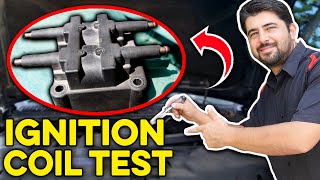
Set a multimeter to Ohms (Ω). Probe the primary terminals on the coil; a healthy coil reads 0.4 to 2.0 ohms. Probe the secondary circuit (positive terminal to the high-voltage boot); it should read 6,000 to 15,000 ohms. An 'OL' reading means the coil is dead.
Tools: Digital Multimeter (Advanced) - Test the PCM Driver Signal Wire
With the coil unplugged and KOEO, probe the signal wire terminal. If you see steady battery voltage, the wire is shorted to power. Reconnect the coil and back-probe the signal wire while cranking. The voltage must pulse toward 0V. If it stays high, the circuit or PCM driver failed.
Tools: Digital Multimeter (with back-probe pins) (Advanced) - Analyze the Primary Ignition Waveform
Connect an oscilloscope to the signal wire of coil #2. A normal waveform shows a flat line near 0V, a vertical rise to battery voltage, a flat dwell period, and a sharp drop to 0V followed by a 400V spike. A P2304 fault shows voltage failing to drop to 0V.
Tools: Oscilloscope, Vehicle-specific wiring diagram (Professional) - Confirm PCM Failure
If the coil, plug, and wiring test perfectly, and the signal remains 'high' when tested directly at the PCM pin, the PCM's internal driver is dead. Replace or rebuild the PCM.
Tools: Professional diagnostic tools, Wiring diagram (Professional)
When This Code Triggers (Freeze-Frame Conditions)
- Engine Coolant Temp: 185-210°F (The fault often appears once the engine is fully warmed up and enters closed-loop operation.)
- Engine RPM: 1500-3000 RPM (The code frequently sets during steady-state cruising or light acceleration, not at idle.)
- Engine Load: 30-60% (Corresponds to normal driving conditions, like maintaining speed on a highway.)
- Vehicle Speed: 40-65 mph (Consistent with highway driving when the ignition system is under a sustained load.)
Related Codes
- P0302 — Cylinder 2 Misfire Detected. P2304 is the electrical cause, and P0302 is the mechanical effect. Fixing P2304 resolves P0302.
- P2301 — Ignition Coil 'A' Primary Control Circuit High. This is the identical fault for cylinder #1. If you swap the coil from cylinder 2 to 1 and the code changes to P2301, the coil is bad.
- P0300 — Random/Multiple Cylinder Misfire. Seeing P0300 alongside P2304 points to a shared failure like a bad engine ground, failing alternator, or faulty PCM.
- P2303 — Ignition Coil 'B' Primary Control Circuit Low. Seeing both a 'High' and 'Low' code for the same coil points directly to an intermittent wiring short or a failing PCM driver.
Climate & Environmental Factors
- Cold Weather: Low temperatures increase electrical resistance and expose failing ignition coils, leading to hard starting and misfires that vanish when the engine warms up.
- High Humidity / Moisture: Moisture seeps into cracked coil housings or compromised wiring insulation, causing connector pin corrosion and short circuits.
- High Altitude: Thinner air requires a stronger spark for efficient combustion. A weak coil that functions at sea level fails completely at higher elevations.
How to Talk to a Mechanic About This Code
Say this: "I have an engine misfire and my scanner shows code P2304 for the ignition coil B primary circuit. I'd like to book a diagnostic appointment. Can you please start by checking the coil, plug, and wiring for cylinder 2?"
This tells the shop you identified the specific cylinder and the electrical nature of the fault. It focuses their diagnostic time, prevents charges for basic code reading, and steers them away from unrelated upsells.
Avoid saying:
- 'My check engine light is on, can you look at it?'
- 'My car is shaking, I think it needs a tune-up.'
- 'Just fix whatever is wrong.'
Questions to ask before authorizing the repair:
- Did you perform a swap test with the coil and spark plug to confirm the failure?
- If the coil isn't the issue, did you test the wiring harness for a short to power between the coil and the PCM?
- If you are recommending a PCM replacement, can you show me the data proving the driver failed?
- What is the warranty on the parts and labor for this repair?
Where to Take It: Dealer vs Independent vs Chain
- Dealer:
Recommended only if a specific TSB applies or if the fault is confirmed to be the PCM.
Best for: Vehicles under warranty., Vehicles with known TSBs related to P2304 (like the 2021-2024 Ford Bronco)., When diagnosis points to a complex PCM failure requiring proprietary software.
Downsides: Highest labor rates., May recommend expensive PCM replacement when a wiring repair suffices. (Typical cost: +50% vs. baseline) - Independent Shop:
Best fit for most P2304 scenarios. An experienced independent mechanic efficiently diagnoses and repairs the most common causes at a fair price.
Best for: Out-of-warranty vehicles where the cause is likely a coil, plug, or wiring issue., Vehicles known to have this code frequently (Jeep, Ram, Ford)., Getting a second opinion on a dealer's PCM diagnosis.
Downsides: Quality varies; ensure the shop has good reviews and technicians skilled in electrical diagnostics. (Typical cost: +0% vs. baseline) - Chain Shop:
Acceptable for a straightforward coil replacement, but avoid for initial diagnosis to prevent misdiagnosing a wiring or PCM issue.
Best for: If you are certain the fix is a simple ignition coil or spark plug replacement.
Downsides: Technician skill varies greatly., Lacks advanced diagnostic tools to trace wiring faults or diagnose a PCM., High pressure to upsell services like fuel system cleanings. (Typical cost: -10% vs. baseline)
When to Walk Away From the Repair
If the estimated repair cost exceeds 40-50% of your car's private-party value, pause and evaluate.
- Car worth $4000, fix is $2200: Walk away. A $2,200 repair for a PCM replacement on a $4,000 car is a poor investment.
- Car worth $12000, fix is $175: Fix it. A $175 repair for a bad ignition coil is routine maintenance.
- Car worth $2500, fix is $1500: Walk away. The repair cost is 60% of the car's value. Other age-related failures will occur soon.
What Scan Tool You Need for This Code
Minimum: A code reader that displays and clears codes, shows freeze-frame data, and views basic live data PIDs like RPM and engine temperature.
A $20 reader only gives the code 'P2304'. A better scanner shows engine conditions when the code set and lets you watch live misfire data to confirm the fix.
Budget: BlueDriver Pro (~$100) — Reads and clears the code, provides detailed freeze-frame data, graphs live data, and accesses Mode 6 data to show misfire counts per cylinder.
Mid-range: Foxwell NT510 Elite (~$180) — Includes all budget features, plus manufacturer-specific diagnostics and bi-directional controls to test circuits without manual probing.
Professional: Autel MaxiCOM MK808S (~$400-500) — Offers full bi-directional control to command ignition coils directly. Provides comprehensive access to all vehicle modules for diagnosing complex wiring or PCM faults.
How to Clear the Code After You Fix It
- Fix the underlying mechanical or electrical issue.
- Use an OBD-II scan tool to clear the Diagnostic Trouble Codes (DTCs).
- Perform a complete drive cycle to allow the vehicle's readiness monitors to run.
Drive cycle (~30 minutes): Start with a cold engine (sit for 8+ hours). Idle for 2-3 minutes with A/C on. Drive for 10-15 minutes at a steady highway speed (55-60 mph). Perform 15-20 minutes of stop-and-go city driving. Allow the vehicle to cool down completely.
Readiness monitors affected: Misfire Monitor, Catalyst (CAT) Monitor, Oxygen (O2) Sensor Monitor
Before emissions retest: drive at least 100 miles to fully set monitors.
Watch out for:
- Disconnecting the battery clears the code but resets all readiness monitors, guaranteeing an emissions test failure.
- The code returns immediately if the root cause (bad coil, wiring short) is not fixed.
Will This Fail Emissions / State Inspection?
Yes — this code typically fails an OBD-II emissions inspection.
- California: An active P2304 code is an automatic smog check failure. A full drive cycle must be completed to set all readiness monitors before a retest.
- New York: The NYS DMV inspection includes an OBD-II scan. An illuminated Check Engine Light and active P2304 code result in immediate failure.
- Texas: In the 17 counties requiring emissions testing, a vehicle with code P2304 fails the OBD portion of the inspection.
Most Commonly Affected Vehicles
- Ram Promaster City (2015-2022) — Extremely common on the 2.4L MultiAir engine. The cause is almost always a failed ignition coil on cylinder #2.
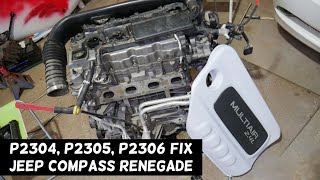
- Jeep Cherokee, Renegade, Compass (2014-2023) — Models equipped with the 2.4L MultiAir engine are highly susceptible. The coil swap is the definitive first diagnostic step.
- Ford F-150, Explorer, Mustang, Bronco (2004-2024) — Often caused by leaking valve cover gaskets flooding the spark plug wells with oil. For 2021-2024 Bronco 2.3L models, check TSB 24-2406 for a required PCM software update.
- Mazda 3, 6, CX-7 (2007-2018) — Experiences ignition coil failure or wiring harness chafing near the engine block.
- Chevrolet Equinox, Silverado (2008-2017) — Triggered by coil failure or wiring harness problems. Aftermarket alarms spliced into the ignition circuit frequently cause this code.
- Volkswagen Jetta, Golf, Passat (2006-2016) — Traced back to a failed coil pack or a short in the wiring harness. Severe carbon buildup on intake valves also contributes to misfires.
- Subaru Outback, Forester, Impreza (2005-2014) — Leaking spark plug tube seals pool oil in the lower spark plug tubes, saturating and ruining the coil.
Manufacturer-Specific Notes
- Chrysler/Dodge/Jeep/Ram/Fiat: On 2.4L MultiAir engines, P2304 is overwhelmingly caused by a failed ignition coil on cylinder #2. Technicians replace this coil as a primary diagnostic step.
- Ford: P2304 is often a secondary failure caused by oil leaks from valve cover gaskets. For 2021-2024 2.3L Broncos, TSB 24-2406 notes a PCM software error causes this code.
- Subaru: The boxer engine design makes lower spark plugs susceptible to oil pooling from leaking tube seals, causing rapid coil failure.
- Chevrolet/GM: Aftermarket devices (remote starters or alarms) spliced into the ignition coil circuits introduce voltage irregularities and trigger this DTC.
Real Owner Stories
2016 Jeep Cherokee 2.4L at 75,000 miles
Check Engine Light illuminated with a rough idle and hesitation. Codes P2304 and P0302 were present.
What they tried:
- Performed the 'mechanic's trick' coil swap test.
- Swapped the ignition coil from cylinder #2 with cylinder #1.
- Cleared the codes and test drove the vehicle.
Outcome: The code changed to P2301 (Ignition Coil 'A' Primary Circuit High). This confirmed the ignition coil was faulty. Replaced the coil with a new Mopar unit, resolving the codes.
Lesson: For 2.4L MultiAir engines, P2304 is almost always a bad coil. The coil swap test is a fast, free, and definitive way to confirm the diagnosis.
2013 Ford F-150 5.0L at 110,000 miles
Engine shuddered during acceleration, triggering P2304. Visual inspection revealed oil pooled in the spark plug well for cylinder #2.
What they tried:
- Replaced the ignition coil and spark plug, but the new coil failed within a few hundred miles.
- Realized the root cause was the oil leak.
- Removed the valve cover to access the seals.
Outcome: The spark plug tube seal failed, flooding the coil with oil. Replaced the valve cover gasket set, cleaned the well, and installed a new coil. The problem was permanently fixed.
Lesson: Always check for oil in the spark plug wells. Replacing the coil without fixing the leak guarantees a repeat failure.
2015 Ford F-150 3.5L EcoBoost at 157,000 miles
Owner experienced intermittent misfires for two years. Replacing all plugs and coils failed to fix it. Finally triggered a P2304 code.
What they tried:
- Replaced the coil on the corresponding cylinder without success.
- Discovered the issue was related to condensation buildup in the intercooler, a known EcoBoost issue.
Outcome: Drilled a 'weep hole' in the intercooler to drain condensation. The P2304 code was triggered when water ingestion caused a momentary short the PCM interpreted as a primary circuit fault.
Lesson: If common fixes fail, research TSBs or pattern failures for your specific engine before chasing complex wiring faults.
How to Prevent This Code From Triggering
- Replace Spark Plugs at Recommended Intervals (Every 60,000-100,000 miles) — Worn spark plugs have a wider gap, forcing the ignition coil to generate higher voltage. This increased workload overheats and destroys the coil.
- Fix Engine Oil Leaks Promptly (As needed) — Leaking valve cover gaskets allow oil to saturate the ignition coil boot, degrading the rubber and causing misfires.
- Use Quality OEM or Top-Tier Aftermarket Coils (During replacement) — Cheap aftermarket coils use low-quality windings that cannot withstand engine heat, leading to premature failure.
- Keep Engine Bay Clean and Dry (Annually) — Moisture corrodes ignition coil connector pins, creating high resistance or short circuits that trigger P2304.
- Ensure Battery and Charging System are Healthy (During routine service) — A weak battery or failing alternator causes unstable voltage, stressing the PCM's ignition drivers and coils.
Frequently Asked Questions
What does the 'B' in P2304 mean?
The letter 'B' refers to the second cylinder in the engine's firing order, which is almost always cylinder #2. Code P2304 points specifically to the ignition coil circuit for cylinder #2.
Can I just replace a fuse to fix P2304?
It is highly unlikely. Ignition coils share a power supply fuse, so a blown fuse triggers codes for multiple coils simultaneously. Checking fuses is a valid preliminary step, but rarely the root cause.
I replaced the coil and spark plug, but the code is still there. What now?
The problem lies in the wiring or the PCM. Meticulously inspect the coil's electrical connector for burnt pins and check the harness for melting or chafing where it shorts to power.
Why is my Check Engine Light flashing with this code?
A flashing light signals a severe engine misfire dumping raw fuel into the exhaust, which destroys your catalytic converter in minutes.
What is the difference between the primary and secondary ignition circuit?
The primary circuit is the low-voltage side (12V) the PCM uses to charge the coil. The secondary circuit is the high-voltage side (40,000+ volts) that generates the spark. P2304 is a fault on the low-voltage primary side.
Can a bad battery cause a P2304 code?
Yes, but it is rare. A failing battery or alternator causes system-wide voltage instability, tricking the PCM into misinterpreting a voltage spike as a coil circuit fault. You will usually see other electrical codes present.
How do I find cylinder #2?
On inline 4 and 6-cylinder engines, cylinder #1 is at the front of the engine (belt side), and numbers increase moving back. On V6 or V8 engines, the layout varies. Consult your vehicle's service manual to identify cylinder #2.
Key Takeaways
- Code P2304 indicates a high-voltage fault in cylinder #2's ignition coil control circuit, causing an immediate and noticeable engine misfire.
- A failed ignition coil causes over 80% of P2304 codes, making a direct coil replacement the most statistically likely fix.
- Swap the ignition coil from cylinder #2 to cylinder #1; if the code changes to P2301, you have definitively proven the coil is defective.
- Stop driving immediately if the Check Engine Light flashes, as raw fuel entering the exhaust will destroy a $1,500+ catalytic converter in under 50 miles.
- Inspect the spark plug well for oil pooling before replacing parts on Ford and Subaru engines, as leaking valve cover gaskets frequently ruin the coil.
Helpful Videos

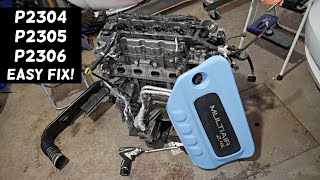
Shop the Parts Behind P2304
Below are the parts most often responsible for code P2304, ranked by how frequently each one is the actual culprit (per the diagnosis above). Tap any to see what we have for your vehicle.




The information in this article is provided for general reference and educational purposes only. Vehicle specifications, procedures, and part compatibility can vary by production date, trim level, and region. Always consult your vehicle's factory service manual and verify part numbers before purchasing or performing repairs. Safety-critical components such as airbags, seat belts, and braking systems should be installed by a qualified professional.
- 🧭 Diagnostic Flowchart
- 🎬 Helpful Videos
- 🛍️ Shop This Part
- What Does P2304 Mean?
- Can I Drive With P2304?
- Common Causes
- Symptoms
- Common Fixes & Costs
- Used vs. New Parts: Buying Guide
- What Happens If You Wait — Timeline
- Cost of Not Fixing It
- Diagnosis Steps
- When This Code Triggers (Freeze-Frame Conditions)
- Related Codes
- Climate & Environmental Factors
- How to Talk to a Mechanic About This Code
- Where to Take It: Dealer vs Independent vs Chain
- When to Walk Away From the Repair
- What Scan Tool You Need for This Code
- How to Clear the Code After You Fix It
- Will This Fail Emissions / State Inspection?
- Most Commonly Affected Vehicles
- Manufacturer-Specific Notes
- Real Owner Stories
- 2016 Jeep Cherokee 2.4L at 75,000 miles
- 2013 Ford F-150 5.0L at 110,000 miles
- 2015 Ford F-150 3.5L EcoBoost at 157,000 miles
- How to Prevent This Code From Triggering
- Frequently Asked Questions
- What does the 'B' in P2304 mean?
- Can I just replace a fuse to fix P2304?
- I replaced the coil and spark plug, but the code is still there. What now?
- Why is my Check Engine Light flashing with this code?
- What is the difference between the primary and secondary ignition circuit?
- Can a bad battery cause a P2304 code?
- How do I find cylinder #2?
- Key Takeaways
- 🎟️ Get 5% Off