

OBD-II Code P2314: Ignition Coil 'E' Secondary Circuit Fault
What P2314 means, why it triggers, and how to fix it
- Code P2314 pinpoints a high-voltage failure in the ignition coil for cylinder #5.
- Swap the cylinder #5 ignition coil with cylinder #1 to instantly confirm if the coil is dead before buying parts.
- For 2015-2016 Chrysler and Dodge minivans, a known PCM manufacturing defect (TSB 18-069-16) causes this code, requiring a computer replacement.
- Driving with an active P2314 misfire for more than a few weeks dumps unburned fuel into the exhaust, causing $1,500+ in catalytic converter damage.
What Does P2314 Mean?
P2314 indicates the Powertrain Control Module (PCM) detected a high-voltage failure in the ignition system for cylinder #5. The secondary circuit creates the spark that ignites the fuel. The code triggers when the spark duration is too short, happens at the wrong time, or fails completely.
Technical definition: Ignition Coil 'E' Secondary Circuit. The Powertrain Control Module (PCM) monitors the ionization field collapse after the cylinder #5 spark event. If this electrical feedback shows 'insufficient ionization' or an abnormal voltage signature, the PCM triggers P2314. 🎬 Watch: How to diagnose insufficient ionization and secondary circuit faults. This indicates an open circuit, short, high resistance, or electrical arcing in the high-voltage output.
Can I Drive With P2314?
Yes, But With Caution. You can drive short distances, but long trips will destroy your catalytic converter. A persistent cylinder #5 misfire dumps unburned fuel into the exhaust, superheating the converter. Continuing to drive adds a $1,500 to $2,500 replacement cost to your repair bill.
Common Causes
- Failed Ignition Coil 'E' (Cylinder 5) (Very Common) — The ignition coil is the most frequent point of failure. Internal secondary windings break down from heat and age, preventing the coil from generating the high voltage needed for a spark.
- Worn or Fouled Spark Plug in Cylinder 5 (Common) — An old, carbon-fouled, or incorrectly gapped spark plug requires excessive voltage to create a spark. This extra strain forces the coil circuit to operate outside its normal range, triggering the code.
- Damaged Wiring or Poor Connection (Common) — Engine heat and vibration damage the wiring harness and connector for the ignition coil. Frayed wires, corroded connector pins, or a loose connection disrupt the electrical circuit.
- Failing Powertrain Control Module (PCM) (Less Common) — The internal driver circuit within the PCM that controls the ignition coil fails. For 2015-2016 Chrysler and Dodge minivans, this is a highly common issue due to a documented manufacturing defect (TSB 18-069-16). 🎬 Watch: How to reflash a Chrysler PCM for this specific defect.
- Faulty Automatic Shutdown (ASD) Relay (Less Common) — The ASD relay supplies battery voltage to the ignition coils. A failing relay provides intermittent or no power to the coils, causing the PCM to detect a secondary circuit fault. This is a known issue on older Dodge trucks.
Symptoms
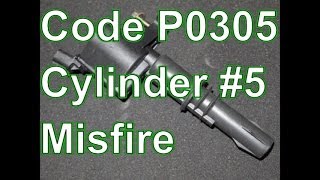
- Engine Misfire or Rough Idle — The engine shakes, stumbles, or runs unevenly at idle or under load. This is caused by cylinder #5 failing to fire and is often accompanied by an audible 'pop' from the exhaust. 🎬 See this walkthrough on diagnosing a cylinder 5 misfire.
- Reduced Engine Power and Hesitation — The vehicle feels sluggish when accelerating or climbing hills. The engine hesitates or stumbles when you press the gas pedal.
- Increased Fuel Consumption — A dead cylinder forces the engine to run inefficiently, drastically reducing fuel economy as the system overcompensates.
- Engine Stalling — The loss of cylinder power causes the engine to stall, particularly at low speeds or when coming to a complete stop.
- Check Engine Light is On (also visible on scanner) — The PCM illuminates the Malfunction Indicator Lamp (MIL) immediately. The light flashes if the misfire is severe enough to risk catalytic converter damage.
Diagnostic Flowchart
Tap your situation to follow the diagnostic path that matches what you're seeing on this code.
Common Fixes & Costs
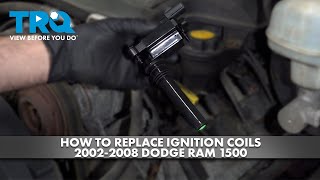
- Replace Ignition Coil 'E' (Cylinder 5) — Parts: $50-$150, Labor: $50-$120, ~0.8 hr book time (DIY)
- Replace Spark Plug in Cylinder 5 — Parts: $10-$30, Labor: $50-$100, ~0.7 hr book time (DIY)
- Replace Powertrain Control Module (PCM) — Parts: $500-$1000, Labor: $150-$300, ~2 hr book time (Professional)
- Repair Wiring or Replace Connector — Parts: $20-$50, Labor: $100-$250, ~1.5 hr book time (Intermediate)
- Replace Automatic Shutdown (ASD) Relay — Parts: $15-$40, Labor: $0-$50, ~0.2 hr book time (DIY)
DIY vs Professional
- Replace Ignition Coil / Spark Plug — Beginner: Yes, on most engines.
Tools: Socket set, spark plug socket, torque wrench, dielectric grease. - Replace ASD Relay — Beginner: Yes.
Tools: None. - Repair Wiring or Replace Connector — Beginner: No.
Tools: Wire strippers, crimpers, heat shrink tubing, soldering iron, multimeter. - Replace Powertrain Control Module (PCM) — Beginner: No.
Tools: Socket set, high-end scan tool for programming.
Used vs. New Parts: Buying Guide
When a used part is worth it: Buying a used ignition coil is not recommended as it is a common wear item. A used PCM from a reputable recycler is a viable option, provided it is reprogrammed for your vehicle's VIN.
Donor-vehicle mileage cap: roughly under 50000 miles for the part to have meaningful remaining life.
Donor quality checklist:
- Verify the donor vehicle was not scrapped for engine-related issues.
- Check for cracks, corrosion, or heat damage on the coil's housing.
- Match the part number exactly; visually identical coils have different internal resistance.
Decision logic:
- If The part is an ignition coil → Buy a new OEM or high-quality aftermarket part. The cost savings of a used coil are not worth the risk of premature failure.
- If The cause is a faulty PCM → A used PCM is a viable option, but it MUST be reprogrammed for your vehicle's VIN and security key.
- If Vehicle is over 150K miles and budget is the primary concern → A used part is a gamble but serves as a temporary solution. Expect a significantly shorter lifespan.
Warranty tradeoff: Used parts typically have a 30-90 day warranty. New aftermarket coils come with a 1-year to limited lifetime warranty. New OEM coils carry a 12-24 month warranty.
Worst-case if a used part fails: $150-$300 if a used ignition coil fails after installation, requiring repeat labor and the purchase of another part.
What Happens If You Wait — Timeline
- 0-1 week: Code P2314 sets, solid Check Engine Light appears. You notice a slightly rough idle on cold starts, but the vehicle drives normally. (MPG impact: 0-5%% · Added cost: $0)
- 1 week - 2 months: The misfire becomes consistent. The engine stumbles on acceleration and loses power on hills. The Check Engine Light flashes during heavy load. (MPG impact: 5-15%% · Added cost: $25-75 in wasted fuel)
- 2-4 months: The persistent misfire dumps unburned fuel into the exhaust. Raw fuel superheats the catalytic converter, melting its internal ceramic structure. You smell rotten eggs. (MPG impact: 15-25%% · Added cost: $1200-$2800 (Catalytic converter replacement required))
- 4+ months: The catalytic converter is completely clogged. The engine suffers severe power loss and cannot accelerate past 40 mph. Extreme backpressure damages exhaust valves. (MPG impact: 25-40%% · Added cost: $1500-$3500+)
Cost of Not Fixing It
- 0-1 month: Noticeable drop in fuel economy (5-15%), rough idle, and poor acceleration. Risk of stalling. (Added cost: Negligible, other than increased fuel costs.)
- 1-6 months: Persistent misfire dumps unburned fuel into the exhaust, overheating and destroying the catalytic converter's internal structure. (Added cost: $1200-$2800)
- 6+ months: Complete catalytic converter failure, damage to oxygen sensors, and potential internal engine damage from running in a constant misfire condition. (Added cost: $1500-$3500+)
Diagnosis Steps
- Read the Trouble Codes
Use an OBD-II scanner to confirm P2314 is present. Look for P0305 (Cylinder 5 Misfire), which almost always accompanies P2314 and confirms the location of the fault.
Tools: OBD-II Scanner (Beginner) - Swap the Ignition Coil
Swap the ignition coil from cylinder #5 with cylinder #1. Clear the codes and drive the car. If the code changes to P2302 (Ignition Coil 'A' fault), the coil is dead. If P2314 returns, the coil is fine.
Tools: Basic socket/wrench set (Beginner) - Inspect the Spark Plug
If the coil is good, remove the spark plug from cylinder #5. Check for wear, cracked porcelain, or heavy carbon deposits. Verify the spark plug gap matches vehicle specifications.
Tools: Spark plug socket, ratchet, gap gauge (Intermediate) - Visually Inspect the Wiring
Examine the wiring and connector for cylinder #5. Look for cracked plastic, burnt marks, corroded pins, or oil contamination. Ensure the connector clicks securely into place.
Tools: Flashlight (Beginner) - Test the Coil Power Supply (KOEO)
Disconnect the coil connector. With the key on, engine off (KOEO), use a multimeter to check for battery voltage (12.6V) at the power supply pin. If voltage is missing, test the ASD relay and supply wiring.
Tools: Multimeter, vehicle-specific wiring diagram (Intermediate) - Test Ignition Coil Secondary Resistance
Remove the ignition coil. Measure the resistance between the high-voltage output tower and a primary connector pin using a multimeter set to Ohms. A reading of infinity (O.L.) means an open circuit; near zero means a short. Both require replacement.
Tools: Multimeter, Service Manual (Advanced) - Check the Coil Control Circuit (Cranking Test)
Connect a 12V test light between the battery positive terminal and the control circuit pin on the coil connector. Crank the engine. The light must blink rapidly. A solid light indicates a short to ground; no light indicates an open circuit or failed PCM.
Tools: 12V test light, vehicle-specific wiring diagram (Advanced) - Test Control Circuit Wiring Integrity
With the ignition off and the PCM disconnected, measure resistance between the control pin at the coil connector and the corresponding PCM pin. The reading must be under 5.0 Ohms. Measure against engine ground to ensure no short exists (must read O.L.).
Tools: Multimeter, back-probe pins, wiring diagram (Advanced) - Test the PCM Driver Circuit with an Oscilloscope
If the coil, plug, and wiring pass all tests, use an oscilloscope to view the voltage pattern on the coil's primary control circuit. An absent or malformed inductive kick confirms a failed driver circuit inside the PCM.
Tools: Oscilloscope, back-probe pins (Professional)
When This Code Triggers (Freeze-Frame Conditions)
- Engine Coolant Temp: 180-210°F (The fault appears once the engine is fully warmed up and enters closed-loop operation.)
- RPM: 1500-3000 (The code sets under light to moderate load, such as steady-speed cruising or gentle acceleration.)
- Engine Load: 30-60% (The engine is working but not under heavy stress. Misfires from a weak coil are highly detectable in this range.)
- Vehicle Speed: 45-65 mph (Steady highway driving is the optimal condition for the PCM to run ignition system diagnostics.)
Related Codes
- P0305 — Cylinder 5 Misfire Detected. P2314 is the specific cause (ignition fault), while P0305 is the effect. They almost always appear together.
- P0300 — Random/Multiple Cylinder Misfire. If the underlying issue (failing PCM, bad ASD relay) affects other cylinders, this code appears alongside P2314.
- P2312 / P2313 — These codes relate to the primary (low-voltage) side of the same ignition coil ('E'). P2314 indicates a fault on the secondary (high-voltage) output side.
- P2317 — Identical code for Ignition Coil 'F' Secondary Circuit, corresponding to cylinder #6.
Climate & Environmental Factors
- Cold Weather: Low temperatures increase electrical resistance within the ignition coil's windings. A marginal coil fails to produce a strong enough spark in the cold, leading to hard starts and misfires.
- High Humidity / Moisture: Moisture penetrates cracks in the coil housing, providing a path for the high-voltage spark to arc to the engine block instead of the spark plug.
- High Altitude: Less dense air at high altitudes makes the engine more sensitive to ignition performance. A weak spark from a failing coil causes a more noticeable power loss at 8,000 feet than at sea level.
How to Talk to a Mechanic About This Code
Say this: "I have an engine misfire and my scanner shows code P2314 for the ignition coil E secondary circuit. I'd like to book a diagnostic appointment. Please start by testing the coil, spark plug, and wiring for cylinder 5 before recommending major part replacements."
This signals you understand the code. It directs the mechanic to follow a logical diagnostic process and prevents them from immediately suggesting an expensive, unnecessary repair.
Avoid saying:
- 'Just fix whatever's wrong'
- 'My check engine light is on, can you look at it?'
- 'My friend says it's the computer, just replace it.'
Questions to ask before authorizing the repair:
- Did you swap the coil with another cylinder and did the fault code move with it?
- If the coil is good, what were the results of the spark plug inspection and the wiring tests?
- Can you show me the failed part?
- What is the warranty on the parts and labor for this repair?
Where to Take It: Dealer vs Independent vs Chain
- Dealer:
Recommended if your vehicle is a Chrysler/Dodge/Jeep known for PCM issues, or if it's under warranty. Otherwise, an independent shop is more cost-effective.
Best for: Vehicles still under powertrain or emissions warranty., Diagnosing manufacturer-specific quirks, like the PCM issue on 2015-2016 Chrysler/Dodge minivans., Complex electrical issues after an independent shop fails to find the cause.
Downsides: Highest labor rates, often 1.5-2x more than independent shops., May recommend replacing more parts than necessary as a precaution. (Typical cost: +50% vs. baseline) - Independent Shop:
Best fit for most situations. A good independent shop easily diagnoses and fixes the common causes of P2314 for a reasonable price.
Best for: Most out-of-warranty vehicles., Standard diagnosis and repair of common codes like P2314., Building a long-term relationship with a mechanic.
Downsides: Quality varies greatly; vet shops by checking for ASE certification., May lack expensive, manufacturer-specific diagnostic tools for complex PCM issues. (Typical cost: +0% vs. baseline) - Chain Shop:
Use with caution. Acceptable if you already diagnosed a bad coil yourself and just need it replaced. AVOID for initial diagnosis.
Best for: Simple, clear-cut part replacements like batteries or tires.
Downsides: Technician skill and experience vary dramatically., High pressure to upsell unnecessary maintenance., Lack the deep diagnostic expertise for electrical issues beyond a simple part swap. (Typical cost: -10% vs. baseline)
When to Walk Away From the Repair
If the estimated repair cost exceeds 40-50% of the car's private-party value, seriously consider selling the car as-is or trading it in.
- Car worth $4000, fix is $2000: Walk away. The repair cost is 50% of the car's value. A PCM replacement for P2314 easily creates this scenario.
- Car worth $12000, fix is $250: Fix it. A $250 repair for a new coil and plug is well below the threshold and restores the vehicle's function.
- Car worth $2500, fix is $1500: Walk away. A repair costing 60% of the car's value is a poor investment. Put that $1500 toward a more reliable vehicle.
What Scan Tool You Need for This Code
Minimum: A basic OBD-II reader that reads codes, clears them, and shows live misfire counts per cylinder.
A $20 code reader only tells you P2314 exists. It won't show live misfire data to confirm the fault is active or if your repair worked. Seeing misfire counts on cylinder #5 is crucial.
Budget: BlueDriver Pro or similar Bluetooth scanner (~$100) — Reads codes, clears them, and provides live data streams including misfire counts for specific cylinders on your smartphone. This is enough to confirm a coil swap test worked.
Mid-range: Foxwell NT510 Elite (~$180) — Offers bidirectional controls (active tests) for some vehicles. This allows you to command a cylinder to drop out, confirming the location of the misfire.
Professional: Autel MaxiCOM MK808 / MK906BT (~$500-1200) — Provides full bidirectional control, accesses manufacturer-specific codes, and graphs multiple data points smoothly, making it easier to spot intermittent wiring issues.
Rent vs buy: Auto parts stores offer free code reading services. However, to properly diagnose P2314 by checking live data and confirming a fix, buying a budget scanner is a worthwhile investment.
How to Clear the Code After You Fix It
- Use an OBD-II scan tool to erase the fault codes.
- Ensure the fuel tank is between 1/4 and 3/4 full.
- Perform a complete drive cycle to allow the onboard diagnostics to run.
Drive cycle (~30 minutes): A complete drive cycle includes: a cold start (sit for 8+ hours), idle for 3 minutes, drive for 20 minutes with mixed stop-and-go and steady highway speeds (55 mph), and allow the vehicle to cool down.
Readiness monitors affected: Catalyst (CAT) monitor, Oxygen (O2) Sensor monitor, Misfire monitor
Before emissions retest: drive at least 100 miles to fully set monitors.
Watch out for:
- Disconnecting the battery clears the code but resets all readiness monitors to 'Not Ready', guaranteeing an emissions test failure.
- The code returns immediately if the root cause of the fault was not repaired.
- Failing to drive the vehicle through varied conditions prevents monitors from setting.
Will This Fail Emissions / State Inspection?
Yes — this code typically fails an OBD-II emissions inspection.
- California: An illuminated Check Engine Light is an automatic failure. You must complete a drive cycle to set all readiness monitors. You can pass with one 'Not Ready' monitor, but the catalyst monitor must be complete.
- New York: The NYVIP3 inspection includes an OBD-II scan. An active P2314 code results in an automatic failure.
- Texas: In counties requiring emissions testing, an active code is an automatic failure. After repair, you can pass with no more than one readiness monitor showing 'Not Ready'.
Most Commonly Affected Vehicles
- Chrysler Town & Country (2015-2016) — TSB #18-069-16 REV. A states P2314 is caused by an internal PCM failure due to an improperly coated vent, not the coil itself.
- Dodge Grand Caravan (2015-2016) — Shares the same platform and TSB (#18-069-16 REV. A) as the Chrysler Town & Country, making the PCM the primary culprit.
- Dodge Ram 1500 (2004-2007) — Frequently reported on these trucks, often related to the coil, wiring, or the Auto Shutdown (ASD) relay circuit.
- Dodge Challenger (2012-2014) — Diagnostic procedures for 6.4L V8 models point towards checking the coil control circuit and ASD relay output.
- Jeep Liberty (2004-2007) — Prevalent in 3.7L V6 models, with owner forums showing reports of P2314 leading to limp mode or severe power loss.
Manufacturer-Specific Notes
- Chrysler/Dodge/Jeep: For 2015-2016 minivans, TSB 18-069-16 REV. A states P2314 is caused by a faulty PCM, not a bad coil. The fix is to replace the PCM if the VIN falls within specific build dates.
- Dodge: On older Dodge trucks, diagnostic procedures specifically call out checking the Automatic Shutdown (ASD) relay output circuit, as a faulty relay mimics a coil failure.
- Ford: Ignition coils fail frequently from oil leaks from the valve cover gaskets. If you find oil in the spark plug well for cylinder #5, replace the valve cover gasket alongside the coil.
- General Motors (Chevrolet/GMC): V8 engine wiring harnesses routed near hot exhaust components become brittle and melt. Pay close attention to the harness loom leading to the coil on cylinder #5.
Real Owner Stories
2005 Jeep Liberty 3.7L at 47k miles - The Easy Fix
Check engine light came on with codes P2314 and P0305 (Cylinder 5 Misfire). Engine was running rough.
What they tried:
- Initially suspected a bad coil, as a similar issue on another cylinder was previously fixed by replacing the coil.
Outcome: Replaced the spark plugs with new NGK V-Power plugs. The rough idle was fixed and the codes cleared. The owner noted spark plugs on this engine require replacement every 30,000 miles.
Lesson: Don't overlook inexpensive fixes. A worn spark plug is a common cause of ignition codes and must be checked first, especially if past the 30,000-mile interval.
2004 Dodge Ram 1500 5.7L Hemi at 117k miles - The Misdiagnosis Rabbit Hole
Needed to pass an emissions test but had a persistent P2314 code and rough idle.
What they tried:
- Replaced all spark plugs, the cylinder 5 ignition coil, and all spark plug wires.
- Swapped coil packs between cylinders, but P2314 did not move.
- Replaced a leaking fuel rail and swapped fuel injectors.
Outcome: The owner was left with the same code after replacing many parts. The problem was likely a wiring issue or a fault in the PCM/ASD circuit that was never properly diagnosed.
Lesson: If swapping the ignition coil to another cylinder does not make the fault code move, the coil is not the problem. Stop replacing parts and perform electrical diagnosis on the wiring harness and ASD relay.
2015 Chrysler Town & Country - The Unusual Root Cause
Check engine light on with code P2314 and P0305.
What they tried:
- Replaced the ignition coil and spark plug for cylinder 5, but the code returned.
Outcome: The actual cause was a faulty Powertrain Control Module (PCM). Chrysler issued TSB #18-069-16 for a batch of vehicles where the PCM was manufactured with an improperly coated vent. The fix was replacing the PCM.
Lesson: Always search for Technical Service Bulletins (TSBs) related to your specific vehicle. A TSB saves you from expensive misdiagnoses by pointing to a known manufacturing issue.
How to Prevent This Code From Triggering
- Replace spark plugs at the recommended interval (Every 30,000 to 100,000 miles, depending on type) — Worn plugs require more voltage to create a spark. This extra strain overheats and destroys the coil's secondary windings over time.
- Use dielectric grease on coil boots (Whenever replacing a coil or spark plug) — Dielectric grease prevents voltage leaks, seals out moisture that causes arcing, and prevents the boot from sticking to the spark plug.
- Inspect ignition wiring during other maintenance (Every 30,000 miles or during oil changes) — Engine heat makes wiring brittle. Checking for chafed wires or corroded connectors catches an open or short circuit before it triggers a code.
- Maintain a healthy battery and charging system (Ongoing) — A weak battery or faulty alternator causes voltage fluctuations. These spikes degrade sensitive driver circuits in the PCM and ignition coils.
- Address engine oil and coolant leaks promptly (As soon as they are noticed) — Leaking valve cover gaskets fill spark plug wells with oil, soaking the coil boot. This causes the spark to short to ground, destroying the coil.
Frequently Asked Questions
What does the 'E' in P2314 mean?
The letter 'E' corresponds to the fifth cylinder in the engine's firing order. P2314 points directly to a problem with the ignition system for cylinder #5.
What does 'Insufficient Ionization' mean?
This means the PCM did not detect the expected electrical characteristics of a healthy spark. The computer is blind to the spark, indicating it was too weak, too short, or completely absent.
What are the most common misdiagnosis mistakes?
The most common mistake is immediately replacing the ignition coil without testing it. The actual cause is often a worn spark plug or a corroded wiring connector. Always swap the coil with another cylinder to confirm it is faulty before buying a new one.
My Check Engine Light turned off by itself. Am I in the clear?
No. The PCM temporarily turns off the light after a few drive cycles if an intermittent fault stops occurring. The code remains stored in memory and the underlying issue, like a loose connection, will return.
Can I just clear the code and keep driving?
You can clear the code, but the underlying problem will trigger it again quickly. Continuing to drive with a persistent misfire dumps unburned fuel into the exhaust. This superheats and destroys your catalytic converter, causing a $1,500+ repair.
Should I replace all my ignition coils at once?
If your vehicle has over 100,000 miles and one coil fails, the others will likely fail soon. If the coils require removing the intake manifold to access, replace them all at once to save on repeat labor costs.
How much does it cost to fix P2314?
A simple spark plug replacement costs $60 to $130. An ignition coil replacement typically costs $100 to $270. If the cause is a faulty PCM, expect to pay $650 to $1,300 for parts, labor, and programming.
What is the 'secondary circuit'?
An ignition coil has a low-voltage 'primary' side and a high-voltage 'secondary' side. The secondary circuit transforms power into a massive 40,000-volt spark for the spark plug. P2314 specifically indicates a failure on this high-voltage output side.
Key Takeaways
- Code P2314 pinpoints a high-voltage failure in the ignition coil for cylinder #5.
- Swap the cylinder #5 ignition coil with cylinder #1 to instantly confirm if the coil is dead before buying parts.
- For 2015-2016 Chrysler and Dodge minivans, a known PCM manufacturing defect (TSB 18-069-16) causes this code, requiring a computer replacement.
- Driving with an active P2314 misfire for more than a few weeks dumps unburned fuel into the exhaust, causing $1,500+ in catalytic converter damage.
Helpful Videos

Shop the Parts Behind P2314
Below are the parts most often responsible for code P2314, ranked by how frequently each one is the actual culprit (per the diagnosis above). Tap any to see what we have for your vehicle.



The information in this article is provided for general reference and educational purposes only. Vehicle specifications, procedures, and part compatibility can vary by production date, trim level, and region. Always consult your vehicle's factory service manual and verify part numbers before purchasing or performing repairs. Safety-critical components such as airbags, seat belts, and braking systems should be installed by a qualified professional.
- 🧭 Diagnostic Flowchart
- 🎬 Helpful Videos
- 🛍️ Shop This Part
- What Does P2314 Mean?
- Can I Drive With P2314?
- Common Causes
- Symptoms
- Common Fixes & Costs
- DIY vs Professional
- Used vs. New Parts: Buying Guide
- What Happens If You Wait — Timeline
- Cost of Not Fixing It
- Diagnosis Steps
- When This Code Triggers (Freeze-Frame Conditions)
- Related Codes
- Climate & Environmental Factors
- How to Talk to a Mechanic About This Code
- Where to Take It: Dealer vs Independent vs Chain
- When to Walk Away From the Repair
- What Scan Tool You Need for This Code
- How to Clear the Code After You Fix It
- Will This Fail Emissions / State Inspection?
- Most Commonly Affected Vehicles
- Manufacturer-Specific Notes
- Real Owner Stories
- 2005 Jeep Liberty 3.7L at 47k miles - The Easy Fix
- 2004 Dodge Ram 1500 5.7L Hemi at 117k miles - The Misdiagnosis Rabbit Hole
- 2015 Chrysler Town & Country - The Unusual Root Cause
- How to Prevent This Code From Triggering
- Frequently Asked Questions
- What does the 'E' in P2314 mean?
- What does 'Insufficient Ionization' mean?
- What are the most common misdiagnosis mistakes?
- My Check Engine Light turned off by itself. Am I in the clear?
- Can I just clear the code and keep driving?
- Should I replace all my ignition coils at once?
- How much does it cost to fix P2314?
- What is the 'secondary circuit'?
- Key Takeaways
- 🎟️ Get 5% Off