

P2402 on 2013-2018 Toyota RAV4: EVAP Pump Control Circuit High Causes and Fixes
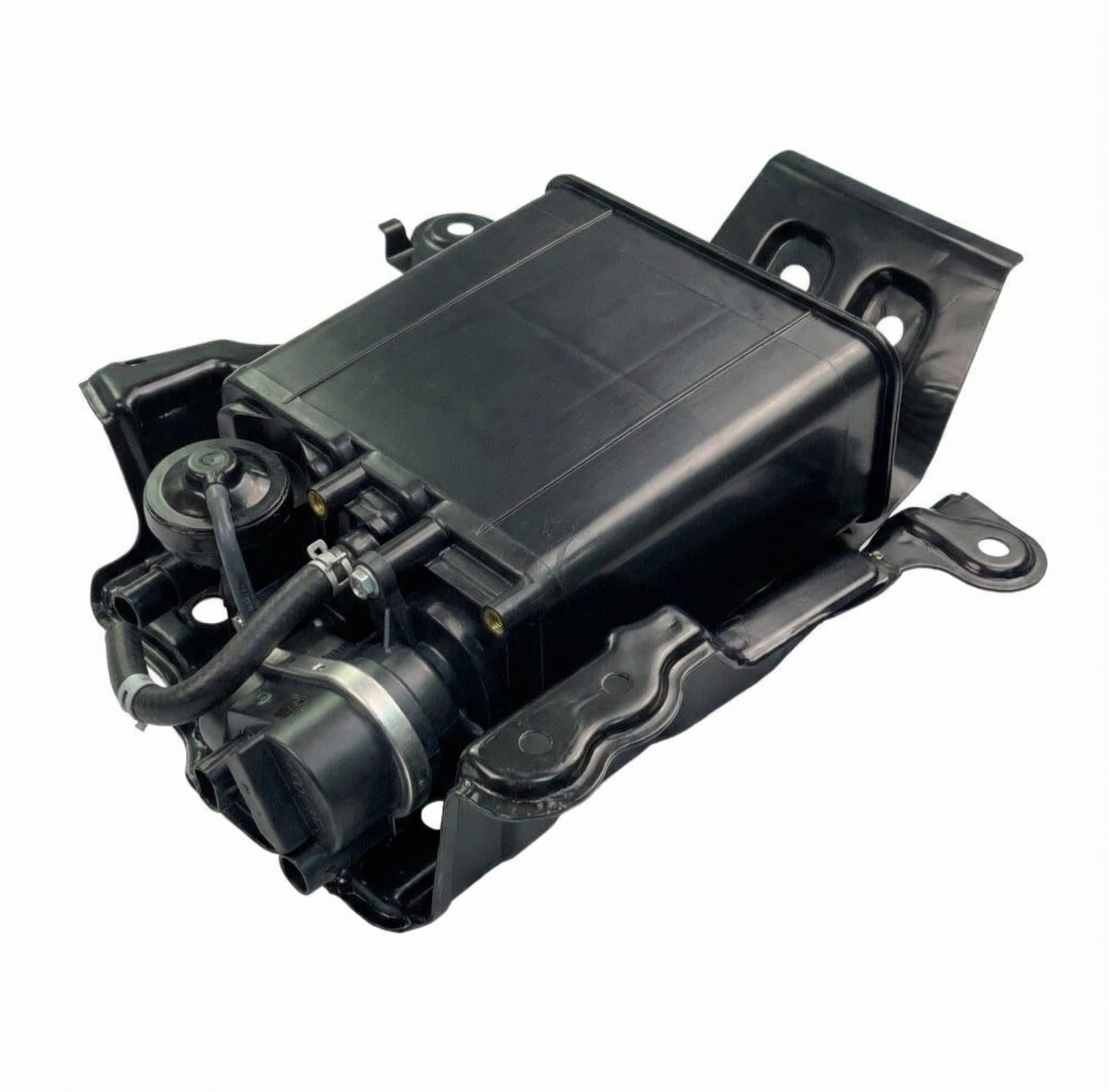
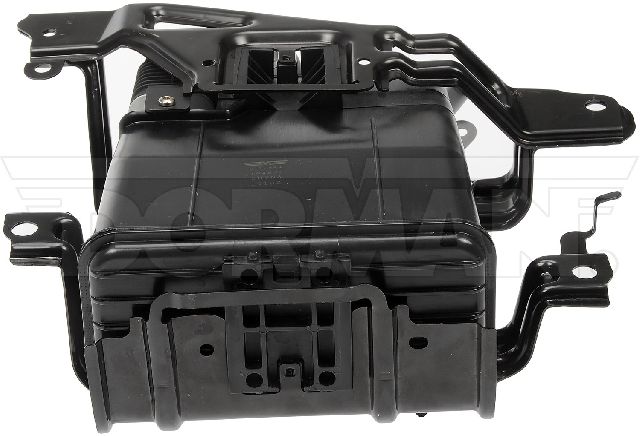
On a 2013-2018 RAV4, P2402 almost always points to a failed vapor canister assembly, especially if other EVAP codes like P043E, P043F, P2401, and P2419 are also present. This cluster of codes is a tell-tale sign of internal failure within the integrated canister unit. Replacing the entire canister assembly (Part # 77740-0R020 for pre-01/2016 models) is the common and recommended fix. Expect to pay ~$400-$500 for an OEM part and consider it a DIY-friendly job (2/5 difficulty).
- P2402 on a 2013-2018 RAV4 is an electrical code for the EVAP leak detection pump circuit.
- It almost always appears with other codes (P043E, P043F, P2401, P2419), which strongly and definitively indicates the entire vapor canister assembly has failed.
- The most effective and common repair is to replace the complete vapor canister assembly (OEM Part # 77740-0R020 for pre-01/2016, 77740-42110 for post-01/2016 Japan-built).
- This repair does not affect how the vehicle drives and is primarily needed to turn off the Check Engine Light and pass an emissions test.
- The replacement is a bolt-on part located under the rear of the vehicle and is a manageable DIY task for those with basic tools, taking about 1-1.5 hours.
What's Unique About the 2013-2018 Toyota RAV4
On the fourth-generation RAV4 (XA40), P2402 is rarely an isolated wiring issue. It's infamous for appearing in a cluster with codes P043E, P043F, P2401, and P2419. This specific combination is a well-documented, tell-tale sign that the entire vapor canister assembly, which houses the leak detection pump, reference orifices, and switching valves, has failed internally. Toyota integrated these components into a single, non-serviceable unit for this model, so when one part fails, the whole assembly must be replaced.
Generation note: The failure pattern of the entire EVAP canister assembly throwing a cluster of codes including P2402 is a known issue on previous Toyota generations as well. TSB T-SB-0161-11 documents this exact issue for the 2006-2011 RAV4, and similar TSBs exist for 2009-2011 Corollas/Matrix and 2007-2011 Tundras, often pointing to water intrusion as the cause of failure. This pattern is further supported by NHTSA ODI #10694017, which describes a Toyota owner experiencing the same cluster of codes (P043E, P043F, P2401, P2402, and P2419) and noting that water can enter the system and contaminate components.
Symptoms You May Notice
- Check Engine Light is on.
- Vehicle will not pass an emissions/smog test.
- In rare cases, a faint fuel odor may be noticeable near the rear of the vehicle.
- An "AWD malfunction" warning may appear on the dashboard alongside the check engine light, as reported in NHTSA ODI #11419086.
- Replacing just the gas cap. A loose or faulty gas cap typically causes a P0442 (small leak) or P0456 (very small leak) code, not a P2402 electrical circuit code.
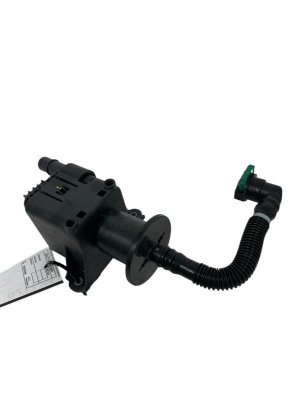
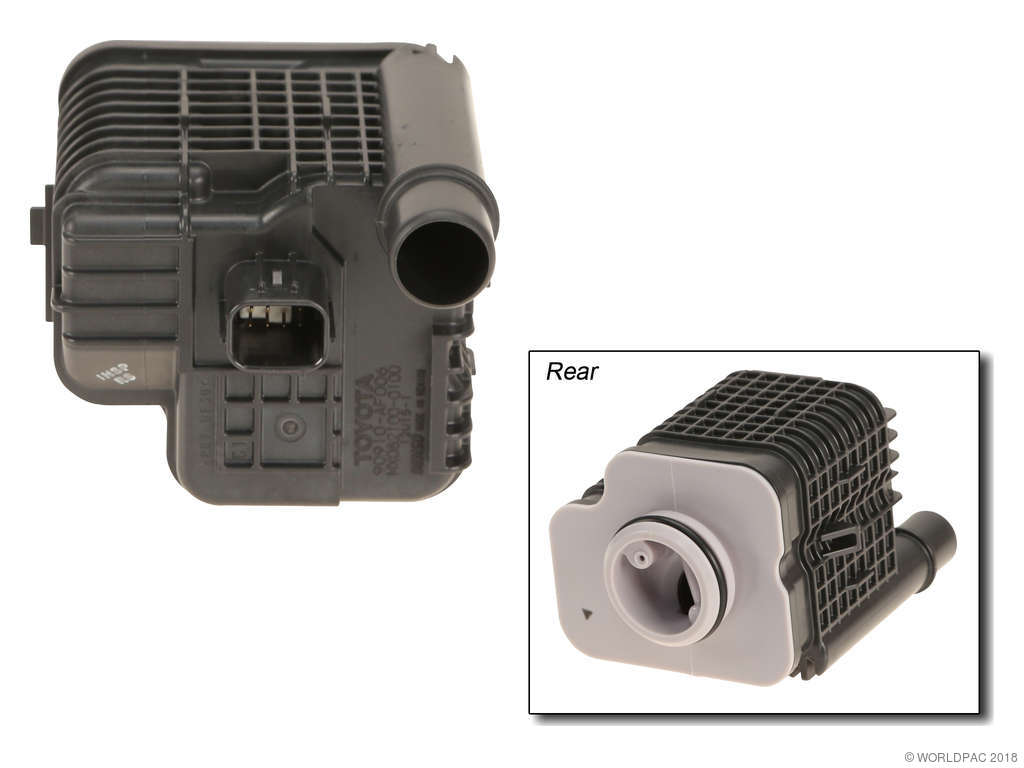
- Searching for a separate leak detection pump. On this vehicle, the pump is not sold or serviced separately; it is integrated into the vapor canister assembly. This differs from some other Toyota models where the pump can be replaced independently.
Most Likely Causes
- Failed Vapor Canister Assembly 🔴 High Probability → Shop Vapor Canister The leak detection pump is integrated into the canister assembly. Internal failure of the pump motor (causing a short circuit), reference orifices, or other integrated valves is common, triggering a cluster of circuit-high and low codes. This design is known to fail as a complete unit, and Toyota has issued TSBs for similar failures on other models due to water intrusion.
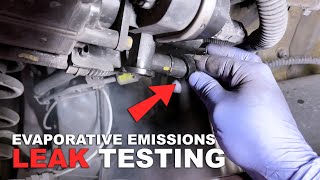
How to confirm: Confirm if the specific cluster of codes (P043E, P043F, P2401, P2419) is present along with P2402. If so, the canister assembly is the definitive culprit. A smoke test may also show smoke escaping from the plastic housing of the canister itself, confirming a physical failure. 🎬 See how a smoke test identifies a failed pump.
Typical fix: Replace the entire vapor canister assembly. 🎬 Watch: A complete walkthrough of the canister replacement process. It is a single part that includes the charcoal canister, leak detection pump, and related valves. The job involves removing a protective shield, disconnecting three hoses and one electrical connector, and unbolting the assembly.
Est. part cost: $380-$570
Rare But Worth Checking
- Wiring Harness Damage: While less common on this platform than canister failure, it's worth a visual inspection. Check the wiring and the 5-pin connector leading to the vapor canister (located under the rear of the vehicle, driver's side) for any signs of chafing, corrosion, or rodent damage that could cause a short to a power source. NHTSA ODI #11387241 notes that while research often points to canister failure for this code cluster, a wiring failure is also a possible culprit.
- Failed Engine Control Module (ECM): → Shop Engine Control Module (ECM) This is extremely rare. The ECM's output driver can theoretically fail and send a constant high voltage. This should only be considered a possibility after the canister assembly and wiring have been definitively ruled out with a multimeter test at the ECM connector.
Diagnosis Steps
- Scan for Codes: Use an OBD-II scanner to confirm P2402 and, more importantly, check for the presence of the entire cluster: P043E, P043F, P2401, and P2419. NHTSA ODI #11533362 confirms that P2402 often appears as a "confirmed" status alongside circuit-low codes for the leak detection pump.
- Inspect Wiring: Visually inspect the wiring harness and electrical connector going to the vapor canister assembly, which is located under the vehicle, on the driver's side, behind a plastic shield. Look for any obvious damage, corrosion, or loose connections.
- Check for TSBs: Be aware of TSB T-SB-0161-11 for the previous generation (2006-2011) RAV4, which notes this exact cluster of codes can be caused by water intrusion into the EVAP system, requiring canister replacement. This highlights a known failure pattern for the platform.
- Condemn the Canister Assembly: If the common cluster of five codes is present, the diagnosis is straightforward. The vapor canister assembly has failed internally and requires replacement. Further electrical testing is usually unnecessary.
- (Optional) Smoke Test: A mechanic may perform a smoke test. If smoke is seen leaking from the plastic housing of the canister assembly itself, it confirms the unit is physically cracked and faulty.
- Replace the Vapor Canister Assembly: If diagnosis points to the canister, replace it as a complete unit. The process involves removing plastic shields, four 12mm bolts, one electrical connector, and three hoses (one with a green clip, one with a white clip, and one standard clamp).
Parts You'll Likely Need
- Vapor Canister Assembly
(OEM #77740-0R020, 77740-42110)— This is the definitive fix for P2402 when it appears with the cluster of related EVAP codes. The assembly contains the leak detection pump that is the source of the electrical fault. Part # 77740-0R020 fits models built up to 01/2016. Part # 77740-42110 fits Japan-built models from 01/2016 onwards. Always verify fitment with VIN.
Trusted brands: Toyota (OEM), Aisan (OEM supplier), Dorman, Standard Motor Products
OEM price range: $396-$500
Aftermarket price range: $225-$460
Related Codes That Often Appear With This One
- P043E — EVAP System Leak Detection Reference Orifice Low Flow. This code, along with the others, points to a fault within the integrated canister assembly.
- P043F — EVAP System Leak Detection Reference Orifice High Flow. This code is also related to the internal workings of the canister assembly.
- P2401 — EVAP System Leak Detection Pump Control Circuit Low. Seeing both 'High' (P2402) and 'Low' circuit codes simultaneously strongly suggests a faulty component (the pump assembly) rather than a simple wiring short or open.
- P2419 — EVAP System Switching Valve Control Circuit Low. This valve is also part of the integrated canister assembly, and its failure code is part of the signature cluster.
Technical Service Bulletins (TSBs) & Recalls
- T-SB-0161-11 (for 2006-2011 RAV4, but corroborates failure pattern of code cluster due to water intrusion).
- T-SB-0178-11 (for 2007-2011 Tundra, shows same code cluster and water intrusion issue on another Toyota model).
- T-SB-0200-11 (for 2009-2011 Corolla/Matrix, again shows same code cluster and water intrusion issue).
Platform-Specific Known Issues
- A Technical Service Bulletin for the preceding generation (T-SB-0161-11 for 2006-2011 RAV4) addresses the same cluster of EVAP codes (P043E, P043F, P2401, P2402, P2419) and points to water intrusion into the EVAP system, requiring the replacement of the charcoal canister. This indicates a historically similar failure pattern on the RAV4 platform.
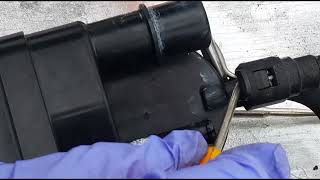
- The plastic hoses connected to the canister can become brittle over time. Care must be taken during removal and installation to avoid cracking them. 🎬 Watch: How to safely disconnect those tricky plastic hose clips.
- NHTSA ODI #10442353 notes that for some Toyota models, water enters the filler pipe cover, which can lead to the contamination of EVAP components and the subsequent storage of codes P043E, P043F, P2401, P2402, and P2419.
Mechanic-Grade Diagnostic Values
- Leak Detection Pump (LDP) Coil Resistance — expected: 0.8 – 1.2 Ω. Failure: A reading outside this range, or an open/short circuit, indicates a faulty pump motor.
- LDP Control Circuit Voltage (Key On, Pump Commanded OFF) — expected: Near 0 V. Failure: Voltage significantly higher than 0V, especially near battery voltage, indicates a short to power in the harness or a failed ECM driver.
- LDP Control Circuit Voltage (Key On, Pump Commanded ON) — expected: Switched voltage close to battery voltage (~11–14 V). Failure: A reading significantly lower than battery voltage or no voltage suggests an open circuit or poor connection.
Scan Tool Commands That Help
- Toyota Techstream: Evaporative System Check (Automatic Mode) — This utility, found under 'Powertrain / Engine and ECT / Utility', forces the vehicle to run the entire EVAP monitor sequence, which normally only runs 5+ hours after the vehicle is shut off. It takes 8-18 minutes and can confirm a fix by checking if any pending codes are set after the test completes.
- Professional Bidirectional Scan Tool (e.g., Snap-on, Autel): EVAP System Test (Manual or Automatic) — Similar to Techstream, these tools can command the EVAP test to run, activating the vent valve and leak detection pump to check for system integrity and component function without waiting for the natural monitor cycle.
Wiring & Ground Locations
- Vapor Canister Connector — Connected directly to the vapor canister assembly, which is located under the vehicle on the driver's side, rearward of the fuel tank. It is a 5-pin connector.. This is the primary connection point for testing the leak detection pump circuit. The P2402 'Circuit High' fault is detected by the ECM through the wiring at this connector. Technicians will backprobe pins here to measure voltage and resistance.
- Rear Body Ground Point (e.g., 'BK' or 'BM') — Toyota wiring diagrams indicate ground points in the rear quarter panel and back door areas. For the 2AR-FE, a key engine-to-chassis ground is on the driver's side strut tower. A poor ground for the EVAP system can cause floating voltages and circuit codes.. Although a faulty ground typically causes 'Circuit Low' codes, intermittent or high-resistance grounds can lead to unpredictable voltage readings. Verifying the ground path from the canister harness to the chassis is a valid, though secondary, diagnostic step.
Real Owner Repair Stories
- Reddit user post (Scion xD (shares similar Toyota EVAP system design)) — Initially an intermittent P2419, which later became a hard fault with the full cluster of P2419, P2402, P2401, P043E, and P043F.
❌ Tried (didn't work) Clearing the codes would work temporarily for months, but they eventually returned as a hard fault.
✅ What actually fixed it The owner verified 12V and ground at the leak detection pump connector, confirming the wiring was good and thus condemning the pump. Replacing the entire charcoal canister assembly (which includes the pump) resolved all codes permanently. - NHTSA ODI #11419086 — An owner reported that their vehicle displayed an "AWD malfunction" along with the engine light. A diagnostic scan revealed the code cluster P043E, P043F, P2401, P2402, and P2419, leading the owner to request a formal address of the problem from the manufacturer.
OEM Part Supersession History
77740-0R020→77740-42110 (for later models)— Model year refresh and change in manufacturing location.
Heads up: Part number 77740-0R020 is specified for Canada-built RAV4 models up to 01/2016. Part number 77740-42110 is specified for Japan-built models from 01/2016 onward. While they may appear physically similar, internal calibration or connector differences may exist. Always verify the correct part number with the vehicle's VIN.
Model Year Variations Within This Range
- 2013 - 01/2016: These models, particularly those built in Canada, typically use vapor canister assembly part number 77740-0R020.
- 01/2016 - 2018: Following the mid-cycle refresh, Japan-built models often require part number 77740-42110. The changeover date is a key separator when ordering this part.
Diagnostic Flowchart
Used vs. New Parts: Buying Guide for This Vehicle
When a used part is the smart pick: A used vapor canister is a significant gamble for this vehicle because the part has a well-known, high failure rate due to internal component failure, not just external damage. It should only be considered if it's from a very low-mileage donor vehicle (e.g., a recent rear-end collision) and the part history is known.
Donor-vehicle mileage cap: roughly under 40000 miles for the part to have meaningful remaining life.
What to inspect on the donor part:
- Verify the part number on the used unit EXACTLY matches the required part for your VIN.
- Inspect the plastic housing for any hairline cracks or signs of stress, especially around the mounting tabs and hose ports.
- Check that all hose connection points and clips are intact and not brittle.
- Ensure the electrical connector pins are clean, straight, and free of any corrosion.
OEM-only on this vehicle (don't cheap out):
- Vapor Canister Assembly: Given the complexity, integration of multiple components (pump, valves, sensors), and the high rate of this specific failure, using an OEM (Toyota) or OEM-supplier (Aisan) part is strongly recommended to ensure a one-time fix.
Aftermarket brands forum-validated for this vehicle:
- Standard Motor Products (SMP): Generally regarded as a quality aftermarket brand, often supplying parts that are re-boxed OE or meet OE specifications.
- Aisan: This is the original equipment manufacturer for many Toyota fuel and emissions components. If available, it is equivalent to a Toyota-branded part.
Brands owners have reported issues with on this vehicle:
- Unbranded / 'White-box' parts: Cheaper, unbranded assemblies from online marketplaces are risky. They may use lower-quality pump motors or internal valves that can fail prematurely or not be calibrated correctly for the Toyota EVAP system's self-tests, causing codes to return.
Real Owner Stories
Aggregated from forums and TSBs cited above. Mileages and costs reflect what owners reported in those sources.
2016 Toyota RAV4
Symptoms: Check engine light was on with EVAP codes P043E, P043F, P2401, and P2402.
What fixed it: Replaced the entire vapor canister assembly (part # 77740-0R020) and cleared the codes with a scanner. The light did not return.
Cost: $417
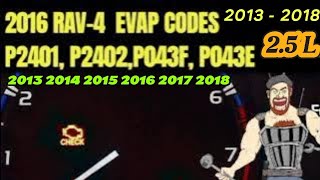
Source hint: YouTube: 2013 - 2018 TOYOTA RAV-4 EVAP CODES P2401 P2402 P043F P043E FIX
2018 Toyota RAV4
Symptoms: The check engine light was intermittent, coming on for a couple of days then turning off for weeks. It stored the full cluster of codes: P043E, P043F, P2401, P2402, and P2419.
What fixed it: The owner identified the charcoal canister assembly as the likely culprit but had not yet replaced it because the light kept turning off. A California SMOG test was due, forcing the repair.
Cost: $600
Source hint: Reddit: 2018 Toyota RAV4 with the infamous Toyota EVAP Codes P043E & F, P2401, P2402, P2419
2017 Toyota RAV4
Symptoms: The check engine light came on with four codes: P043E, P043F, P2401, and P2402.
What fixed it: The dealership diagnosed the issue but the repair was not completed. They stated the extended warranty claim was denied because lines to/from the canister were damaged with water contamination, and quoted $1800 for the total repair.
Cost: $1800
Source hint: Reddit r/MechanicAdvice
2009 Toyota RAV4
Symptoms: Owner reported the same five codes: P043E, P043F, P2401, P2402, and P2419.
What fixed it: In a rare case, replacing the canister did not fix the issue and the codes returned, highlighting a potential for a wiring or ECM issue if the new part doesn't resolve the problem.
Source hint: 2CarPros - URL: 2carpros.com/questions/toyota-rav4-2009-toyota-rav4-codes-p043e-p043f-p2401-p2402-and-p2419
Related OBD-II Codes
Frequently Asked Questions
I see TSB T-SB-0161-11 mentioned for an older RAV4. Does it apply to my 2013-2018 model?
My Check Engine Light for P2402 and related codes turned off by itself. Am I in the clear?
I only have code P2402. Is it still the vapor canister assembly?
Can I just replace the leak detection pump instead of the whole expensive canister assembly?
What's the most reliable way to confirm the canister has failed before buying a new one?
Are there any other Toyota or Lexus models that have this same problem?
Helpful Videos

Used OEM Parts in Stock
New Aftermarket Parts Available


The information in this article is provided for general reference and educational purposes only. Vehicle specifications, procedures, and part compatibility can vary by production date, trim level, and region. Always consult your vehicle's factory service manual and verify part numbers before purchasing or performing repairs. Safety-critical components such as airbags, seat belts, and braking systems should be installed by a qualified professional.
- Toyota RAV4:
- 🧭 Diagnostic Flowchart
- 🎬 Helpful Videos
- 🛍️ Shop This Part
- What's Unique About the 2013-2018 Toyota RAV4
- Symptoms You May Notice
- Most Likely Causes
- Rare But Worth Checking
- Diagnosis Steps
- Parts You'll Likely Need
- Related Codes That Often Appear With This One
- Technical Service Bulletins (TSBs) & Recalls
- Platform-Specific Known Issues
- Mechanic-Grade Diagnostic Values
- Scan Tool Commands That Help
- Wiring & Ground Locations
- Real Owner Repair Stories
- OEM Part Supersession History
- Model Year Variations Within This Range
- Used vs. New Parts: Buying Guide for This Vehicle
- Real Owner Stories
- 2016 Toyota RAV4
- 2018 Toyota RAV4
- 2017 Toyota RAV4
- 2009 Toyota RAV4
- Related OBD-II Codes
- Frequently Asked Questions
- 🎟️ Get 5% Off