

P2402 on 2011-2018 Volkswagen Jetta: EVAP Pump Circuit High Causes and Fixes
On a 2011-2018 VW Jetta, code P2402 is almost always caused by a failed EVAP Leak Detection Pump (LDP), also known as a DMTL pump. This is a very common DIY fix, with the part costing between $75 and $150 for an aftermarket replacement. The pump is located in the rear passenger-side wheel well, accessible by removing the wheel and liner.
- P2402 is an electrical fault with the EVAP Leak Detection Pump, not a physical leak.
- The most common fix by a wide margin is to replace the Leak Detection Pump (LDP) located in the rear passenger wheel well.
- This is a DIY-friendly repair that can be done in about an hour with basic tools (T-25 Torx, 8/10mm sockets), saving significant money over shop labor costs.
- Do not waste money replacing the gas cap for this specific code; it is a circuit fault.
- The vehicle is safe to drive with this code, but it will have an active Check Engine Light and will fail an emissions test.
What's Unique About the 2011-2018 Volkswagen Jetta
The 2011-2018 Jetta (Mk6 generation) uses an EVAP Leak Detection Pump (LDP) that is a very common failure point across many Volkswagen, Audi, and other European models from this era. The failure is almost always internal to the pump, causing an electrical short that triggers the P2402 code. While EVAP issues can be complex, this specific code on this platform has a very high probability of being a bad pump, making diagnosis more straightforward than on other vehicles where wiring or other components are more common culprits. The issue is so common that the replacement part has been updated by manufacturers like Bosch.
Symptoms You May Notice
- Check Engine Light is on.
- Vehicle will not pass an emissions inspection.
- A faint rattling noise may be heard from the rear passenger side of the vehicle, where the pump is located.
- Replacing the gas cap. A loose or faulty gas cap typically causes a P0455 (large leak) or P0457 code, not a P2402 electrical circuit code. A YouTube repair video for a Jetta with P2402 confirmed replacing the cap did not fix the issue. 🎬 Watch: Diagnostic video confirming gas cap didn't fix P2402
- Replacing the N80 EVAP Purge Valve. While this is a common EVAP system component to fail, it is not typically associated with the P2402 code, which points specifically to the leak detection pump circuit.
Most Likely Causes
- Faulty EVAP Leak Detection Pump (LDP/DMTL Pump) 🔴 High Probability → Shop Vapor Canister The pump contains a small motor and electronics that are known to fail and create an internal short circuit. This is a well-documented, high-failure item on many VW models of this era, including the Jetta, Passat, Tiguan, and Atlas.
How to confirm: The most reliable method is to test the component. Using a multimeter, check the wiring harness connector for power and a ground signal from the ECM. If wiring is good, the pump itself is faulty. A professional may use a bi-directional scan tool to command the pump on and listen for operation. Many DIY videos confirm this is the primary failure point.
Typical fix: Replace the leak detection pump assembly. The pump is located behind the rear passenger-side wheel well liner. 🎬 Watch: Step-by-step Jetta leak detection pump replacement
Est. part cost: $75-$180 - Wiring Harness or Connector Issue ⚪ Low Probability The pump is located in the wheel well, exposing the wiring to moisture and road debris, which can lead to corrosion or damage over time. However, owner and mechanic reports overwhelmingly point to pump failure rather than wiring issues.
How to confirm: Visually inspect the wiring and connector leading to the LDP for any signs of corrosion, damage, or loose pins. Use a multimeter to check for continuity and proper voltage at the connector.
Typical fix: Repair the damaged section of wiring or clean/replace the connector.
Est. part cost: $5-$50
Rare But Worth Checking
- Blown Fuse or Faulty Relay: While uncommon for a 'Circuit High' code (which implies a short, not an open circuit), it's a simple and inexpensive check. Before replacing the pump, verify that the fuse for the EVAP system is intact.
- Faulty Powertrain Control Module (PCM): → Shop Engine Control Module (ECM) This is extremely rare. The PCM should only be considered after all other possibilities, including the pump and wiring, have been definitively ruled out. A PCM failure is highly unlikely to be the cause.
Diagnosis Steps
- Retrieve the fault code using an OBD-II scanner to confirm P2402 is present.
- Raise and safely support the rear of the vehicle. Remove the passenger-side rear wheel.
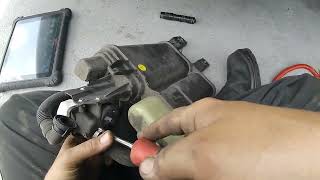
- Remove the screws (typically T-25 Torx and 8mm bolts) holding the felt wheel well liner in place and pull it back to expose the EVAP components. 🎬 See: How to access and replace the pump
- Locate the Leak Detection Pump (LDP). It is a plastic assembly with several hoses and an electrical connector, mounted on a bracket.
- Inspect the electrical connector and nearby wiring for any visible damage, corrosion, or loose connections.
- If the wiring appears intact, disconnect the connector. Use a multimeter to verify that the harness is receiving power (battery voltage) and a ground signal from the ECM when the key is on. (Note: The ground may be pulse-width modulated by the PCM).
- If power and ground are present, the Leak Detection Pump is faulty and must be replaced. This is the most common outcome.
- If power or ground is missing, trace the wiring back to find the break or short.
- After replacing the pump, clear the fault code with the scanner and perform a drive cycle to ensure the Check Engine Light does not return.
Parts You'll Likely Need
- EVAP System Leak Detection Pump
(OEM #1K0906201L)— This pump is the overwhelming cause of code P2402 due to a common internal electrical failure. The original part is often superseded by an updated version.
Trusted brands: Bosch (OEM supplier, p/n 0261222022), Dorman (p/n 310-601), Standard Motor Products
OEM price range: $150-$220
Aftermarket price range: $75-$150
Technical Service Bulletins (TSBs) & Recalls
- While no specific TSB for the 2011-2018 Jetta was found in the search, TSBs for newer VW models like the Taos (01-23-02) and Tiguan address the same P2402 code and LDP failure, indicating a persistent issue with the component across the brand.
- Manufacturer service bulletin #VIN4APIN20231010 notes that customers may report the MIL-on with P2402 stored in the ECM memory, sometimes accompanied by a rattle from below the vehicle.
- Bulletin #VIN4APIN20230912 also documents reports of the MIL-on with P2402 and a rattle from below the vehicle, as well as related codes like P2421 and P04F0.
- According to Bulletin #VIN4APIN20230522, P2402 can be stored in the ECM memory alongside other EVAP codes such as P0442 and P0456.
- Bulletin #VIN4APIN20230518 confirms that P2402 is frequently found in conjunction with P0442, P04F0, and P0456 in the ECM memory.
Platform-Specific Known Issues
- The issue is so prevalent on VW platforms that some newer models like the 2022 Tiguan have had an extended warranty issued for this specific pump.
- A Reddit user with a 2014 Jetta reported their pump failed at 170,000 miles, and they successfully replaced it themselves, confirming the DIY nature of the fix.
Mechanic-Grade Diagnostic Values
- Leak Detection Pump (V144) internal resistance between pins 1 and 2 — expected: 134 to 153 Ω. Failure: A reading far outside this range (e.g., 42 Ω) indicates an internal short.
- Leak Detection Pump (V144) internal resistance between pins 1 and 3 — expected: 134 to 153 Ω. Failure: A reading far outside this range (e.g., 29 Ω) indicates an internal short.
- Voltage at LDP connector power pin (Pin 3) — expected: ~12V with ignition on. Failure: No voltage indicates a wiring or fuse issue upstream.
- Voltage at LDP connector ground control pin (Pin 2) — expected: Near 0V or a Pulse-Width Modulated (PWM) signal when commanded ON by the ECM.. Failure: Voltage remaining high (near battery voltage) when the pump should be active points to a bad ECM driver or an open in the ground circuit.
Scan Tool Commands That Help
- VCDS (VAG-COM) or ODIS: Engine (01) -> Output Tests (03) -> EVAP Leak Detection Pump — This command actively cycles the LDP solenoid, allowing a technician to listen for the pump's clicking/operation to confirm if it's responding to commands from the ECM. If the pump makes noise during the test but the code persists, it suggests an issue with the pump's internal sense circuit or wiring, rather than a complete failure to activate.
- ODIS (Dealer Tool): Guided Fault Finding Test Plan for P2402 — This is the dealership-level procedure that provides a step-by-step diagnostic tree. It guides the technician through checking specific measuring blocks, voltages, and running output tests to systematically isolate the fault between the pump, wiring, or ECM.
Wiring & Ground Locations
- LDP Connector Pin 3 — At the 3-pin connector on the Leak Detection Pump in the right rear wheel well.. This pin should have battery voltage (~12V) with the ignition on. A lack of voltage here points to a problem with the power supply or fuse, not the pump itself.
- LDP Connector Pin 2 — At the 3-pin connector on the Leak Detection Pump.. This is the control wire from the ECM, which provides a switched or PWM ground. During an output test, this pin should show a connection to ground. If it remains at a high voltage, the issue could be a broken wire to the ECM or a failed ECM driver.
- LDP Connector Pin 1 — At the 3-pin connector on the Leak Detection Pump.. This is the sense circuit wire that reports the pump's status back to the ECM. A 'Circuit High' code can be caused by an internal short inside the pump that sends incorrect voltage down this line.
- Ground Point G682 — Right side of luggage compartment.. This is a primary ground point for components in the rear of the vehicle. While a failure is unlikely, a corroded or loose G682 could cause intermittent electrical issues for various systems, including the EVAP LDP.
Real Owner Repair Stories
- Ross-Tech Forums user (Volkswagen with same LDP system as Jetta) — P2402 code that returns on a cold start, about five seconds after the engine fires up.
❌ Tried (didn't work) Replacing the LDP with a new part., Replacing the LDP with a second, different new part., Performing a smoke test (no leaks found)., Confirming the pump clicks during VCDS output test., Bench-testing the pump (it inflated a balloon)., Verifying correct resistance values on the pump's pins., Verifying power and ground at the connector.
✅ What actually fixed it The user suspected an issue with low battery voltage during cranking on cold starts. The final fix proposed by another forum member was to check and potentially supplement the battery voltage during a cold start, as a significant voltage drop during cranking could potentially trigger the sensitive circuit fault before the system stabilizes.
"I Checked Everything" — The Actual Cause
- A smoke test is not an effective diagnostic tool for a P2402 code. This is an electrical 'Circuit High' fault, indicating a problem with voltage levels in the pump's control circuit, not a physical leak of fuel vapor in the EVAP hoses. Technicians should focus on electrical testing (voltage, resistance, and ground checks) rather than smoke testing.
OEM Part Supersession History
1K0-906-201-D (and others)→1K0906201L— The LDP is a high-failure part, and manufacturers often update the internal electronics or motor to improve reliability. The 'L' version is a common replacement for earlier iterations.
Heads up: While older part numbers may be listed, it is best practice to use the latest superseded part number (like 1K0906201L or the Bosch equivalent 0261222022) for the repair to ensure the most updated design.
Diagnostic Flowchart
Other Known Issues on This Vehicle
Issues unrelated to this code that are worth knowing about as an owner of this generation:
- Timing Chain Tensioner Failure (2.0T TSI EA888) 🔴 High — Common on earlier models (pre-2013) before an updated tensioner was used from the factory. Failure can occur without warning, typically between 60k-100k miles, leading to catastrophic engine damage. (Ref: Multiple class-action lawsuits led to a settlement with an extended warranty for some vehicles.)
- Water Pump / Thermostat Housing Leaks (2.0T TSI) 🟠 Medium — Very common failure. The plastic housing can crack or the gasket can fail, causing coolant leaks. Often occurs around 80k-120k miles. (Ref: A class-action settlement was reached for some 2.0T engines regarding water pump failures.)
- Clogged Heater Core (TDI Models) 🟠 Medium — Common in TDI models, leading to poor or no heat in the cabin. Caused by sediment buildup in the cooling system, sometimes attributed to G12/G13 coolant breaking down. Can occur multiple times if the system isn't flushed properly.
- Worn Lower Control Arm Bushings 🟡 Low — The rear bushing on the front lower control arms frequently fails, causing clunking noises over bumps. A common wear item that often needs replacement around 70k-100k miles.
- Failing Ignition Coils 🟡 Low — A common cause of engine misfires. Relatively inexpensive and easy to replace. Often recommended to replace as a set along with spark plugs.
Used vs. New Parts: Buying Guide for This Vehicle
When a used part is the smart pick: For this specific repair, buying a used Leak Detection Pump is strongly discouraged. This component has a very high failure rate across all VW models of this era. A used part from a donor vehicle is likely to have significant wear and may fail soon after installation, if it doesn't arrive already faulty.
What to inspect on the donor part:
- Not applicable, as used is not recommended.
Aftermarket brands forum-validated for this vehicle:
- Bosch (0261222022): As the Original Equipment Manufacturer (OEM), this is the most reliable choice and is often the part you get in a VW-branded box.
- Dorman (310-601): A widely available and commonly used aftermarket alternative that is confirmed to resolve the P2402 code.
Brands owners have reported issues with on this vehicle:
- No-name or unbranded pumps from online marketplaces should be avoided. Given the electrical sensitivity of this part, sticking with a reputable OEM or aftermarket supplier like Bosch or Dorman is the safest investment to ensure the repair is successful long-term.
Real Owner Stories
Aggregated from forums and TSBs cited above. Mileages and costs reflect what owners reported in those sources.
2014 Volkswagen Jetta — 170000 miles
Symptoms: Check Engine Light was on with code P2402.
What fixed it: The owner successfully performed a DIY replacement of the Leak Detection Pump.
Source hint: Reddit r/Jetta
2022 Volkswagen Jetta
Symptoms: P2402 code present; owner noted the replacement part was on national backorder due to high failure rates.
What fixed it: Replacement of the Leak Detection Pump (LDP).
Source hint: Reddit r/Jetta
2013 Volkswagen Jetta
Symptoms: Check Engine Light on for P2402.
What fixed it: Replacement of the LDP using Dorman part number 310-601.
Source hint: YouTube - RM Auto Haus
2014 Volkswagen Jetta
Symptoms: Check Engine Light on; owner initially tried a new gas cap which did not work.
What fixed it: Replacing the Leak Detection Pump (Dorman 310-601).
Source hint: YouTube - Wrenching On The Cheap
Related OBD-II Codes
Frequently Asked Questions
Is there a TSB for the P2402 code on my 2011-2018 Volkswagen Jetta?
Where is the Leak Detection Pump located on my Jetta?
Can I just replace my gas cap to fix the P2402 code?
What specific part should I use to replace the faulty pump?
Why does the Leak Detection Pump fail so often on this generation of Jetta?
Will a faulty LDP cause my Jetta to fail an emissions test?
Helpful Videos
We Have This Part in Stock


The information in this article is provided for general reference and educational purposes only. Vehicle specifications, procedures, and part compatibility can vary by production date, trim level, and region. Always consult your vehicle's factory service manual and verify part numbers before purchasing or performing repairs. Safety-critical components such as airbags, seat belts, and braking systems should be installed by a qualified professional.
- Volkswagen Jetta:
- 🧭 Diagnostic Flowchart
- 🎬 Helpful Videos
- 🛍️ Shop This Part
- What's Unique About the 2011-2018 Volkswagen Jetta
- Symptoms You May Notice
- Most Likely Causes
- Rare But Worth Checking
- Diagnosis Steps
- Parts You'll Likely Need
- Technical Service Bulletins (TSBs) & Recalls
- Platform-Specific Known Issues
- Mechanic-Grade Diagnostic Values
- Scan Tool Commands That Help
- Wiring & Ground Locations
- Real Owner Repair Stories
- "I Checked Everything" — The Actual Cause
- OEM Part Supersession History
- Other Known Issues on This Vehicle
- Used vs. New Parts: Buying Guide for This Vehicle
- Real Owner Stories
- 2014 Volkswagen Jetta — 170000 miles
- 2022 Volkswagen Jetta
- 2013 Volkswagen Jetta
- 2014 Volkswagen Jetta
- Related OBD-II Codes
- Frequently Asked Questions
- 🎟️ Get 5% Off