

OBD-II Code P2433: Secondary Air Injection System Air Flow/Pressure Sensor Circuit High
What P2433 means, why it triggers, and how to fix it
- P2433 triggers when the secondary air injection pressure sensor sends a constant high-voltage signal (above 4.8V) to the PCM.
- Fix this code immediately to prevent limp mode engagement and avoid catalytic converter damage that costs upwards of $2,500.
- Inspect the air pump hoses for moisture or soot before replacing electronic parts; a failed $50 check valve will quickly destroy a new $400 air pump.
- Use a bi-directional scan tool to command the air pump on and off while graphing sensor voltage to definitively isolate electrical shorts from mechanical failures.
What Does P2433 Mean?
The Powertrain Control Module (PCM) detected a fault in the secondary air injection (SAI) system. The SAI pumps fresh air into the exhaust during cold starts to burn unburnt fuel and reduce emissions. P2433 specifically means the voltage signal from the bank 1 air flow/pressure sensor is stuck above the normal range (typically over 4.8 volts for more than two seconds), indicating an electrical short or a failed sensor.
Technical definition: Secondary Air Injection System Air Flow/Pressure Sensor Circuit High Bank 1. The PCM sets this code when the bank 1 air pressure sensor circuit voltage exceeds the manufacturer's specified maximum threshold for a predetermined time. This tells the PCM the system is at maximum pressure, even when the pump is off.
Can I Drive With P2433?
Yes, But With Caution. You can drive with this code, but address it promptly. Ignoring it causes failed emissions tests, rough starts, stalling, and reduced engine power. On Toyota Tundras, this code triggers 'limp mode,' severely limiting speed. 🎬 See how to replace a Tundra secondary air valve The greatest long-term risk is destroying the catalytic converter with unburned fuel, a repair that costs between $800 and $2,500.
Common Causes
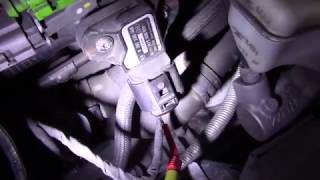
- Faulty Secondary Air Injection Pressure Sensor (Very Common) — The sensor fails, clogs with carbon, shorts internally, or suffers moisture contamination, sending a constant high-voltage signal to the PCM.
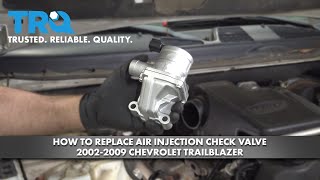
- Faulty One-Way Check Valve (Very Common) — A stuck-open check valve allows hot exhaust gases and moisture to flow backward into the air pump and sensor. This causes rapid corrosion and electrical shorts, making it the primary root cause of sensor failure. 🎬 Watch: How to replace a secondary air injection check valve
- Wiring or Connector Short (Common) — The wiring harness or connector for the pressure sensor corrodes, frays, or shorts directly to power. This bypasses the sensor's resistance and sends a full 5-volt signal to the computer.
- Failed Secondary Air Injection Pump (Less Common) — The air pump motor seizes due to moisture intrusion. While this usually triggers flow-related codes, it triggers P2433 if the internal failure shorts the shared sensor circuit.
- Faulty Air Control/Switching Solenoid Valve (Less Common) — The valve directing airflow from the pump sticks closed. This causes a massive pressure buildup in the system that the sensor accurately reports as a high reading.
- Incorrect Sensor Installed (Uncommon) — On Volkswagen models, the SAI pressure sensor and the Manifold Absolute Pressure (MAP) sensor are physically identical. Accidentally swapping them during a repair guarantees an incorrect voltage reading and triggers this code.
Symptoms
- Check Engine Light is On — This is the most common and often the only symptom you will notice.
- Reduced Engine Power or 'Limp Mode' — The PCM intentionally limits engine power and disables overdrive to prevent damage. This is a guaranteed symptom on Toyota Tundras and Sequoias.
- Failed Emissions Test — The vehicle automatically fails an emissions inspection because the secondary air injection system is a federally mandated emissions control.
- Engine Hesitation or Stalling — The engine hesitates, runs rough, or stalls immediately after a cold start. The idle smooths out once the engine reaches operating temperature.
- Abnormal Air Pump Noise — A loud whining, grinding, or vacuum-cleaner-like sound comes from the engine bay for the first 60 seconds after a cold start, indicating a failing pump bearing.
Diagnostic Flowchart
Tap your situation to follow the diagnostic path that matches what you're seeing on this code.
Common Fixes & Costs
- Replace Secondary Air Injection Pressure Sensor — Parts: $50-$180, Labor: $50-$125, ~0.8 hr book time (DIY)
- Replace One-Way Check Valve(s) — Parts: $40-$150, Labor: $75-$175, ~1.2 hr book time (Intermediate)
- Replace Secondary Air Injection Pump — Parts: $200-$800, Labor: $150-$400, ~1.5 hr book time (Intermediate)
- Repair or Replace Wiring/Connector — Parts: $10-$50, Labor: $75-$200, ~1.5 hr book time (Intermediate)
- Install SAI System Bypass Kit (Off-Road Use Only) — Parts: $150-$400, Labor: $50-$150, ~0.5 hr book time (DIY)
- Clean Carbon from Cylinder Head Passages — Parts: $10-$30, Labor: $200-$400, ~3.5 hr book time (Advanced)
DIY vs Professional
- Replace Secondary Air Injection Pressure Sensor 🟢 Beginner
Tools: Socket set, screwdrivers. - Replace One-Way Check Valve(s) 🟢 Beginner
Tools: Socket set, wrenches, pliers, penetrating oil. - Replace Secondary Air Injection Pump 🟢 Beginner
Tools: Socket set, pliers for hose clamps. - Repair or Replace Wiring/Connector 🟢 Beginner
Tools: Digital multimeter, wire strippers, crimpers, heat shrink tubing, soldering iron. - Clean Carbon from Cylinder Head Passages 🟢 Beginner
Tools: Extensive toolset for engine disassembly, gasket scrapers, brushes, shop vacuum.
Used vs. New Parts: Buying Guide
When a used part is worth it: For purely mechanical parts like mounting brackets or hoses from a low-mileage donor, used is acceptable. For core electrical components like the air pump, sensor, or check valves, buy new to avoid repeat failures.
Donor-vehicle mileage cap: roughly under 60000 miles for the part to have meaningful remaining life.
Donor quality checklist:
- Verify the donor vehicle was not scrapped for an emissions-related failure.
- Avoid check valves from the 'rust belt' as they are prone to internal corrosion.
- Match part numbers exactly; visual similarities do not guarantee compatibility.
Decision logic:
- If The part is electronic (pump, sensor) or a known high-failure item (check valve) → Buy new. The risk of premature failure and paying for labor twice outweighs the savings.
- If Vehicle is older (>150K miles) and the budget is extremely tight → A used pump or valve from a low-mileage, accident-damaged car is a calculated risk. Expect a shorter lifespan.
- If The part is a simple hose or bracket in good condition → Used is a reasonable way to save money.
Warranty tradeoff: Used parts from a salvage yard typically have a 30-90 day warranty. New aftermarket parts carry a 1-year to limited lifetime warranty. New OEM parts have a 1-year/12,000-mile warranty.
Worst-case if a used part fails: $300-$600 if a used pump or valve fails shortly after installation, requiring repeat labor costs plus the price of another replacement part.
What Happens If You Wait — Timeline
- 0-1 month: Check Engine Light is on. The code P2433 is stored. The car fails an emissions test. (MPG impact: 0-2%% · Added cost: $0)
- 1-3 months: The faulty system causes richer cold starts, leading to minor carbon buildup. Drivers notice hesitation or rough idle for the first minute after a cold start. (MPG impact: 2-5%% · Added cost: $20-$70 in wasted fuel.)
- 3-12 months: Moisture corrodes the air pump internals and the pressure sensor connector. The pump becomes noisy or seizes. The catalytic converter is put under consistent stress from unburned fuel. (MPG impact: 5-10%% · Added cost: $250-$800 (cost to replace a failed air pump and sensor due to moisture damage).)
- 12+ months: Prolonged exposure to rich exhaust mixtures overheats and permanently damages the catalytic converter's internal structure, requiring replacement. (MPG impact: 10-15%% · Added cost: $800 - $2500+ (cost of catalytic converter replacement).)
Cost of Not Fixing It
- 0-1 month: Guaranteed failure of an emissions/smog test. Rough starting or hesitation in cold weather. (Added cost: $0)
- 1-6 months: Increased stress on the catalytic converter from unburned fuel. Reduced fuel economy and worsening engine performance. (Added cost: $50)
- 6+ months: Permanent damage to the catalytic converter due to prolonged exposure to rich exhaust, requiring complete replacement. (Added cost: $800 - $2500)
Diagnosis Steps
- Read Codes and Review Freeze Frame Data
Use an OBD-II scanner to confirm P2433 is active. Check for related codes (P0410, P0411, P2440). Review the freeze frame data to verify the engine coolant temperature and RPM when the fault occurred.
Tools: OBD-II Scanner (Beginner) - Inspect Hoses for Moisture and Soot
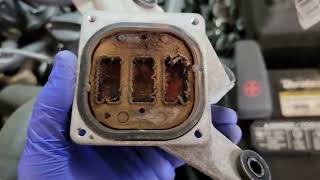
Disconnect the hose between the air pump and the check valve. Look for water, condensation, or black exhaust soot inside. Finding any of these proves the check valve has failed and destroyed the downstream electronics.
Tools: Flashlight, Pliers (Beginner) - Test Sensor Circuit Voltages
With the key on, engine off (KOEO), back-probe the sensor's connector. Verify the 5-volt reference from the PCM and a ground below 0.1 volts. If the signal wire reads above 4.8V, the sensor is shorted internally or the wire is shorted to power.
Tools: Digital Multimeter, Back-probe pins (Intermediate) - Graph Sensor Data During Pump Activation
Use a bi-directional scan tool to command the SAI pump on and off. Graph the live data from the SAI pressure sensor. If the voltage stays stuck near 5V regardless of the pump's state, the fault is purely electrical.
Tools: Bi-directional Scan Tool (Advanced) - Perform Voltage Drop Test on Ground
Place one multimeter lead on the negative battery terminal and the other on the sensor's ground wire. With the key on, the reading must be under 100mV (0.1V). A higher reading indicates high resistance in the ground circuit.
Tools: Digital Multimeter (Advanced) - Inspect Air Passages for Carbon Blockages
If the sensor and wiring test perfect but pressure spikes when the pump runs, the air injection passages in the cylinder head are blocked with carbon. Remove the check valve to inspect the ports.
Tools: Basic Hand Tools, Flashlight (Advanced)
When This Code Triggers (Freeze-Frame Conditions)
- Engine Coolant Temp: 40-100°F (Cold start, engine warming up)
- RPM: 700-1200 RPM (Cold idle)
- Engine Load: 15-30% (Low load during idle)
- Vehicle Speed: 0 mph (Stationary, immediately after start-up)
Related Codes
- P0410 — 'Secondary Air Injection System Malfunction.' A general code indicating a fault in the SAI system. P2433 isolates the issue specifically to the pressure sensor circuit.
- P0411 — 'Secondary Air Injection System Incorrect Flow Detected.' Indicates a mechanical airflow issue (bad pump, clogged passage), whereas P2433 indicates an electrical circuit issue.
- P2432 — 'Secondary Air Injection System Air Flow/Pressure Sensor Circuit Low.' The direct opposite of P2433. P2433 is a short to power, while P2432 is a short to ground or an open circuit.
- P2440 — 'Secondary Air Injection System Switching Valve Stuck Open Bank 1.' A stuck valve allows exhaust to destroy the sensor, directly causing P2433. Fix P2440 first.
Climate & Environmental Factors
- Cold Weather: The SAI system only operates during cold starts. Faults are almost exclusively detected during the first start of the day in cold weather.
- Humidity and Moisture: High humidity causes condensation inside the exhaust. When a check valve fails, this moisture travels backward into the air pump and sensor, causing rapid corrosion and electrical shorts.
- Altitude: Operating at high altitude creates a lower atmospheric pressure baseline. A failing sensor is pushed outside its operational range more easily at altitude, triggering the code.
How to Talk to a Mechanic About This Code
Say this: "I have an OBD-II code P2433 for the secondary air injection pressure sensor. I'd like to schedule a diagnostic. Can you please start by inspecting the one-way check valve for moisture or soot and testing the pressure sensor's electrical circuit before recommending major part replacements?"
This signals you understand the common failure patterns. It directs the mechanic to check for a cheap root cause (the check valve) and perform a proper electrical diagnosis, preventing them from immediately quoting an expensive air pump replacement.
Avoid saying:
- 'My check engine light is on, can you just fix it?'
- 'I think I need a new smog pump.'
- 'Just do whatever you think is best.'
Questions to ask before authorizing the repair:
- Did you find any moisture or soot in the air hoses? If so, are you replacing the check valve in addition to any other parts?
- What was the voltage reading on the sensor's signal wire with the key on? Did you test the ground circuit?
- If you're recommending a new air pump, can you confirm the old one has failed and it's not just a bad sensor or valve?
- What is the warranty on the parts and the labor for this repair?
Where to Take It: Dealer vs Independent vs Chain
- Dealer:
Recommended if your vehicle has a specific TSB or is a Toyota/Lexus with limp mode. Otherwise, it is a costly option.
Best for: Vehicles with known TSBs (like VW/Audi) or manufacturer warranty extensions (like Toyota/Lexus)., Complex electrical issues or when the vehicle is in 'limp mode'.
Downsides: Highest labor rates, often 1.5-2x more than independent shops., Recommends replacing an entire expensive assembly instead of a smaller failed component. (Typical cost: +50% vs. baseline) - Independent Shop:
Best overall fit. An experienced independent mechanic diagnoses and repairs P2433 effectively and more affordably than a dealer.
Best for: Most out-of-warranty vehicles where cost is a factor., Diagnosing and repairing common emissions system faults.
Downsides: Quality and experience vary greatly; check reviews and look for ASE certifications., Lacks access to the very latest manufacturer-specific bulletins. (Typical cost: +0% vs. baseline) - Chain Shop:
Acceptable for a straightforward sensor or pump replacement if you've already diagnosed the problem yourself. AVOID for initial diagnosis of P2433, as misdiagnosis is likely.
Best for: Simple, clear-cut part replacements like a sensor when you are certain that is the only issue.
Downsides: Technician skill varies dramatically., Lacks the advanced diagnostic tools or experience for circuit testing or identifying root causes like a failed check valve. (Typical cost: -10% vs. baseline)
When to Walk Away From the Repair
If the estimated repair cost exceeds 40-50% of the car's private-party value, seriously consider selling or trading it in rather than repairing it.
- Car worth $8000, fix is $2500: Fix it, but get a second opinion. The cost is high (~31% of value), but still well below the walk-away threshold. Inquire about aftermarket bypass kits for off-road use as a cheaper alternative.
- Car worth $5000, fix is $450: Fix it. The repair cost is less than 10% of the vehicle's value.
- Car worth $3000, fix is $1800: Walk away. The repair cost is 60% of the car's value, which is a poor investment on an aging vehicle.
What Scan Tool You Need for This Code
Minimum: A scanner that reads live data for the SAI pressure sensor and offers bi-directional control to command the air pump on and off.
A basic $20 code reader only gives you the P2433 code. To properly diagnose, you must see the sensor's live voltage to know if it's truly stuck high. Bi-directional control confirms if the pump and valves are working, separating an electrical from a mechanical problem.
Budget: BlueDriver Pro Scan Tool (~$100) — Reads and clears codes, provides freeze frame data, and graphs live sensor voltage. It is a great starting point for seeing if the sensor voltage is stuck high, but lacks bi-directional control.
Mid-range: TOPDON ArtiDiag800BT / Foxwell NT1009 (~$350) — Offers full system diagnostics plus bi-directional controls. This allows you to command the SAI pump and solenoids on/off from the tool, which is the most effective way for a DIYer to pinpoint the fault.
Professional: Autel MaxiCOM MK808BT / XTOOL D7 (~$450-600) — Provides extensive bi-directional control, advanced data graphing, and OEM-level functions. These tools are for the serious DIYer or aspiring professional who needs comprehensive capabilities.
Rent vs buy: For a one-time fix, try the free loaner tool from an auto parts store, but it lacks live data or bi-directional features. To properly diagnose P2433 yourself, buying a mid-range scanner with bi-directional control is the most effective investment.
How to Clear the Code After You Fix It
- Use an OBD-II scan tool to clear the P2433 code.
- Ensure the fuel tank is between 1/4 and 3/4 full.
- Perform a complete drive cycle to run the system's readiness monitor.
Drive cycle (~30 minutes): Let the vehicle sit for 8+ hours for a true cold start. Start the engine and let it idle for 2-3 minutes. Drive for 15-20 minutes with a mix of city (stop-and-go) and highway (steady 55 mph for 5+ minutes) conditions. Allow the vehicle to cool down.
Readiness monitors affected: Secondary Air System, Catalyst monitor, O2 sensor monitor, EVAP System
Before emissions retest: drive at least 100 miles to fully set monitors.
Watch out for:
- Not letting the vehicle sit for at least 8 hours to achieve a true 'cold start,' which is required for the SAI monitor to run.
- Clearing the code and immediately going for an emissions test before the readiness monitors have been set to 'Ready'.
- Failing to fix the underlying mechanical fault, causing the code to return on the next cold start.
Will This Fail Emissions / State Inspection?
Yes — this code typically fails an OBD-II emissions inspection.
- California: An active Check Engine Light for P2433 is an automatic failure. All readiness monitors must be set to 'Ready,' so you cannot pass by simply clearing the code before the test.
- New York: The NYS DMV inspection includes an OBD-II scan. An illuminated Malfunction Indicator Lamp for an emissions-related code like P2433 results in a failed test.
- Texas: In the 17 counties requiring emissions testing, an active P2433 code causes the vehicle to fail the OBD portion of the annual inspection.
Most Commonly Affected Vehicles
- Toyota Tundra (2007-2013) — Extremely common failure caused by moisture intrusion from failed check valves. Triggers 'limp mode.' Many owners opt for an aftermarket bypass kit due to high dealer repair costs.
- Toyota Sequoia (2008-2013) — Shares the same problematic SAI system as the Tundra. Prone to costly moisture-related failures of the air pumps and valves.
- Lexus GX470, LX570 (2005-2013) — Built on similar platforms to the Tundra/Sequoia, these models suffer from the same high-failure-rate secondary air injection systems.
- Volkswagen Jetta, Golf, Passat (2005-2012) — Often affected by a faulty pressure sensor. TSB 26-19-02 recommends a service kit (Part No. 07K 198 125) with an updated sensor and adapter harness.
- Subaru Forester, Impreza, Legacy (2006-2012) — The air switching valves are a primary failure point, often sticking open or closed. Some mechanics offer an ECU reflash to delete the system for off-road use.
- BMW 3-Series (E90), X3, X5 (2005-2011) — Prone to issues with the secondary air pump and check valves. A common contributing factor is the complete blockage of air passages in the cylinder head with carbon.
- Chevrolet Trailblazer (2002-2009) — Commonly experiences failures of the air diverter/check valve, which allows moisture back into the system and destroys the pump.
- Ford F-150, Mustang (2005-2010) — Experiences this code due to faulty check valves or wiring issues in the SAI circuit.
Manufacturer-Specific Notes
- Toyota/Lexus: System failures are extremely common and force the truck into 'limp mode'. Toyota issued a Warranty Enhancement Program for 2007-2010 Tundras and 2008-2010 Sequoias, extending coverage for the air pumps and valves to 10 years/150,000 miles.
- Subaru: The air switching valves are a frequent point of failure, more so than the pump itself. For recurring issues, independent shops offer an ECU reflash to disable the system entirely for off-road use.
- Audi/Volkswagen: TSB 26-19-02 advises that the pressure sensor becomes contaminated. It provides a service kit (Part No. 07K 198 125) with an updated sensor and an adapter harness to resolve the issue.
- General Motors (Chevrolet/GMC): The check valve (diverter valve) on the exhaust manifold fails and allows moisture to travel backward, destroying the air pump. Replacing the pump without replacing this valve guarantees repeat failure.
Real Owner Stories
2011 Toyota Tundra with P2433 & P2440
Check Engine Light on, 4-Lo light flashing, and truck was in limp mode.
What they tried:
- Initial attempts to clear the code by disconnecting the battery worked temporarily.
- Owner identified the issue was with the Bank 1 (driver's side) air injection pump assembly.
Outcome: Replaced the entire driver's side secondary air injection pump assembly. This cleared all codes (P2433, P2440) and resolved the limp mode issue.
Lesson: On Toyota Tundras, P2433 is often accompanied by other SAI codes like P2440 and forces the truck into limp mode. The pressure sensor is integrated into the valve/pump assembly, requiring replacement of the entire unit.
2011 VW Jetta 2.5L with P2433
Check Engine Light came on. A scan at an auto parts store revealed code P2433.
What they tried:
- The owner researched the code and found it was likely the SAI pressure sensor.
- Further research uncovered a Volkswagen Technical Service Bulletin (TSB 26-19-02) for this exact issue.
Outcome: The owner purchased the specific sensor service kit (part number 07K 198 125) recommended by the TSB, which includes an updated sensor and an adapter harness to fix the problem.
Lesson: For VWs, always check for TSBs. A known issue with the SAI pressure sensor led to an updated part. Verify the SAI sensor and MAP sensor are not accidentally swapped.
2008 Chevrolet Trailblazer 4.2L with P2433
Check Engine Light was on. Upon inspection, the owner discovered clear water inside the air pump.
What they tried:
- The owner identified that moisture had entered the system from a failed one-way check valve.
Outcome: The root cause was diagnosed as a failed check valve allowing moisture to flow backward into the pump and damage the electronics. The fix required replacing the check valve first, then replacing the pump and sensor.
Lesson: Finding moisture in the air pump or its hoses is a critical clue pointing to a failed check valve. Replacing the pump or sensor without replacing the bad check valve guarantees the new parts will fail rapidly.
How to Prevent This Code From Triggering
- Proactively Replace the One-Way Check Valve(s) (Every 60,000-80,000 miles, or immediately if buying a used vehicle from a humid/rust-belt region.) — The check valve is the most common failure point leading to catastrophic system damage. It is a cheap part whose failure allows moisture and exhaust to destroy the expensive pump and sensor.
- Inspect and Clean Air Pump Intake Filter (During regular air filter changes (every 15,000-30,000 miles).) — The SAI pump breathes through a small foam filter. If this filter clogs with dirt or degrades, the pump starves for air or ingests debris, leading to failure.
- Ensure Engine Air Filter Housing is Properly Sealed (Every time the engine air filter is serviced.) — The SAI pump pulls its air from the clean side of the engine air filter box. If the lid is not sealed correctly, unfiltered, moist air is drawn into the SAI pump, causing damage.
- Perform Occasional Hard Acceleration (Once per month (where safe and legal).) — This helps blow out carbon deposits that accumulate in the cylinder head's secondary air passages. Clogged passages cause pressure spikes and valve failures.
Frequently Asked Questions
What does 'Bank 1' mean in the code P2433?
Bank 1 refers to the side of the engine that contains cylinder #1. On V6 or V8 engines, there are two banks. On an inline 4-cylinder or inline-6 engine, there is only one bank, which is always Bank 1.
What is the most common misdiagnosis for P2433?
The most common mistake is replacing the expensive air injection pump without testing the one-way check valve. A failed check valve allows moisture to destroy the new pump immediately.
Can I just clear the code and keep driving?
You can clear the code, but it returns as soon as the computer runs its self-test on the next cold start. Clearing the code does not fix the underlying electrical or mechanical problem.
Why did this problem only show up in cold weather?
The secondary air injection system only runs when the engine is cold to reduce cold-start emissions. The system's self-test runs simultaneously, making faults apparent during colder temperatures.
My mechanic says the MAP sensor and SAI pressure sensor look the same. Could they be mixed up?
Yes, this is a known issue on Volkswagens. The Manifold Absolute Pressure (MAP) sensor and the SAI pressure sensor are physically identical. Swapping them during a repair triggers code P2433.
What is an SAI bypass kit and is it legal?
An SAI bypass kit is an electronic module that tricks the ECU into thinking the secondary air system is functioning correctly. Because it disables an emissions control system, it is illegal for street use and fails visual emissions inspections.
Can a bad O2 sensor cause a P2433 code?
No. A bad O2 sensor does not directly cause P2433, which is a specific electrical circuit code for the pressure sensor. However, a malfunctioning SAI system causes incorrect O2 sensor readings.
Key Takeaways
- P2433 triggers when the secondary air injection pressure sensor sends a constant high-voltage signal (above 4.8V) to the PCM.
- Fix this code immediately to prevent limp mode engagement and avoid catalytic converter damage that costs upwards of $2,500.
- Inspect the air pump hoses for moisture or soot before replacing electronic parts; a failed $50 check valve will quickly destroy a new $400 air pump.
- Use a bi-directional scan tool to command the air pump on and off while graphing sensor voltage to definitively isolate electrical shorts from mechanical failures.
Helpful Videos
Shop the Parts Behind P2433
Below are the parts most often responsible for code P2433, ranked by how frequently each one is the actual culprit (per the diagnosis above). Tap any to see what we have for your vehicle.



The information in this article is provided for general reference and educational purposes only. Vehicle specifications, procedures, and part compatibility can vary by production date, trim level, and region. Always consult your vehicle's factory service manual and verify part numbers before purchasing or performing repairs. Safety-critical components such as airbags, seat belts, and braking systems should be installed by a qualified professional.
- 🧭 Diagnostic Flowchart
- 🎬 Helpful Videos
- 🛍️ Shop This Part
- What Does P2433 Mean?
- Can I Drive With P2433?
- Common Causes
- Symptoms
- Common Fixes & Costs
- DIY vs Professional
- Used vs. New Parts: Buying Guide
- What Happens If You Wait — Timeline
- Cost of Not Fixing It
- Diagnosis Steps
- When This Code Triggers (Freeze-Frame Conditions)
- Related Codes
- Climate & Environmental Factors
- How to Talk to a Mechanic About This Code
- Where to Take It: Dealer vs Independent vs Chain
- When to Walk Away From the Repair
- What Scan Tool You Need for This Code
- How to Clear the Code After You Fix It
- Will This Fail Emissions / State Inspection?
- Most Commonly Affected Vehicles
- Manufacturer-Specific Notes
- Real Owner Stories
- 2011 Toyota Tundra with P2433 & P2440
- 2011 VW Jetta 2.5L with P2433
- 2008 Chevrolet Trailblazer 4.2L with P2433
- How to Prevent This Code From Triggering
- Frequently Asked Questions
- What does 'Bank 1' mean in the code P2433?
- What is the most common misdiagnosis for P2433?
- Can I just clear the code and keep driving?
- Why did this problem only show up in cold weather?
- My mechanic says the MAP sensor and SAI pressure sensor look the same. Could they be mixed up?
- What is an SAI bypass kit and is it legal?
- Can a bad O2 sensor cause a P2433 code?
- Key Takeaways
- 🎟️ Get 5% Off