

OBD-II Code P2446: Secondary Air Injection System Pump Stuck On Bank 2
The Ultimate Guide to What P2446 Means, Why It Triggers, and Exactly How to Fix It
- Code P2446 indicates the Bank 2 secondary air injection pump is stuck on, typically caused by a welded $20 relay, a moisture-seized pump, or a faulty pressure sensor.
- Toyota Tundra and Sequoia owners must check TSB EG045-07; Toyota defines P2446 as a Bank 1 switching valve failure, requiring a completely different diagnostic path.
- Listen for a loud vacuum-cleaner noise under the hood lasting longer than 90 seconds after a cold start, which drains the battery overnight if the relay is stuck.
- Never replace the $500+ air pump without first testing the $20 AIR pump relay; Subaru issued safety recall WTM-73 specifically for this relay failing.
- Faced with $2,000+ repair bills for failed pumps and valves, many out-of-warranty Toyota and Lexus owners install a $200 electronic bypass kit to clear the code and restore power.
What Does P2446 Mean?
Your car's Powertrain Control Module (PCM) detected a failure in the secondary air injection (SAI) system. The SAI system pumps fresh air into the exhaust during a cold start to burn excess hydrocarbons and heat the catalytic converter. Code P2446 specifically means the air pump for Bank 2 (the side of the engine without cylinder #1) remains activated when the computer commanded it to shut off.
Technical definition: The SAE/OBD-II definition is "Secondary Air Injection System Pump Stuck On Bank 2". The powertrain control module (PCM) monitors the SAI system using a pressure sensor. If the sensor reports high pressure after the PCM commands the pump to turn off, the computer sets this code.
Can I Drive With P2446?
Yes, But With Caution. You can drive with this code, but address it immediately. A pump stuck in the 'on' position drains the battery overnight. On Toyota and Lexus vehicles, P2446 triggers an immediate 'limp mode', slashing engine power to prevent damage. Ignoring the code alters exhaust temperatures during warm-up, destroying the catalytic converters and forcing a $1,500 to $2,500 repair.
Common Causes
- Stuck or faulty AIR pump relay (Very Common) — The relay is an electronic switch controlling power to the pump. Its internal contacts weld shut over time, supplying constant power and forcing the pump to run continuously. This is the primary cause for a 'stuck on' code and triggered a massive safety recall on Subaru models.
- Faulty secondary air injection pump (Very Common) — The pump seizes or shorts out due to internal wear or moisture damage. Condensation buildup or a failed check valve allows water into the pump housing, destroying the electric motor.
- Faulty pressure sensor (Common) — The pressure sensor verifies pump operation for the PCM. A failed sensor sends a stuck-high voltage signal, tricking the computer into thinking the pump is running when it is physically off.
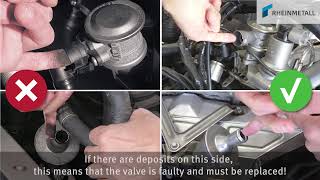
- Failed one-way check valve (Common) — The check valve blocks hot, moist exhaust gases from flowing backward into the air pump. When it fails open, exhaust destroys the plastic pump components and allows condensation to pool and freeze. 🎬 Watch: A quick and easy way to check the air valve.
- Damaged wiring or connectors (Common) — Frayed wires, loose connections, a short-to-power, heavy corrosion, or rodent damage in the electrical circuit forces the pump to run continuously or corrupts the sensor data. 🎬 See these expert tips for troubleshooting the secondary air system.
- Brittle or broken vacuum lines (Less Common) — On systems utilizing vacuum-actuated switching valves (common on BMWs), old plastic vacuum lines crack and leak, preventing the valves from opening or closing.
- Weak or failing battery (Rare) — A dying battery causes severe voltage drops during startup, triggering spurious error codes across multiple modules, including the SAI system.
- Failed powertrain control module (PCM) (Rare) — The vehicle's main computer fails and grounds the pump circuit permanently. Rule out all electrical and mechanical components before condemning the PCM.
Symptoms
- Check Engine Light is on — The MIL illuminates immediately after the PCM detects the fault during the cold-start monitor cycle.
- Loud vacuum noise from the engine bay — You will hear a loud whining sound from the secondary air pump that runs continuously, even after the engine is turned off.
- Dead battery — A welded relay forces the air pump to run while the vehicle is parked, completely draining the battery overnight.
- Vehicle enters 'limp mode' — Toyota and Lexus computers severely limit throttle response and disable overdrive to protect the engine, making the vehicle difficult to drive at highway speeds.
- Engine stalling or rough idle — Unmetered air entering the exhaust alters the oxygen sensor readings, forcing the engine to run lean and stumble during cold starts.
Diagnostic Flowchart
Tap your situation to follow the diagnostic path that matches what you're seeing on this code.
Common Fixes & Costs
- Replace the AIR pump relay
— Parts: $15-$50, Labor: $20-$50, ~0.2 hr book time
(DIY)
: OEM
: OEM - Replace the secondary air injection system pressure sensor — Parts: $75-$250, Labor: $50-$150, ~0.8 hr book time (DIY)
- Replace the secondary air injection pump
— Parts: $200-$800, Labor: $150-$300, ~2.5 hr book time
(Intermediate)
: OEM
: OEM - Replace the one-way check valve / switching valve
— Parts: $150-$755, Labor: $200-$1200, ~6 hr book time
(Intermediate)
: OEM
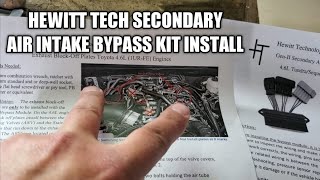
: OEM - Install Secondary Air Injection System Bypass Kit — Parts: $40-$450, Labor: $50-$150, ~1 hr book time (DIY)
- Repair or replace damaged wiring — Parts: $10-$50, Labor: $125-$250, ~1.5 hr book time (Intermediate)
- Professional Diagnosis — Parts: $0, Labor: $100-$165, ~1 hr book time (Professional)
Used vs. New Parts: Buying Guide
When a used part is worth it: Never buy a used relay or sensor. A used pump or valve assembly from a low-mileage, rear-ended vehicle saves money, but carries high risk because internal moisture damage is invisible.
Donor-vehicle mileage cap: roughly under 60000 miles for the part to have meaningful remaining life.
Donor quality checklist:
- Verify the donor vehicle's VIN to ensure it wasn't flooded.
- Avoid parts from 'Rust Belt' regions due to severe corrosion on connectors.
- Match the OEM part number exactly.
Decision logic:
- If The failed part is a relay, fuse, or sensor → Always buy new; the cost is low and reliability is critical.
- If Vehicle has over 150k miles and the repair budget is tight → A used pump assembly is a gamble. A new aftermarket part with a warranty is safer.
- If The part is known for high failure rates (e.g., Toyota pumps) → Buy a new OEM or reputable aftermarket part. A used part contains the exact same design flaws.
Warranty tradeoff: Used parts offer a 30-day warranty. New aftermarket parts offer 1-year warranties. New OEM parts carry a 1-year/12k-mile warranty and are the most reliable.
Worst-case if a used part fails: $500-$1500 if a used pump fails, requiring repeat labor and a second replacement part.
What Happens If You Wait — Timeline
- 0-2 weeks: Check Engine Light illuminates. If caused by a stuck relay, the pump runs continuously, creating noise and draining the battery overnight. (MPG impact: 0%% · Added cost: $50-$150 (for a new battery if drained completely))
- 2 weeks - 3 months: A pump stuck on burns itself out from continuous operation. On Toyota/Lexus models, the vehicle unexpectedly enters 'limp mode', creating a safety hazard. (MPG impact: 0-5%% · Added cost: $200-$800 (for a new air pump if it burns out))
- 3-9 months: Prolonged exposure to hot exhaust gases melts the plastic internals of the air pump and damages the pressure sensors. Incorrect air/fuel ratios stress the catalytic converter. (MPG impact: 5-10%% · Added cost: $300-$800 (wasted fuel and damage to multiple SAI components))
- 9+ months: Sustained abnormal temperatures in the exhaust during warm-up cycles destroy the catalytic converter substrate, requiring a massive repair bill. (MPG impact: 10-15%% · Added cost: $1200-$2800 (for catalytic converter replacement))
Cost of Not Fixing It
- Immediate: Guaranteed failure of any OBD-II emissions inspection. A dead battery overnight if the pump is stuck running. (Added cost: $50-$200 (Towing or battery replacement))
- 1-6 months: On Toyota/Lexus vehicles, the engine enters 'limp mode' unexpectedly. Continued abnormal airflow alters operating temperatures, stressing the catalytic converter. (Added cost: $0 (High inconvenience and safety risk))
- 6+ months: Premature catalytic converter failure occurs due to prolonged exposure to incorrect air/fuel mixtures during the warm-up phase. This requires a multi-thousand dollar repair. (Added cost: $1200-$2800)
Diagnosis Steps
- Read the code and check TSBs
Use an OBD-II scanner to confirm P2446. Check for Technical Service Bulletins (TSBs). Toyota defines this code differently (as a switching valve failure), and Subaru has active recalls for the relay.
Tools: OBD-II scanner, internet access (Beginner) - Listen to the Pump
Start the engine cold. The pump should sound like a small vacuum cleaner and shut off after 30-90 seconds. If it runs continuously, pull the AIR pump relay from the fuse box immediately to prevent battery drain.
Tools: Your ears (Beginner) - Check the AIR pump relay
Locate the secondary air injection pump relay. Swap it with an identical relay from a non-essential system (like the horn). If the pump shuts off normally with the new relay, the original relay is welded shut and must be replaced.
Tools: Owner's manual, fuse puller (Beginner) - Analyze Live Data PIDs
Connect a scan tool and monitor 'SAI Pump Commanded State' and 'SAI Pressure Sensor'. If the pressure reads high (e.g., >20 kPa or >3.5V) while the pump is physically off and making no noise, the pressure sensor is faulty.
Tools: Advanced OBD-II Scan Tool (Intermediate) - Test the air pump control circuit
Disconnect the air pump electrical connector. Measure for voltage with a multimeter. After the initial 90-second cold start, voltage must drop to zero. Continuous battery voltage confirms a short to power or a stuck relay.
Tools: Multimeter (Intermediate) - Test the One-Way Check Valve
Disconnect the hose connecting the check valve to the air pump. Start the engine. You must not feel exhaust pulsing out of the valve. If exhaust escapes, the valve failed open and will destroy any new pump you install.
Tools: Basic hand tools, pliers (Intermediate) - Visually inspect the system
Inspect the pump housing for water stains or melted plastic. Check all vacuum hoses for cracks. Disconnect the pressure sensor and pump connectors to check for green corrosion or melted pins.
Tools: Flashlight (Beginner) - Measure Pump Current Draw
Clamp an ammeter around the pump's power wire. A healthy pump draws 2-5 amps. A draw exceeding 15 amps indicates a seized motor. A draw near 0 amps while the pump runs indicates a shattered internal impeller.
Tools: Clamp-on ammeter (DC) (Advanced) - Check Pressure Sensor Reference Voltage
Back-probe the pressure sensor connector with the key on, engine off. Verify a steady 5V on the reference wire and 0V on the ground wire. Missing reference voltage points to a wiring harness or PCM failure.
Tools: Multimeter, wiring diagram (Advanced) - Test Relay Coil Resistance
Remove the SAI relay. Measure resistance between the coil terminals (usually 85 and 86). Resistance must match the manufacturer spec (typically 50-100 Ohms). Infinite resistance (OL) means the coil is dead.
Tools: Multimeter (Advanced)
When This Code Triggers (Freeze-Frame Conditions)
- Engine Coolant Temp: 40-80°F (5-27°C) (The code sets during the cold start phase when the engine coolant is near ambient temperature.)
- Time Since Engine Start: 30-90 seconds (The fault triggers exactly when the PCM commands the pump to shut off after its initial warm-up cycle.)
- SAI System Status: Commanded OFF (The PCM orders the pump to stop, but the pressure sensor reports high pressure, confirming the 'stuck on' state.)
- SAI Pressure Sensor Voltage: 3.5V - 4.5V (Voltage remains high (indicating pressure) despite the pump being commanded off.)
Related Codes
- P2444 — Indicates 'Pump Stuck On Bank 1'. The diagnostic process is identical, just focused on the opposite cylinder bank.
- P2445 — Indicates 'Pump Stuck Off Bank 1'. A 'Stuck Off' code points to a dead pump or blown fuse, while P2446 ('Stuck On') points to a stuck relay or faulty sensor.
- P2447 — Indicates 'Pump Stuck Off Bank 2'. The pump is not activating when commanded, whereas P2446 indicates it is not deactivating.
- P0418 — Indicates a general electrical fault in the control circuit, pointing directly to a bad SAI pump relay or wiring issue.
Climate & Environmental Factors
- High Humidity & Water Intrusion: Moisture from the exhaust condenses in the system when the engine cools. If the check valve fails, water flows back into the air pump, corroding and seizing the electric motor.
- Cold Climates & Short Trips: Water collected in the pump freezes. When commanded on at a cold start, the motor burns out trying to spin against solid ice. Short trips prevent the exhaust from evaporating accumulated condensation.
- Rust Belt Regions: Heavy road salt accelerates corrosion on the pump housing, brackets, and electrical connectors, destroying the physical and electrical integrity of the system.
How to Talk to a Mechanic About This Code
Say this: "I have an OBD-II code P2446 for the secondary air injection system. Please start by testing the pump relay and checking the pressure sensor's live data before recommending a full pump or valve replacement."
This directs the mechanic to check the cheapest failure points (relay, sensor) first, preventing them from immediately quoting a $1,500 pump and valve assembly. It proves you understand the common misdiagnoses for this code.
Avoid saying:
- 'My check engine light is on, can you just fix it?'
- 'I think I need a new air pump.'
- 'Just do whatever you think is best.'
Questions to ask before authorizing the repair:
- Did you test the relay and confirm it is not welded shut?
- What was the pressure sensor voltage reading when the pump was commanded off?
- Did you check for TSBs or recalls related to this system for my specific VIN?
- If the pump needs replacement, did you confirm the one-way check valve seals properly?
- What is the warranty on the parts and labor?
Where to Take It: Dealer vs Independent vs Chain
- Dealer:
Use a dealer only if your vehicle is covered by a known recall or warranty enhancement. Otherwise, it is an unnecessarily expensive option.
Best for: Vehicles under a recall (Subaru SAI relay) or warranty extension (Toyota Tundra/Sequoia)., Complex diagnostics on German vehicles requiring proprietary software.
Downsides: Highest labor rates, often double the cost of independent shops., Dealers strictly replace entire expensive assemblies rather than diagnosing a $20 relay. (Typical cost: +50% vs. baseline) - Independent Shop:
The best fit for most situations. Instruct them specifically to check for TSBs related to your vehicle and code P2446.
Best for: Out-of-warranty vehicles where cost is a major factor., Diagnosing and replacing common failure parts like pumps, relays, and sensors.
Downsides: Technicians miss manufacturer-specific code definitions (e.g., the Toyota P2446 quirk) if they fail to consult TSBs. (Typical cost: +0% vs. baseline) - Chain Shop:
Not recommended. The risk of misdiagnosing a faulty sensor and selling you a $1,000 air pump replacement is extremely high.
Best for: Routine maintenance like oil changes or tire rotations.
Downsides: Technicians lack the experience for nuanced diagnostic work., High pressure to meet sales targets leads to upselling unnecessary parts. (Typical cost: -10% vs. baseline)
When to Walk Away From the Repair
If the P2446 repair estimate exceeds 40% of your car's Kelley Blue Book private-party value, sell the car as-is or trade it in.
- Car worth $10000, fix is $2200: Fix it. The repair cost is 22% of the vehicle's value, well below the walk-away threshold.
- Car worth $4000, fix is $2200: Walk away. The repair cost is 55% of the car's value. It is not economical to perform this repair.
- Car worth $15000, fix is $150: Fix it. A simple relay or sensor replacement is minimal compared to the car's value.
What Scan Tool You Need for This Code
Minimum: A scanner that reads codes, shows freeze-frame data, and displays live data PIDs for the Secondary Air Injection Pressure Sensor.
A $20 code reader only displays the P2446 code, leaving you guessing between a bad relay, pump, or sensor. Proper diagnosis requires live pressure sensor data to confirm if the sensor sends a false 'stuck on' signal when the pump is physically off.
Budget: BlueDriver Pro (~$100) — Connects via Bluetooth to graph live data from the SAI pressure sensor, allowing you to determine if the pump is truly running or if the sensor is lying.
Mid-range: Foxwell NT510 Elite (~$180) — Provides bidirectional control, allowing you to manually command the SAI pump on and off directly from the scanner without waiting for a cold start.
Professional: Autel MaxiCOM MK808 (~$500) — Offers full bidirectional control, advanced live data graphing, and topology mapping to test the entire SAI system and perform ECU coding if required.
Rent vs buy: AutoZone loans basic code readers for free, but they lack live data. Buy a budget scanner like the BlueDriver to properly diagnose the pressure sensor.
How to Clear the Code After You Fix It
- Use an OBD-II scan tool to clear the P2446 code.
- Ensure the battery remains connected to preserve other readiness monitors.
- Perform a complete drive cycle to set the emissions monitors to 'Ready'.
Drive cycle (~30 minutes): Start the engine cold (sit overnight) and idle for 3 minutes. Drive in mixed city traffic for 15 minutes. Drive at a steady highway speed (55-65 mph) for 15 minutes. Allow the vehicle to cool down completely and repeat.
Readiness monitors affected: Secondary Air System, Catalyst, Oxygen (O2) Sensor
Before emissions retest: drive at least 100 miles to fully set monitors.
Watch out for:
- Clearing the code and immediately taking an emissions test guarantees a failure because the readiness monitors report 'Not Ready'.
- Disconnecting the battery resets the code but erases all monitors, requiring a lengthy drive cycle.
- The code returns immediately on the next cold start if the stuck relay or faulty sensor was not replaced.
Will This Fail Emissions / State Inspection?
Yes — this code typically fails an OBD-II emissions inspection.
- California: An active P2446 code is an automatic failure. After repairs, a complete drive cycle must set the readiness monitors before a retest.
- New York: An illuminated Malfunction Indicator Lamp (MIL) results in an automatic failure. The vehicle also fails if too many readiness monitors read 'not ready'.
- Texas: In the 17 counties requiring emissions testing, an active P2446 code causes an automatic failure.
Most Commonly Affected Vehicles
- Toyota Tundra (2007-2013) — A design flaw allowed water intrusion, destroying pumps and valves. Toyota issued a 10-year/150k-mile warranty extension for this issue.
- Toyota Sequoia (2008-2013) — Shares the problematic Tundra system. Bypass kits are the most common solution for owners out of warranty.
- Subaru WRX / STI (2008-2014) — Subaru issued safety recall WTM-73 to replace the secondary air pump relay, which sticks and causes the pump to run continuously.
- Lexus GX470 (2005-2009) — Owners frequently report this code, leading to expensive dealership repairs due to the intake manifold removal required.
- BMW 3-Series (E46) (1999-2006) — Caused by vacuum lines that become brittle and break, preventing the control valve from operating.
- Volkswagen Passat / Jetta (2000-2010) — Frequently appears on VW models equipped with the 2.5L or 2.0T engines utilizing secondary air injection.
- Hyundai Santa Fe (DM) (2013-2018) — Occurs on models equipped with the 2.2L CRDi diesel engine.
- Pontiac Vibe (2009-2010) — Appears on the 2.4L engine, which is shared with the Toyota Matrix.
Manufacturer-Specific Notes
- Toyota: CRITICAL: On Tundra and Sequoia models, Toyota defines P2446 as 'Switching Valve Stuck CLOSED Bank 1'. This is completely different from the generic OBD-II definition. Technicians must read TSBs EG045-07 and 0157-10 to avoid replacing the wrong parts on the wrong bank.
- Toyota/Lexus: Due to massive failure rates from water intrusion, Toyota issued Customer Support Program ZHA, extending warranty coverage for air injection pumps and valves to 10 years or 150,000 miles.
- Subaru: Subaru issued safety recall WTM-73 for the secondary air pump relay on 2008-2014 turbo models. The relay fails and causes the pump to run continuously, creating a fire risk.
- Subaru/Toyota/Lexus: Due to $2,000+ repair costs, owners frequently install an 'SAI Bypass Kit'. This electronic module fools the ECU into thinking the system works, preventing limp mode. It is strictly for off-road use.
Real Owner Stories
2008 Subaru Impreza WRX at 110K miles
Check Engine Light appeared with P2446. Owner heard a loud whirring noise from the engine bay that wouldn't turn off, even after shutting the car off. The battery was dead the next morning.
What they tried:
- Jump-started the car and confirmed the pump was running continuously.
- Pulled the SAI pump relay from the fuse box, stopping the pump and preventing battery drain.
Outcome: Owner discovered Subaru safety recall WTM-73. A local Subaru dealer replaced the faulty secondary air injection pump relay free of charge. Total cost: $0.
Lesson: For Subaru owners with turbo models from 2007-2014, the first step for a 'pump stuck on' code is checking if the WTM-73 recall applies to their VIN.
2008 Toyota Sequoia 5.7L at 147K miles
P2446 code appeared with no limp mode. Owner was confused by the generic code definition.
What they tried:
- Researched online forums and found that for this specific Toyota model, P2446 refers to 'Air Switching Valve Stuck Closed on Bank 1', not 'Pump Stuck On Bank 2'.
Outcome: Based on TSBs EG045-07 and 0157-10, the owner identified the issue as the switching valve assembly under the intake manifold. Faced with a $2,000 repair estimate, the owner installed a Hewitt Tech SAIS Bypass Kit for $450, resolving the code permanently.
Lesson: Never trust the generic code definition for a Toyota Tundra or Sequoia. Always check the TSB, as P2446 points to the Bank 1 switching valve. Misdiagnosis leads to replacing the wrong parts.
2007 Toyota Tundra 5.7L with high mileage
Owner installed a Hewitt Tech bypass kit two years prior to fix a P2433 code. Suddenly, a new P2446 code appeared.
What they tried:
- Posted on a Tundra forum for advice, confused because the bypass kit should prevent SAI codes.
Outcome: Forum members explained that if original check valves fail and are left in place without installing block-off plates, moisture reaches the pressure sensors, causing new codes. The owner added block-off plates to fully seal the system.
Lesson: When installing an SAI bypass kit, installing the accompanying block-off plates is mandatory. Failing to do so allows moisture intrusion to damage sensors and trigger new codes years later.
How to Prevent This Code From Triggering
- Inspect and clean one-way check valves (Every 60,000 miles) — The check valve defends against hot, moist exhaust flowing back into the pump. Carbon buildup causes them to stick. Cleaning with carburetor cleaner ensures they seal properly.
- Ensure air filter and housing are properly sealed (During every air filter change) — The SAI pump draws air from the clean side of the engine's air filter housing. A cracked housing allows unfiltered, damp air directly into the SAI pump, accelerating wear.
- Avoid driving through high water (As needed) — On trucks like the Toyota Tundra, SAI pumps are located in the fender wells. Deep water submerges the pumps, forcing water inside and causing immediate failure.
- Allow the engine to fully warm up (Daily habit) — Frequent short trips prevent the exhaust system from burning off condensation. Allowing a full warm-up evaporates this moisture, protecting the SAI components.
Frequently Asked Questions
What are the most common misdiagnosis mistakes for P2446?
The biggest mistake is replacing the $500 air pump without testing the $20 relay first. On Toyota trucks, mechanics fail to read the TSB, misdiagnosing the code as a Bank 2 pump failure when Toyota defines it as a Bank 1 valve failure.
I hear the pump running all the time, even with the engine off. What should I do?
This is a classic symptom of a welded AIR pump relay. The pump runs constantly and will drain your battery overnight. Locate the AIR pump relay in your fuse box and pull it out immediately to cut power.
What is an SAI bypass kit and is it a good idea?
An SAI bypass kit is an electronic module that tricks the ECU into thinking the system works perfectly, bypassing $2,000+ repairs on older Toyota, Lexus, and Subaru vehicles. While it restores engine power and clears the code, it disables an emissions control device. These kits are strictly for off-road use and will fail a visual emissions inspection.
What is 'Bank 2'?
On V6 or V8 engines, the cylinders are divided into two banks. 'Bank 2' is the side of the engine that does not contain the number one cylinder. Inline engines typically only have one bank.
Can I just ignore this code?
Do not ignore this code, as it guarantees an emissions test failure and often triggers a sudden, dangerous 'limp mode' with severe power loss. A pump stuck running will also drain your battery overnight. Long-term neglect alters exhaust temperatures, destroying your catalytic converters and adding $2,000 to your repair bill.
How can I prevent this from happening again?
Moisture is the primary cause of pump failure. If you replace the pump, you must replace the one-way check valves; a leaking old valve will quickly destroy the new pump with exhaust condensation.
Can a weak battery cause code P2446?
A dying battery causes severe voltage drops during startup, triggering spurious error codes across multiple modules. If P2446 appears alongside unrelated electrical glitches, test your battery and alternator before buying expensive emissions parts.
Key Takeaways
- Code P2446 indicates the Bank 2 secondary air injection pump is stuck on, typically caused by a welded $20 relay, a moisture-seized pump, or a faulty pressure sensor.
- Toyota Tundra and Sequoia owners must check TSB EG045-07; Toyota defines P2446 as a Bank 1 switching valve failure, requiring a completely different diagnostic path.
- Listen for a loud vacuum-cleaner noise under the hood lasting longer than 90 seconds after a cold start, which drains the battery overnight if the relay is stuck.
- Never replace the $500+ air pump without first testing the $20 AIR pump relay; Subaru issued safety recall WTM-73 specifically for this relay failing.
- Faced with $2,000+ repair bills for failed pumps and valves, many out-of-warranty Toyota and Lexus owners install a $200 electronic bypass kit to clear the code and restore power.
Helpful Videos

Shop the Parts Behind P2446
Below are the parts most often responsible for code P2446, ranked by how frequently each one is the actual culprit (per the diagnosis above). Tap any to see what we have for your vehicle.


The information in this article is provided for general reference and educational purposes only. Vehicle specifications, procedures, and part compatibility can vary by production date, trim level, and region. Always consult your vehicle's factory service manual and verify part numbers before purchasing or performing repairs. Safety-critical components such as airbags, seat belts, and braking systems should be installed by a qualified professional.
- 🧭 Diagnostic Flowchart
- 🎬 Helpful Videos
- 🛍️ Shop This Part
- What Does P2446 Mean?
- Can I Drive With P2446?
- Common Causes
- Symptoms
- Common Fixes & Costs
- Used vs. New Parts: Buying Guide
- What Happens If You Wait — Timeline
- Cost of Not Fixing It
- Diagnosis Steps
- When This Code Triggers (Freeze-Frame Conditions)
- Related Codes
- Climate & Environmental Factors
- How to Talk to a Mechanic About This Code
- Where to Take It: Dealer vs Independent vs Chain
- When to Walk Away From the Repair
- What Scan Tool You Need for This Code
- How to Clear the Code After You Fix It
- Will This Fail Emissions / State Inspection?
- Most Commonly Affected Vehicles
- Manufacturer-Specific Notes
- Real Owner Stories
- 2008 Subaru Impreza WRX at 110K miles
- 2008 Toyota Sequoia 5.7L at 147K miles
- 2007 Toyota Tundra 5.7L with high mileage
- How to Prevent This Code From Triggering
- Frequently Asked Questions
- What are the most common misdiagnosis mistakes for P2446?
- I hear the pump running all the time, even with the engine off. What should I do?
- What is an SAI bypass kit and is it a good idea?
- What is 'Bank 2'?
- Can I just ignore this code?
- How can I prevent this from happening again?
- Can a weak battery cause code P2446?
- Key Takeaways
- 🎟️ Get 5% Off