

P2452 on 2011-2015 Ford F-350 SD: DPF Pressure Sensor 'A' Circuit Causes and Fixes
On a 2011-2015 F-350 with the 6.7L Power Stroke, code P2452 is most often caused by a failed Diesel Particulate Filter (DPF) pressure sensor, its connecting hoses, or the associated wiring. Inspect the hoses for cracks or blockages and check the wiring at the connector for damage before replacing the sensor. A new sensor (OEM Part No. BC3Z-9J460-B) costs between $50 and $150.
- P2452 on a 6.7L Power Stroke almost always points to the DPF pressure sensor or its hoses.
- Always inspect the two hoses for cracks, melting, or blockages before spending money on a new sensor.
- Ignoring this code can lead to a clogged DPF, reduced engine power, and much more expensive repairs down the line.
- After replacing the sensor or hoses, you may need a specialized scan tool to perform a manual DPF regeneration and reset the system parameters for the repair to be fully effective.
What's Unique About the 2011-2015 Ford F-350 SD
On the 6.7L Power Stroke engine, the DPF pressure sensor and its associated hoses are common failure points. The hoses can become brittle from heat and crack, or get clogged with soot, leading to incorrect readings. Furthermore, the wiring harness leading to the sensor is susceptible to heat damage and chafing, which can cause wires to break at the connector, mimicking a sensor failure. While the code points to an electrical circuit issue, the root cause is very often a mechanical failure of the sensor, its connecting lines, or the wiring pigtail. Ford has also issued Technical Service Bulletins for DPF-related issues, indicating that sometimes a software update or a specific manual regeneration procedure is required after a repair. [SSM 47402]
Diagnostic Flowchart
Tap your situation to follow the diagnostic path that matches what you're seeing on this vehicle.
Symptoms You May Notice
- Check Engine Light is on
- Message on the dash like "Service Exhaust System" or "DPF Full"
- Reduced engine power or "limp mode"
- Vehicle may not be able to perform a DPF regeneration
- Increased black smoke from the exhaust
- Failed emissions test
- Replacing the entire DPF assembly when only the sensor or hoses are faulty.
- Replacing the DPF pressure sensor without first inspecting the hoses for cracks or blockages and the wiring for damage.
Most Likely Causes
- Failed DPF Pressure Sensor 🔴 High Probability The sensor (OEM Part No. BC3Z-9J460-B) operates in a harsh environment and is a known failure point on this platform.
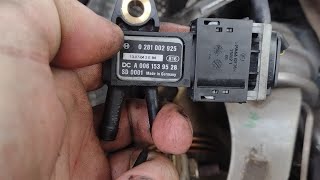
How to confirm: With a scan tool, monitor the DPF pressure sensor PID 🎬 Watch: How to test the DPF differential pressure sensor with the Key On, Engine Off (KOEO). It should read at or near zero PSI. A related TSB for a later model suggests checking the voltage PID (e.g., DPF_INP_V), which should be under 0.4 volts; a higher reading often indicates a bad sensor. Other sources suggest a KOEO voltage of around 0.5V is normal. If the value is stuck high or doesn't change with RPM, the sensor is likely faulty.
Typical fix: Replace the DPF pressure sensor.
Est. part cost: $50-$150 - Clogged, Cracked, or Melted DPF Sensor Hoses 🔴 High Probability The rubber/silicone hoses that connect the sensor to the DPF are exposed to extreme heat and can degrade, crack, or get clogged with soot.
How to confirm: Visually inspect the hoses running from the DPF to the pressure sensor. Look for cracks, melting, kinks, or swelling. Remove the hoses and check for blockages by blowing compressed air through them.
Typical fix: Replace the damaged hoses. Often sold as a kit with clamps. Aftermarket kits like Dorman 904-7120 are available.
Est. part cost: $20-$60 - Damaged Wiring or Connector 🟡 Medium Probability The wiring harness for the sensor can become brittle from heat or chafe on nearby components, causing wires to break, often right at the connector pigtail.
How to confirm: Visually inspect the wiring harness and connector for the DPF pressure sensor. Pull gently on the wires entering the connector to check for breaks inside the insulation. A technician found broken wires by performing a 'wiggle test' on the harness while watching live sensor data on a scan tool; fluctuations in the reading indicated a wiring fault.
Typical fix: Repair the damaged wiring or replace the connector pigtail. 🎬 See this walkthrough for repairing the sensor circuit
Est. part cost: $15-$40 - Clogged DPF Pressure Sensor Ports 🟡 Medium Probability The metal pipes on the DPF where the sensor hoses attach can become clogged with soot, preventing an accurate pressure reading.
How to confirm: After removing the sensor hoses, carefully clean the metal ports on the DPF with a small pick or wire to ensure they are clear of soot buildup.
Typical fix: Clean the ports thoroughly.
Est. part cost: $0
Rare But Worth Checking
- Severely Clogged DPF: While a clogged DPF can cause this code, it's more likely to throw a P2463 (Soot Accumulation). However, if regeneration has been failing for a long time due to a bad sensor, the DPF itself may become overly restricted.
- Faulty Powertrain Control Module (PCM): This is extremely rare. All other possibilities, including wiring, sensors, and the DPF itself, should be exhaustively ruled out before considering the PCM as the cause.
Diagnosis Steps
- Scan for all DTCs to see if other codes are present, which can provide more context.
- Perform a thorough visual inspection of the DPF pressure sensor, its electrical connector, and the two hoses connected to it. Look for any signs of melting, cracking, or physical damage.
- Carefully inspect the wiring harness leading to the sensor. Perform a 'wiggle test' on the harness while monitoring the sensor's live data on a scan tool to check for intermittent connections or breaks in the wiring.
- Remove the hoses from the sensor and the DPF. Inspect them for internal blockages or collapse. Check that the metal pipes on the DPF are clear of soot.
- With a scan tool, observe the live data for the DPF pressure sensor (Ford PID: DPF_P or DPF_V) with the key on and engine off. The pressure reading should be 0 psi or very close to it. The voltage PID should be low, typically around 0.5 volts.
- Start the engine. The pressure reading should increase slightly at idle and rise as you increase engine RPM. If the value is stuck at zero, an abnormally high number, or is erratic during a wiggle test, the sensor or its circuit is faulty.
- If the sensor, hoses, and wiring appear to be in good condition, but the readings are still incorrect, the sensor itself is the most likely culprit.
- After replacing parts, clear the codes. A manual DPF regeneration and parameter reset using a capable scan tool may be required, as mentioned in TSB SSM 47402. [SSM 47402, 34]
Parts You'll Likely Need
- DPF Pressure Sensor
(OEM #BC3Z-9J460-B)— This sensor is the most common part to fail electronically, causing the P2452 code.
Trusted brands: Motorcraft (DPFE22), Bosch, Alliant Power
OEM price range: $100-$180
Aftermarket price range: $50-$120 - DPF Pressure Sensor Hoses — These hoses are a frequent point of failure due to heat and pressure, causing leaks or blockages that mimic a bad sensor.
Trusted brands: Motorcraft, Dorman (e.g., 904-7120), Febi Bilstein
OEM price range: $40-$70
Aftermarket price range: $20-$50
Related Codes That Often Appear With This One
- P2463 — This code indicates 'DPF Soot Accumulation'. It often appears with P2452 because a faulty sensor prevents proper regeneration, leading to the DPF becoming clogged. [SSM 47402]
- P2459 — This code means 'DPF Regeneration Frequency'. If the sensor is providing incorrect data, the PCM may attempt regenerations too often or not often enough, triggering this code. [SSM 47402]
- P246C — This code means 'DPF Restriction - Forced Limited Power'. It is triggered when the DPF is so clogged that the PCM reduces engine power to prevent damage. This is a direct consequence of the issues causing P2452. [SSM 47402]
- P2201 — This code relates to the NOx sensor circuit. Problems in one part of the complex diesel emissions system can sometimes cause the PCM to flag issues in another. [SSM 47402]
Technical Service Bulletins (TSBs) & Recalls
- SSM 47402: Mentions that for DTC P2452 (and others), a manual regeneration and DPF parameter reset may be required after diagnostics and repair.
- TSB 18-2371: While for 2017-2018 models, this TSB directly addresses P2452 caused by a DPF sensor malfunction. It provides a key diagnostic parameter: checking if the DPF_INP_V PID is less than 0.4 volts with the ignition on, which is a valuable test for earlier models as well.
Platform-Specific Known Issues
- Ford Technical Service Bulletin SSM 47402 notes that when diagnosing P2452, a manual regeneration and DPF parameter reset may be necessary after the repair is completed. [SSM 47402]
- The wiring harness for the DPF pressure sensor can become brittle or chafe against nearby components, leading to broken wires directly at the connector. This can mimic a sensor failure and should be inspected closely before replacing the sensor.
Mechanic-Grade Diagnostic Values
- DPF Pressure Sensor Voltage (Key On, Engine Off) — expected: ~0.5 Volts. Failure: Voltage is stuck high (e.g., near 4.5V), low (near 0V), or reads significantly different from the expected 0.5V baseline.
- DPF Pressure Sensor Operating Voltage Range — expected: 0.5V to 4.5V, varying with engine RPM and load.. Failure: Voltage is stuck at a specific value (e.g., 0.5V or 4.5V) and does not change with engine load, or is erratic.
- DPF Pressure Sensor Pressure (Key On, Engine Off) — expected: 0 kPa (0 psi). Failure: Any reading other than zero indicates a biased or faulty sensor that is not returning to its baseline.
- DPF Pressure Sensor Circuit Reference Voltage — expected: 5 Volts. Failure: Significantly lower or no voltage indicates a problem with the PCM or the wiring providing power to the sensor.
Scan Tool Commands That Help
- Ford IDS / FORScan: DPF Parameter Reset / SCR Parameter Reset — This function is required by TSB SSM 47402 after replacing a DPF component. It resets the learned values and counters within the PCM, informing the system that a new, clean component is installed. [SSM 47402, 23, 26]
- Ford IDS / FORScan: DPF Manual Regeneration (Operator Commanded Regeneration) — Used to initiate a stationary, forced regeneration to burn off accumulated soot. This is often necessary after a repair that prevented automatic regeneration, such as fixing a faulty sensor that led to a P2463 (Soot Accumulation) code.
Wiring & Ground Locations
- DPF Pressure Sensor Connector — On the DPF pressure sensor itself. On many 6.7L Power Stroke trucks, the sensor is mounted on the vehicle frame rail or on a bracket in the engine compartment, connected to the DPF via hoses.. The connector and its pigtail are a common point of failure. Wires can break inside the insulation right at the connector due to heat and vibration, causing an open circuit and triggering P2452.
- G104 — Located at the left rear of the engine compartment.. This is a major ground point for various engine compartment components. While not exclusively for the DPF sensor, a poor or corroded ground here can introduce electrical noise into the PCM and other modules, potentially causing erratic sensor readings and incorrect diagnostic codes.
Real Owner Repair Stories
- YouTube Channel 'PowerStroke Tech Talk W/ARod' (2019 Ford F-550 6.7L (Note: Newer model, but demonstrates an identical, common failure mode for the 6.7L platform)) — Check Engine Light with codes P2452 (DPF Pressure Sensor 'A' Circuit) and P2455 (Circuit High).
❌ Tried (didn't work) Initial visual inspection of the sensor and hoses showed no obvious damage.
✅ What actually fixed it While performing a wiggle test on the wiring harness, the technician noticed the live data for the sensor was erratic. Closer inspection revealed two of the three wires were broken inside the insulation, right at the sensor connector. The final fix was to replace the connector pigtail.
"I Checked Everything" — The Actual Cause
- A common scenario for P2452 is when the DPF pressure sensor and its hoses pass a visual inspection, leading a technician to believe they are not the cause. However, the actual fault is often an internal failure of the sensor that isn't visible, or an intermittent break in the wiring that is only revealed by a 'wiggle test' while monitoring live scan tool data.
OEM Part Supersession History
BC3Z-9J460-B→BC3Z-9J460-G— Standard part revision by the manufacturer for improvements or supplier changes.
Heads up: BC3Z-9J460-E is also listed as an alternate part number. BC3Z-9J460-G is the latest direct replacement for -B and -E.BC3Z-9J460-A→BC3Z-9J460-F— Standard part revision. Note that the -A/-F series appears to be a different sensor, sometimes designated DPFE21, versus the -B/-G series (DPFE22). Compatibility should be verified by VIN.
Heads up: The 'A'/'F' sensor may be for a different application (e.g., Cab & Chassis vs. pickup) or position. Using the wrong sensor series could result in incorrect readings even if it physically fits.
Model Year Variations Within This Range
- 2011-2014: These early 6.7L engines used a unique dual-compressor-wheel VGT turbocharger (SST). While not directly related to the P2452 code, these early models are known to have more 'first-generation' issues with turbos and emissions systems compared to later years.
- 2015: For the 2015 model year, Ford introduced significant updates, including a larger, more conventional single VGT turbo (Garrett GT37), an improved Bosch CP4.2 fuel pump, and enhanced injector nozzles. These changes increased power and addressed some reliability concerns of the earlier engines. While the P2452 fault remains common, the surrounding engine and emissions components are different from the 2011-2014 models.
Helpful Videos


The information in this article is provided for general reference and educational purposes only. Vehicle specifications, procedures, and part compatibility can vary by production date, trim level, and region. Always consult your vehicle's factory service manual and verify part numbers before purchasing or performing repairs. Safety-critical components such as airbags, seat belts, and braking systems should be installed by a qualified professional.
- Ford F-350 SD:
- 🧭 Diagnostic Flowchart
- 🎬 Helpful Videos
- What's Unique About the 2011-2015 Ford F-350 SD
- Symptoms You May Notice
- Most Likely Causes
- Rare But Worth Checking
- Diagnosis Steps
- Parts You'll Likely Need
- Related Codes That Often Appear With This One
- Technical Service Bulletins (TSBs) & Recalls
- Platform-Specific Known Issues
- Mechanic-Grade Diagnostic Values
- Scan Tool Commands That Help
- Wiring & Ground Locations
- Real Owner Repair Stories
- "I Checked Everything" — The Actual Cause
- OEM Part Supersession History
- Model Year Variations Within This Range
- 🎟️ Get 5% Off