

P2453 on 2014 Ram 3500 6.7L Cummins: DPF Sensor Causes and Fixes
On a 2014 Ram 3500, code P2453 is most often caused by failed rubber hoses connected to the DPF pressure sensor, or the sensor itself. The hoses are a common failure point due to heat and can become cracked, melted, or clogged with soot. Replacing the hoses and thoroughly cleaning the metal pipes they connect to is often the fix. A less common but known issue is a wiring harness chafe point near the transmission.
- Always check the DPF pressure sensor hoses and the metal pipes they connect to first. This is the most common and cheapest fix.
- Do not immediately assume the expensive DPF is bad. P2453 is a sensor circuit code, not a filter failure code.
- Driving with this code active will prevent DPF regeneration and can lead to a much more expensive repair if the DPF becomes completely clogged.
- If the hoses and sensor are confirmed to be good, the issue could be a simple wiring problem or require a software update from a Ram dealer.
What's Unique About the 2014-2014 Ram 3500
For the 2014 model year Ram 3500 with the 6.7L Cummins engine, the DPF pressure sensor and its associated hoses are known failure points. The rubber hoses are susceptible to heat damage from the nearby exhaust and transmission, causing them to crack, melt, or clog with soot. Additionally, Ram issued several Technical Service Bulletins (TSBs) for this model year that involved software updates for "OBD Template changes for P2453," indicating the factory refined the computer's logic for monitoring this sensor to prevent unnecessary fault codes.
Diagnostic Flowchart
Tap your situation to follow the diagnostic path that matches what you're seeing on this vehicle.
Symptoms You May Notice
- Check Engine Light (CEL) is on.
- Dashboard message like "Service Electronic Throttle Control" or "Exhaust System Fault".
- Reduced engine power or 'limp mode'.
- Noticeable decrease in fuel economy.
- The DPF regeneration process may not happen or will be incomplete.
- Brief puffs of black smoke from the tailpipe during normal driving.
- Replacing the entire Diesel Particulate Filter (DPF) assembly. The P2453 code almost always points to a problem with the sensor, its hoses, or wiring, not the expensive filter itself. Always diagnose the cheaper components first.
Most Likely Causes
- Cracked, Melted, or Clogged DPF Pressure Sensor Hoses 🔴 High Probability The rubber hoses are located near hot exhaust and transmission components, leading to heat degradation. The hose near the transmission bell housing is particularly prone to melting. Soot can also bake inside, creating a hard blockage.
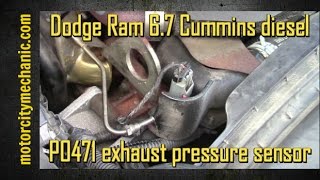
How to confirm: Visually inspect the two rubber hoses connected to the DPF pressure sensor, which is typically mounted on the passenger side of the transmission. Look for cracks, melting, swelling, or loose connections. Remove them and check for soot blockages by blowing through them.
Typical fix: Replace the damaged hoses (e.g., Mopar 68035554AF). It is critical to also clean the metal pipes the hoses connect to with a stiff wire (like a coat hanger, speedometer cable, or welding rod), as they often get clogged with hard-packed soot as well.
Est. part cost: $30-$60 - Faulty DPF Differential Pressure Sensor 🟡 Medium Probability The sensor is exposed to constant heat and vibration, which can cause it to fail electronically or for its readings to drift out of the correct range over time, a condition known as calibration drift.
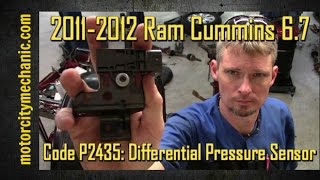
How to confirm: After confirming the hoses and pipes are clear and intact, test the sensor. With a scan tool, check the DPF pressure reading with the Key On, Engine Off (KOEO); it should be at or near zero (0.0 PSI). If it shows a significant pressure reading when the engine is off, the sensor is faulty. A more precise test is to check the signal voltage with KOEO, which should be between 0.68 and 0.77 VDC. 🎬 Watch: A professional guide to testing DPF sensor voltage and pressure.
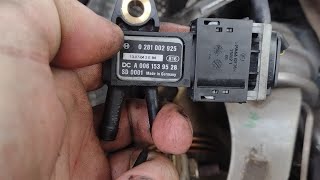
Typical fix: Replace the DPF differential pressure sensor. The sensor is often mounted to a bracket on the transmission with a single 10mm nut, making replacement 🎬 See this walkthrough for replacing the sensor on a Ram Cummins. relatively simple after removing the hoses and electrical connector.
Est. part cost: $70-$150 - Outdated Powertrain Control Module (PCM) Software ⚪ Low Probability Manufacturer TSB #18-002-14 REV. B specifically mentions "OBD Template changes for P2453," indicating a software update was released to improve how the system interprets sensor data and prevent unnecessary MIL illumination. The TSB notes that some DTCs were being triggered as a one-trip fault when they should have been two-trip faults.
How to confirm: A Ram dealership or a qualified shop with a wiTECH scan tool (Release 15.02 or higher) can check if your vehicle's PCM software has been updated per the TSBs.
Typical fix: Update the PCM software to the latest version. This is a dealer-only or specialized shop repair.
Est. part cost: $0-$200 - Damaged Wiring or Connectors ⚪ Low Probability The wiring harness to the sensor is in a harsh environment under the truck and can be damaged by heat, debris, or corrosion. A specific chafe point has been noted on some Ram trucks where the engine grounding strap on the driver's side of the transmission can rub through the main harness (Connector C108), potentially affecting the DPF sensor signal wire.
How to confirm: Visually inspect the wiring harness and connector for the DPF pressure sensor. Look for frayed wires, melted insulation, or corroded pins in the connector. Gently pull on the individual wires at the connector, as they can sometimes break internally right at the crimp. Inspect the harness near the transmission for any signs of chafing.
Typical fix: Repair the damaged section of the wiring harness or replace the connector pigtail. Secure the harness away from any sharp edges or heat sources.
Est. part cost: $20-$100
Rare But Worth Checking
- Exhaust Leak: An exhaust leak upstream of the DPF or its sensor tubes can alter the pressure differential, causing an incorrect reading. Check for black soot stains around exhaust flanges.
- Cracked or Internally Damaged DPF: If the internal structure of the DPF is cracked, it can cause erratic pressure readings. A key symptom is finding soot inside the tailpipe, which should normally be clean. This is an expensive repair and should only be considered after all other causes are ruled out.
Diagnosis Steps
- Read the trouble codes with an OBD-II scanner to confirm P2453 is the primary code and check for any others like P2454 or P2455.
- Perform a thorough visual inspection. Locate the DPF pressure sensor on the passenger side of the transmission, typically mounted to a bracket.
- Carefully inspect the two rubber hoses connected to the sensor. Look for any signs of melting, cracking, swelling, or kinks. The hose near the transmission is especially vulnerable to heat.
- Remove the hoses from the sensor and the metal pipes. Inspect them for any soot or hard carbon blockages.
- Crucially, use a long, stiff but flexible wire (like a section of a coat hanger, weed eater line, or speedometer cable) to clean out the metal pipes that the hoses connect to. They are frequently clogged with hard-packed soot and this step is often missed.
- If the hoses are damaged, replace them. If they are intact but were clogged, reinstall them after cleaning the pipes.
- Inspect the electrical connector and wiring harness for the sensor. Check for corrosion, damaged wires, or loose connections. Gently tug on each wire at the connector to ensure it's secure.
- If the code persists after addressing hoses and wiring, test the sensor itself. Use a scan tool to monitor the 'DPF Differential Pressure' reading with the Key On, Engine Off (KOEO). The reading should be 0.0 PSI or very close to it. A non-zero reading indicates a bad sensor. For a more precise check, back-probe the sensor connector and measure the signal voltage with a multimeter (KOEO); it should be between 0.68 and 0.77 VDC.
- If all hardware checks out, contact a dealership to see if your vehicle requires a PCM software update as mentioned in TSBs like #18-002-14 REV. B.
Parts You'll Likely Need
- DPF Pressure Sensor Hoses
(OEM #68035554AF)— These hoses are the most common failure point, frequently cracking, melting, or clogging with soot due to their location near high-heat components.
Trusted brands: Mopar, Dorman (904-409)
OEM price range: $40-$60
Aftermarket price range: $25-$40 - DPF Differential Pressure Sensor
(OEM #68085750AA)— This sensor is the second most likely part to fail. It can fail electronically from heat and vibration, causing incorrect readings even if the hoses are fine.
Trusted brands: Mopar, Bosch, Standard Motor Products
OEM price range: $120-$180
Aftermarket price range: $70-$120
Related Codes That Often Appear With This One
- P2454 — This code for 'DPF Pressure Sensor A Circuit Low' can be triggered by the same wiring or sensor faults that cause P2453, especially a short to ground. 🎬 Watch: Diagnosing P2454 and related circuit low codes on your Ram.
- P2455 — This code for 'DPF Pressure Sensor A Circuit High' can also be triggered by a faulty sensor or related wiring issues.
- P2463 — This code indicates 'Diesel Particulate Filter - Soot Accumulation'. If the P2453 fault prevents the PCM from accurately tracking soot load and initiating regeneration, the DPF will eventually become clogged, triggering P2463.
Technical Service Bulletins (TSBs) & Recalls
- 1800214REVC: Mentions "OBD Template changes for P2453" as part of a software update.
- 18-002-14 REV. B: Mentions "OBD Template changes for P2453" as part of a software update.
- 1800214: Mentions "OBD Template changes for P2453" as part of a software update.
- 18-002-14: Mentions "OBD Template changes for P2453" as part of a software update.
Platform-Specific Known Issues
- Ram issued multiple TSBs (including #1800214REVC, #18-002-14 REV. B, #1800214, and #18-002-14) for the 2014 model year that included software updates related to code P2453. This indicates that in some cases, the issue may be related to software logic rather than a hardware failure.
- A known wiring harness chafe point exists on some trucks near the driver's side of the transmission bell housing where a ground strap can rub through the harness insulation, potentially shorting the DPF sensor signal wire.
Mechanic-Grade Diagnostic Values
- DPF Differential Pressure Sensor 5V Supply Circuit — expected: 4.5 - 5.5 Volts with ignition on, engine off.. Failure: Voltage below 4.5V or above 5.5V indicates a wiring or PCM issue.
- DPF Differential Pressure Sensor Signal Voltage (KOEO) — expected: 0.68 - 0.77 VDC with key on, engine off.. Failure: A reading outside this narrow window suggests a biased or faulty sensor.
- DPF Differential Pressure Sensor Ground Circuit Resistance — expected: Less than 10 ohms between the sensor ground circuit connector pin and the battery negative terminal.. Failure: Resistance above 10 ohms indicates a poor ground connection.
Scan Tool Commands That Help
- wiTECH: Clear DTCs — After performing a PCM flash reprogramming as per a TSB, the wiTECH application will automatically present all resulting DTCs and allow the technician to clear them.
- wiTECH: Powertrain Verification Test — This procedure should be performed after a repair (like replacing the sensor or fixing a leak) to verify the fault has been corrected.
Wiring & Ground Locations
- DPF Pressure Sensor Connector — Mounted on a bracket on the passenger side of the transmission, above the pan.. This is the central connection point for all electrical tests. The three pins are typically Pin 1: 5-volt supply (K354 circuit), Pin 2: Sensor ground, and Pin 3: Signal return to ECM (K355 circuit).
- Connector C108 — Main harness connector located on the driver's side of the transmission, near the bell housing.. This connector is in the area of a known chafe point where a metal grounding strap can rub through the harness and damage the DPF sensor signal wire, causing a short.
- Ground G905A — The grounding strap that can cause the chafe is attached to the upper rear of the engine block/transmission housing area.. This strap, when loose or improperly routed, can physically contact and abrade the C108 harness, leading to a short to ground on the DPF sensor signal wire.
Real Owner Repair Stories
- YouTube user 'Ovens Garage' (2009 Ram 3500 6.7L Cummins (demonstrates an identical issue common to the 2014 model)) — Check Engine Light with code P2454 (DPF Pressure Sensor A Circuit Low), which is closely related to P2453.
❌ Tried (didn't work) Initial diagnosis pointed towards the sensor or PCM, but the owner decided to trace the wiring first.
✅ What actually fixed it The owner traced the harness from the sensor forward to the driver's side of the transmission. They discovered a metal grounding strap near connector C108 had rubbed through the insulation of the brown wire with a white stripe (the sensor signal wire), causing it to short to ground. The fix was to insulate the damaged wire with RTV sealant and zip-tie the grounding strap out of the way to prevent future contact. - Reddit user experience (Vehicle with P2453) — Engine light on for P2453.
❌ Tried (didn't work) A mechanic performed a DPF clean and a forced regeneration, claiming the issue was fixed.
✅ What actually fixed it The engine light returned two days later. This story illustrates a common misdiagnosis where the DPF itself is treated (cleaned/regenerated) instead of addressing the root cause, which is typically a fault in the sensor's circuit (hoses, sensor, wiring) that is providing bad data. The 'fix' did not work because the underlying circuit performance issue was not resolved.
OEM Part Supersession History
68085750AA→68085750AB— Standard part revision by the manufacturer for improvement or supplier change.
Heads up: The new part number 68085750AB is a direct replacement for 68085750AA and is fully compatible.
Helpful Videos
We Have This Part in Stock


The information in this article is provided for general reference and educational purposes only. Vehicle specifications, procedures, and part compatibility can vary by production date, trim level, and region. Always consult your vehicle's factory service manual and verify part numbers before purchasing or performing repairs. Safety-critical components such as airbags, seat belts, and braking systems should be installed by a qualified professional.
- Ram 3500:
- 🧭 Diagnostic Flowchart
- 🎬 Helpful Videos
- 🛍️ Shop This Part
- What's Unique About the 2014-2014 Ram 3500
- Symptoms You May Notice
- Most Likely Causes
- Rare But Worth Checking
- Diagnosis Steps
- Parts You'll Likely Need
- Related Codes That Often Appear With This One
- Technical Service Bulletins (TSBs) & Recalls
- Platform-Specific Known Issues
- Mechanic-Grade Diagnostic Values
- Scan Tool Commands That Help
- Wiring & Ground Locations
- Real Owner Repair Stories
- OEM Part Supersession History
- 🎟️ Get 5% Off