

P2463 on 2011-2015 Ford F-450 SD: DPF Soot Accumulation Causes and Fixes
This code means the Diesel Particulate Filter (DPF) is clogged with soot. The most common fix is to perform a manual (forced) regeneration with a scan tool. If that fails, the DPF pressure sensor may be faulty or the DPF itself may require professional cleaning or replacement. It's critical to diagnose correctly, as a faulty sensor can falsely trigger this code even if the filter is clean.
- P2463 means the DPF is clogged; do not ignore it, as it will lead to reduced power and potentially expensive component damage.
- Before replacing any parts, check if the truck's computer software is up to date and attempt a forced DPF regeneration with a professional scan tool.
- Driving habits are a major factor. Ensure the truck is regularly driven at highway speeds for at least 20-30 minutes to allow the DPF to clean itself automatically.
- If a forced regeneration doesn't work, the DPF pressure sensor is the next most likely culprit and is far cheaper to replace than the DPF itself.
What's Unique About the 2011-2015 Ford F-450 SD
For the 6.7L Power Stroke in this era, Ford issued multiple Technical Service Bulletins (TSBs) for P2463. These TSBs often point to software logic issues requiring a PCM update, or procedural fixes like a manual regeneration and parameter reset, rather than immediate parts replacement. [TSB 17-2234, SSM 47402] The system is particularly sensitive to driving habits; frequent short trips or prolonged idling prevent the exhaust from getting hot enough (over 250-300°C) to clean the filter, making this code common for trucks used in city environments or for stationary PTO work. For vehicles used in this manner, Ford provided a way to enable Operator Commanded Regeneration (OCR), allowing the driver to initiate a stationary regen.
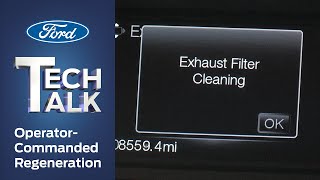
🎬 Watch: Ford Tech Talk explains how Operator-Commanded Regeneration works.Diagnostic Flowchart
Tap your situation to follow the diagnostic path that matches what you're seeing on this vehicle.
Symptoms You May Notice
- Check Engine Light illuminated
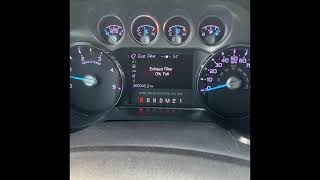
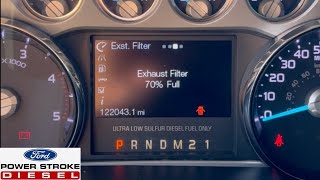
- DPF or 'Exhaust Filter Full' warning message on the dashboard
- Engine power is significantly reduced (limp mode)
- Vehicle may not allow for normal regeneration to occur [TSB16-0098]
- Increased fuel consumption
- Excessive black smoke from the exhaust
- Cooling fans running more often and high idle speed as the truck repeatedly tries and fails to regenerate
- Overheated DPF housing or other exhaust components
- Replacing the DPF immediately. The actual cause is often a failed regeneration cycle, a bad sensor, or a software issue, not a failed DPF. A forced regeneration or sensor replacement is a much cheaper first step.
- Ignoring the DPF pressure sensor hoses. The rubber hoses connecting the sensor to the exhaust bungs can become clogged with soot, cracked, or melted, causing a false high-pressure reading even if the sensor itself is fine.
Most Likely Causes
- Insufficient DPF Regeneration 🔴 High Probability Trucks used for short trips, excessive idling, or low-speed city driving often fail to meet the conditions for automatic DPF regeneration (sustained highway speeds for 20-30 mins), leading to soot buildup.
How to confirm: Review the vehicle's recent usage patterns. If it hasn't been driven at sustained highway speeds for 20-30 minutes, this is the likely trigger. A scan tool can show a high 'Soot Load %' PID.
Typical fix: Perform a manual (forced) DPF regeneration using a Ford-specific scan tool (like IDS or FORScan). Afterwards, ensure the truck is driven regularly at highway speeds to allow for automatic cleaning.
Est. part cost: $0 - Faulty DPF Pressure Sensor 🟡 Medium Probability The sensor and its rubber hoses are exposed to extreme heat and exhaust particles. Hoses can crack, melt, or get clogged with soot, and the sensor itself can fail electronically, sending false 'clogged' signals to the PCM even when the DPF is clean.
How to confirm: Inspect the sensor's hoses for cracks, melting, or blockages. With a scan tool, monitor the DPF pressure sensor voltage/pressure (PID: DP_DPF) with the key on, engine off (should be 0 psi). Then monitor at idle and under load. Compare readings to manufacturer specifications. A reading that is high when the engine is off or doesn't change with RPM suggests a bad sensor or clogged hose.
Typical fix: Replace the DPF pressure sensor and its associated hoses. This is a common and relatively inexpensive fix that should be considered before DPF replacement.
Est. part cost: $40-$120 - Powertrain Control Module (PCM) Software Error 🟡 Medium Probability Ford released multiple TSBs indicating the original PCM software could incorrectly interpret sensor data or have flawed regeneration logic, triggering P2463. [TSB 17-2234, TSB 17-0021]
How to confirm: A Ford dealership or a shop with access to Ford's service information can check if the vehicle's PCM calibration has been updated per the relevant TSBs. [TSB 17-2234, TSB 17-0021]
Typical fix: Reprogram the PCM to the latest available calibration using Ford's Integrated Diagnostic System (IDS) or a J2534 pass-through device. [TSB 17-2234, TSB 17-0021]
Est. part cost: $0 (labor cost for programming will apply) - Clogged or Failed Diesel Particulate Filter (DPF) ⚪ Low Probability → Shop Diesel Particulate Filter (DPF) If the code is ignored for too long, the soot can become so compacted that it won't burn off ('ash accumulation'). High heat from repeated failed regens can also damage the filter media internally, causing it to crack or melt.
How to confirm: If a forced regeneration fails to clear the code and DPF pressure readings remain high (after confirming the sensor is good), the filter is likely the cause. Physical inspection after removal may show signs of melting, cracking, or excessive ash at the outlet.
Typical fix: Remove the DPF for professional off-vehicle cleaning (baking and cleaning). If it's damaged, it must be replaced.
Est. part cost: $250-$650 (for cleaning), $1500-$2500+ (for replacement)
Rare But Worth Checking
- Faulty Exhaust Gas Temperature (EGT) Sensor: → Shop Exhaust Gas Temperature (EGT) Sensor The DPF system uses multiple EGT sensors to monitor temperatures for regeneration. If one provides an inaccurate reading (e.g., stuck reading cold), the PCM may not initiate or may abort the regeneration process, leading to soot buildup.
- Underlying Engine Issue Causing Excessive Soot: Problems like leaking fuel injectors, a faulty EGR system, or a failing turbo can produce more soot than the DPF system was designed to handle, causing it to clog prematurely. Leaking piezo injectors are a known issue on the 6.7L Power Stroke.
- Exhaust Leaks: Any exhaust leak upstream of the DPF can alter the pressure differential, confusing the DPF pressure sensor and leading to incorrect readings and failed regeneration cycles.
Diagnosis Steps
- Check for TSBs: Use the VIN to check for open recalls or TSBs related to P2463, specifically TSB 17-2234, TSB 17-0021, and SSM 47402. [TSB 17-2234, TSB 17-0021, SSM 47402]
- Scan Tool Analysis: Use a capable scan tool (like FORScan or IDS) to read the DPF soot load percentage (PID: DPF_SOOT_LOAD) and differential pressure (PID: DP_DPF). A high soot load confirms the need for regeneration.
- Attempt Manual Regeneration: Following the tool's prompts, initiate a 'manual' or 'forced' DPF regeneration. This process takes 30-60 minutes and involves running the engine at high RPM while parked in a safe, outdoor location away from flammables. A quarter tank of fuel is typically required.
- Reset DPF Parameters: After a successful regeneration, use the scan tool to perform a 'DPF Parameter Reset' as mentioned in TSB SSM 47402. This tells the PCM that the filter is now clean. [SSM 47402]
- Inspect DPF Pressure Sensor & Hoses: If regeneration fails or the code returns, turn the engine off. Visually and physically inspect the DPF pressure sensor and its rubber hoses for any signs of damage, melting, cracks, or blockages.
- Test Sensor Live Data: Monitor the DPF pressure sensor readings (DP_DPF) with the scan tool. With Key On, Engine Off, the pressure should be 0 psi. If it reads high, the sensor is faulty. If it doesn't increase smoothly with engine RPM, the sensor or its hoses are suspect.
- Consider PCM Update: If TSBs are applicable and haven't been performed, have a dealer or qualified shop update the PCM calibration. This can resolve logic errors that falsely trigger the code. [TSB 17-2234]
- Professional DPF Service: If all the above steps fail, the DPF itself is likely the problem and needs to be removed for professional cleaning or replacement.
Parts You'll Likely Need
- DPF Pressure Sensor
(OEM #BC3Z-9J460-C (also known as Motorcraft DPFE-20))— This sensor is a frequent point of failure
Related Codes That Often Appear With This One
- P246C — This code indicates DPF restriction and that a forced limited power mode has been activated. It's a direct consequence of P2463 not being addressed. Ford TSBs frequently list these two codes together. [SSM 47402, TSB 17-2234]
- P2459 — This code means 'Diesel Particulate Filter Regeneration Frequency' is too high. It often appears before P2463, indicating the truck is trying to regenerate too often because of an underlying issue like a failing sensor or excessive soot production. [TSB16-0098]
- P2201 — This code relates to the NOx sensor circuit. Issues with the emissions control system can be interrelated, and Ford TSBs list this code alongside P2463 as being potentially resolved by a PCM reprogram. [TSB 17-2234]
- P2452 — This code specifically points to a fault in the DPF Pressure Sensor 'A' Circuit. It often accompanies P2463, strongly suggesting the sensor or its wiring is the root cause, rather than a truly clogged filter.
Technical Service Bulletins (TSBs) & Recalls
- TSB 17-2234: Addresses MIL with DTCs P2201, P2459, P2463, P246C on 2015-2016 models, fixed by a PCM reprogram.
- SSM 47402: Instructs technicians to perform a manual regeneration followed by a DPF parameter reset when diagnosing P2463 and related codes.
- TSB 16-0098: Notes that if regeneration attempts are unsuccessful (P2459), P2463 may set as a result of the accumulation. [TSB16-0098]
- TSB 17-0021: An earlier version of TSB 17-2234, also recommending a PCM reprogram for P2463 on 2015-2016 models.
- TSB 21-2052: Provides information on enabling Operator Commanded Regeneration (OCR) for trucks with low-speed/idling duty cycles to prevent soot buildup.
Platform-Specific Known Issues
- Per TSB 17-2234 and 17-0021, some 2015-2016 F-Super Duty trucks with the 6.7L engine may exhibit P2463 due to a PCM software glitch, which is resolved by reprogramming the module to the latest calibration.
- SSM 47402 provides a specific procedure for service technicians: when encountering P2463, a manual regeneration should be performed, followed immediately by a 'DPF Parameter Reset' using the scan tool.
- For trucks used in low-speed or stationary applications, Ford released TSB 21-2052 (superseding 18-2232) which details how to enable Operator Commanded Regeneration (OCR). This allows the driver to manually start a regeneration cycle via the instrument cluster menu to prevent soot buildup before P2463 occurs.
Mechanic-Grade Diagnostic Values
- DPF Differential Pressure Sensor Signal Voltage — expected: 0.71 to 0.77 VDC. Failure: Voltage outside of the expected range.
- DPF Differential Pressure (PID: DP_DPF or similar) — expected: 0 psi (or near 0 kPa) with Key On, Engine Off (KOEO). Failure: Any significant pressure reading with the engine off indicates a biased or faulty sensor.
- DPF Soot Load (PID: DPF_SOOT_LD) — expected: Increases with driving, should drop to a low percentage (e.g., <30%) after a successful regeneration.. Failure: Reaching 100% or higher triggers a regen. If it fails to drop after a regen, the filter is still clogged or the sensor is bad.
Scan Tool Commands That Help
- FORScan: Diesel Particulate Filter Static Regeneration — To command a stationary (forced) regeneration when the DPF is full and normal driving conditions are not clearing it. This is a primary fix for P2463.
- FORScan: Reset the Diesel Particulate Filter Learned Values — After performing a static regeneration or replacing the DPF. This command, mentioned in TSB SSM 47402, tells the PCM that the filter is now clean. [SSM 47402]
- FORScan: PCM Configuration Change: Operator Commanded Regeneration (OCR) — To enable the OCR menu in the instrument cluster. This allows the driver to monitor DPF soot level and manually request a regeneration, preventing future soot buildup for those with unfavorable driving cycles.
- FORScan: IPC Configuration Change: DPF Soot % Screen — To enable a screen on the dashboard that displays the DPF soot percentage, allowing for proactive monitoring without needing a scan tool connected at all times.
Wiring & Ground Locations
- DPF Pressure Sensor Connector — The sensor is typically mounted on a bracket attached to the transmission or frame rail, with two rubber hoses connecting to steel pipes on the DPF assembly.. The connector and wiring to the DPF pressure sensor are susceptible to heat damage and corrosion. A poor connection can cause erratic readings, triggering P2463 even if the sensor and filter are good.
- Main Engine Harness Grounds — Key grounding points are located on the inner fenders near the batteries and on the engine block/cylinder heads. A specific harness routes under the engine in a plastic channel and is prone to damage.. A bad ground can cause incorrect readings from any sensor on that circuit. While not a primary cause, verifying grounds is a crucial step in diagnosing persistent electronic faults.
Real Owner Repair Stories
- Ford Truck Enthusiasts Forum (2015 F-350 6.7L with 37,000 miles) — DPF Load PID on scan tool reached 127% before regeneration. After regen, DPF Soot PID only dropped to 1.53 g/l and DPF Load PID never went below 30%.
❌ Tried (didn't work) A standard active regeneration cycle did not appear to be cleaning the filter thoroughly.
✅ What actually fixed it The user noted that Ford's programming can initiate a regen based on a 500-mile interval even if soot levels aren't critically high. The concern was that the filter wasn't fully cleaning, indicating potential for future clogging due to ash buildup over time, even though the code was cleared. The fix is continued monitoring and ensuring complete regens.
OEM Part Supersession History
BC3Z-9J460-C→BC3Z-9J460-D (DPFE-21), BC3Z-9J460-F (DPFE-131)— Standard part revision and improvement by the manufacturer.
Heads up: While BC3Z-9J460-C is the most cited part for this range, some chassis configurations or later model years may use the superseded numbers. Always verify the correct part number for the specific vehicle's VIN.
Model Year Variations Within This Range
- 2015-2016: The 2015 model year received a significant update. It features a larger, more reliable Garrett GT37 turbocharger instead of the earlier single-sequential turbo. It also has an improved high-pressure fuel pump (CP4.2) and injector nozzles, resulting in a power increase to 440 hp and 860 lb-ft of torque. These changes can affect soot production and DPF behavior.
- 2011-2014: These earlier models use the smaller, single-sequential turbocharger which is known to be less reliable than the 2015+ unit. The engine was initially rated at 390 hp / 735 lb-ft but was quickly updated via software to 400 hp / 800 lb-ft.
Helpful Videos
![[EN] How to replace a DPF sensor | Masters of Motion](https://img.youtube.com/vi/rX9WGUP7p7c/mqdefault.jpg)

The information in this article is provided for general reference and educational purposes only. Vehicle specifications, procedures, and part compatibility can vary by production date, trim level, and region. Always consult your vehicle's factory service manual and verify part numbers before purchasing or performing repairs. Safety-critical components such as airbags, seat belts, and braking systems should be installed by a qualified professional.
- Ford F-450 SD:
- 🧭 Diagnostic Flowchart
- 🎬 Helpful Videos
- What's Unique About the 2011-2015 Ford F-450 SD
- Symptoms You May Notice
- Most Likely Causes
- Rare But Worth Checking
- Diagnosis Steps
- Parts You'll Likely Need
- Related Codes That Often Appear With This One
- Technical Service Bulletins (TSBs) & Recalls
- Platform-Specific Known Issues
- Mechanic-Grade Diagnostic Values
- Scan Tool Commands That Help
- Wiring & Ground Locations
- Real Owner Repair Stories
- OEM Part Supersession History
- Model Year Variations Within This Range
- 🎟️ Get 5% Off