

OBD-II Code P2542: Low Pressure Fuel System Sensor Circuit High
What P2542 means, why it triggers, and how to fix it
- Code P2542 indicates the low-pressure fuel sensor circuit is sending an impossible voltage signal (typically over 4.5V) to the engine computer.
- The most frequent fixes are replacing a failed sensor ($120-$360) or repairing a shorted wiring harness.
- For 2008-2015 Land Rover and Jaguar models, do not replace parts immediately; a $150-$250 dealer PCM software update is the documented fix (TSB SSM72531).
- Never replace the sensor without checking live data; if disconnecting the sensor drops the voltage to 0V, the sensor is bad, but if it stays at 5V, the wiring is shorted.
- Driving with P2542 risks unexpected stalling in traffic and causes up to $2,800 in catalytic converter damage from unburnt fuel within 1 to 6 months.
What Does P2542 Mean?
The Powertrain Control Module (PCM) is receiving a voltage signal from the low-pressure fuel sensor that exceeds the normal 4.5-volt limit. This sensor measures fuel flow from the tank to the engine. When the signal pegs at 5 volts, the PCM cannot regulate fuel delivery, causing immediate drivability issues.
Technical definition: SAE/OBD-II code P2542 is defined as "Low Pressure Fuel System Sensor Circuit High". It triggers when the PCM detects the low-pressure fuel sensor signal wire voltage remains above the calibrated maximum threshold (typically 4.5V to 4.8V) for a set duration.
Can I Drive With P2542?
Yes, But With Caution. You can drive short distances, but prolonged driving risks unexpected stalling in traffic. Ignoring the code starves the high-pressure fuel pump and dumps unburnt fuel into the exhaust, destroying the catalytic converter—a $1,200 to $2,800 repair.
Common Causes
- Failed Low-Pressure Fuel Sensor (Very Common) — Internal sensor failure causes a constant 5-volt signal. This is the most frequent hardware cause, including out-of-box failures from cheap aftermarket sensors.
- Wiring Shorted to Power (Common) — The sensor's signal wire chafes against hot engine components or the frame, melting the insulation and touching a 5V or 12V power source.
- Outdated PCM Software (Common) — On 2008-2015 Land Rover and Jaguar models, a known software glitch misinterprets normal sensor signals as 'too high'. A dealer software update is the only fix.
- Corroded or Water-Damaged Connector (Less Common) — Heavy rain, flooding, or pressure washing forces water into the sensor connector, bridging the 5V reference and signal pins to create a false high reading.
- Poor Ground Connection (Less Common) — Excessive resistance (over 0.1 ohms) on the sensor's ground circuit causes the signal voltage to float upward, triggering the code.
- Failing Powertrain Control Module (PCM) (Rare) — An internal short in the PCM's 5-volt reference circuit sends unregulated voltage to the sensor.
- Fuel Contamination (Rare) — Severely contaminated fuel damages the internal diaphragm of the fuel pressure sensor, causing it to fail and report an incorrect maximum voltage.
Symptoms
- Check Engine Light is On — The Malfunction Indicator Lamp (MIL) illuminates immediately upon the PCM detecting the high voltage.
- Engine Stalling and Rough Idle — The engine stalls at low speeds, idles roughly, or refuses to start because the PCM is cutting fuel delivery.
- Hesitation or Loss of Power — The vehicle hesitates during acceleration and enters 'limp mode' to prevent engine damage.
- Longer Crank Times — The engine takes 3 to 5 seconds longer than usual to start, especially when warm.
- Reduced Fuel Economy — Fuel consumption increases by 10-25% because the computer defaults to a rich fuel mixture to prevent stalling.
Diagnostic Flowchart
Tap your situation to follow the diagnostic path that matches what you're seeing on this code.
Common Fixes & Costs
- Replace Low-Pressure Fuel Sensor — Parts: $45-$160, Labor: $75-$200, ~0.8 hr book time (DIY)
- Repair Damaged Wiring Harness — Parts: $10-$50, Labor: $150-$300, ~2.0 hr book time (Intermediate)
- Update PCM Software — Parts: $0, Labor: $150-$250, ~1.0 hr book time (Professional)
- Clean Electrical Connector — Parts: $5-$15, Labor: $50-$100, ~0.5 hr book time (DIY)
- Replace PCM — Parts: $600-$900, Labor: $200-$300, ~1.5 hr book time (Professional)
Used vs. New Parts: Buying Guide
When a used part is worth it: Buying a used fuel pressure sensor is never recommended. The savings are minimal compared to the high risk of premature failure. Only buy used if replacing an entire wiring harness.
Donor-vehicle mileage cap: roughly under 50000 miles for the part to have meaningful remaining life.
Donor quality checklist:
- Verify the exact OEM part number matches.
- Avoid parts from vehicles with flood damage or visible connector corrosion.
- Ensure the donor vehicle was scrapped for reasons unrelated to the engine or fuel system.
Decision logic:
- If The sensor is under $150 new from an OEM or reputable brand like Bosch. → Always buy new. The reliability and warranty are worth the cost.
- If The vehicle is over 15 years old and the budget is extremely tight. → A used sensor is a gamble but serves as a temporary fix.
Warranty tradeoff: Used parts offer a 30-90 day warranty covering only the part. New OEM parts carry a 1-2 year warranty.
Worst-case if a used part fails: $250-$500. If the used sensor fails, you pay for labor a second time plus the cost of a new sensor.
What Happens If You Wait — Timeline
- 0-2 weeks: Check Engine Light illuminates. Vehicle experiences slightly longer crank times but drives normally. (MPG impact: 0-5%% · Added cost: $0)
- 2 weeks - 3 months: Symptoms become consistent. Engine hesitates, idles roughly, and stalls at low speeds. Power loss is severe. (MPG impact: 10-25%% · Added cost: $50-$150 in wasted fuel.)
- 3-8 months: The high-pressure fuel pump strains from unreliable fuel supply. The engine runs rich, overheating the catalytic converter. (MPG impact: 15-30%% · Added cost: $400-$1000 (risk of HPFP damage))
- 8+ months: The catalytic converter melts from prolonged exposure to unburnt fuel. The PCM fails from long-term electrical shorts. (MPG impact: >25%% · Added cost: $1500-$3000 (catalytic converter) + $800 (PCM replacement).)
Cost of Not Fixing It
- 0-1 month: Noticeable drop in fuel economy (up to 25%), poor acceleration, and high risk of stalling in traffic. (Added cost: $50-$100 in wasted fuel.)
- 1-6 months: The engine runs overly rich, overheating and melting the catalytic converter. The high-pressure fuel pump sustains damage from fuel starvation. (Added cost: $1200-$2800 for catalytic converter and high-pressure pump replacement.)
- 6+ months: Persistent electrical shorts stress the Powertrain Control Module (PCM), leading to internal module failure. (Added cost: $800-$1500 for PCM replacement.)
Diagnosis Steps
- Check for Technical Service Bulletins (TSBs)
Search online for TSBs related to your vehicle's make, model, year, and code P2542. For Land Rover and Jaguar, TSB SSM72531 dictates a software update is the only fix.
Tools: Internet access (Beginner) - Scan Live Data to Confirm the Fault
Connect an OBD-II scanner. With the key on but the engine off (KOEO), view the voltage from the low-pressure fuel sensor. A reading stuck at or near 5.0 volts confirms the 'circuit high' fault.
Tools: OBD-II Scanner with Live Data (Beginner) - Isolate the Sensor from the Circuit
While watching the live data, disconnect the sensor's electrical connector. If the voltage drops to 0 volts and code P2541 (Circuit Low) appears, the sensor is internally shorted and must be replaced. If the voltage stays at 5V, the wiring is shorted to power.
Tools: OBD-II Scanner with Live Data (Intermediate) - Visually Inspect the Wiring and Connector
Inspect the wiring harness for chafing, melting, or bare wires. Check the connector for green corrosion or water entry. Apply dielectric grease to the pins upon reassembly.
Tools: Flashlight, Dielectric Grease (Beginner) - Test the Connector Pins with a Multimeter
With the sensor disconnected and key on, test the harness terminals. You must find a 5-volt reference signal, a solid ground (near 0 ohms to battery negative), and the signal wire. If the signal wire reads 5 volts while disconnected, trace the harness for a short to power.
Tools: Digital Multimeter (Intermediate) - Perform a Voltage Drop Test on the Ground Circuit
Connect the multimeter's black lead to the battery negative and the red lead to the sensor's ground pin (plugged in, key on). A reading above 100mV (0.1V) proves excessive resistance in the ground circuit.
Tools: Digital Multimeter (Advanced) - Verify Fuel Pressure with a Mechanical Gauge
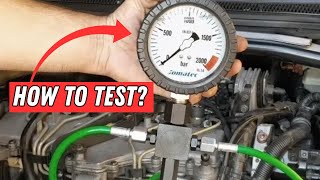
Connect a mechanical gauge to the low-pressure service port. At idle, pressure is typically 55-65 PSI. If the mechanical gauge is normal but the scan tool shows maximum voltage, the fault is strictly electrical.
Tools: Mechanical Fuel Pressure Gauge (Advanced) - Perform a Module Self-Test
If all wiring and the sensor pass testing, use an advanced scan tool to command a PCM module self-test. A failure confirms a faulty PCM. Take the vehicle to a diagnostic technician if this step is required.
Tools: Advanced OBD-II Scanner (Professional)
When This Code Triggers (Freeze-Frame Conditions)
- Engine Coolant Temp: 180-205°F (82-96°C) (The fault is often detected once the engine reaches full operating temperature.)
- RPM: 700-2500 RPM (The code sets at idle or during steady-state cruising as it is an electrical fault, not performance-based.)
- Engine Load: 15-60% (Occurs under various load conditions, from idle to moderate acceleration.)
- Vehicle Speed: 0-60 mph (The electrical fault is present at any speed, including when stopped.)
Related Codes
- P2541 — Means 'Low Pressure Fuel System Sensor Circuit Low.' It is the direct opposite of P2542. If disconnecting the sensor changes the code from P2542 to P2541, the sensor is internally shorted and must be replaced.
- P008A — Means 'Low Pressure Fuel System Pressure - Too Low.' P2542 is an electrical fault, while P008A is a mechanical performance fault. P2542 shows a voltage stuck near 5V, while P008A shows a valid voltage corresponding to low pressure.
- P008B — Means 'Low Pressure Fuel System Pressure - Too High.' Indicates a mechanical issue like a faulty fuel pressure regulator. The scan tool shows a plausible voltage corresponding to high pressure, unlike the illogical maximum voltage of P2542.
- P0193 — Means 'Fuel Rail Pressure Sensor Circuit High.' Diagnostically identical to P2542, but refers to the sensor on the high-pressure side of a direct-injection system.
Climate & Environmental Factors
- Humidity / Water Intrusion: Heavy rain or engine pressure washing forces water into non-sealed connectors, bridging the pins and causing an immediate short circuit that triggers the 'Circuit High' reading.
- Extreme Heat: Prolonged extreme heat accelerates the degradation of wiring insulation, making wires brittle and highly susceptible to cracking and shorting against the engine block.
How to Talk to a Mechanic About This Code
Say this: "I have a Check Engine Light and a P2542 code. I'd like to schedule a diagnostic. Based on my research, the cause is the low-pressure fuel sensor, wiring, or a software update. Can you start by checking the sensor's live voltage data to confirm it's reading high?"
This signals you are an informed customer. It directs the technician to the correct diagnostic starting point (live data), saving time and preventing unnecessary part replacements.
Avoid saying:
- 'My car is hesitating, just fix it.'
- 'My check engine light is on, can you look at it?'
- 'I think I need a new fuel pump.'
Questions to ask before authorizing the repair:
- Did the sensor voltage on the scan tool drop to zero when you disconnected it?
- Can you confirm the wiring harness was inspected for shorts and the connector pins for corrosion?
- For Land Rover/Jaguar: Have you confirmed my vehicle has the latest PCM software per TSB SSM72531?
- What is the warranty on the recommended repair, including parts and labor?
Where to Take It: Dealer vs Independent vs Chain
- Dealer:
Required for Land Rover/Jaguar software updates. For other makes, an independent shop is more cost-effective.
Best for: Land Rover or Jaguar vehicles requiring TSB software updates., Vehicles under powertrain or emissions warranty., Complex electrical issues requiring manufacturer-specific tools.
Downsides: Labor rates are 1.5x to 2x higher than independent shops., May default to replacing parts rather than repairing wiring. (Typical cost: +50% vs. baseline) - Independent Shop:
Best overall fit. An experienced technician diagnoses a bad sensor or wiring short as effectively as a dealer for less.
Best for: Out-of-warranty vehicles where cost is a priority., Common vehicles (Ford, GM, VW) where P2542 is well-understood., Diagnosing and repairing wiring issues.
Downsides: Quality varies; check for ASE certifications., May lack software tools for PCM updates on luxury brands. (Typical cost: +0% vs. baseline) - Chain Shop:
Avoid for initial diagnosis of an electrical fault like P2542.
Best for: Simple maintenance like oil changes.
Downsides: Technician skill is inconsistent., High pressure to sell parts without proper circuit diagnosis., Lack advanced diagnostic capabilities. (Typical cost: -10% vs. baseline)
When to Walk Away From the Repair
If the estimated repair cost exceeds 40-50% of your car's private-party value, consider selling or trading in the vehicle.
- Car worth $4000, fix is $2000: Walk away. A repair costing 50% of the car's value is a poor investment, especially if the diagnosis points to PCM failure.
- Car worth $12000, fix is $350: Fix it. A sensor replacement or wiring repair restores the vehicle's function and value.
- Car worth $2500, fix is $1200: Borderline. If the fix is a guaranteed sensor replacement, it might be worth it. If it's a complex wiring issue, sell the car as a 'mechanic special'.
What Scan Tool You Need for This Code
Minimum: An OBD-II scanner that reads and displays live sensor data, specifically the voltage from the low-pressure fuel system sensor.
A basic $20 code reader cannot show live voltage readings. Without live data, you cannot confirm if the voltage is stuck at 5V, leading to unnecessary part replacements.
Budget: BlueDriver Pro Bluetooth OBD-II Scanner (~$100) — Connects to your smartphone to view and graph live fuel pressure sensor voltage, the key diagnostic step for P2542.
Mid-range: Foxwell NT510 Elite (~$180) — Provides live data graphing and reads manufacturer-specific codes. Offers bi-directional controls to test components on supported vehicles.
Professional: Autel MaxiCOM MK808 (~$500-900) — Offers professional-level diagnostics, fast live data, advanced graphing, and bi-directional circuit testing.
Rent vs buy: Auto parts stores offer loaner scanners for a refundable deposit. This is the best option for a one-time diagnosis.
How to Clear the Code After You Fix It
- Use an OBD-II scan tool to clear the P2542 code from the PCM's memory.
- Perform a complete OBD-II drive cycle to allow the vehicle's readiness monitors to run and complete.
- Check readiness monitor status with a scan tool before attempting an emissions test.
Drive cycle (~30 minutes): Start with a cold engine (sat for 8+ hours with fuel between 1/4 and 3/4 full). Idle for 2-3 minutes with A/C and rear defroster on. Accelerate to 55 mph and maintain speed for at least 5 minutes. Coast to a stop without using the brakes excessively. Drive in stop-and-go city conditions for about 10 minutes.
Readiness monitors affected: Catalyst Monitor, Oxygen (O2) Sensor Monitor, Evaporative System (EVAP) Monitor
Before emissions retest: drive at least 100 miles to fully set monitors.
Watch out for:
- Clearing the code by disconnecting the battery resets all readiness monitors to 'Not Ready', causing an automatic emissions test failure.
- The code returns immediately if the underlying electrical short was not repaired.
- Failing to start the drive cycle with a completely cold engine prevents the EVAP monitor from running.
Will This Fail Emissions / State Inspection?
Yes — this code typically fails an OBD-II emissions inspection.
- California: An illuminated Check Engine Light results in an automatic smog check failure. A full drive cycle must be completed to set readiness monitors before a re-test.
- New York: An active P2542 code automatically fails the emissions inspection. For 2001+ vehicles, only one readiness monitor is allowed to be 'Not Ready'.
- Texas: In emissions-testing counties, an active P2542 code is an automatic failure. Clearing the code just before the test results in a 'Not Ready' failure.
Most Commonly Affected Vehicles
- Land Rover LR2, Range Rover Evoque (2008-2015) — Caused by a known software glitch requiring a PCM update (TSB SSM72531 / Campaign Q511). Do not replace the sensor before updating the software.
- Ford F-150 (EcoBoost) (2011-2020) — Commonly affected by wiring harness chafing against the frame or a failed sensor.
- Volkswagen GTI, Golf, Jetta (2.0T TSI) (2008-2019) — Prone to direct sensor failure. The sensor is a common replacement item costing $120-$160.
- Audi A3, A4 (2.0T) (2006-2013) — Shares engine components with Volkswagen; highly susceptible to the same sensor failures.
- Hyundai / Kia Sonata, Optima, Santa Fe (2.4L GDI) (2011-2019) — The fuel pressure sensor on the 2.4L GDI engine is a known failure point.
- Chevrolet Cruze, Malibu, Equinox (2010-2020) — Diagnosis often requires checking the sensor signal and wiring harness integrity near the fuel rail.
- Toyota RAV4 (2019-2023) — Owner reports indicate this code appears after heavy rain, pointing to water intrusion in the sensor connector.
- Volvo XC90, S60 (3.2L SI6) (2007-2014) — Shares the 3.2L engine with Land Rover; experiences identical sensor failures.
Manufacturer-Specific Notes
- Land Rover / Jaguar: A 'sub-optimal PCM software calibration' is the primary cause for P2542 on the LR2 and Evoque. TSB SSM72531 dictates technicians must perform a software update before replacing any hardware.
- Ford: On F-150s, the Fuel Pump Driver Module (FPDM) located above the spare tire corrodes and fails, causing cascading fuel pressure codes. Inspect the FPDM if wiring checks out.
- General Motors (GM): On some GM vehicles, the low-pressure fuel sensor is integrated into the fuel pump module inside the tank. Fixing P2542 requires replacing the entire $500-$800 fuel pump assembly.
Real Owner Stories
2014 Land Rover LR2 with ~100K miles
Check Engine Light came on with P2542 code. The vehicle experienced rough idle, hesitation on acceleration, and occasional stalling.
What they tried:
- Initially suspected a bad fuel pressure sensor, a common failure item.
Outcome: The owner discovered Land Rover TSB SSM72531, indicating a software glitch. A dealership performed a PCM software update, resolving all symptoms and clearing the code permanently.
Lesson: For Land Rover and Jaguar, always check TSBs before replacing parts. A $200 software update saves you from a needless $400+ sensor replacement.
2014 Ford F-150 3.5L EcoBoost with 120K miles
The truck suddenly had poor acceleration and entered 'limp mode'. The Check Engine Light was on, showing code P2542.
What they tried:
- The owner replaced the low-pressure fuel sensor, but the code and symptoms returned immediately.
Outcome: Upon inspecting the wiring harness near the engine, the owner found the signal wire chafed against the frame, causing a short to power. Repairing the wire and adding protective loom fixed the issue.
Lesson: If replacing the sensor fails, the fault is in the wiring. Visually inspect for wires rubbing against metal parts, especially on trucks prone to vibration.
2008 Ford Ranger 4.0L with 150K miles
The engine intermittently died during heavy rain or after a car wash, throwing multiple 5V reference codes including P2542.
What they tried:
- The owner noticed wiring going to a shared 5V sensor had cracked insulation.
Outcome: The owner repaired the damaged wires using waterproof heat shrink tubing and dielectric grease. The stalling issue in wet conditions was resolved.
Lesson: Water intrusion causes intermittent electrical faults. If P2542 appears after rain, the root cause is a poorly sealed connector or damaged wiring insulation.
How to Prevent This Code From Triggering
- Apply Dielectric Grease to Connectors (During any related maintenance or every 30K miles in wet climates) — Dielectric grease seals electrical contacts from moisture, preventing the shorts that trigger 'Circuit High' codes.
- Inspect and Secure Wiring Harnesses (During every oil change) — Engine vibration chafes wiring insulation against metal edges. Securing loose wiring prevents shorts to power.
- Clean Engine Bay Cautiously (When washing the engine) — Avoid spraying high-pressure water directly at electrical connectors to prevent immediate short circuits.
- Replace Fuel Filter at Recommended Intervals (Per manufacturer's schedule (e.g., every 20-40K miles)) — A clogged filter stresses the fuel pump and allows debris to reach and damage the fuel pressure sensor diaphragm.
- Use Top Tier Certified Fuel (Every fill-up) — Detergent additives prevent contamination and deposits that degrade the sensor's internal components over time.
Frequently Asked Questions
What does 'Circuit High' actually mean?
It means the voltage in the sensor's electrical circuit is stuck near its maximum limit, usually 5 volts. This is an impossible reading under normal conditions, indicating an electrical short or a failed sensor.
I replaced the fuel pressure sensor, but P2542 came back. What now?
The problem lies in the wiring, connector, or PCM software. Re-inspect the wiring harness for a short-to-power and check the connector for hidden corrosion. On Land Rovers, a PCM software update is likely required.
Can weather or water cause a P2542 code?
Yes. Water entering the sensor's electrical connector bridges the pins, causing a short circuit that spikes the voltage. If the code appeared after heavy rain or a car wash, dry and clean the connector first.
Can I just replace the sensor to fix P2542?
Replacing the sensor fixes the issue about 60% of the time, but it is not guaranteed. Always disconnect the sensor while watching live data first; if the voltage stays at 5V, a new sensor will not fix the shorted wiring.
Will a basic code reader fix this?
No. A basic code reader only clears the code temporarily. You need a scanner that displays live data to view the sensor's actual voltage and confirm the repair.
Is this an expensive repair?
A DIY sensor replacement costs under $160, while a dealer software update runs $150-$250. However, if the wiring harness requires extensive tracing or the PCM has failed, costs exceed $800.
Can a bad fuel pump cause a P2542 code?
No. P2542 is strictly an electrical circuit fault (voltage too high). A failing fuel pump causes mechanical low-pressure codes like P0087 or P008A.
What is the difference between the low-pressure and high-pressure fuel sensor?
The low-pressure sensor monitors fuel from the in-tank pump (40-75 PSI). The high-pressure sensor monitors pressure after the engine-driven pump (up to 2,000+ PSI). P2542 refers exclusively to the low-pressure side.
Key Takeaways
- Code P2542 indicates the low-pressure fuel sensor circuit is sending an impossible voltage signal (typically over 4.5V) to the engine computer.
- The most frequent fixes are replacing a failed sensor ($120-$360) or repairing a shorted wiring harness.
- For 2008-2015 Land Rover and Jaguar models, do not replace parts immediately; a $150-$250 dealer PCM software update is the documented fix (TSB SSM72531).
- Never replace the sensor without checking live data; if disconnecting the sensor drops the voltage to 0V, the sensor is bad, but if it stays at 5V, the wiring is shorted.
- Driving with P2542 risks unexpected stalling in traffic and causes up to $2,800 in catalytic converter damage from unburnt fuel within 1 to 6 months.
Helpful Videos
Shop the Parts Behind P2542
Below are the parts most often responsible for code P2542, ranked by how frequently each one is the actual culprit (per the diagnosis above). Tap any to see what we have for your vehicle.


The information in this article is provided for general reference and educational purposes only. Vehicle specifications, procedures, and part compatibility can vary by production date, trim level, and region. Always consult your vehicle's factory service manual and verify part numbers before purchasing or performing repairs. Safety-critical components such as airbags, seat belts, and braking systems should be installed by a qualified professional.
- 🧭 Diagnostic Flowchart
- 🎬 Helpful Videos
- 🛍️ Shop This Part
- What Does P2542 Mean?
- Can I Drive With P2542?
- Common Causes
- Symptoms
- Common Fixes & Costs
- Used vs. New Parts: Buying Guide
- What Happens If You Wait — Timeline
- Cost of Not Fixing It
- Diagnosis Steps
- When This Code Triggers (Freeze-Frame Conditions)
- Related Codes
- Climate & Environmental Factors
- How to Talk to a Mechanic About This Code
- Where to Take It: Dealer vs Independent vs Chain
- When to Walk Away From the Repair
- What Scan Tool You Need for This Code
- How to Clear the Code After You Fix It
- Will This Fail Emissions / State Inspection?
- Most Commonly Affected Vehicles
- Manufacturer-Specific Notes
- Real Owner Stories
- 2014 Land Rover LR2 with ~100K miles
- 2014 Ford F-150 3.5L EcoBoost with 120K miles
- 2008 Ford Ranger 4.0L with 150K miles
- How to Prevent This Code From Triggering
- Frequently Asked Questions
- What does 'Circuit High' actually mean?
- I replaced the fuel pressure sensor, but P2542 came back. What now?
- Can weather or water cause a P2542 code?
- Can I just replace the sensor to fix P2542?
- Will a basic code reader fix this?
- Is this an expensive repair?
- Can a bad fuel pump cause a P2542 code?
- What is the difference between the low-pressure and high-pressure fuel sensor?
- Key Takeaways
- 🎟️ Get 5% Off