

P2545 on 2014-2018 Land Rover Range Rover Evoque: Torque Request Signal Fault Guide
On a 2014-2018 Range Rover Evoque, code P2545 is almost always caused by outdated Transmission Control Module (TCM) software. The primary fix, recommended by Land Rover in Technical Service Bulletin (TSB) SSM73291, is a software update performed by a dealer or qualified shop after verifying the transmission fluid level is correct.
- P2545 on a 2014-2018 Evoque is a known issue with a specific fix outlined in Land Rover TSBs.
- Do not rush to replace expensive parts. The first step should always be checking the fluid level and then performing a TCM software update by a qualified shop.
- This is not a DIY-friendly repair due to the need for specialized diagnostic and programming tools.
- Always ensure the transmission fluid level is correct, as this can cause a variety of shifting and communication problems.
- The code is often accompanied by P2546; they point to the same software-related issue.
What's Unique About the 2014-2018 Land Rover RANGE ROVER EVOQUE
The 2014-2018 Evoque uses the ZF 9HP48 9-speed automatic transmission. This gearbox was known across many car brands for having shifting issues and drivability complaints, especially in its early years. Land Rover, like other manufacturers, released multiple software updates for the Transmission Control Module (TCM) to resolve these problems. Code P2545, specifically the variant P2545-86, is a well-documented issue on this platform, addressed by Land Rover's own technical service bulletins which prioritize a software update over hardware replacement.
Diagnostic Flowchart
Tap your situation to follow the diagnostic path that matches what you're seeing on this vehicle.
Symptoms You May Notice
- Check Engine Light illuminated
- Reduced engine power or sluggish acceleration
- Vehicle enters 'limp mode' (limited RPM)
- Harsh, erratic, or delayed gear shifts 🎬 See how a software update fixes jumpy gear shifts.
- Delayed throttle response
- "Gearbox Fault" message may appear on the instrument cluster
- Replacing the Transmission Control Module (TCM) when only a software update was needed.
- Assuming a major internal transmission failure without first following the TSB diagnostic steps of checking fluid and software.
- Replacing the main vehicle battery when the small auxiliary battery is the cause of electrical gremlins.
Most Likely Causes
- Transmission Control Module (TCM) Software Out of Date 🔴 High Probability → Shop Transmission Assembly Land Rover issued Technical Service Bulletin SSM73291 specifically recommending a software update as the primary fix for this code (P2545-86) on the 9HP48 transmission. An earlier TSB, SSM72946, noted that TCMs were being replaced under warranty unnecessarily when a software update was the correct fix.
How to confirm: A Land Rover dealer or specialist with the appropriate diagnostic tool (SDD or Pathfinder) can check the current software version against the latest available version.
Typical fix: Update the TCM software to the latest version. This is a non-physical repair performed via the OBD-II port, often taking 1-1.5 hours of labor.
Est. part cost: $0 - Low or Incorrect Transmission Fluid Level 🟡 Medium Probability → Shop Transmission Assembly The TSB diagnostic procedure explicitly requires checking for leaks and verifying the fluid level before any other steps, indicating it's a common contributing factor. The sealed nature of the transmission means leaks are the only way for fluid to get low, and checking it is not a simple DIY task.
How to confirm: The transmission fluid level must be checked by a technician, as there is no dipstick. The procedure requires the vehicle to be level and the transmission fluid to be at a specific temperature (typically 30°C to 50°C) while the engine is running.
Typical fix: Top off the fluid to the correct level and repair any leaks found. Use only the manufacturer-specified fluid, ZF Lifeguard 9 or equivalent.
Est. part cost: $50-$150 - Wiring Harness or Connector Issue ⚪ Low Probability Signal range/performance codes can be triggered by poor electrical connections. While not the most common cause for this specific code, it's a possibility, especially if other CAN bus errors are present. A recall on some vehicles with the 9HP48 transmission for insufficient wiring harness crimps highlights potential vulnerability.
How to confirm: Visually inspect the wiring harness and connectors going to the Transmission Control Module for any signs of damage, corrosion, or looseness. A multimeter can be used to check for continuity and resistance in the circuit.
Typical fix: Repair or replace the damaged section of wiring or clean/replace the faulty connector.
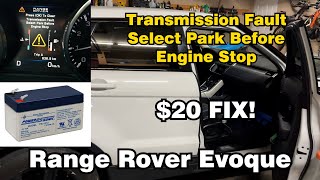
Est. part cost: $20-$200 - Failing Auxiliary Battery ⚪ Low Probability On some Evoque models, a failing auxiliary battery (used for the start/stop system) can cause a variety of seemingly unrelated electronic faults, including 'Gearbox Fault' messages. While not a direct cause of P2545, it can contribute to general module communication issues.
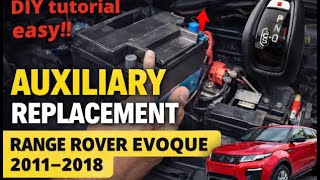
How to confirm: Test the auxiliary battery's voltage and health. It is typically located under the glove compartment. 🎬 Watch: Step-by-step guide to replacing the auxiliary battery. A healthy battery should be over 12.5V; failing batteries have been measured as low as 8-11V.
Typical fix: Replace the small auxiliary battery.
Est. part cost: $50-$100
Rare But Worth Checking
- Failing Transmission Control Module (TCM): → Shop Transmission Assembly This should only be considered after a software update has been performed and all wiring has been confirmed to be in good condition. A module failure is rare compared to a software glitch. TSB SSM72946 explicitly states that TCMs were being replaced when no fault was found.
- Failing Powertrain Control Module (PCM): → Shop Engine Control Module (ECM) The PCM is the source of the torque request signal. If the TCM and wiring are good, the PCM could be sending a faulty signal, though this is uncommon.
Diagnosis Steps
- Connect a professional diagnostic scanner (ideally Land Rover's SDD or Pathfinder) and check for any other DTCs, especially in the TCM. Address other codes first.
- Visually inspect the transmission for any signs of fluid leaks. Repair as necessary.
- Verify the transmission fluid level is correct. This must be done with the engine running, vehicle level, and fluid temperature between 30°C and 50°C.
- Using a Land Rover-approved diagnostic tool, check if a TCM software update is available. The TSB directs technicians to update the software if an update is available.
- If an update is available, connect a battery power supply and perform the TCM software update.
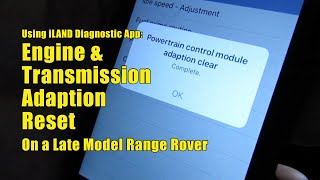
- Clear all DTCs and perform a test drive to see if the code returns. 🎬 Learn how to perform a transmission adaptation reset.
- If the code returns, inspect the wiring harness and connectors between the PCM and TCM for damage, corrosion, or loose pins.
- If wiring is confirmed good and the software is up to date, further diagnostics on the TCM and PCM hardware may be required. TSB SSM73291 advises raising a technical assistance request with Land Rover at this point.
Parts You'll Likely Need
- Transmission Control Module (TCM) Software Update — This is not a physical part, but a service. It is the most common and manufacturer-recommended first step to fix this code. Dealer labor rates for this service can range from $150 to over $350.
OEM price range: $150-$350
Aftermarket price range: N/A - Automatic Transmission Fluid
(OEM #LR065143 (for AW-1 spec, verify correct fluid for 9-speed))— The fluid level must be correct. If a leak is found or the level is low, a top-off or fluid change will be necessary. The ZF 9HP48 transmission requires a specific fluid, often ZF Lifeguard 9.
Trusted brands: ZF Lifeguard 9, OEM Land Rover Fluid
OEM price range: $40-$60 per liter
Aftermarket price range: $30-$50 per liter
Related Codes That Often Appear With This One
- P2546 — Land Rover TSB SSM73291 explicitly mentions that P2545-86 and P2546-86 often appear together, as they relate to the same system and type of fault.
Technical Service Bulletins (TSBs) & Recalls
- SSM73291 - L550 & L538 9HP48 9-speed with P2545-86 and/or P2546-86 DTC`s stored. This TSB is the primary source, instructing technicians to check fluid levels and update the TCM software as the main course of action.
- SSM72946 - An earlier version of the bulletin which also highlights the issue and notes that TCMs were being replaced unnecessarily.
- SSM73594 - This TSB documents the exact same P2545-86 issue and fix on the Jaguar E-Pace, which uses the same 9HP48 transmission, confirming the fix across JLR platforms.
Platform-Specific Known Issues
- The ZF 9HP48 transmission used in this vehicle was subject to numerous software revisions to improve shift quality and resolve communication errors like P2545.
- Early versions of the software were particularly prone to harsh shifting, hesitation, and setting communication faults.
- A gearbox adaptation reset may also be recommended after a software update or fluid service to help the transmission relearn shift points.
Mechanic-Grade Diagnostic Values
- Transmission Fluid Temperature for Level Check — expected: Between 30°C and 50°C (86°F and 122°F). Failure: Checking the level outside this temperature range will result in an incorrect fluid level, which can cause shifting problems.
- Auxiliary Battery Voltage (Key-On, Engine-Off) — expected: ~12.5V or higher. Failure: A reading below 12V, particularly in the 8V-11V range, indicates a failing battery that can cause various electronic faults.
Hidden / Shadow Codes Worth Checking
- P2545-86: This is the manufacturer-specific version of the code, where the '-86' suffix indicates 'Signal Invalid'. This is more precise than the generic 'Range/Performance' definition and is the exact code cited in Land Rover's Technical Service Bulletins for this issue. (see via A Land Rover-specific diagnostic tool like SDD (Symptom Driven Diagnostics) or Pathfinder is required to see the two-digit suffix.)
Scan Tool Commands That Help
- JLR SDD / Pathfinder: Update the TCM software — This is the primary repair step recommended by Land Rover TSBs SSM73291 and SSM72946 after verifying the fluid level is correct.
- JLR SDD / Pathfinder / Advanced Aftermarket (e.g., iCarsoft LR V4.0): Transmission Adaptation Reset / Adaption Clear — After a software update, fluid change, or if harsh shifting persists. This clears the TCM's learned shift patterns, forcing it to relearn. A specific re-learn drive cycle (gentle acceleration and coasting) must be performed immediately after for the procedure to be effective.
- JLR SDD / Pathfinder: Configure new modules – Transmission control module — This function is used only when the physical TCM has been replaced with a new unit to integrate it with the vehicle.
Wiring & Ground Locations
- Auxiliary Battery — Inside the passenger compartment, located under/behind the glove box, often behind a removable panel.. A failing auxiliary battery can cause low voltage and communication errors across modules, leading to a 'Gearbox Fault' message and potentially related DTCs like P2545.
- G1D108 — Primary ground point located near the main battery in the engine compartment.. A poor main ground connection for the engine compartment can affect the PCM and other critical modules, potentially causing communication signal errors.
- G1D130A — Ground point located at the left front of the engine compartment.. This ground serves various components in the engine bay. Corrosion or looseness could interfere with sensor or module signals related to the powertrain.
Real Owner Repair Stories
- YouTube user Martin Perrett (Range Rover Evoque (year not specified, but L538 generation)) — Intermittent 'Gearbox Fault' message on the instrument cluster.
❌ Tried (didn't work) Restarting the car would temporarily clear the fault.
✅ What actually fixed it Replacing the small auxiliary battery located under the glove compartment. The user also noted that intermittent blue screens on the camera system were also resolved by this fix. - YouTube user 'o1Tox' (2015 Range Rover Evoque) — 'Gearbox Fault' message on the dashboard, vehicle would not shift into gear.
❌ Tried (didn't work) Initial diagnosis pointed towards the secondary battery based on online research.
✅ What actually fixed it The user replaced the secondary (auxiliary) battery. They noted the old battery was visibly swollen on the side, confirming it had failed. - Reddit user on r/RangeRover (2016 Range Rover) — Jerky shifting, especially with low speed limits.
✅ What actually fixed it The user shared a DIY transmission adaptation reset procedure: Ignition on (engine off), press accelerator to the floor for 15 seconds, turn ignition off with pedal still depressed, release pedal, wait 2 minutes, then start and drive. This procedure resets the transmission's learned values.
"I Checked Everything" — The Actual Cause
- The most common 'missed diagnosis' for this code follows the pattern described in Land Rover's own TSB SSM72946. Technicians were replacing the entire Transmission Control Module (TCM) and warranty returns showed the modules had 'no fault found'. The actual root cause in many of these cases was simply that the TCM's software was out of date and required a reflash, not a hardware replacement.
Model Year Variations Within This Range
- 2014-2017 vs 2018+: The diagnostic software used by dealers for software updates and advanced diagnostics changed. Earlier models in this range use SDD (Symptom Driven Diagnostics), while later models (approx. 2017/2018 onwards) require the newer Pathfinder software. While the fault and fix are the same, the tool and procedure to apply the fix vary.
Helpful Videos
We Have This Part in Stock



The information in this article is provided for general reference and educational purposes only. Vehicle specifications, procedures, and part compatibility can vary by production date, trim level, and region. Always consult your vehicle's factory service manual and verify part numbers before purchasing or performing repairs. Safety-critical components such as airbags, seat belts, and braking systems should be installed by a qualified professional.
- Land Rover RANGE ROVER EVOQUE:
- 🧭 Diagnostic Flowchart
- 🎬 Helpful Videos
- 🛍️ Shop This Part
- What's Unique About the 2014-2018 Land Rover RANGE ROVER EVOQUE
- Symptoms You May Notice
- Most Likely Causes
- Rare But Worth Checking
- Diagnosis Steps
- Parts You'll Likely Need
- Related Codes That Often Appear With This One
- Technical Service Bulletins (TSBs) & Recalls
- Platform-Specific Known Issues
- Mechanic-Grade Diagnostic Values
- Hidden / Shadow Codes Worth Checking
- Scan Tool Commands That Help
- Wiring & Ground Locations
- Real Owner Repair Stories
- "I Checked Everything" — The Actual Cause
- Model Year Variations Within This Range
- 🎟️ Get 5% Off