

P2583 on 2017-2023 Mercedes-Benz E-Class: Front Radar Sensor Fault Causes and Fixes
This code means the front radar sensor for your adaptive cruise control (Distronic) and Active Brake Assist has a fault. The most common cause is a dirty sensor in the front grille; cleaning it often fixes the issue. If not, the sensor may need professional recalibration or replacement.
- P2583 disables your adaptive cruise control and active emergency braking systems.
- Always start by thoroughly cleaning the radar sensor located in the front grille, as this is the most common and cheapest fix.
- Any repair beyond cleaning, such as replacement or alignment after a minor impact, requires expensive professional calibration to ensure safety systems work correctly.
- Check for open recalls, as a software update (Recall #2019080008) was issued for this system on some E-Class models.
What's Unique About the 2017-2023 Mercedes-Benz E-Class
On modern Mercedes-Benz vehicles like the W213 E-Class, this code is tied directly to critical safety systems. Unlike simple engine codes, P2583 disables Active Brake Assist, a key collision prevention feature. Diagnosis and repair, particularly sensor replacement or alignment, are complex and require the proprietary Mercedes-Benz Xentry diagnostic tool for calibration, making most fixes beyond a simple cleaning unsuitable for DIY. Replacement also requires online SCN (Software Calibration Number) coding, a dealer-level function.
Symptoms You May Notice
- Adaptive cruise control (Distronic) is inoperative or will not engage.
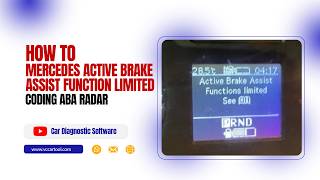
- A warning message on the dashboard, such as 'Active Brake Assist Functions Limited'.
- The check engine light may be illuminated.
- Other driver-assist system warning lights may be on, such as for PRE-SAFE functions.
- Replacing the radar sensor without attempting to clean it first.
- Replacing the sensor when the actual issue is a damaged mounting bracket or misalignment that requires calibration.
Most Likely Causes
- Obstructed or Dirty Radar Sensor 🔴 High Probability The sensor is located in the front grille, making it susceptible to being blocked by dirt, snow, ice, or road debris.
How to confirm: Visually inspect the front grille, typically the large star emblem or the area immediately around it. The sensor surface may be visibly dirty.
Typical fix: Thoroughly clean the sensor surface with a soft cloth and a gentle cleaner. Clear the code and test drive to see if the fault returns.
Est. part cost: $0 - Radar Sensor Misalignment or Dislodged Bracket 🟡 Medium Probability A minor front-end impact from a parking bump or road debris can knock the sensor out of its precise alignment or even pop it loose from its mounting clips.
How to confirm: After gaining access behind the grille, check if the sensor unit is loose or has play in its mounting bracket. A professional diagnosis with an alignment tool is needed to confirm misalignment. The alignment values in Xentry must be between -3 and +3 degrees to pass.
Typical fix: If dislodged, the sensor may simply need to be clicked back into its bracket. If misaligned, it requires professional recalibration using specialized equipment. A dealership calibration can cost several hundred dollars alone.
Est. part cost: $0 if simply reseating, but calibration costs are labor. - Failed Front Radar Sensor ⚪ Low Probability → Shop Collision Avoidance Sensor Electronic components can fail over time due to heat, vibration, or internal defects. Water intrusion during heavy rain has also been cited as a cause of failure.
How to confirm: This is diagnosed by exclusion. If the sensor is clean, properly mounted, has good power and ground, and still sets the code, the sensor itself is likely faulty. This requires a diagnostic scan tool.
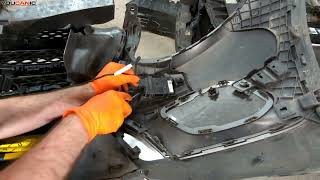
Typical fix: Replace the front radar sensor and perform a mandatory calibration and SCN coding. 🎬 See this DIY walkthrough for replacing the front radar sensor. One owner on MBWorld reported a dealer quote of over $4,100 AUD for the part plus $850 AUD for labor and calibration.
Est. part cost: $800-$1500 - Wiring or Connector Issue ⚪ Low Probability The sensor's location in the front of the vehicle exposes its wiring and connector to potential damage from road debris and moisture.
How to confirm: Inspect the sensor's electrical connector and harness for corrosion, bent pins, water ingress, or physical damage. A multimeter can be used to check for power and ground at the connector.
Typical fix: Repair the damaged wiring or clean/replace the connector.
Est. part cost: $20-$200
Rare But Worth Checking
- Control Unit Software Fault: A recall (MBUSA #2019080008, NHTSA 19V-540) was issued for some 2019-2020 E-Class models for a software error that could impair Active Brake Assist. The fix is a free software update performed by the dealer, which takes about 30 minutes. It is crucial to check if your vehicle's VIN was affected and if the recall work was performed.
Diagnosis Steps
- Read the fault codes with a Mercedes-Benz compatible OBD-II scanner to confirm P2583 is present and to check for any other related ADAS codes.
- Visually inspect the front radar sensor, located in the front grille, for any dirt, snow, ice, or physical damage.
- Thoroughly clean the sensor surface with a soft cloth and appropriate cleaner, even if it appears clean.
- Clear the fault codes and perform a test drive to see if the code and symptoms return.
- If the code returns, inspect the sensor's mounting bracket for looseness or damage. Ensure it is securely clipped in place.
- If the sensor is secure and clean, the vehicle must be taken to a qualified shop. They will use an OEM-level scan tool to check live data, test the wiring, and determine if the sensor is misaligned, requires calibration, or has failed.
Parts You'll Likely Need
- Front Distance Range Radar Sensor
(OEM #A0009055103)— If the sensor is clean and properly mounted but the code persists, the sensor itself has likely failed internally. This part number is widely referenced for this function across multiple Mercedes platforms of the era.
Trusted brands: Bosch, Continental, Mercedes-Benz Genuine
OEM price range: $1000-$1500
Aftermarket price range: $700-$1200
Platform-Specific Known Issues
- Recall 2019080008: Mercedes-Benz recalled certain E-Class models to update the radar sensor control unit software to prevent impairment of the Active Brake Assist function.
Mechanic-Grade Diagnostic Values
- Radar Sensor Alignment Angle — expected: -3.0 to +3.0 degrees (horizontal and vertical). Failure: A value outside of this range will prevent successful calibration and set a fault.
- Sensor CAN Bus Resistance — expected: Approximately 180 ohms when measuring across the two CAN lines at the control module connector (with two sensors in parallel).. Failure: An open circuit (infinite resistance) or a short (near zero ohms) indicates a wiring or sensor fault.
Hidden / Shadow Codes Worth Checking
- C163600: This event code indicates a 'Sensor CAN bus OFF fault', signifying a communication failure on the dedicated network the front radar sensor uses. It often appears alongside P2583. (see via A professional or dealer-level scan tool like Mercedes Xentry is required, as this code may not be visible on standard OBD-II readers.)
- B220600: This fault means 'The current vehicle identification number is incorrect or not present'. It will be stored if a used radar sensor is installed without being properly coded to the new vehicle's VIN. (see via Visible in Mercedes Xentry. Requires engineering software like DTS Monaco to correct by writing the correct VIN to the used module.)
Scan Tool Commands That Help
- Mercedes Xentry / DAS: Initial Startup — This procedure is mandatory after installing a new radar sensor. It installs the latest firmware and configures the sensor for the specific vehicle. It requires an online connection to Mercedes servers for SCN (Software Calibration Number) coding.
- Mercedes Xentry / DAS: Calibration by means of test drive — Used to correct sensor misalignment after a minor impact, bumper removal, or if the sensor has lost its calibration. The tool puts the system into a learning mode, and the technician must perform a specific drive cycle, often on a straight road, for the sensor to adjust its angles.
- DTS Monaco: Variant Coding / VIN Writing — This is an advanced, non-dealer function used to program a *used* radar sensor. If a sensor from a donor car is installed, it will contain the old VIN and set a B220600 fault. DTS Monaco can be used to write the correct vehicle VIN to the used module, allowing it to be accepted by the car before performing calibration.
Wiring & Ground Locations
- Heater Booster Ground (Point 4) — Located in the passenger footwell area. This is a common and accessible grounding point for electronics in the front of the cabin.. While the sensor itself is grounded near the front of the chassis, a poor ground at the main control unit (often located inside the cabin) can cause communication faults. This accessible point can be used for testing the ground circuit integrity of the ADAS control module.
- Front Radar Sensor Connector (A90) — Directly on the back of the radar sensor unit, which is mounted behind the front grille star emblem.. This is the primary point for checking power (12V), ground (typically a brown wire on Mercedes), and CAN bus signals (often a twisted pair of wires, e.g., violet and violet/white) directly at the sensor to rule out wiring harness damage.
Real Owner Repair Stories
- MHH Auto Forum User (2018 E220d (W213)) — Blind spot assist and other radar functions inoperative after an accident and repair.
❌ Tried (didn't work) Installing a used radar sensor with the same part number., Checking the sensor mounting bracket., Swapping the problematic sensor to the other side of the car (the fault followed the sensor).
✅ What actually fixed it The used sensor had been matched to the car's VIN using a tool (Autologic), which cleared a VIN mismatch fault. However, it still would not calibrate and threw a C110178 'adjustment is incorrect' fault. The final conclusion was that the 'new used' sensor itself was internally faulty, despite having the correct part number and being VIN-matched. The fix required sourcing another, functional used sensor.
OEM Part Supersession History
A0009003212, A0009006314, A0009008209, A0009009217→A0009007913— Part evolution and firmware updates for improved performance and reliability.
Heads up: While later part numbers supersede earlier ones, installing a used part from another vehicle, even with a compatible number, requires VIN coding and calibration to function. A part must be checked for current flashware after installation.
Model Year Variations Within This Range
- 2021-2023 (Facelift): The facelift (W213) models may use different radar sensor part numbers (e.g., A0009003212 is cited for a 2021 model) compared to the pre-facelift A0009055103. While functionally similar, it is critical to match the part number to the vehicle's specific VIN and equipment list, as sensors are not universally interchangeable.
Diagnostic Flowchart
Other Known Issues on This Vehicle
Issues unrelated to this code that are worth knowing about as an owner of this generation:
- 48V Mild-Hybrid System Battery Failure 🔴 High → Shop Vehicle Battery — Affects models with EQ Boost (M256 inline-6 and M264 inline-4 engines), particularly from 2019-2022. Failure can occur suddenly, even at low mileage, causing a no-start condition or shutting the vehicle down while driving. (Ref: Multiple service campaigns and TSBs exist, including software updates for the battery control unit (e.g., Campaign #2025070002) and checks for grounding connections. A class-action lawsuit investigation was initiated due to the widespread nature of the problem.)
- Airmatic Suspension Faults 🟠 Medium — Common on vehicles equipped with the optional air suspension, typically after 50,000-80,000 miles. Symptoms include one corner of the car sagging overnight, a bumpy ride, or the compressor running constantly. (Ref: No specific recall, but it is a widely documented issue. The most common failures are leaking air struts (rubber bags become porous) or a failed valve block.)
- M274 Engine Piston/Wrist Pin Failure 🔴 High — Primarily affects early 2.0L M274 4-cylinder engines (found in E300 models, approx. 2017-2018). An unfavorable tolerance in the wrist pin can cause a knocking noise and may lead to a cracked piston and catastrophic engine failure. (Ref: TSB LI03.10-P-060916 was issued, identifying the issue and providing a fix (piston replacement). The issue was addressed in engines built after mid-2015, but some later models have still reported failures.)
- Water Pump Failure 🟠 Medium — Can affect both 4-cylinder and 6-cylinder engines. The pump, whether belt-driven or electric, can fail, leading to coolant leaks and engine overheating. Failures can occur as early as 60,000 miles.
- Early Build Electrical Gremlins and Rattles 🟡 Low — More common on 2017-2018 models. Owners report issues like the infotainment screen freezing, non-working LED lights, and various interior rattles.
Used vs. New Parts: Buying Guide for This Vehicle
When a used part is the smart pick: A used radar sensor is a financially viable option only if you have access to advanced diagnostic tools like DTS Monaco or have a specialist independent shop that can perform VIN coding. Without this, the part is unusable as it is VIN-locked to the donor car. Given the high cost of a new OEM sensor, the savings can be substantial if the programming hurdle can be overcome.
Donor-vehicle mileage cap: roughly under 80000 miles for the part to have meaningful remaining life.
What to inspect on the donor part:
- Ensure the part number is an exact match or a confirmed superseded number for your vehicle's VIN.
- Inspect the sensor housing for any cracks, swelling, or signs of water intrusion.
- Check the electrical connector pins for any corrosion or damage.
- Buy from a reputable seller who guarantees the part is functional and not from a heavily damaged front-end collision.
OEM-only on this vehicle (don't cheap out):
- Front Distance Range Radar Sensor
Aftermarket brands forum-validated for this vehicle:
- There are no known-good new aftermarket alternatives. The OEM suppliers are Continental and Bosch. A used OEM part is the only alternative to a new one.
Brands owners have reported issues with on this vehicle:
- Avoid any unbranded, no-name sensors. These are complex electronic components and non-OEM versions are not available and would not integrate with the vehicle's safety systems.
Real Owner Stories
Aggregated from forums and TSBs cited above. Mileages and costs reflect what owners reported in those sources.
2017 Mercedes-Benz E-Class (W213)
Symptoms: Front radar sensor failure occurred during heavy rain.
What fixed it: Replacement of the radar sensor, fitting, and recalibration by the dealer.
Cost: $3,800-$4,000
Source hint: MBWorld.org Forums - Thread: 'Radar Sensor'
2016/2017 Mercedes-Benz E-Class (W213)
Symptoms: Multiple electrical gremlins and quality issues including brake judder and interior rattles.
What fixed it: Documented as part of early-build quality complaints; required multiple dealer visits for electrical troubleshooting.
Source hint: MBWorld.org Forums - Thread: 'W213 E Class problems'
Related OBD-II Codes
Frequently Asked Questions
Is there a recall for the radar sensor issues on my E-Class?
My dashboard says 'Active Brake Assist Functions Limited' and Distronic won't work. What is the first thing I should check?
Can I use a used radar sensor from another W213 E-Class to fix P2583?
What are the alignment specifications for the radar sensor if it gets knocked loose?
Does heavy rain affect the radar sensor on the 2017-2023 E-Class?
I have an E300 with a knocking noise; is that related to the P2583 code?
Helpful Videos

The information in this article is provided for general reference and educational purposes only. Vehicle specifications, procedures, and part compatibility can vary by production date, trim level, and region. Always consult your vehicle's factory service manual and verify part numbers before purchasing or performing repairs. Safety-critical components such as airbags, seat belts, and braking systems should be installed by a qualified professional.
- Mercedes-Benz E-Class:
- 🧭 Diagnostic Flowchart
- 🎬 Helpful Videos
- What's Unique About the 2017-2023 Mercedes-Benz E-Class
- Symptoms You May Notice
- Most Likely Causes
- Rare But Worth Checking
- Diagnosis Steps
- Parts You'll Likely Need
- Platform-Specific Known Issues
- Mechanic-Grade Diagnostic Values
- Hidden / Shadow Codes Worth Checking
- Scan Tool Commands That Help
- Wiring & Ground Locations
- Real Owner Repair Stories
- OEM Part Supersession History
- Model Year Variations Within This Range
- Other Known Issues on This Vehicle
- Used vs. New Parts: Buying Guide for This Vehicle
- Real Owner Stories
- 2017 Mercedes-Benz E-Class (W213)
- 2016/2017 Mercedes-Benz E-Class (W213)
- Related OBD-II Codes
- Frequently Asked Questions
- 🎟️ Get 5% Off