

P2583 on 2015-2024 Porsche Macan: ACC/PAS Front Radar Sensor Fault Guide
This code likely points to a fault with the Adaptive Cruise Control (ACC) front radar sensor. The most common cause is a dirty or obstructed sensor on the front bumper. If cleaning doesn't work, it could be a low battery causing electrical gremlins or a misaligned sensor needing professional calibration. A specific P-code is rare; owners usually see an 'ACC/PAS not available' message.
- The warning you'll likely see on the dash is 'ACC/PAS not available', not a check engine light.
- Before doing anything else, thoroughly clean the front radar sensor area on the bumper grille.
- Check your battery's health; low voltage is a very common trigger for this fault on Porsches.
- Any work involving wheel alignment or minor front-end impacts may require an expensive ADAS recalibration at a dealership.
What's Unique About the 2015-2024 Porsche Macan
While the P2583 code is heavily associated with Honda vehicles, the underlying system it represents—a front-facing radar for adaptive cruise control—is present on optionally-equipped Porsche Macans. 🎬 See how the adaptive cruise control system is retrofitted. Macan owners more frequently report seeing dashboard messages like 'ACC/PAS not available' rather than a specific P-code. These warnings are notoriously sensitive and can be triggered by non-critical issues like low battery voltage after the car has been sitting, or by a dirty sensor. The system's complexity means that even a wheel alignment can necessitate a costly sensor recalibration.
Symptoms You May Notice
- "ACC/PAS not available" message on the multi-function display.
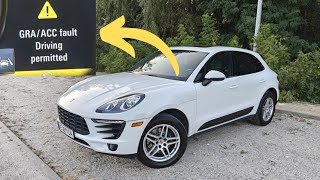
- "GRA/ACC Fault" warning on the instrument clu 🎬 Watch: See what this specific dashboard warning looks like.ster.
- "ACC/PAS unavailable, service required" message.
- Adaptive Cruise Control cannot be activated or deactivates unexpectedly.
- Porsche Active Safe (forward collision warning and braking) is disabled.
- In some cases, other seemingly unrelated warning lights may appear (e.g., 'Engine control fault'), often triggered by an underlying low battery voltage.
- Replacing the radar sensor when it only needs cleaning or recalibration. Always start with the simplest fix.
- Assuming the radar sensor is the only cause, when a faulty windshield camera or even a bad wheel speed sensor could be contributing to the fault message on some platforms.
Most Likely Causes
- Dirty or Obstructed Radar Sensor 🔴 High Probability The sensor is located in the front bumper grille, making it susceptible to dirt, bugs, snow, and ice. Heavy rain can also temporarily trigger the fault.
How to confirm: Visually inspect the radar sensor 'eye' in the center of the lower front bumper grille. If it is covered in dirt, snow, or ice, this is the likely cause.
Typical fix: Gently clean the sensor area with a soft microfiber cloth and car wash soap. For ice, allow the vehicle to warm up. After cleaning, restart the car; the warning may clear on its own after a short drive.
Est. part cost: $0 - Low Battery Voltage or Weak Battery 🟡 Medium Probability → Shop Vehicle Battery Porsches have complex electrical systems that are sensitive to voltage drops. If the car sits for extended periods, the battery can discharge enough to cause random electronic faults on startup. One owner reported a fault caused by a voltage drop during engine cranking.
How to confirm: The issue often occurs after the vehicle has been parked for several days and may be accompanied by other random warning lights. Test the battery voltage with a multimeter; a reading below 12.2V at rest indicates a discharged or failing battery. The fault may appear and then disappear after the car has been driven and the battery has recharged.
Typical fix: Use a battery conditioner (like a CTEK charger) to fully charge the battery. If the battery is old (4+ years) and fails a load test, it should be replaced and registered to the vehicle using a compatible scan tool.
Est. part cost: $0-$400 - Radar Sensor Misalignment ⚪ Low Probability A minor front-end impact, such as bumping a curb, hitting a large pothole, or even a standard wheel alignment can knock the sensor's precise alignment out of specification.
How to confirm: This can only be confirmed with a diagnostic scan tool (like PIWIS) at a dealership or qualified independent shop. The scan tool will show a fault for sensor misalignment. On some VAG vehicles, a misalignment of even 1 degree can cause a fault.
Typical fix: The radar sensor must be recalibrated using specialized ADAS alignment tools and software. This is not a DIY job. Costs can range from $300 to over $800 depending on the dealer and what other services are performed.
Est. part cost: $0 (for labor only)
Rare But Worth Checking
- Faulty Radar Sensor or Damaged Wiring: Physical damage from road debris or a front-end collision can damage the sensor or its wiring harness. This is less common than obstruction or alignment issues but results in a permanent fault that will not clear. A French forum user noted a dealer immediately suggested a €1000+ sensor replacement.
- Water Ingress in Battery Compartment: → Shop Vehicle Battery One forum user on PCGB reported that a clogged sunroof drain led to water filling the battery compartment, causing corrosion on the battery terminals and widespread electrical issues, including the ACC fault.
- Faulty Windshield Camera Module: → Shop Windshield The ACC/PAS system uses both the front radar and a camera mounted behind the rearview mirror. On related VAG platforms, a known failure is a chip on the camera's circuit board desoldering itself, causing a 'No Sensor View' or 'Missing Video Data' fault (C1107, C1108). This can sometimes be repaired by reflowing the solder with a heat gun.
Diagnosis Steps
- Check for Dashboard Warnings: Note the exact message displayed (e.g., 'ACC/PAS not available').
- Clean the Front Radar Sensor: Thoroughly inspect and clean the round sensor located in the center of the lower front bumper. Ensure it is free of dirt, snow, ice, or obstructions.
- Clean the Windshield Camera Area: Clean the inside and outside of the windshield in front of the rearview mirror assembly where the forward-facing camera is located.
- Restart the Vehicle: After cleaning, turn the car off, lock it, wait a few minutes, and then restart it to see if the warning resets. Some systems require a short drive over 30 mph to self-clear.
- Check Battery Health: If the car has been sitting or the battery is over 4 years old, check the battery voltage. A reading below 12.2V is a red flag. Connect a battery tender if the vehicle is not driven daily.
- Scan for Fault Codes: Use a Porsche-compatible OBD-II scanner (like a PIWIS, Autel, or Launch scanner) to read the fault codes from the specific ACC/ADAS module (Address 13 on many VAG cars). A generic scanner may not be able to communicate with this module.
- Inspect for Damage: Visually inspect the front bumper and the sensor area for any signs of physical damage or misalignment.
- Professional Calibration: If a misalignment code is present, or if you've had a wheel alignment or minor front-end work done, the vehicle must be taken to a dealership or a qualified shop with ADAS calibration equipment to have the sensor re-aimed.
Parts You'll Likely Need
- Adaptive Cruise Control Radar Sensor
(OEM #95B.907.567.H (2019+), 95B.907.567.B (2015-2018))— This is only needed if the sensor has failed internally due to physical or electrical damage, which is rare. Most faults are due to obstruction or misalignment. Note that part numbers are superseded over time.
Trusted brands: Bosch, Porsche (OEM)
OEM price range: $1500-$2200 - AGM Battery — A weak battery is a common cause of various electronic faults on the Macan. If the current battery fails a load test, replacement is necessary to ensure system stability.
Trusted brands: Varta, Interstate, Bosch
OEM price range: $400-$600
Aftermarket price range: $250-$400
Related Codes That Often Appear With This One
- C1107 - Video Cable for Image Processing Signal Failure
- C1108 - Function Limitation due to Missing Video Data
Platform-Specific Known Issues
- Macan electronics are highly sensitive to battery voltage. A slightly discharged battery is a primary cause of intermittent and seemingly random warning lights, including for the ACC/PAS system.
- The ACC system is known to occasionally perform 'phantom braking' events, where it brakes for no apparent reason. This is a known quirk of the system.
- Recalibration of the ACC sensor is often required after a standard four-wheel alignment, significantly increasing the service cost.
Mechanic-Grade Diagnostic Values
- Vehicle Voltage During Control Unit Programming — expected: 13.5V - 14.5V. Failure: Voltage outside this range can cause programming to fail or damage the control unit.
- ACC Radar Sensor Calibration Input Values — expected: Measurements from the ground to the fender height at each wheel, entered in mm.. Failure: Incorrect measurements will lead to a failed calibration and continued ACC faults.
Scan Tool Commands That Help
- PIWIS: Control unit programming and coding (campaign) — Used to update control unit software, which can resolve software-based glitches causing ACC faults. This is often done as part of a service campaign.
- PIWIS: Maintenance of vehicle data / PR numbers — When retrofitting or replacing a major component like the ACC module, the vehicle's option code (PR number) must be changed from the standard cruise control (8T1) to ACC (8T3). This requires an enabling code and tells the car to recognize the new hardware.
- PIWIS, Autel, Launch X431: Height sensor calibration — If the vehicle has air suspension, the ride height calibration must be correct before attempting an ACC radar calibration, as the vehicle's rake angle is a critical input for the radar's alignment. This function is found under the 'Level Control/PASM' menu.
- PIWIS: Read / delete all fault memories — After performing software updates or repairs, this function is used to clear stored fault codes from all modules. Some codes may require a test drive to fully clear.
Wiring & Ground Locations
- ACC Sensor Power/Ground/CAN — The harness runs from the front sensor, through a grommet behind the inner fender liner, to the passenger side fuse panel and A-pillar area.. Retrofit guides show that power and ground are tapped at the passenger side fuse box. Communication lines (CAN bus) are routed up the passenger A-pillar, across the headliner, and tapped into an existing CAN bus line in the driver's side A-pillar. A fault could be caused by a bad connection at any of these points.
- Main Ground Point — On the driver's side firewall, there is a large silver post under the access panel used for jump-starting; this is a primary chassis ground point.. A poor main ground connection can cause a multitude of seemingly unrelated electronic faults, including ACC/PAS errors due to unstable voltage supplied to the control modules.
- Overhead Console Connector (Blue) — In the overhead console, the blue connector provides power to the rearview mirror assembly, which often includes the forward-facing camera.. This is a common tap-in point for radar detectors. Improperly tapping into these wires could disrupt power or communication to the forward camera, which works in conjunction with the ACC radar, potentially causing a system fault.
Real Owner Repair Stories
- Macan Forum user (2017 Macan GTS) — A cascade of warning lights including "ACC/PAS unavailable service required", "Start/stop operation deactivated", "Transmission Failure - Park vehicle safely", and "AWD fault, only rear-wheel drive".
❌ Tried (didn't work) Replacing the battery.
✅ What actually fixed it The dealer (Porsche Montélimar) diagnosed the problem as a faulty rear right ABS (wheel speed) sensor. They advised that all four sensors should be changed as a set to resolve the issue completely. - Macan Forum user 'wizbang' (2019 Macan S with 3,000 miles) — Constant messages: "ACC/PAS unavailable. Sensor dirty", "PAS currently restricted. Sensor dirty", and "Acc/Cruise control not possible. Move gear selector to D/M".
❌ Tried (didn't work) Repeatedly cleaning the sensor.
✅ What actually fixed it The Porsche dealer diagnosed the issue for two hours and determined the front radar sensor itself had failed. The final fix was replacing the ACC sensor module under warranty. - PCGB Forum user 'Marksgd' (2016 Macan) — Initial "ACC/PAS unavailable service required" message, which then escalated to include an "engine control fault" message, and the turn signals and high beams stopped working.
❌ Tried (didn't work) Dealer initially found no fault codes and only charged the battery, but the problem returned.
✅ What actually fixed it The root cause was a clogged sunroof drain which allowed water to fill the battery compartment. This caused corrosion on the battery terminals, leading to the widespread, intermittent electrical failures. The ultimate fix involved clearing the drain, cleaning the terminals, and properly securing the battery.
OEM Part Supersession History
95B.907.567.B→95B.907.567.H and other revisions— Part updates and revisions for facelift models.
Heads up: The sensor for the 2015-2018 (95B.1) models is different from the 2019+ (95B.2) models. They are not interchangeable. Always confirm the correct part number for the specific vehicle VIN.
Model Year Variations Within This Range
- 2019+: The ACC system was enhanced with a Traffic Jam Assist function, which adds steering assistance at speeds up to 60 km/h, using improved radar and video sensors. This corresponds with the change in the radar sensor part number from 95B.907.567.B to 95B.907.567.H.
- 2022+: The control stalk for the ACC was changed for the 2022 model year facelift. A video guide for a 2025 model shows the controls are the same from 2022 onward, but different from earlier models.
Diagnostic Flowchart
Other Known Issues on This Vehicle
Issues unrelated to this code that are worth knowing about as an owner of this generation:
- Transfer Case Failure 🔴 High — Very common on 2015-2018 models. Symptoms include shuddering or jerking at low speeds, especially during tight turns. Less common on 2019+ models but still reported. (Ref: Porsche issued a 7-year extended warranty and TSB #2222 for this issue.)
- Timing Cover Oil Leak 🔴 High — Common on V6 models (S, GTS, Turbo) from 2015-2018. Caused by aluminum bolts on the timing chain cover stretching and breaking. (Ref: Porsche issued TSB 1902 (NHTSA ID 10168341) and later released a new repair procedure using steel bolts that does not require engine removal, reducing labor costs from ~40 hours to a few hours.)
- PDK Transmission Faults 🟠 Medium — Not widespread, but failures can occur, often in the electronically controlled clutch section (mechatronics unit). Symptoms can include rough shifting or complete failure to engage gears. Repairs are very expensive.
- High Oil Consumption 🟠 Medium — Reported in some early V6 engines and later 2.0L base models. Can consume a quart of oil in as little as 1,000 miles. In severe cases, engines were replaced under warranty.
- Infotainment (PCM) System Glitches 🟡 Low — Fairly common across all years, especially earlier models. Symptoms include the system freezing, rebooting, or being slow to respond.
Used vs. New Parts: Buying Guide for This Vehicle
When a used part is the smart pick: A used ACC radar sensor can be a cost-effective choice, saving thousands compared to a new OEM part, as demonstrated by retrofitters who have sourced them from eBay for around $500 AUD instead of $6500 AUD new. However, this path is only for advanced DIYers or shops with extensive Porsche electronic experience.
Donor-vehicle mileage cap: roughly under 100000 miles for the part to have meaningful remaining life.
What to inspect on the donor part:
- Ensure the sensor comes with the mounting bracket attached. The bracket is often not sold separately by Porsche.
- Visually inspect the lens for deep scratches, cracks, or signs of delamination.
- Check the electrical connector pins for any signs of corrosion, water damage, or being bent.
- Buy from a reputable seller who guarantees the part is functional and not from a major front-end collision.
OEM-only on this vehicle (don't cheap out):
- Adaptive Cruise Control Radar Sensor. While a used OEM part is viable, aftermarket versions are non-existent or untrustworthy. The sensor requires precise calibration and communication with other vehicle systems that aftermarket suppliers cannot replicate.
Brands owners have reported issues with on this vehicle:
- Any non-OEM or 'plug-and-play' kit from unknown brands. These often fail to integrate with the vehicle's complex CAN bus and safety systems, and cannot be properly calibrated.
Real Owner Stories
Aggregated from forums and TSBs cited above. Mileages and costs reflect what owners reported in those sources.
Porsche Macan (Year/Engine not specified)
Symptoms: The owner received an 'ACC/PAS unavailable' message which was eventually traced back to a low battery condition.
What fixed it: The root cause was clogged sunroof drains that filled the battery compartment with water, causing corrosion; clearing the drains and addressing the battery issues resolved the electrical faults.
Source hint: pcgb.com: Forum user 'Marksgd' detailed a saga where an initial 'ACC/PAS unavailable' message was traced back to a low battery
2015-2018 Porsche Macan V6
Symptoms: Owner experienced a voltage drop during engine cranking which triggered a random electronic fault for the ACC system.
What fixed it: Recharging the battery or replacing an old battery (4+ years) and registering it to the vehicle.
Source hint: Article Context: common_causes and forum_citations (macanforum.com)
Related OBD-II Codes
Frequently Asked Questions
My Macan is displaying 'ACC/PAS not available' after a heavy snowstorm. Is the sensor broken?
Can a weak battery really cause an ACC/PAS fault on a Porsche Macan?
I just had a four-wheel alignment done and now my ACC is disabled. Are they related?
Is there a TSB for the 'ACC/PAS unavailable' message related to water damage?
Can I use a generic OBD-II scanner to diagnose P2583 on my Macan?
How much does it cost to fix a misaligned radar sensor at the dealership?
Helpful Videos

The information in this article is provided for general reference and educational purposes only. Vehicle specifications, procedures, and part compatibility can vary by production date, trim level, and region. Always consult your vehicle's factory service manual and verify part numbers before purchasing or performing repairs. Safety-critical components such as airbags, seat belts, and braking systems should be installed by a qualified professional.
- Porsche Macan:
- 🧭 Diagnostic Flowchart
- 🎬 Helpful Videos
- What's Unique About the 2015-2024 Porsche Macan
- Symptoms You May Notice
- Most Likely Causes
- Rare But Worth Checking
- Diagnosis Steps
- Parts You'll Likely Need
- Related Codes That Often Appear With This One
- Platform-Specific Known Issues
- Mechanic-Grade Diagnostic Values
- Scan Tool Commands That Help
- Wiring & Ground Locations
- Real Owner Repair Stories
- OEM Part Supersession History
- Model Year Variations Within This Range
- Other Known Issues on This Vehicle
- Used vs. New Parts: Buying Guide for This Vehicle
- Real Owner Stories
- Porsche Macan (Year/Engine not specified)
- 2015-2018 Porsche Macan V6
- Related OBD-II Codes
- Frequently Asked Questions
- 🎟️ Get 5% Off