

P2583 on 2018-2024 Volkswagen Tiguan: Front Assist Sensor Fault Causes and Fixes
This code means there is a fault with the front radar sensor for your Adaptive Cruise Control (ACC) and Front Assist systems. The most common cause is a dirty or obstructed sensor located in the front bumper, often behind the VW emblem; cleaning it may solve the issue. If not, the sensor likely needs professional recalibration, module recoding (especially after a battery change), or in some cases, replacement.
- P2583 on a Tiguan means your Front Assist and Adaptive Cruise Control are disabled due to a radar sensor fault.
- Before going to a shop, always thoroughly clean the front bumper and VW emblem, as a dirty sensor is the most common cause.
- If you recently replaced the battery, the fault may be a software issue that requires a professional to recode a control module.
- Do not attempt to replace the sensor yourself. Any repair or replacement requires a professional ADAS calibration that is not a DIY job.
What's Unique About the 2018-2024 Volkswagen Tiguan
While P2583 is a generic code for a front radar fault, the Tiguan and other modern Volkswagens have a specific vulnerability. The fault can sometimes be triggered after a battery replacement due to a software issue in the CAN Gateway module, which may require recoding rather than replacing any hardware. Unlike some other brands that use detailed suffix codes to specify the fault (e.g., obstruction vs. misalignment), a general P2583 on a VW requires a more thorough diagnosis with a tool like VCDS or ODIS to pinpoint the exact cause, which could range from misalignment to a software glitch. Furthermore, replacing the sensor isn't plug-and-play; it involves removing 'Component Protection,' an anti-theft feature that requires online dealer-level tools (like ODIS with a GeKo account) to authorize the new part to the vehicle.
Symptoms You May Notice
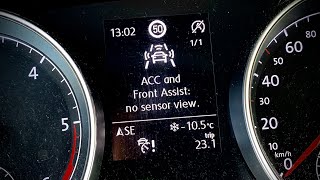
- "Front Assist: No sensor view" or "ACC and Front Assist currently not available" message on the dashboard.
- Illuminated EPC (Electronic Power Control) or Check Engine light.
- Adaptive Cruise Control (ACC) is inoperative or cannot be activated.
- The automatic emergency braking (Front Assist) system is disabled.
- Unwarranted or phantom braking events (in some cases before the system fails completely).
- Replacing the radar sensor when the actual problem is just a misalignment or a software coding issue. Always perform calibration and coding checks before replacing this expensive part.
Most Likely Causes
- Obstructed Radar Sensor 🔴 High Probability The sensor is located in the front bumper area, either in the lower grille or behind the VW emblem, making it susceptible to being blocked by dirt, mud, snow, ice, or even a poorly placed license plate holder.
How to confirm: Visually inspect the front of the vehicle. If the VW emblem or the lower grille area where the sensor is housed is covered in debris, this is the likely cause. The warning message may explicitly say "No sensor v 🎬 Watch: Quick fix for the 'no sensor view' error message.iew".
Typical fix: Thoroughly clean the sensor area with a soft cloth and mild, solvent-free cleaner. For ice, allow the vehicle to warm up to melt it. After cleaning, cycle the ignition off and on; the fault may clear after a short drive.
Est. part cost: $0 - Sensor Misalignment 🟡 Medium Probability Even a minor front-end impact, like a curb strike or parking lot bump, can knock the radar sensor's mounting bracket out of its precise alignment, triggering a fault. Changes in vehicle ride height, such as from using a trailer hitch carrier, can also cause temporary misalignment.
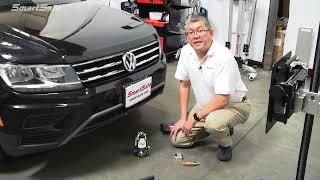
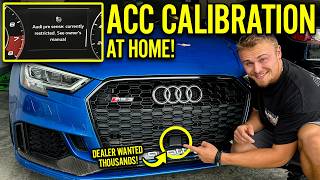
How to confirm: This can only be confirmed by a professional shop using a diagnostic scan tool (like ODIS or VCDS) to check the sensor's reported alignment status in Address 13 (ACC). The acceptable range is typically -0.8° to +0.8°. 🎬 See how to perform a DIY radar alignment for code C1103. A visual inspection may reveal a bent or loose bracket.
Typical fix: The sensor must be recalibrated by a VW dealer or a qualified ADAS service center. This involves setting up specific targets in front of the vehicle and using a diagnostic tool to perform the aiming procedure. This is not a DIY job.
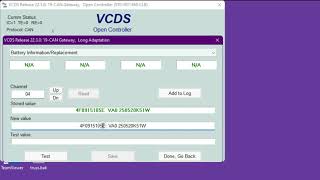
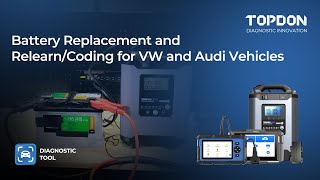
Est. part cost: $0 (Labor cost is significant, typically $300-$600) - CAN Gateway Software Corruption ⚪ Low Probability On 2013-2024 VW models, including the Tiguan, this fault can appear after a battery replacement or a significant voltage drop, causing the CAN Gateway module 🎬 Watch: How to properly code a new battery to avoid errors. to lose its proper coding for the ACC system.
How to confirm: A technician with a VW-specific diagnostic tool (like VCDS or ODIS) would check the coding of the CAN Gateway (Address 19) and the ACC module (Address 13) to see if it is incorrect or lost. The gateway's installation list must have module 13 checked.
Typical fix: The CAN Gateway module needs to be recoded to enable communication with the ACC radar. This is a software fix performed by a professional or an experienced DIYer with the right tools.
Est. part cost: $0 (Labor cost applies) - Damaged Wiring or Connector ⚪ Low Probability The sensor's wiring harness is located in the front bumper, making it vulnerable to damage from road debris, accidents, or corrosion from road salt.
How to confirm: A visual inspection of the sensor's connector and nearby wiring for breaks, corrosion, or loose pins. A multimeter would be used to check for continuity and proper voltage at the connector. Water ingress in the connector is a common failure point. The connector is an 8-pin plug, part number 4F0972708.
Typical fix: Repair the damaged section of the wiring harness or replace the electrical connector. Ensure the connector seal is intact upon reassembly.
Est. part cost: $20-$100
Rare But Worth Checking
- Faulty Radar Sensor: While less common than alignment or obstruction issues, the sensor itself can fail internally. This is typically diagnosed only after all other possibilities (obstruction, alignment, wiring, coding) have been ruled out. Replacement requires mandatory calibration.
- Damaged Mounting Bracket: The plastic bracket that holds the radar sensor can crack or break from a minor impact, preventing the sensor from staying aligned. VW offers repair kits for these brackets.
Diagnosis Steps
- Check for Warnings: Note the exact message displayed on your Tiguan's instrument cluster (e.g., 'Front Assist unavailable', 'No sensor view').
- Clean the Sensor: Thoroughly wash the front bumper, paying special attention to the large VW emblem and/or the lower grille area where the radar sensor is located. Use a soft cloth and avoid solvents.
- Cycle Ignition & Drive: Turn the vehicle completely off, wait a minute, and then restart the engine. A short drive may be required for the system to re-check itself and clear the error if it was a temporary obstruction.
- Professional Scan: If the fault persists, the vehicle must be scanned with a VW-specific tool like VCDS or ODIS. A basic code reader is insufficient. Check for faults in Address 13 (ACC) and Address 19 (CAN Gateway).
- Check for Misalignment: Using the scan tool, access Address 13 (ACC) and check the live data for the sensor's misalignment angle. If it's outside the typical +/- 0.8 degree specification, calibration is needed.
- Check Module Coding: Especially if the battery was recently replaced, verify the coding of the CAN Gateway (Address 19). Ensure that the ACC (Module 13) is enabled in the gateway's installation list.
- Inspect Wiring and Bracket: If coding is correct and alignment fails, visually inspect the sensor's electrical connector for corrosion or damage and the plastic mounting bracket for cracks or looseness.
- Perform Recalibration: If misalignment is the cause, or if the sensor or bumper has been disturbed, a full ADAS recalibration must be performed by a qualified shop.
- Replace Sensor: If the sensor fails to calibrate after confirming its mounting bracket is secure and wiring is intact, the sensor itself is likely faulty and will need to be replaced, followed by a new calibration.
Parts You'll Likely Need
- Front Radar Sensor (ACC Sensor)
(OEM #3QF907561D (or superseding versions like 2Q0907561M). Part number can vary by model year and trim.)— This part is only replaced if it fails internally and cannot be calibrated, or if it sustains physical damage. It is the core component of the system.
Trusted brands: Bosch (OEM supplier), Hella
OEM price range: $800-$1200
Aftermarket price range: $500-$900
Related Codes That Often Appear With This One
- U0235 — This code means 'Lost Communication With Cruise Control Front Distance Range Sensor.' It often appears with P2583 and points towards a wiring, connector, or module coding issue rather than just a simple obstruction.
- C110300 — This is a VW-specific fault code for 'Adaptive cruise control sensor misadjusted'. It directly confirms that the sensor's alignment is out of specification and requires calibration.
Technical Service Bulletins (TSBs) & Recalls
- TSB 45-21-01 (NHTSA ID: 2062957): Addresses customer reports of unwarranted Autonomous Emergency Braking (AEB). It guides technicians to check for sensor misalignment due to damage or vehicle loading (e.g., trailer hitches) and to verify the alignment angle is within specification (-0.8° to +0.8°).
- TSB 48-23-01 (NHTSA ID: 2070207): Pertains to 'Travel Assist currently not available' messages on 2022-2023 models, often caused by a faulty sensor mat in the steering wheel, which is a separate issue but can cause similar driver-assist warnings.
Platform-Specific Known Issues
- A known issue on modern VWs is the ACC/Front Assist system faulting after a battery change. This is often due to the CAN Gateway module losing its configuration and requires recoding with a diagnostic tool, not a part replacement.
- Unwarranted Autonomous Emergency Braking (AEB) has been reported by some owners, which can be related to sensor misalignment or other system faults. VW has issued TSB 45-21-01 (NHTSA ID 2062957) to guide dealers in diagnosing this concern.
Mechanic-Grade Diagnostic Values
- ACC Sensor Misalignment Angle (Horizontal & Vertical) — expected: -0.8° to +0.8°. Failure: A reading outside of this range will set a C110300 fault and disable the system.
Hidden / Shadow Codes Worth Checking
- C110300: VW-specific code for 'Adaptive cruise control sensor misadjusted.' This is the primary code that confirms a physical alignment or calibration issue, rather than just an obstruction. (see via VW-specific scan tools like VCDS or ODIS, by accessing Address 13 (Auto Dist. Reg).)
- P2583 with suffixes (e.g., -54, -76): While less common on VW than on brands like Honda, some advanced scanners may show suffixes. P2583-54 indicates 'Aiming Incomplete' and P2583-76 indicates 'Misalignment'. Their presence strongly points towards a calibration issue. (see via Professional-grade multi-brand scan tools or dealer-level diagnostics (ODIS).)
Scan Tool Commands That Help
- VCDS (Ross-Tech): Security Access 16 -> Login Code '14117' -> Basic Settings -> 'Reset in misalignment angle' — To perform a software reset of the stored misalignment angle if the deviation is minor. This can sometimes clear the fault without requiring a full static calibration, especially if no physical impact occurred.
- ODIS (VW/Audi Dealer Tool): Guided Functions -> Address 0013 (Distance Control) -> 0013 - Calibration — This is the official procedure for performing a static recalibration of the ACC sensor. It requires a physical calibration rig (e.g., VAS 6430) and walks the technician through the entire aiming process.
- ODIS (VW/Audi Dealer Tool): Guided Functions -> Component Protection -> Deactivate — This is a mandatory step after installing a new or used ACC sensor. It requires an online connection with a valid GeKo account to authorize the new module's serial number to the vehicle's immobilizer system.
Wiring & Ground Locations
- 12 — On the left side of the engine compartment, near the strut tower.. This is a primary earth point for the front section of the vehicle. A loose or corroded ground here can cause sporadic and difficult-to-diagnose electrical issues with various front-end modules, including the ACC sensor.
- 4F0972708 / 5QF973707 — The 8-pin electrical connector that plugs into the back of the ACC radar sensor.. This connector is the single point of failure for all power, ground, and CAN bus communication to the sensor. Damage or corrosion on these pins will cause a P2583 or U0235 fault.
Real Owner Repair Stories
- GOLFMK7 forum user @jorohu (2014 VW Golf MK7 (shares MQB platform and systems with Tiguan)) — "ACC Not Available" message on the dash. VCDS showed a misalignment error in Module 13.
❌ Tried (didn't work) Clearing codes normally., Checking live data showed minimal deviation (0.08º and 0.501º) but the error persisted.
✅ What actually fixed it Using VCDS, the user went to Module 13 -> Security Access - 16 -> entered code 14117. This enabled the option in Basic Settings to 'Reset in misalignment angle'. Executing this function cleared the error and restored ACC functionality without a physical recalibration at the dealer.
OEM Part Supersession History
3QF907561D→2Q0907561M, 3QF907561G, and others.— Internal hardware/software revisions for improved performance or component availability.
Heads up: While newer parts often supersede older ones, it is critical to verify compatibility by VIN. Some modules may have different software feature sets (SWaP/FeC) or require specific datasets to be loaded via ODIS. Installing a physically identical but functionally different module can make it impossible to code and calibrate.
Model Year Variations Within This Range
- 2022-2024 (Facelift models): Facelift models introduced 'Travel Assist,' which integrates ACC and Lane Assist more deeply. While the underlying radar hardware is similar, the software and potential for interaction faults with other systems (like the steering wheel's capacitive sensor, see TSB 48-23-01) are greater. The radar sensor itself may be a newer, flat-faced type which can have different bootloader and component protection schemes than the older round-faced radars.
Diagnostic Flowchart
Other Known Issues on This Vehicle
Issues unrelated to this code that are worth knowing about as an owner of this generation:
- Panoramic Sunroof Leaks 🔴 High — Widespread across the generation, often due to clogged drain tubes or cracked sunroof frames. Can lead to water damage in the headliner, electronics, and footwells. (Ref: Multiple TSBs issued, including 60-19-04, and several class-action lawsuits have been filed regarding this issue.)
- Water Pump / Thermostat Housing Failure 🔴 High → Shop Integrated Thermostat Housing Assembly — A very common failure point on the 2.0T EA888 Gen3 engine. The plastic housing becomes brittle and cracks, causing coolant leaks. Often occurs between 40,000 and 80,000 miles. (Ref: VW issued a warranty extension for the water pump on some models for up to 8 years / 80,000 miles.)
- Jerky Acceleration / Transmission Hesitation 🟠 Medium — Owners frequently report hesitation when accelerating from a stop and jerky or hard shifts, particularly in 2018-2019 models.
- EPC Light Illumination 🟠 Medium — The Electronic Power Control (EPC) light can illuminate for various reasons, commonly related to throttle body issues, faulty wheel speed sensors, or brake light switch failure. A weak battery can also trigger this light.
- High Oil Consumption 🟡 Low — Some owners report the 2.0T engine consuming oil, requiring top-offs between scheduled oil changes. This is sometimes attributed to piston ring or valve seal issues.
Used vs. New Parts: Buying Guide for This Vehicle
When a used part is the smart pick: A used ACC sensor is almost NEVER a smart choice for a DIY or independent shop repair on this vehicle. While the part itself may be functional, it is 'locked' to the donor vehicle by Component Protection. Removing this protection requires expensive dealer-level tools with a paid online subscription (ODIS with GeKo access). The cost and complexity of adapting a used sensor often exceed the savings over a new part.
Donor-vehicle mileage cap: roughly under 50000 miles for the part to have meaningful remaining life.
What to inspect on the donor part:
- Ensure the part number is an exact match or a confirmed supersession for your vehicle's VIN.
- Inspect the connector pins for any signs of corrosion or damage.
- Check the plastic housing and mounting points for any cracks or stress marks, which could indicate impact damage and internal misalignment.
- Ask the seller if they can provide the VIN of the donor vehicle, which can help a dealer verify compatibility.
OEM-only on this vehicle (don't cheap out):
- Front Radar Sensor (ACC Sensor)
Aftermarket brands forum-validated for this vehicle:
- Bosch (often the OEM supplier)
Brands owners have reported issues with on this vehicle:
- Unnamed/unbranded sensors from online marketplaces like AliExpress or eBay are extremely risky. They may be physically similar but often lack the correct internal software (dataset) or may be impossible to adapt due to Component Protection issues, making them completely unusable.
Real Owner Stories
Aggregated from forums and TSBs cited above. Mileages and costs reflect what owners reported in those sources.
2019 Volkswagen Jetta (MQB Platform)
Symptoms: Front Assist warning appeared exactly one day after the dealership performed a battery replacement.
What fixed it: The issue is related to CAN gateway coding loss after power interruption; however, in this specific instance, the owner noted the error cleared on its own after a short drive.
Source hint: Reddit r/Volkswagen - 'Front assist not available after battery change'
2024 Volkswagen Tiguan
Symptoms: Owner encountered difficulties attempting to clear driver-assist faults and modify module coding due to the SFD (Vehicle Diagnostic Protection) lock.
What fixed it: Requires authorized access to bypass the SFD lock to make changes to the CAN gateway or ACC modules.
Source hint: Ross-Tech Forums - 'Problem with 2024 Tiguan'
Related OBD-II Codes
Frequently Asked Questions
Why did my Tiguan display 'Front Assist: No sensor view' after a heavy snowstorm?
Does TSB 45-21-01 apply to my Tiguan if it brakes suddenly for no reason?
I just replaced the battery in my 2019 Tiguan and now Front Assist is unavailable. What happened?
Can I recalibrate the Tiguan radar sensor myself if it's misaligned?
My 2022 Tiguan shows 'Travel Assist currently not available.' Is this the same as the P2583 radar issue?
What is the acceptable alignment range for the Tiguan's ACC sensor?
Helpful Videos


The information in this article is provided for general reference and educational purposes only. Vehicle specifications, procedures, and part compatibility can vary by production date, trim level, and region. Always consult your vehicle's factory service manual and verify part numbers before purchasing or performing repairs. Safety-critical components such as airbags, seat belts, and braking systems should be installed by a qualified professional.
- Volkswagen Tiguan:
- 🧭 Diagnostic Flowchart
- 🎬 Helpful Videos
- What's Unique About the 2018-2024 Volkswagen Tiguan
- Symptoms You May Notice
- Most Likely Causes
- Rare But Worth Checking
- Diagnosis Steps
- Parts You'll Likely Need
- Related Codes That Often Appear With This One
- Technical Service Bulletins (TSBs) & Recalls
- Platform-Specific Known Issues
- Mechanic-Grade Diagnostic Values
- Hidden / Shadow Codes Worth Checking
- Scan Tool Commands That Help
- Wiring & Ground Locations
- Real Owner Repair Stories
- OEM Part Supersession History
- Model Year Variations Within This Range
- Other Known Issues on This Vehicle
- Used vs. New Parts: Buying Guide for This Vehicle
- Real Owner Stories
- 2019 Volkswagen Jetta (MQB Platform)
- 2024 Volkswagen Tiguan
- Related OBD-II Codes
- Frequently Asked Questions
- 🎟️ Get 5% Off