

OBD-II Code P2598: Turbocharger Boost Control Position Sensor 'A' Performance - Stuck Low
What P2598 means, why it triggers, and how to fix it
- Code P2598 triggers a low-power limp mode because the turbocharger's position sensor reports a 'stuck low' value, cutting off boost pressure.
- A failed electronic turbocharger actuator causes over 70% of P2598 codes, especially on 2011+ Ford, GM, and Ram diesel trucks.
- Driving with P2598 for more than a few days clogs the Diesel Particulate Filter (DPF) with soot, adding a $1,500 to $4,000 replacement cost to your repair bill.
- Always disconnect the actuator and manually test the turbo vane linkage for binding before spending $2,500+ on a full turbocharger replacement.
What Does P2598 Mean?

Your car's engine control module (ECM) detects the variable geometry turbo (VGT) position sensor is stuck. This sensor reports the exact position of the turbo's internal vanes, which control boost pressure. Code P2598 means the sensor reports a 'low' position (vanes open wider than commanded), causing the engine to lose significant power and fail to build boost.
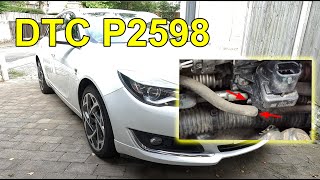
🎬 Watch: A detailed breakdown of the P2598 code and its causes.Technical definition: The SAE/OBD-II definition is 'Turbocharger Boost Control Position Sensor 'A' Performance - Stuck Low'. The Powertrain Control Module (PCM) detects the sensor's reported position is lower than the commanded position by a margin of 15% or more for a set duration.
Can I Drive With P2598?
Yes, But With Caution. You can drive, but the engine enters a low-power 'limp mode', making acceleration unsafe in traffic. Avoid heavy loads, towing, or highway driving. Ignoring this code causes excessive soot to clog the Diesel Particulate Filter (DPF), adding a $1,500-$4,000 repair to the final bill, or destroying the turbocharger.
Common Causes

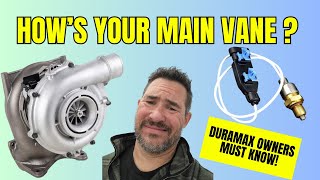
- Failed Turbocharger Vane Position Actuator/Sensor (Very Common) — The electronic actuator containing the position sensor fails internally due to extreme heat and vibration. Manufacturers issue frequent technical service bulletins (TSBs) for this exact failure on modern diesel trucks. 🎬 See how to locate, test, and replace the vane position sensor.
- Sticking or Seized Turbocharger Vanes (Common) — Soot and carbon from the exhaust build up inside the turbocharger housing, seizing the internal vanes. When the vanes cannot move, the actuator arm fails to reach its commanded position, forcing the sensor to report a stuck value. 🎬 Watch: How to clean sticky turbo vanes without a full teardown.
- Damaged Wiring or Corroded Connectors (Less Common) — The wiring harness connecting to the turbo actuator sits in a high-heat, high-vibration zone. Melted wires, chafed insulation, or corroded connector pins interrupt the signal or power to the actuator.
- Vacuum Leaks (on vacuum-actuated systems) (Less Common) — Vacuum-actuated turbo systems rely on a sealed vacuum circuit. A cracked hose, faulty vacuum pump, or leaking shared component (like an EGR valve) prevents the actuator from moving as commanded.
- Exhaust Leaks Upstream of the Turbo (Uncommon) — A cracked exhaust manifold or leaking gasket before the turbo alters exhaust flow dynamics. This confuses the PCM into flagging a vane position error while the system attempts to compensate for the lost drive pressure.
- Boost Leaks in the Intake System (Uncommon) — A severe air leak in the charge air cooler or intake boots causes a massive loss of boost pressure. The PCM logs a turbo control fault as it maxes out the actuator trying to compensate.
- Low System Voltage / Weak Battery (Rare) — Electronic actuators require stable voltage to function and report position correctly. A failing alternator or weak battery drops system voltage, causing erratic actuator behavior.
- Faulty Engine Control Unit (ECU/PCM) (Rare) — A software glitch, corrupted calibration table, or internal ECU failure causes the computer to misread a perfectly good sensor signal.
Symptoms

- Severe Loss of Power / Limp Mode — The engine feels extremely sluggish. The ECU limits RPMs (typically to 2,500) and cuts fuel delivery to prevent damage, making hill climbs or highway merging difficult.
- Check Engine Light is On — A solid Check Engine Light illuminates. An 'Engine Service Now' or 'Reduced Engine Power' message also appears on the dashboard.
- Low or Zero Boost Pressure — Dashboard boost gauges read near zero, even under heavy acceleration, because the turbo cannot build pressure.
- Traction Control Light On — Ford and GM vehicles often illuminate the traction control or StabiliTrak light as a secondary warning when the powertrain enters limp mode.
- Unusual Whistling or Hissing Noises — Abnormal whistling or hissing from the engine bay indicates a boost leak or exhaust gas bypassing stuck turbo vanes.
Diagnostic Flowchart

Tap your situation to follow the diagnostic path that matches what you're seeing on this code.
Common Fixes & Costs
- Replace Turbocharger Vane Position Actuator/Sensor — Parts: $250-$450, Labor: $500-$1000, ~4.5 hr book time (Professional)
- Clean Sticking Turbocharger Vanes — Parts: $50-$150, Labor: $1000-$1500, ~9 hr book time (Professional)
- Replace Entire Turbocharger Assembly — Parts: $1500-$3500, Labor: $1000-$1800, ~11 hr book time (Professional)
- Repair Damaged Wiring or Connectors — Parts: $20-$150, Labor: $150-$350, ~1.5 hr book time (Intermediate)
- Repair Vacuum System Leak — Parts: $10-$100, Labor: $100-$250, ~1 hr book time (Intermediate)
Used vs. New Parts: Buying Guide
When a used part is worth it: Buying a used electronic turbo actuator is not recommended due to high failure rates. A remanufactured unit from a reputable supplier is a viable, cost-effective alternative to a new OEM part.
Donor-vehicle mileage cap: roughly under 40000 miles for the part to have meaningful remaining life.
Donor quality checklist:
- For remanufactured parts, choose suppliers offering at least a 12-month warranty.
- Verify the part number exactly; identical-looking actuators have different internal software calibrations.
- Avoid 'as-is' parts from online marketplaces.
Decision logic:
- If The part is a simple mechanical component with no electronics (e.g., a bracket or linkage arm). → Used is acceptable if in good physical condition.
- If The part is the electronic actuator/sensor itself. → Buy new OEM or a quality remanufactured unit with a warranty. The savings from a used part do not justify the risk of repeat failure.
- If The entire turbocharger assembly is needed due to seized vanes. → A quality remanufactured turbo is a good option, provided the root cause of the original failure is addressed.
Warranty tradeoff: Used parts typically have a 30-90 day warranty. New aftermarket parts offer a 1-year warranty. New OEM parts offer a 1-2 year warranty. Some remanufacturers offer unlimited mileage warranties for 12 months.
Worst-case if a used part fails: $600-$1500 if a used actuator fails shortly after installation, primarily due to repeating the high labor cost.
What Happens If You Wait — Timeline
- 0-1 week: Check Engine Light illuminates and code P2598 stores. Engine enters 'limp mode' with a severe lack of power. Driving is difficult and unsafe. (MPG impact: 10-25%% · Added cost: $0)
- 1 week - 2 months: Inefficient combustion generates excessive soot. The Diesel Particulate Filter (DPF) clogs at an accelerated rate, triggering frequent, failed regeneration cycles. (MPG impact: 15-30%% · Added cost: $50-$200 in wasted fuel)
- 2-6 months: The DPF becomes completely saturated. The 'DPF Full' warning light illuminates, forcing a more restrictive low-power mode. The DPF requires professional cleaning or replacement. (MPG impact: 25-40%% · Added cost: $1,500-$4,000 (for DPF cleaning or replacement))
- 6+ months: Catastrophic failure. The severely clogged DPF creates extreme exhaust backpressure, destroying the turbocharger's seals and bearings, and potentially causing internal engine damage. (MPG impact: >40%% · Added cost: $4,000-$8,000+ (for combined DPF and turbocharger replacement))
Cost of Not Fixing It
- 0-1 month: Significant loss of power (limp mode), poor fuel economy (10-25% drop), and unsafe driving conditions. Increased soot production loads the DPF faster than normal. (Added cost: Negligible, besides increased fuel cost.)
- 1-6 months: Excessive soot clogs the Diesel Particulate Filter (DPF), preventing passive regeneration. This leads to DPF failure, requiring forced regeneration or replacement. (Added cost: $1,000-$4,000 for DPF replacement.)
- 6+ months: Catastrophic DPF failure, damage to the turbocharger from excessive backpressure, and contamination of exhaust sensors. (Added cost: $3,500-$8,000+ for combined DPF, turbo, and sensor repairs.)
Diagnosis Steps
- Read Trouble Codes & Review Freeze Frame Data
Use an OBD-II scanner to confirm P2598 is the active code. Note codes like P0299 (Underboost) or P003A. Review freeze frame data to see engine conditions (RPM, load, temp) when the fault occurred.
Tools: OBD-II Scanner (Beginner) - Listen for Actuator Movement (KOEO Test)
With the engine off but the key in the 'on' position (KOEO), have a helper cycle the ignition off and on. You should hear the electronic actuator buzz or cycle as it performs a self-test sweep. No sound strongly suggests a dead actuator or power supply issue.
Tools: A quiet environment (Intermediate) - Manually Check the Vane Linkage Arm
Disconnect the actuator from the turbo linkage arm (often held by a small clip). Move the arm on the turbo by hand. It must move smoothly through its full range of motion (about half an inch). If it is stiff, gritty, or seized, the internal vanes are stuck.
Tools: Basic hand tools, pliers (Advanced) - Check Live Data with an Advanced Scan Tool
Monitor the 'Commanded' vs. 'Actual' turbo actuator position PIDs (e.g., VGT_POS_CMD vs. VGT_POS). Command the actuator to move using bidirectional controls. If the 'Actual' position doesn't change or shows a persistent discrepancy (>15-20%), the actuator/sensor or vanes are at fault.
Tools: Advanced OBD-II Scanner (Intermediate) - Visually Inspect Wiring and Connectors
Inspect the wiring harness leading to the turbocharger actuator. Check for melted plastic, chafed wires, or green corrosion on the connector pins. Ensure the connector is fully seated.
Tools: Flashlight (Beginner) - Test the Actuator Power and Ground Circuit
Disconnect the actuator connector and probe the harness side. Check for battery voltage on the power supply pin and continuity to ground (<1 ohm) on the ground pin. A voltage drop >1.0V suggests high resistance.
Tools: Multimeter (Advanced) - ADVANCED: Test Analog Sensor Signal Voltage
For systems with an analog position sensor (like GM Duramax), back-probe the signal wire at the actuator connector. With the key on, voltage should sweep smoothly (e.g., ~0.5V to ~4.5V) as the actuator is commanded to move. Voltage stuck under 1.0V confirms the 'Stuck Low' fault.
Tools: Multimeter with back-probe pins, Advanced OBD-II Scanner (Advanced) - PRO TIP: Test Actuator Motor Winding Resistance
Measure the resistance of the internal motor windings. On certain 6.7L Power Stroke actuators, resistance between pins 3 and 4 should be 108-132 Ohms. An 'Open Line' (OL) reading indicates a failed internal motor winding.
Tools: Multimeter (Professional) - PRO TIP: Check Actuator CAN Bus Voltage
For CAN bus controlled actuators (2020+ 6.7L Power Stroke), check the two CAN lines at the actuator connector (Key On, Engine Off). Each line (CAN_H and CAN_L) should average 2.5V. A significant deviation points to a communication circuit fault, not a failed actuator.
Tools: Multimeter or Oscilloscope (Professional)
When This Code Triggers (Freeze-Frame Conditions)
- Engine Coolant Temp: 180-200°F (82-93°C) (Fully warmed up, not during initial cold start.)
- RPM: 1500-2500 RPM (During steady cruise or light to moderate acceleration when boost is commanded.)
- Engine Load: 30-60% (The engine is under a moderate load, requiring the turbo to build boost.)
- Vehicle Speed: 35-65 mph (Occurs during highway or arterial road driving, not typically at idle or low-speed city driving.)
Related Codes
- P0299 — Means 'Turbocharger Underboost'. P2598 is a direct cause for P0299; if the actuator is stuck low, the vanes prevent the turbo from building boost. Fix P2598 first.
- P003A — Means 'Turbocharger Boost Control 'A' Position Exceeded Learning Limit'. Indicates the actuator moved beyond its calibrated range due to failure or stuck vanes. Fixing P2598 resolves P003A.
- P2599 — The opposite code, 'Stuck High'. P2598 means vanes are stuck open (low boost), while P2599 means they are stuck closed (overboost). Both point to the actuator or vanes.
- P0047 — Means 'Turbo/Super Charger Boost Control Solenoid Circuit Low'. Points to an electrical fault (short to ground) in the control solenoid circuit, whereas P2598 is a mechanical/performance code.
Climate & Environmental Factors
- Extreme Cold Weather: In temperatures below -4°F (-20°C), mechanical parts of the actuator or turbo vanes move slowly. This sluggish response causes the sensor's actual position to lag behind the commanded position, temporarily triggering P2598.
- High Humidity / Moisture: Moisture accelerates corrosion on the actuator's electrical connector pins. On models like the Ford Transit, water ingress into the main engine ECU causes erratic electronic signals leading to this code.
- High Altitude: High altitude operation forces the turbocharger to work harder to produce boost. This exacerbates existing marginal problems with actuator response or sticking vanes.
How to Talk to a Mechanic About This Code
Say this: "Hi, my vehicle has a P2598 check engine light code and is in limp mode. I'd like to schedule a diagnostic appointment. Please focus on testing the turbocharger actuator and manually checking if the turbo vane linkage arm moves freely before quoting a full turbocharger replacement."
This signals you are an informed consumer. It directs the shop to perform crucial diagnostic steps that differentiate between a very expensive repair (full turbo replacement) and a moderate one (actuator replacement).
Avoid saying:
- 'My truck is running weak, can you fix it?'
- 'The check engine light is on, just do whatever it takes.'
- 'I think I need a new turbo.'
Questions to ask before authorizing the repair:
- Did you manually disconnect the actuator and confirm the vane linkage arm on the turbo moves smoothly without sticking?
- Can you show me the live data from the scan tool comparing the commanded VGT position to the actual VGT position?
- If replacing the actuator, does the quoted price include performing the mandatory 'VGT Vane Position Learn' procedure?
- What is the parts and labor warranty for this specific repair?
Where to Take It: Dealer vs Independent vs Chain
- Dealer:
Best for: Vehicles still under powertrain or emissions warranty., Very new models (e.g., 2020+ Ford Super Duty) where manufacturer TSBs are critical.
Downsides: Highest labor rates, often 1.5-2x more than an independent shop., May recommend a full turbo replacement if not specifically asked to diagnose the actuator separately. (Typical cost: +50% vs. baseline) - Independent Shop:
Excellent choice, IF you select a well-regarded diesel or turbo specialist. Their experience leads to a faster, more accurate, and cheaper diagnosis.
Best for: Out-of-warranty vehicles where cost is a major factor., Shops specializing in diesel trucks (Power Stroke, Duramax, Cummins) or turbochargers.
Downsides: Quality varies widely. You must find a reputable specialist, not a general auto repair shop., May lack the absolute latest dealer-level software for very new models. (Typical cost: +0% vs. baseline) - Chain Shop:
AVOID. This is a complex diagnostic task far outside the scope of a typical chain repair shop.
Best for: Simple, high-volume jobs like oil changes, tires, and brake pads.
Downsides: Technician skill is highly variable., Lack specialized diagnostic tools and in-depth expertise required for complex powertrain faults like P2598., High risk of misdiagnosis. (Typical cost: -10% vs. baseline)
When to Walk Away From the Repair
If the estimated repair cost exceeds 40-50% of the vehicle's current private-party market value, seriously consider alternatives to repair.
- Car worth $30000, fix is $4500: Fix it. At 15% of the vehicle's value, this is a reasonable cost for a critical powertrain repair on a valuable truck.
- Car worth $8000, fix is $3500: Borderline. This repair is 44% of the van's value. Get a second opinion and assess the vehicle's overall condition before proceeding.
- Car worth $4000, fix is $2800: Walk away. The repair cost is 70% of the car's value. It is not economically viable to perform this repair.
What Scan Tool You Need for This Code
Minimum: A scan tool that reads manufacturer-specific live data PIDs, specifically 'Commanded VGT Position' and 'Actual VGT Position'.
A basic $20 code reader only shows the P2598 code. It cannot show the live data needed to see *why* the code is setting, leaving you guessing between a wiring issue, a stuck vane, or a bad actuator.
Budget: BlueDriver Pro or BAFX/OBDLink Adapter with FORScan (~$70-120) — BlueDriver graphs live data, including turbo-related PIDs. For Ford owners, an adapter with FORScan software provides near-dealer-level diagnostics, including reading necessary PIDs and performing the VGT relearn procedure.
Mid-range: Foxwell NT-Series or ANCEL HD3200 (~$250-400) — Offers broader vehicle coverage and includes the specific 'VGT Relearn' or 'Turbo Calibration' special function needed after replacing an actuator. Provides robust live data and limited bidirectional control.
Professional: Autel MaxiCOM MK808 / MK900BT or LAUNCH X431 Series (~$450-1200) — Professional-grade tools with full bidirectional control, allowing you to command the actuator through its range of motion. Contains necessary VGT calibration functions for Ford, GM, and Cummins.
Rent vs buy: Renting from an auto parts store is NOT viable; their loaner tools are basic readers. For P2598, you must have a tool capable of live data and special functions. Buying a mid-range or pro-level scanner pays for itself by avoiding one misdiagnosis.
How to Clear the Code After You Fix It
- Use an advanced OBD-II scan tool to perform the 'Turbocharger Vane Position Learning' or 'VGT Calibration' procedure.
- Use the scan tool to clear the P2598 and any related fault codes.
- Perform a complete drive cycle to ensure the fault does not return and to allow readiness monitors to set.
Drive cycle (~20 minutes): 1. Cold start and idle for 2-3 minutes. 2. Drive in stop-and-go traffic for 5 minutes. 3. Accelerate to a steady highway speed (55-60 mph) for 10 minutes. 4. Safely decelerate to 20 mph without braking, then accelerate again. 5. Allow the vehicle to cool down completely.
Readiness monitors affected: Comprehensive Component Monitor, Exhaust Gas Recirculation (EGR) System, Catalyst Monitor
Before emissions retest: drive at least 50 miles to fully set monitors.
Watch out for:
- Skipping the mandatory scan tool 'relearn' procedure after replacing the actuator causes the code to return immediately.
- Clearing the code without fixing the root cause results in the code reappearing as soon as the PCM tests the system.
- Disconnecting the battery clears the code but resets all readiness monitors, causing an automatic emissions test failure.
Will This Fail Emissions / State Inspection?
Yes — this code typically fails an OBD-II emissions inspection.
- California: An illuminated Check Engine Light results in an automatic smog test failure. All OBD readiness monitors must be set to 'Ready'.
- New York: Vehicles 1996 and newer undergo an OBD-II inspection. An illuminated Malfunction Indicator Lamp for P2598 is an automatic failure.
- Texas: In counties requiring emissions testing, an active Check Engine Light causes an automatic inspection failure.
Most Commonly Affected Vehicles
- Ford F-250/F-350/F-450 Super Duty (2020-2022) — A very common failure of the electronic turbo actuator on the 6.7L Power Stroke. Addressed in Ford TSBs SSM 51150 and SSM 53328. The correct actuator part number is LC3Z-9G488-B.
- Ford Transit (2012-2016) — Prone to this code from a failing electronic actuator (worn internal plastic gears) or sticking internal turbo vanes.
- Ford Ranger (2012-2015) — The 2.2L and 3.2L diesel engines commonly experience this code due to turbo actuator failures or related wiring issues.
- Chevrolet / GMC Silverado / Sierra 2500HD/3500HD (2011-2016) — The vane position sensor on the LML Duramax diesel engine is a known failure point, requiring replacement of the sensor/actuator assembly.
- Chevrolet / GMC Cruze / Equinox / Terrain (2017-2018) — Common on 1.6L diesel (LH7) models. GM TSB 17-NA-301 states this code sets during vehicle transport due to repeated braking affecting the vacuum system.
- Vauxhall / Opel Insignia (2016-2017) — On 1.6L diesel engines (B16DTH), this code traces back to a vacuum leak affecting the turbo actuator, often caused by a faulty EGR component.
- Volkswagen Jetta / Golf / Passat (TDI) (2009-2015) — Caused by a failing electronic actuator or excessive soot buildup causing the VNT vanes to stick.
- BMW X5 / 3-Series (Diesel Models) (2009-2018) — Triggered by a faulty charging pressure sensor or wiring, leading to 'Reduced Engine Output' messages.
- Ram ProMaster (2014-2018) — On the 3.0L EcoDiesel engine, this code points to a failing electronic actuator or soot-fouled turbo vanes.
Manufacturer-Specific Notes
- Ford: On 6.7L Power Stroke engines (2020-2022), TSB SSM 53328 and SSM 51150 explicitly state the actuator (LC3Z-9G488-B) is a separate service part and 'Replacement of the turbocharger assembly is no longer required.' The relearn procedure requires engine coolant above 158°F (70°C).
- General Motors (Chevrolet/GMC): On 2017-2018 1.6L diesel engines, TSB 17-NA-301 advises P2598 sets falsely during vehicle transport due to repeated braking maneuvers affecting the vacuum system. Clear the code and test drive before replacing parts.
- Vauxhall / Opel: On 1.6L CDTi engines, P2598 is frequently caused by a vacuum leak elsewhere in the system, such as the EGR cooler bypass valve. A thorough vacuum system test is essential before replacing the actuator.
- Volkswagen / Audi: On TDI engines, short-trip driving accelerates soot buildup in the VNT mechanism. If replacing the actuator, ensure the VNT lever on the turbo moves freely by hand first to prevent destroying the new actuator.
Real Owner Stories
2021 Ford F-250 with 6.7L Power Stroke at 45,000 miles
While towing a trailer, the truck suddenly lost power and went into limp mode. The check engine light and a 'Service Engine Soon' message appeared on the dash.
What they tried:
- The owner checked for loose connections but found nothing.
- A local mechanic read code P2598 and immediately suspected the turbo actuator.
Outcome: The mechanic replaced the electronic turbo actuator (Part No. LC3Z-9G488-B) per Ford TSB 53328. After installation, a 'Turbocharger Vane Position Learning' procedure was performed with a scan tool. The repair cost $950. Power was restored, and the code did not return.
Lesson: On modern Ford Power Stroke engines, P2598 is almost always a failed actuator. Do not let a shop replace the entire turbo ($3,000+) before replacing the much cheaper actuator. A scan tool relearn is mandatory.
2012 Ford Transit 2.2L at 187,000 miles
The work van started making a whining noise during acceleration, then entered limp mode with code P2598.
What they tried:
- The owner replaced the electronic actuator, but the fault returned immediately.
- They manually checked the actuator arm on the turbo and found it completely seized.
Outcome: The root cause was severe carbon buildup physically sticking the internal turbo vanes. A full turbo removal and cleaning was necessary.
Lesson: Before replacing the actuator, disconnect it and manually check if the turbo's linkage arm moves freely. If the arm is stiff, replacing the actuator wastes money; the new part cannot overcome the mechanical seizure.
2016 Vauxhall Insignia 1.6L CDTi
The car intermittently went into limp mode with reduced power, logging code P2598. Clearing the code fixed it temporarily, but it returned under acceleration.
What they tried:
- The mechanic tested the turbo actuator using a vacuum pump and confirmed it was mechanically sound.
- They tested the vacuum system controlling the actuator.
Outcome: The problem was a vacuum leak from a faulty EGR cooler bypass valve sharing the same vacuum circuit. Repairing the EGR vacuum leak resolved the P2598 code without replacing turbo parts.
Lesson: On vacuum-actuated turbo systems, P2598 does not always mean the turbo or actuator is bad. Test the entire vacuum system, as a leak in an unrelated component is often the root cause.
2015 GMC Sierra 2500HD with LML Duramax
The truck intermittently threw P2598 and P2599, triggering reduced power mode on the highway.
What they tried:
- The owner observed 'Desired TC Vane Position' and 'Actual TC Vane Position' deviating on a scan tool.
- They researched TSBs pointing to the Vane Position Sensor.
Outcome: The owner replaced the Vane Position Sensor as a preventive measure. This is a known weak point on 2011-2016 Duramax LML engines.
Lesson: On LML Duramax engines, the vane position sensor is a high-failure item. Replacing this sensor resolves intermittent P2598/P2599 codes and prevents stranding.
How to Prevent This Code From Triggering
- Perform regular 'Italian tune-ups' or use the exhaust brake (Once every 1-2 weeks) — Sustained highway driving under load or using the exhaust brake forces the VGT vanes through their full range of motion, breaking loose soot deposits before they seize the vanes.
- Avoid excessive idling and short-trip driving (Daily habit) — Short trips prevent the exhaust system from reaching temperatures high enough to burn off soot, leading to rapid carbon accumulation in the turbo and DPF.
- Use high-quality diesel fuel and a cetane booster additive (Every fill-up) — Higher cetane fuel promotes complete combustion, producing less soot and reducing the material that fouls the turbocharger vanes.
- Follow manufacturer-specified oil change intervals with correct oil (Per vehicle maintenance schedule) — Low-ash engine oil (e.g., CJ-4/CK-4) is critical for DPF health and provides proper lubrication for the turbocharger's bearings.
- Address other engine faults promptly (As needed) — Leaking injectors, faulty EGR valves, or boost leaks cause excessive soot production. Fixing these reduces the soot load on the turbo and DPF.
Frequently Asked Questions
What is the most common misdiagnosis for P2598?
The most expensive mistake is replacing the entire turbocharger assembly when only the electronic actuator failed. Ford TSBs specifically note the actuator is a separate serviceable part. Always manually check if the turbo vanes are seized with carbon before buying an actuator, as stuck vanes will destroy the new part.
Can I just clean the sensor?
No, the sensor is an integral, sealed component inside the electronic actuator assembly. While cleaning external wiring connectors helps resolve electrical faults, internal sensor failures require replacing the entire actuator. If carbon buildup causes the issue, the entire turbo requires removal for physical cleaning.
What is a VGT turbo actuator?
A VGT turbo actuator is a small electronic or vacuum-powered motor that moves a lever on the turbocharger. This lever adjusts internal vanes to control the speed of exhaust gas hitting the turbine wheel, regulating boost pressure across the RPM range.
Is it dangerous to drive with code P2598?
It is not an immediate fire or explosion risk, but the severe lack of power makes merging or climbing hills unsafe. Continued driving also causes inefficient combustion, rapidly clogging the Diesel Particulate Filter (DPF) and causing thousands in secondary damage.
Why is the labor cost so high to fix this?
On modern diesel trucks and vans, the turbocharger sits deep in the engine valley or against the firewall, buried under the intake manifold and fuel lines. Accessing the actuator or removing the turbocharger assembly routinely takes a technician 4 to 8 hours of labor.
Do I need to do a 'relearn' procedure after replacing the actuator?
Yes, virtually all modern vehicles require a relearn. After installing an electronic actuator, you must perform a 'Turbocharger Variable Vane Actuator Position Learning' procedure using a high-level bidirectional scan tool. Skipping this calibration guarantees the code returns immediately.
Can a bad DPF cause code P2598?
A P2598 fault causes the DPF to fail, not the other way around. When the turbo fails to produce correct boost, the engine runs rich and creates excessive soot that clogs the DPF. While a completely blocked DPF creates extreme backpressure, it rarely triggers a vane position code directly.
Key Takeaways
- Code P2598 triggers a low-power limp mode because the turbocharger's position sensor reports a 'stuck low' value, cutting off boost pressure.
- A failed electronic turbocharger actuator causes over 70% of P2598 codes, especially on 2011+ Ford, GM, and Ram diesel trucks.
- Driving with P2598 for more than a few days clogs the Diesel Particulate Filter (DPF) with soot, adding a $1,500 to $4,000 replacement cost to your repair bill.
- Always disconnect the actuator and manually test the turbo vane linkage for binding before spending $2,500+ on a full turbocharger replacement.
Helpful Videos


Shop the Parts Behind P2598
Below are the parts most often responsible for code P2598, ranked by how frequently each one is the actual culprit (per the diagnosis above). Tap any to see what we have for your vehicle.


The information in this article is provided for general reference and educational purposes only. Vehicle specifications, procedures, and part compatibility can vary by production date, trim level, and region. Always consult your vehicle's factory service manual and verify part numbers before purchasing or performing repairs. Safety-critical components such as airbags, seat belts, and braking systems should be installed by a qualified professional.
- 🧭 Diagnostic Flowchart
- 🎬 Helpful Videos
- 🛍️ Shop This Part
- What Does P2598 Mean?
- Can I Drive With P2598?
- Common Causes
- Symptoms
- Common Fixes & Costs
- Used vs. New Parts: Buying Guide
- What Happens If You Wait — Timeline
- Cost of Not Fixing It
- Diagnosis Steps
- When This Code Triggers (Freeze-Frame Conditions)
- Related Codes
- Climate & Environmental Factors
- How to Talk to a Mechanic About This Code
- Where to Take It: Dealer vs Independent vs Chain
- When to Walk Away From the Repair
- What Scan Tool You Need for This Code
- How to Clear the Code After You Fix It
- Will This Fail Emissions / State Inspection?
- Most Commonly Affected Vehicles
- Manufacturer-Specific Notes
- Real Owner Stories
- 2021 Ford F-250 with 6.7L Power Stroke at 45,000 miles
- 2012 Ford Transit 2.2L at 187,000 miles
- 2016 Vauxhall Insignia 1.6L CDTi
- 2015 GMC Sierra 2500HD with LML Duramax
- How to Prevent This Code From Triggering
- Frequently Asked Questions
- What is the most common misdiagnosis for P2598?
- Can I just clean the sensor?
- What is a VGT turbo actuator?
- Is it dangerous to drive with code P2598?
- Why is the labor cost so high to fix this?
- Do I need to do a 'relearn' procedure after replacing the actuator?
- Can a bad DPF cause code P2598?
- Key Takeaways
- 🎟️ Get 5% Off