

P2610 on 2013-2016 Dodge Challenger: PCM Internal Engine Off Timer Fixes
This code means the engine's computer (PCM) has a problem with its internal clock. For the 2013-2016 Challenger, the most common fix is a PCM software update performed by a Dodge dealer, as specified in multiple Technical Service Bulletins (TSBs). This is a known software glitch. If a reflash doesn't work, the issue may be a failing crankshaft position sensor, a weak battery, or a faulty PCM.
- P2610 on a 2013-2016 Challenger is most often caused by a software glitch in the PCM.
- Before replacing any parts, check with a Dodge dealer to see if a PCM software update is available for your vehicle; this is the most likely fix.
- If the code persists after a software update, the next most likely cause is a faulty crankshaft position sensor (CKP), especially if code P0335 is also present.
- This code will cause an automatic failure of an emissions test, so it should be addressed before your next inspection.
What's Unique About the 2013-2016 Dodge CHALLENGER
On the 2013-2016 Dodge Challenger, P2610 is a well-documented issue. Chrysler (now Stellantis) released numerous Technical Service Bulletins (TSBs) acknowledging that the original PCM software logic was flawed. These bulletins often bundle the fix for P2610 with fixes for other seemingly unrelated codes, like those for the crankshaft sensor (P0335) or EVAP system (P0456). This strongly indicates the root cause is frequently a software glitch that requires a dealer-installed update, rather than an immediate hardware failure. This issue is also common on platform-mates like the Dodge Charger, Chrysler 300, and Jeep Grand Cherokee with the same engines.
Diagnostic Flowchart
Tap your situation to follow the diagnostic path that matches what you're seeing on this vehicle.
Generation note: The 2013-2016 range covers the third-generation Dodge Challenger, which received a significant interior and exterior facelift for the 2015 model year. However, the TSBs related to P2610 apply to vehicles both before and after this facelift, indicating the PCM logic issue is present across these model years and engine options.
Symptoms You May Notice
- Check Engine Light is on.
- Inability to pass an emissions/smog test because readiness monitors will not complete.
- Potential for long crank times, stalling, or no-start if a related crankshaft position sensor is also failing. [Bulletin #1808816, #1807517, 16]
- In some cases, the vehicle may enter a low-power 'limp mode'.
- Replacing the PCM before verifying that the required software update has been performed. The TSBs clearly indicate a software reflash is the intended first step.
- Replacing other sensors like the Engine Coolant Temperature (ECT) sensor without any corresponding fault codes. While a bad ECT can affect timers on some vehicles, the Dodge TSBs for this model point specifically to software and the CKP sensor.
Most Likely Causes
- PCM Software Requires Update 🔴 High Probability Multiple manufacturer TSBs confirm that flawed software logic is a primary cause for this code on this platform. [Bulletin #1807020, #1807320, #1808816, #1807517, #1809416, 5]
How to confirm: A Dodge dealership or a shop with a subscription to OEM service information (like ALLDATA) or a wiTECH scan tool can check your vehicle's VIN against available TSBs and software updates.
Typical fix: Reprogramming (reflashing) the PCM with the latest manufacturer-approved software. This is a 1-2 hour labor job at a dealership.
Est. part cost: $0 - Failing Crankshaft Position Sensor (CKP) 🟡 Medium Probability → Shop Engine Crankshaft Position Sensor The TSBs for the Challenger consistently list P2610 alongside CKP sensor codes (P0335, P0339). The PCM uses the CKP signal to determine when the engine stops rotating, which starts the 'engine off' timer. A faulty sensor can disrupt this process, often failing when hot and causing stalling or no-start conditions.
How to confirm: Scan for codes P0335 or P0339. If present, diagnose the CKP sensor circuit, checking for a proper signal, good wiring, and correct sensor resistance. A common failure sign is oil contamination in the sensor's electrical connector.
Typical fix: Replace the crankshaft position sensor and inspect its wiring connector for oil and damage.
Est. part cost: $25-$70 - Weak or Failing Battery ⚪ Low Probability → Shop Vehicle Battery
How to confirm: Test the battery voltage with the engine off (should be ~12.4-12.6V) and while running (should be ~13.7-14.7V). Perform a load test to check its health. Low voltage during startup or after sitting can corrupt the PCM's timer memory.
Typical fix: Replace the battery and ensure terminals are clean and tight. After replacement, the code may need to be cleared with a scan tool.
Est. part cost: $150-$250 - Faulty Powertrain Control Module (PCM) ⚪ Low Probability → Shop Engine Control Module (ECM)
How to confirm: This is a last resort. If the software is up-to-date, the battery is good, and all related sensors and wiring have been tested, the PCM itself may have an internal hardware fault.
Typical fix: Replace the PCM. This requires programming the new module to the vehicle's VIN and security information, which is best done by a dealer or a specialist service.
Est. part cost: $400-$800
Diagnosis Steps
- Scan the PCM for any and all trouble codes. Note any codes that appear alongside P2610, especially P0335 or EVAP-related codes.
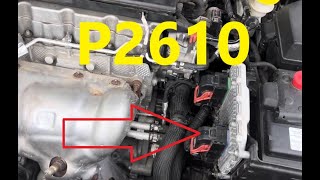
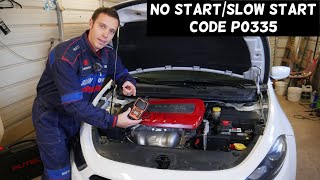
- Check for open recalls or Technical Service Bulletins (TSBs) for your vehicle's VIN. The high number of TSBs for P2610 makes this a critical first step. A dealer can do this, or you can search the NHTSA database. 🎬 Watch: A breakdown of P2610 symptoms, causes, and common fixes.
- If a TSB exists for a PCM reflash (e.g., TSB 18-088-16 REV. A), have this service performed by a Dodge dealer or qualified shop. This is the most probable solution and costs around $100-$200.
- Test the battery and charging system to ensure stable voltage is being supplied to the PCM. A weak battery or faulty alternator can cause this code.
- If code P0335 is present, follow the diagnostic procedure for the crankshaft position sensor. This includes checking the sensor's signal, wiring, and connector for damage or oil contamination.
- If all other steps fail and the code persists, the PCM itself may be faulty and require testing or replacement by a specialized service.
Parts You'll Likely Need
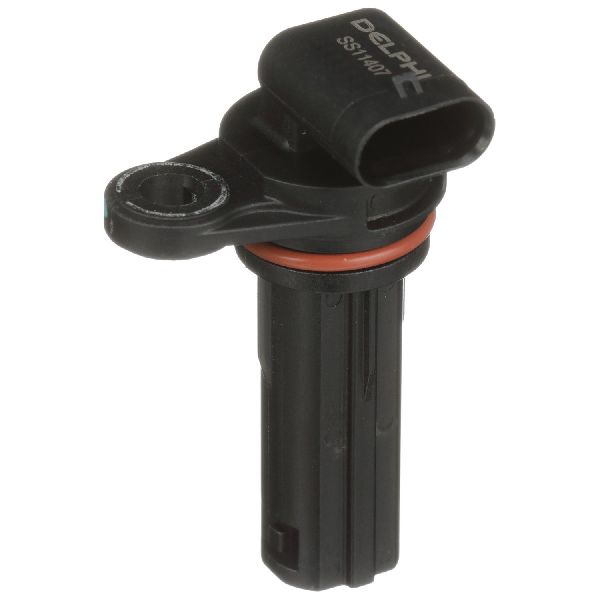
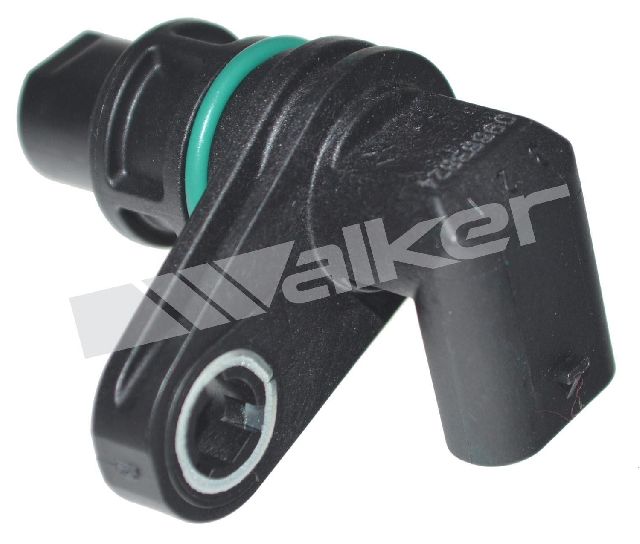
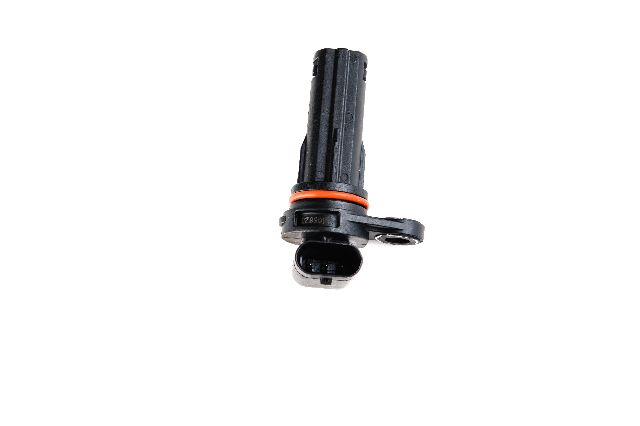
- Crankshaft Position Sensor
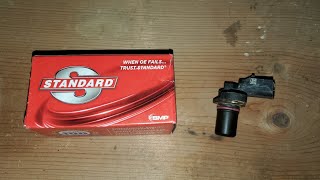
(OEM #5149167AF (for 3.6L V6), 68477925AB (replaces 68140678AB for 5.7L/6.4L V8))— Often fails in conjunction with P2610, as the PCM relies on its signal to start the engine-off timer. The official TSBs frequently link these faults. [Bulletin #1807020, #1807320, #1808816]
Trusted brands: Mopar, NTK, Delphi
OEM price range: $50-$90
Aftermarket price range: $25-$70
Related Codes That Often Appear With This One
- P0335 — Crankshaft Position Sensor Circuit. The PCM needs this sensor's signal to know when the engine has stopped, which is the trigger to start the 'engine off' timer. A fault here directly impacts the timer's function. [Bulletin #1807020, #1807320, #1808816, 19]
- P0456 — EVAP System Small Leak. This code often appears with P2610 because the EVAP leak test is one of the primary functions that relies on an accurate engine off timer to run correctly. The same PCM software update often fixes both codes. [Bulletin #1807020, #1807320, #1809416]
- P2299 — Brake Pedal Position / Accelerator Pedal Position Incompatible. The TSBs show this code is also resolved by the same PCM software update, indicating a broader logic issue within the original software. [Bulletin #1807320, #1807517]
Technical Service Bulletins (TSBs) & Recalls
- 1807020: Addresses P2610 along with P0456 and P0335, fixed by a software update.
- 1807320: Addresses P2610 with U1424-00, P0456, P2299, and P0335, fixed by a software update.
- 1808816: Addresses P2610 with P0335 and P0606, fixed by a software update.
- 1807517: Addresses P2610 with multiple other codes including P0335, P0339, and EVAP codes, fixed by a software update.
- 1809416: Addresses P2610 with various misfire and EVAP codes, fixed by a software update.
- 18-088-16 REV. A: Supersedes a previous bulletin, confirming the PCM reflash fixes P2610, P0335, and P0456 on 2013-2014 models with the 3.6L engine.
Platform-Specific Known Issues
- Chrysler issued multiple TSBs (e.g., #18-070-20, #18-073-20, #18-088-16) that address P2610 via a PCM software update. These bulletins confirm the issue is often not a failed part, but a correctable software problem from the factory.
- TSB 18-088-16 Revision A is a key document, explicitly linking P2610 with P0335 (Crankshaft Position Sensor Circuit) and P0456 (EVAP System Small Leak) for 2013-2014 Challenger, Charger, and 300 models with the 3.6L engine, and confirms the fix is a PCM reflash.
Mechanic-Grade Diagnostic Values
- Crankshaft Position Sensor (2-wire inductive type) internal resistance — expected: 200 to 1,000 Ohms. Failure: A reading of 0 Ohms indicates a short circuit; an infinite (M Ohm) reading indicates an open circuit.
- Crankshaft Position Sensor (3-wire Hall effect type) power supply — expected: 5V, 8V, or 12V reference voltage on the power wire (check vehicle-specific diagram).. Failure: No voltage indicates a wiring or PCM issue.
- Crankshaft Position Sensor (3-wire Hall effect type) ground circuit — expected: Near 0V on the ground wire.. Failure: Voltage present on the ground wire indicates a bad ground connection.
- Battery Voltage (Engine Off) — expected: 12.2V to 12.6V. Failure: Voltage below 12.2V indicates a discharged or failing battery that can cause memory issues in the PCM.
- Charging System Voltage (Engine Running) — expected: 13.5V to 14.5V. Failure: Voltage outside this range indicates a problem with the alternator or voltage regulator, which can cause electrical issues and trigger P2610.
- Engine Coolant Temperature (ECT) Sensor Resistance (generic value) — expected: 2,000 to 3,000 Ohms at 68°F (20°C). Failure: No reading or a reading far outside this range suggests a faulty sensor, though this is a less common cause for P2610 on this platform.
Scan Tool Commands That Help
- Professional Scan Tool (e.g., wiTECH, Autel, Snap-on): Live Data > Monitor 'Engine Off Timer' PID — After shutting the engine off, a technician can watch this parameter to see if the timer is counting correctly. A timer that is stuck, not starting, or providing an irrational value confirms a performance issue and helps differentiate between a sensor input problem and an internal PCM calculation fault.
OEM Part Supersession History
5149167AD, 5149167AE→5149167AF— Standard part revision and improvement by the manufacturer.
Heads up: The newest part number, 5149167AF, is the correct service replacement for the 3.6L V6 engine in this vehicle range and is backward compatible with the older parts.
Helpful Videos
We Have This Part in Stock


The information in this article is provided for general reference and educational purposes only. Vehicle specifications, procedures, and part compatibility can vary by production date, trim level, and region. Always consult your vehicle's factory service manual and verify part numbers before purchasing or performing repairs. Safety-critical components such as airbags, seat belts, and braking systems should be installed by a qualified professional.
- Dodge CHALLENGER:
- 🧭 Diagnostic Flowchart
- 🎬 Helpful Videos
- 🛍️ Shop This Part
- What's Unique About the 2013-2016 Dodge CHALLENGER
- Symptoms You May Notice
- Most Likely Causes
- Diagnosis Steps
- Parts You'll Likely Need
- Related Codes That Often Appear With This One
- Technical Service Bulletins (TSBs) & Recalls
- Platform-Specific Known Issues
- Mechanic-Grade Diagnostic Values
- Scan Tool Commands That Help
- OEM Part Supersession History
- 🎟️ Get 5% Off