

P2610 on 2011-2017 Honda Odyssey: ECM/PCM Engine Off Timer Fixes
This code means the engine's computer (PCM) has a problem with its internal clock. Before replacing the expensive PCM, check for a weak battery and have a dealer check for a PCM software update, as these are common and much cheaper fixes. A failing battery is the most frequent trigger, as low voltage disrupts the PCM's keep-alive memory.
- P2610 means the engine computer's internal 'off' timer is malfunctioning.
- Before any expensive repairs, fully test the 12V battery and check for corrosion on terminals and grounds. A weak battery is a very common cause.
- Ask a Honda dealer to check if there is a software update (reflash) available for the Powertrain Control Module (PCM), as this is a frequent and relatively inexpensive fix.
- If the battery is good and the software is up to date, the problem may be a faulty Engine Coolant Temperature (ECT) sensor or, most likely, a failed PCM that needs replacement.
What's Unique About the 2011-2017 Honda Odyssey
On this generation of Honda Odyssey, like many other Honda models, the P2610 code is frequently triggered by either a simple low voltage condition from an aging battery or a software glitch in the PCM. While an internal PCM failure is a definite possibility, Honda has often issued software updates to correct logic errors that can cause this code. Therefore, checking for a software reflash at a dealership is a critical diagnostic step before condemning the expensive computer. Many owner forums corroborate that starting with a battery test and then checking for software updates are the first two, and most successful, steps.
Symptoms You May Notice
- Check Engine Light is on
- Vehicle may fail an emissions test
- Slightly reduced fuel economy
- Potential for poor engine performance, such as rough idling or hesitation, though this is less common
- Longer than normal crank times or occasional rough starts
- Replacing the PCM without first testing the battery and checking for software updates. A weak battery is a very common cause and a much cheaper fix.
Most Likely Causes
- Weak or Failing Battery 🔴 High Probability → Shop Vehicle Battery Modern vehicles like the Odyssey have a significant constant power draw for various modules. An aging battery may not maintain the stable voltage required for the PCM's keep-alive memory, corrupting the internal timer. This is the most cited cause in both repair databases and owner forums.
How to confirm: Perform a comprehensive battery test using a digital battery tester that checks for voltage, cranking amps, and internal resistance. Voltage should be above 12.4V when off. During cranking, it should not drop significantly. Also, check the alternator output, which should be stable around 14.2-14.5 volts with the engine running.
Typical fix: Replace the 12-volt battery and clean the battery terminals thoroughly. 🎬 Watch: How to install a new battery on your Odyssey
Est. part cost: $150-$250 - PCM Software Requires Update 🔴 High Probability Manufacturers often release software updates to fix bugs discovered after the vehicle is released. An incorrect timer logic can be one such bug. 🎬 See this video on P2610 causes and fixes Other manufacturers, like Lexus, have issued TSBs specifically for P2610 caused by software logic.
How to confirm: A Honda dealership or a well-equipped independent shop can check for available PGM-FI (Programmed Fuel Injection) software updates using the Honda Diagnostic System (HDS). They will connect to the vehicle and compare the current software part number to the latest available version.
Typical fix: Update the PCM software to the latest version. This is often called 'reflashing'.
Est. part cost: $0 - Internal PCM Failure 🟡 Medium Probability Heat, vibration, and age can cause internal components or solder joints within the PCM to fail, leading to a hardware fault in the timer circuit. This is a diagnosis of exclusion after all other possibilities are ruled out.
How to confirm: This is diagnosed by exclusion. If the battery, charging system, wiring, and software are all confirmed to be good, the PCM itself is the likely cause. A final check is to substitute a known-good PCM.
Typical fix: Replace the Powertrain Control Module (PCM). The new module must be programmed to the vehicle's VIN and specific options.
Est. part cost: $800-$1500 - Poor Power or Ground Connection ⚪ Low Probability Corrosion on battery terminals or main chassis/engine grounds can cause intermittent voltage drops to the PCM, mimicking a failing battery.
How to confirm: Visually inspect the battery terminals, main engine ground straps, and PCM connectors for corrosion or looseness. Perform a voltage drop test on the main power and ground circuits to ensure there is less than 0.2V of drop under load.
Typical fix: Clean or replace corroded terminals and ground straps. Ensure all connections are tight.
Est. part cost: $5-$50 - Faulty Engine Coolant Temperature (ECT) Sensor ⚪ Low Probability The PCM often cross-references the ECT sensor reading to determine how long the engine has been off (by seeing how much it has cooled). An inaccurate sensor can provide conflicting data, leading the PCM to believe its internal timer is faulty.
How to confirm: With a cold engine (off for at least 8 hours), use a scan tool to compare the ECT sensor reading to the ambient air temperature sensor reading. They should be within a few degrees of each other. If not, the ECT sensor is likely faulty. Usually, a faulty ECT sensor will also trigger other specific codes (e.g., P0118).
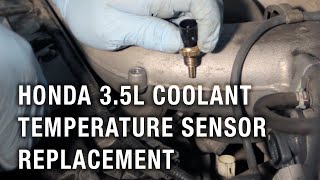
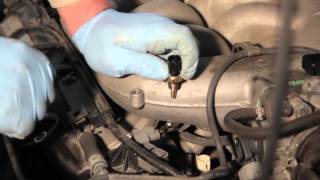
Typical fix: Replace the Engine Coolant Temperature (ECT) sensor. 🎬 Watch: Honda 3.5L coolant temperature sensor replacement walkthrough
Est. part cost: $20-$60
Diagnosis Steps
- Read the trouble codes with an OBD-II scanner. Confirm P2610 is present and note any other codes.
- Perform a complete battery and charging system test. Ensure the battery is fully charged and healthy. A voltage below 12.4V at rest is a red flag. Check that the alternator is charging correctly (typically 13.5V-14.5V).
- Inspect the battery terminals and main chassis ground connections for looseness and corrosion. Clean and tighten as necessary. Perform a voltage drop test on the PCM power and ground circuits if you suspect a connection issue.
- Contact a Honda dealer or qualified shop to determine if a PGM-FI (PCM) software update is available for your vehicle's VIN. If an update is available, have it performed.
- If the code returns, use a scan tool to monitor the Engine Coolant Temperature (ECT) sensor. On a cold engine (off for several hours), its reading should closely match the ambient air temperature reading.
- If the ECT sensor is inaccurate, replace it. Note that this will usually be accompanied by other DTCs.
- If all previous steps have been completed and the code persists, the fault is most likely an internal failure of the Powertrain Control Module (PCM).
- Confirm PCM failure by replacing it with a known-good unit, if possible, before purchasing a new one. Ensure the replacement is programmed to the vehicle.
Parts You'll Likely Need
- Powertrain Control Module (PCM)
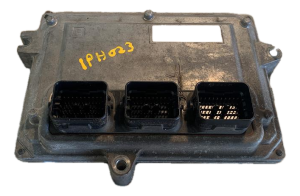
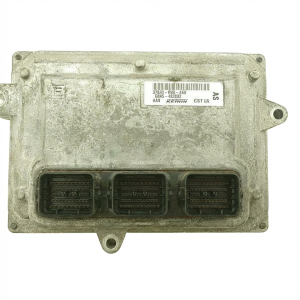
(OEM #37820-RV0-A53, 37820-RV0-A54, 37820-RV0-A55, 37820-RV0-A56, 37820-RV0-A57, 37820-RV0-A58, 37820-RV0-A61, 37820-RV0-A62, 37820-RV0-A63, 37820-RV0-A64, 37820-RV0-A65, 37820-RV0-A66, 37820-RV0-A67, 37820-RV0-A75)— This is the final step if all other diagnostics fail. The timer circuit inside the module itself can fail. Part numbers vary by year and trim level (LX, EX, EX-L vs Touring).
Trusted brands: Honda (OEM)
OEM price range: $1000-$1500
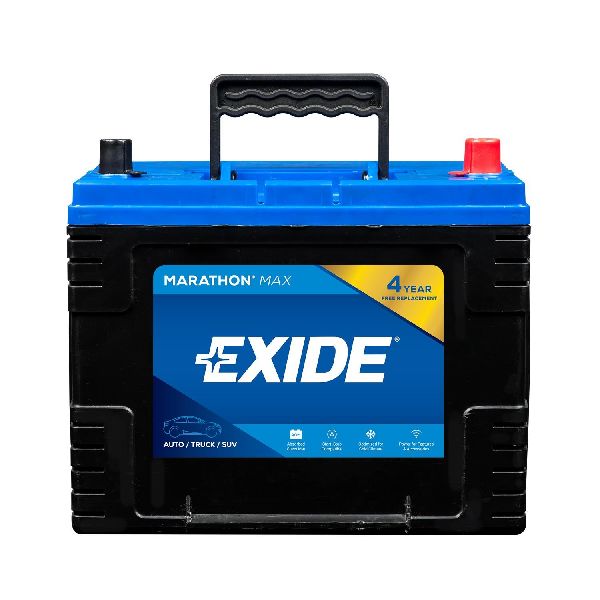
Aftermarket price range: $350-$800 (Remanufactured/Used) - 12V Battery — A weak battery causing low voltage is a very common trigger for this code, as it disrupts the PCM's memory.
Trusted brands: Interstate, DieHard, Duralast
OEM price range: $200-$300
Aftermarket price range: $150-$250 - Engine Coolant Temperature (ECT) Sensor — An inaccurate ECT sensor can confuse the PCM's logic for determining engine-off time, triggering the code.
Trusted brands: Denso, NTK, Bosch
OEM price range: $40-$70
Aftermarket price range: $20-$50
Mechanic-Grade Diagnostic Values
- Engine Coolant Temperature (ECT) Sensor Resistance — expected: Approx. 2000-3000 Ω at 20°C (68°F); Approx. 200-300 Ω at 90°C (194°F).. Failure: Readings that are significantly outside this range, or an open/short circuit, indicate a faulty sensor.
- Alternator Output Voltage (Engine Running) — expected: 13.5V - 14.5V, typically around 14.2V.. Failure: Voltage below 13V or above 15V indicates a charging system problem that can cause electrical issues, including setting a P2610.
- Freeze Frame Data: Control Module Voltage — expected: Should be above 12.0V at the time the fault was logged.. Failure: A low voltage reading (e.g., under 11.5V) in the freeze frame data strongly suggests the P2610 was triggered by a power supply issue, likely a weak battery or poor connection, rather than an internal PCM fault.
Scan Tool Commands That Help
- Honda Diagnostic System (HDS) or equivalent (i-HDS, VXDIAG): Replace ECM/PCM — This function is required after physically installing a new or used PCM. It initiates the process of programming the VIN and registering the immobilizer system to the new module, allowing the engine to start.
- Honda Diagnostic System (HDS) or equivalent: Immobilizer Setup Tool — Used in conjunction with the 'Replace ECM/PCM' function. This tool is necessary to register all existing keys to the newly installed PCM. Without this step, the vehicle will not recognize the keys and will not start.
- Honda Diagnostic System (HDS) or equivalent: Clear DTCs — After performing any repair (e.g., replacing the battery, updating software), this command should be used to clear the P2610 code. The vehicle should then be driven through a full drive cycle to see if the code returns, confirming if the fix was successful.
Wiring & Ground Locations
- G101 — Located on the engine, specifically on the front of the right cylinder head, often near the thermostat housing.. This is a primary power and logic ground for the PCM. A corroded, loose, or broken G101 ground can cause intermittent voltage drops or electrical noise, directly impacting the PCM's ability to maintain its internal clock and other functions, potentially triggering a P2610 code.
- PCM Connectors A, B, C — The PCM is located in the right rear of the engine compartment. The connectors are embossed with symbols for identification: Connector A (White) has a square, Connector B (Gray) has a triangle, and Connector C has a circle.. When diagnosing a potential PCM failure or wiring issue, technicians need to test for stable power and ground at these specific connectors. Knowing the identification marks prevents confusion and allows for accurate pin-point testing based on a wiring diagram.
- Transmission to Body Ground Strap — A braided or insulated cable connecting the transmission case to the vehicle's chassis/frame, typically near the front subframe.. While G101 is the primary PCM ground, this main engine/transmission ground strap ensures a solid ground path for the entire powertrain. If this strap is corroded or broken, which is common, the electrical system may try to find ground through smaller wires, causing voltage fluctuations that can affect the PCM and trigger codes like P2610.
Real Owner Repair Stories
- Odyclub.com forum member (2011 Honda Odyssey) — Check Engine Light with code P2610.
❌ Tried (didn't work) The owner initially suspected a complex PCM or sensor issue.
✅ What actually fixed it Replacing the vehicle's 5-year-old battery. The code appeared during a period of cold weather, which likely pushed the aging battery over the edge, causing a voltage drop sufficient to trigger the P2610. The code did not return after battery replacement. - Odyclub.com forum member (2012 Honda Odyssey) — Check Engine Light with P2610, car running fine otherwise.
❌ Tried (didn't work) Clearing the code, but it returned.
✅ What actually fixed it The dealership performed a PCM software update. The owner noted that the dealer first confirmed the battery was healthy before proceeding with the software update, which resolved the issue permanently.
OEM Part Supersession History
37820-RV0-A61, A62, A63, A64, A65, A66, A67→37820-RV0-A68— Incremental hardware and software revisions by Honda to improve reliability and address field issues.
Heads up: While earlier part numbers may function, the latest superseded part (37820-RV0-A68) is the most updated version for 2014-2016 models and is the preferred replacement to ensure all factory updates are included. Always match the part number to the vehicle's specific year and trim when replacing.37820-RV0-A54, A55, A56, A57, A58→Later revisions, though a direct supersession to a single number is not clearly documented in public sources.— Revisions for early-generation (2011-2013) models.
Heads up: PCMs for 2011-2013 models are generally not interchangeable with 2014-2017 models due to wiring and feature changes after the 2014 model year refresh.
Model Year Variations Within This Range
- 2014-2017: The Honda Odyssey received a mid-cycle refresh for the 2014 model year, which included updates to the powertrain and electronics. As a result, PCM part numbers are different for 2011-2013 vs. 2014-2017 models. It is critical to use the correct PCM for the specific model year range. For example, part numbers like 37820-RV0-A6x are for 2014+ models, while 37820-RV0-A5x are for 2011-2013 models.
Diagnostic Flowchart
Other Known Issues on This Vehicle
Issues unrelated to this code that are worth knowing about as an owner of this generation:
- VCM-Related Piston Ring Wear & Oil Consumption 🔴 High — Very common, especially on 2011-2013 models. Can occur at any mileage but often noted after 70k miles. Leads to misfire codes (P0301-P0304). (Ref: TSB 13-081 (Warranty Extension))
- Torque Converter Judder / Shudder 🟠 Medium — Common issue felt between 20-60 mph. Caused by deteriorated transmission fluid. (Ref: TSB 17-043, TSB 17-044)
- Power Sliding Door Failure 🟠 Medium — Widespread across the generation. Can be caused by a failed motor, rusted cables, or faulty latch assemblies. (Ref: Multiple recalls and dealer messages issued for various door components.)
- Parasitic Battery Drain 🟡 Low → Shop Vehicle Battery — Reported by many owners, particularly for the 2011 model year. The battery drains completely over a few days for no apparent reason.
- Warped Front Brake Rotors 🟡 Low — Very common due to the vehicle's weight. Results in steering wheel vibration during braking.
- Failed Engine Mounts 🟠 Medium — The passenger-side mount often fails first, leading to vibrations and potentially damaging other components like the intake boot.
Used vs. New Parts: Buying Guide for This Vehicle
When a used part is the smart pick: A used PCM from a reputable salvage yard can be a cost-effective option, but ONLY if you have access to a Honda Diagnostic System (HDS) or a qualified shop that does. The used PCM is a paperweight until it is properly programmed to your vehicle's VIN and immobilizer system. It is not a plug-and-play part.
Donor-vehicle mileage cap: roughly under 120000 miles for the part to have meaningful remaining life.
What to inspect on the donor part:
- Verify the exact part number from the donor vehicle matches what is required for your vehicle's year and trim.
- Source from a vehicle that was not involved in a flood or front-end collision.
- Ask for a warranty (even 30-90 days) to protect against receiving a dead-on-arrival unit.
- Check the connectors on the used PCM for any signs of corrosion, bent pins, or physical damage.
OEM-only on this vehicle (don't cheap out):
- Powertrain Control Module (PCM) - While used OEM is an option, avoid aftermarket 'rebuilt' PCMs from unknown brands. A new OEM unit from Honda or a used OEM unit are the most reliable choices. Programming is always required.
Aftermarket brands forum-validated for this vehicle:
- For the ECT sensor, if needed, Denso and NTK are original equipment suppliers to Honda and are considered reliable aftermarket choices.
Brands owners have reported issues with on this vehicle:
- Unbranded, no-name PCM/ECM units sold on auction sites without a clear warranty or programming support should be avoided. The cost of diagnosing a faulty replacement module will quickly erase any initial savings.
Real Owner Stories
Aggregated from forums and TSBs cited above. Mileages and costs reflect what owners reported in those sources.
2011-2017 Honda Odyssey
Symptoms: Check engine light on; discussions regarding electrical gremlins and the battery draining completely over a few days for no apparent reason.
What fixed it: Replacing the 12-volt battery and cleaning the battery terminals; this is the overwhelming consensus for resolving the issue.
Source hint: Odyclub.com - Multiple threads discuss P2610
2011-2013 Honda Odyssey — ~75000 miles
Symptoms: Misfire codes (P0301-P0304) and high oil consumption alongside other engine codes.
What fixed it: Addressing VCM-related piston ring wear as per TSB 13-081.
Source hint: TSB 13-081 (Warranty Extension)
2011-2017 Honda Odyssey
Symptoms: P2610 code present; battery and charging system tested fine.
What fixed it: Updating the PCM software to the latest version (reflashing) using the Honda Diagnostic System (HDS).
Source hint: Odyclub.com - Multiple threads discuss P2610
Related OBD-II Codes
Frequently Asked Questions
Could my 2011 Honda Odyssey's frequent battery drainage be causing the P2610 code?
Is there a software update for the PGM-FI system to fix this on my Odyssey?
My Odyssey has a P2610 and is also shuddering between 20-60 mph; are these related?
Can a faulty Engine Coolant Temperature (ECT) sensor trigger P2610 on a Honda?
Will a weak battery cause other issues besides the Check Engine Light?
Helpful Videos
Used OEM Parts in Stock
New Aftermarket Parts Available


The information in this article is provided for general reference and educational purposes only. Vehicle specifications, procedures, and part compatibility can vary by production date, trim level, and region. Always consult your vehicle's factory service manual and verify part numbers before purchasing or performing repairs. Safety-critical components such as airbags, seat belts, and braking systems should be installed by a qualified professional.
- Honda Odyssey:
- 🧭 Diagnostic Flowchart
- 🎬 Helpful Videos
- 🛍️ Shop This Part
- What's Unique About the 2011-2017 Honda Odyssey
- Symptoms You May Notice
- Most Likely Causes
- Diagnosis Steps
- Parts You'll Likely Need
- Mechanic-Grade Diagnostic Values
- Scan Tool Commands That Help
- Wiring & Ground Locations
- Real Owner Repair Stories
- OEM Part Supersession History
- Model Year Variations Within This Range
- Other Known Issues on This Vehicle
- Used vs. New Parts: Buying Guide for This Vehicle
- Real Owner Stories
- 2011-2017 Honda Odyssey
- 2011-2013 Honda Odyssey — ~75000 miles
- 2011-2017 Honda Odyssey
- Related OBD-II Codes
- Frequently Asked Questions
- 🎟️ Get 5% Off