

P2610 on 2012-2019 Toyota Prius C: Engine Off Timer Performance Causes and Fixes
On a 2014-2017 Prius C, this code is almost always due to a software glitch fixed by a dealer ECU update under TSB T-SB-0336-17. For all years, first test the 12V auxiliary battery, as a weak battery is the other most common cause. The software update is often covered under the Federal Emissions Warranty (8 years/80,000 miles), so it may be free.
- For a 2014-2017 Prius C, P2610 is most likely a software bug that a Toyota dealer can fix via a reflash per TSB T-SB-0336-17. Check if this is covered by the 8-year/80,000-mile Federal Emissions Warranty.
- For any 2012-2019 Prius C, your first and most important diagnostic step is to have the 12V auxiliary battery professionally load tested, especially if it's over 3 years old or has been recently jump-started.
- Do not replace the Engine Control Module (ECM) unless you have ruled out both the software update (on applicable years) and a weak 12V battery. A true ECM hardware failure is extremely rare.
- The car is safe to drive with this code, but you will not pass an emissions test.
What's Unique About the 2012-2019 Toyota Prius C
For the Toyota Prius C, especially from 2014-2017, this code is a well-documented issue caused by overly sensitive software logic in the ECM, not a hardware failure. Toyota released Technical Service Bulletin T-SB-0336-17 with a software update to fix it. On any Prius C, the health of the 12V auxiliary battery is also a critical factor; the complex hybrid system relies on stable 12V power to maintain the ECM's keep-alive memory when the car is off, and a weak battery can easily trigger this code, sometimes after a jump-start.
Symptoms You May Notice
- Check Engine Light is on.
- Inability to pass an emissions test because readiness monitors will not complete.
- Code may appear after jump-starting the vehicle or if the 12V battery has been drained.
- Replacing the Engine Control Module (ECM) before performing the software update on 2014-2017 models or without first testing the 12V battery. The TSBs for this issue explicitly warn that the problem is the software, not the hardware, and that the ECM should not be replaced as part of the standard repair.
Most Likely Causes
- Outdated Engine Control Module (ECM) Software 🔴 High Probability → Shop Engine Control Module (ECM) Affects 2014-2017 models specifically. Toyota issued TSB T-SB-0336-17 acknowledging the original software logic was too sensitive and could falsely trigger the code.
How to confirm: A Toyota dealer or qualified shop can check your vehicle's current calibration ID against the TSB to see if the update has been performed. An 'Authorized Modifications' label may also be affixed under the hood if the TSB work was completed.
Typical fix: Reprogram (reflash) the ECM with the updated software provided in the TSB. This is a 0.4-hour job according to Toyota. The dealer must use a stable power supply to maintain 13.5 volts during the procedure.
Est. part cost: $0 - Weak or Failing 12V Auxiliary Battery 🟡 Medium Probability → Shop Vehicle Battery Hybrid systems are very sensitive to 12V battery health. The ECM requires constant, stable power to maintain its internal clock (keep-alive memory) when the vehicle is off. A weak battery can cause this memory to be lost.
How to confirm: Perform a professional load test on the 12V battery. A simple voltage check is not sufficient, but a resting voltage below 12.4V is a strong indicator 🎬 Watch: How to quickly check your Prius battery voltage of a problem. The battery should hold a charge under load.
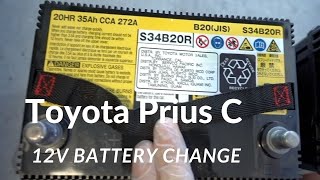
Typical fix: Replace the 12V auxiliary battery. The Prius C typically uses an AGM battery 🎬 See this step-by-step guide for replacing the 12V battery of group size S46B24R.
Est. part cost: $200-$350
Rare But Worth Checking
- ECM Power or Ground Circuit Issue: A corroded or loose wire providing power or ground to the Engine Control Module can cause intermittent voltage drops, mimicking a weak battery and disrupting the internal timer. This should be inspected if a new battery doesn't solve the issue on a non-TSB-applicable vehicle.
- Faulty Engine Control Module (ECM): → Shop Engine Control Module (ECM) A true internal hardware failure of the ECM is rare. This should only be considered after the software has been updated (if applicable) and the 12V battery and wiring have been confirmed to be in perfect condition. One owner of a 2004 Prius reported having to replace the ECM to finally fix the code.
- Aftermarket Remote Starter: In at least one documented case on a Prius V, an aftermarket remote starter (Viper brand) was suspected of causing the P2610 code to appear intermittently, likely by interrupting or interfering with the ECM's shutdown sequence.
Diagnosis Steps
- Scan the vehicle for any other DTCs. Address other codes first, especially any related to battery voltage (e.g., C1241) or the charging system.
- Thoroughly test the 12V auxiliary battery using a professional load tester. A healthy resting voltage should be ~12.6V; a reading below 12.4V warrants a charge and re-test. Ensure terminals are clean and tight. 🎬 Watch: How to locate and swap the 12V battery
- For 2014-2017 models, contact a Toyota dealer to determine if TSB T-SB-0336-17 applies and if the software update has already been performed. If not, have the ECM reprogrammed. This may be covered under the 8-year/80,000-mile Federal Emissions Warranty.
- For models outside the TSB range (2012-2013, 2018-2019), if the battery is good, the next step is to inspect the ECM's power and ground connections for any signs of corrosion or damage. Check the ECU-B fuse.
- If an aftermarket remote starter is installed, investigate if it is wired correctly and not interfering with the ECM's power supply or shutdown process.
- If all other steps fail to resolve the issue, a hardware failure of the ECM itself may be the cause, though this is very uncommon.
Parts You'll Likely Need
- 12V Auxiliary Battery
(OEM #28800-21181 (Note: This part number may be discontinued and superseded by a newer version).)— A weak 12V battery is a leading cause of this code on all Prius C model years, as it fails to maintain the ECM's keep-alive memory for the internal clock.
Trusted brands: Toyota TrueStart, Duralast Platinum, EverStart Platinum, Optima YellowTop
OEM price range: $250-$350
Aftermarket price range: $200-$270
Technical Service Bulletins (TSBs) & Recalls
- T-SB-0336-17: 'MIL ON DTC P2610' - States that some 2014-2017 Prius C vehicles (among other Toyota models) may exhibit this code and that the ECM logic has been modified to fix it. The repair is to reprogram the ECM.
Platform-Specific Known Issues
- A software update is the official fix for P2610 on 2014-2017 models, as documented in Toyota TSB T-SB-0336-17. This repair may be covered under the Federal Emissions Warranty (8 years/80,000 miles) or a longer PZEV warranty in certain states (up to 15 years/150,000 miles). The ECM is considered a 'specified major emission control component' under this warranty.
Mechanic-Grade Diagnostic Values
- ECM +B (Constant Power) Voltage — expected: 11V to 14V at all times. Failure: Voltage below 11V indicates a problem with the battery or the power feed circuit to the ECM.
- ECM IGSW (Ignition Switch) Voltage — expected: 11V to 14V when Power Switch is ON (IG). Failure: Voltage below 11V when the car is on indicates a fault in the ignition switch circuit or related relays.
- ECM Ground Circuit Resistance — expected: Below 1 Ω. Failure: Resistance above 1 Ω between the ECM ground pins and the chassis ground indicates a poor ground connection, which can cause floating voltages and erratic behavior.
- Voltage during ECM Reflash — expected: Maintained at a constant 13.5V. Failure: Voltage drops or spikes during the reflash procedure can corrupt the ECM software, potentially bricking the module. A dedicated power supply is required.
Scan Tool Commands That Help
- Toyota Techstream: Check for Current Calibration ID — This is the first step when diagnosing P2610 on a 2014-2017 model. It's used to compare the installed software version against the updated version listed in TSB T-SB-0336-17 to determine if a reflash is needed.
- Toyota Techstream: ECU Flash Reprogramming — This function is used to install the updated software from Toyota to correct the overly sensitive logic that causes P2610. This is the primary repair for TSB-applicable vehicles.
- Toyota Techstream: Freeze Frame Data — Used to view the vehicle's state (engine temp, speed, etc.) at the exact moment the P2610 code was set. This can provide clues, such as whether the code set after a cold soak or during a drive cycle, which can help differentiate a battery issue from a software bug.
Wiring & Ground Locations
- Engine Control Module (ECM) — Located in the engine compartment, at the center rear, near the firewall.. The ECM houses the internal timer. All power and ground circuits terminate here, making it the central point for voltage and resistance checks.
- ECU-B Fuse — Located in the fuse box in the engine compartment (Type A fuse box). It is a 7.5A fuse.. The ECU-B fuse provides constant battery power (keep-alive memory) to the ECM for functions like the internal clock. A blown or poor connection at this fuse can directly cause P2610.
- ECM Ground Points (E01, E02, E04) — These are the primary ground connections for the ECM, typically bolted to the engine block or chassis near the ECM itself.. A corroded or loose ground connection at these points can cause a voltage differential, disrupting the ECM's internal timer and mimicking the symptoms of a failing battery or ECM.
Real Owner Repair Stories
- ? ()
- ? ()
OEM Part Supersession History
28800-21180→28800-21181— Standard part update/revision.
Heads up: Both are specified for the Prius C, but 28800-21181 is the later, more commonly available part.89661-52U80→89661-52U81— Software/hardware revision for the Engine Control Module.
Heads up: When replacing an ECM, the part number must be matched exactly to the original unit to ensure compatibility with the vehicle's systems and immobilizer.
Model Year Variations Within This Range
- 2014-2017: These model years are subject to TSB T-SB-0336-17, which identifies a software logic issue as the primary cause of P2610. The fix is a dealer-performed ECM reflash, which is not applicable to other years.
- 2012-2013: These models are not covered by the software TSB. For these years, the cause is almost always a weak 12V auxiliary battery or, much more rarely, a wiring/ground issue or a faulty ECM. Specific ECM part numbers for these years include 89661-52U80 and 89661-52U81.
Diagnostic Flowchart
Used vs. New Parts: Buying Guide for This Vehicle
When a used part is the smart pick: A used Engine Control Module (ECM) is a cost-effective option if a true hardware failure is confirmed, which is rare for this code. It is critical to source a used ECM for models outside the 2014-2017 TSB range, as a new ECM would not solve the software issue on those models anyway.
Donor-vehicle mileage cap: roughly under 150000 miles for the part to have meaningful remaining life.
What to inspect on the donor part:
- Part number MUST exactly match the original ECM (e.g., 89661-52U80).
- Inspect connector pins for any signs of corrosion, moisture, or physical damage.
- Buy from a reputable seller that offers a warranty and has good reviews.
- Ensure the donor vehicle was not involved in a flood or fire.
OEM-only on this vehicle (don't cheap out):
- Engine Control Module (ECM): While a used OEM part is viable, aftermarket or cloned ECMs are strongly discouraged due to complex immobilizer and hybrid system integration. A replacement ECM requires programming to the vehicle's immobilizer system to start.
Aftermarket brands forum-validated for this vehicle:
- For the 12V Battery: Yuasa (often the OEM supplier), Optima (YellowTop), Duralast Platinum (AGM), EverStart Platinum (AGM).
Brands owners have reported issues with on this vehicle:
- Avoid non-AGM (Absorbed Glass Mat) batteries for the 12V auxiliary position, as they may not meet the specific venting and power delivery requirements of the Prius C hybrid system.
Real Owner Stories
Aggregated from forums and TSBs cited above. Mileages and costs reflect what owners reported in those sources.
2014 Toyota Prius C 1NZ-FXE 1.5L I4 Hybrid
Symptoms: The Check Engine Light came on with code P2610.
What fixed it: The owner took the vehicle to a dealer who performed the ECM reflash specified in TSB T-SB-0336-17. The repair was covered under warranty.
Source hint: PriusChat: 'Code p2610?'
2011 Toyota Prius
Symptoms: The P2610 code appeared after the owner had to perform multiple jump-starts on the vehicle.
What fixed it: The forum discussion highlighted that the root cause was the weak 12V battery, as the code is highly sensitive to low voltage events.
Source hint: Reddit r/prius: '2011 Toyota Prius P2610 Code Help'
2004 Toyota Prius
Symptoms: The vehicle was showing an OBD code P2610 that could not be resolved by common fixes.
What fixed it: The ultimate fix was a rare ECM replacement, confirming that while uncommon, a hardware failure can be the cause.
Source hint: PriusChat: 'Prius 2004 Gen II ECM replacement with P2610 OBD code'
Related OBD-II Codes
Frequently Asked Questions
Does TSB T-SB-0336-17 apply to my 2018 Prius C?
Is the ECM software update for P2610 covered by warranty on my 2016 Prius C?
My Prius C threw code P2610 right after I had to jump-start it. What's the most likely problem?
What kind of 12V battery does my Prius C need for a replacement?
How can I check if the software update from TSB T-SB-0336-17 has already been performed on a used 2015 Prius C?
Is it common for the ECM itself to fail and cause a P2610 code on this car?
Helpful Videos

We Have This Part in Stock


The information in this article is provided for general reference and educational purposes only. Vehicle specifications, procedures, and part compatibility can vary by production date, trim level, and region. Always consult your vehicle's factory service manual and verify part numbers before purchasing or performing repairs. Safety-critical components such as airbags, seat belts, and braking systems should be installed by a qualified professional.
- Toyota Prius C:
- 🧭 Diagnostic Flowchart
- 🎬 Helpful Videos
- 🛍️ Shop This Part
- What's Unique About the 2012-2019 Toyota Prius C
- Symptoms You May Notice
- Most Likely Causes
- Rare But Worth Checking
- Diagnosis Steps
- Parts You'll Likely Need
- Technical Service Bulletins (TSBs) & Recalls
- Platform-Specific Known Issues
- Mechanic-Grade Diagnostic Values
- Scan Tool Commands That Help
- Wiring & Ground Locations
- Real Owner Repair Stories
- OEM Part Supersession History
- Model Year Variations Within This Range
- Used vs. New Parts: Buying Guide for This Vehicle
- Real Owner Stories
- 2014 Toyota Prius C 1NZ-FXE 1.5L I4 Hybrid
- 2011 Toyota Prius
- 2004 Toyota Prius
- Related OBD-II Codes
- Frequently Asked Questions
- 🎟️ Get 5% Off