

P2635 on 2007-2017 GMC Acadia 3.6L V6: Fuel Pump Performance Causes and Fixes
On a first-generation (2007-2016) GMC Acadia, P2635 almost always means the in-tank low-pressure fuel pump is failing, especially if the engine stalls in hot weather. The most common fix is replacing the entire fuel pump module assembly with an updated part to resolve a known vapor buildup issue documented in GM TSB 17-NA-335.
- P2635 on a 2007-2016 GMC Acadia is a strong indicator of a failing in-tank fuel pump.
- Symptoms like stalling are much more likely to occur in hot weather or during long drives.
- Do not drive the vehicle, as the engine can stall without warning, creating a serious safety hazard.
- The fix is not simple; it requires dropping the fuel tank and is best left to a professional or experienced DIYer.
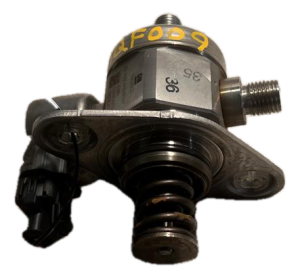
- Ensure you are replacing the correct part: the low-pressure pump in the tank, not the high-pressure pump on the engine.
What's Unique About the 2007-2017 GMC Acadia
The first-generation GMC Acadia (2007-2016) and its platform-mates (Buick Enclave, Chevy Traverse, Saturn Outlook) are particularly known for this issue. GM has released multiple Technical Service Bulletins (TSBs), most notably 17-NA-335, acknowledging that the original in-tank fuel pump can fail to handle high ambient temperatures (above 100°F / 37.7°C). This leads to vapor buildup in the fuel feed line, causing a sudden loss of fuel pressure, engine stalling, and the P2635 code, often accompanied by P018B. Therefore, unlike on other vehicles where this code could have many causes, on an Acadia it points very strongly to a specific, well-documented failing fuel pump module design.
Generation note: The 2007-2017 year range covers two generations of the Acadia. The first generation (2007-2016) and the first-gen model sold as the 'Acadia Limited' in 2017 are built on the GM Lambda platform and are highly prone to this specific fuel pump issue. The fully redesigned second-generation Acadia (2017-present) is a different platform, and while it can still experience this code, the widespread, heat-related failure is characteristic of the first generation.
Symptoms You May Notice
- Engine stalling, especially in hot weather or on long drives.
- Reduced engine power and poor acceleration.
- Hesitation or stumbling when pressing the gas pedal.
- Extended cranking time before the engine starts.
- Check Engine Light is on
- Engine surging or rough idle.
- Loud whining or screaming noise from the fuel tank area. 🎬 Watch how to fix a stalling GMC Acadia
- Replacing the high-pressure fuel pump (HPFP) on the engine. P2635 specifically relates to the low-pressure pump in the tank.
- Replacing the fuel pressure sensor without confirming the fuel pump's performance first.
- Replacing fuel injectors or other fuel system components before diagnosing the fuel supply from the tank.
Most Likely Causes
- Failing In-Tank Fuel Pump Module 🔴 High Probability → Shop Fuel Pump The original equipment pump design is known to be susceptible to failure in high ambient temperatures, as acknowledged by GM in service bulletin 17-NA-335, which describes vapor buildup in the fuel line.
How to confirm: Monitor fuel pressure with a scan tool while driving. A sharp drop in 'Fuel Tank Fuel Pressure' that deviates from the 'Desired Fuel Pressure' just before a stall, especially when hot, confirms a failing pump. The pressure commanded by the FPCM will not match the actual pressure reading. 🎬 See how to diagnose low fuel pressure issues
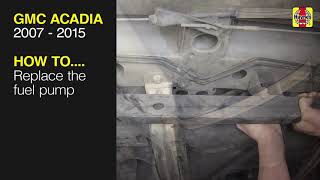
Typical fix: Replace the entire in-tank fuel pump module assembly with a new, updated part. This involves dropping the fuel tank. 🎬 Watch this step-by-step fuel pump replacement walkthrough
Est. part cost: $250-$500 - Faulty Fuel Pump Control Module (FPCM) 🟡 Medium Probability → Shop Fuel Pump The FPCM is often mounted on the vehicle's rear frame crossmember, exposing it to moisture and road salt, which can lead to corrosion of the module housing and connector pins, causing internal failure.
How to confirm: Inspect the module and its connector for heavy corrosion or damage. Use a scan tool to check for communication with the FPCM. If the module is unresponsive or a U0109 'Lost Communication With Fuel Pump Control Module' code is present, the module is the primary suspect.
Typical fix: Replace the Fuel Pump Control Module. On these models, the new module must be programmed to the vehicle's VIN.
Est. part cost: $100-$250 - Damaged Wiring or Connectors ⚪ Low Probability Wiring to the FPCM or the fuel pump connector on top of the tank can become corroded or damaged due to their exposed locations. A poor ground connection under the driver's door is also a known weak point that can cause this code.
How to confirm: Perform a visual inspection of the wiring harness running to the FPCM and the fuel tank. Check for continuity and voltage drops at the FPCM connector and the fuel pump connector. Specifically check the condition of the ground point on the frame rail under the driver's side door.
Typical fix: Repair or replace the damaged section of the wiring harness or the connector itself. Clean and secure any corroded ground connections.
Est. part cost: $20-$100
Rare But Worth Checking
- Failed Fuel Pressure Sensor: → Shop Fuel Pressure Sensor While the sensor itself can fail and send false readings, it's far less common than the pump failing. GM TSBs note that code P018B often appears with P2635, but this is usually because the sensor is correctly reporting the low pressure caused by the pump, not because the sensor itself is faulty. A stuck sensor reading (e.g., 48.7 PSI with engine off) would indicate a faulty sensor.
Diagnosis Steps
- Connect a professional scan tool capable of reading live data from the Fuel Pump Control Module (FPCM).
- Check for any other diagnostic trouble codes, paying close attention to P018B (confirms pressure issue) or U0109 (points to FPCM failure).
- Observe the 'Fuel Tank Fuel Pressure' and 'Desired Fuel Pressure' PIDs (Parameter IDs) on the scan tool.
- If possible and safe, try to replicate the failure conditions (e.g., driving on a hot day). Watch for the actual fuel pressure to drop significantly below the desired pressure just before a stall or hesitation event. This strongly indicates a failing pump.
- If pressure drops confirm a pump issue, proceed with replacing the in-tank fuel pump module with an updated part number.
- If fuel pressure appears stable but the code persists, or if code U0109 is present, perform a thorough inspection of the FPCM and its wiring harness for corrosion or damage. The FPCM is typically located on a rear frame crossmember.
- If the wiring is intact, the FPCM itself is likely faulty and requires replacement and VIN-specific programming.
Parts You'll Likely Need
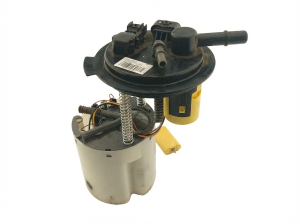
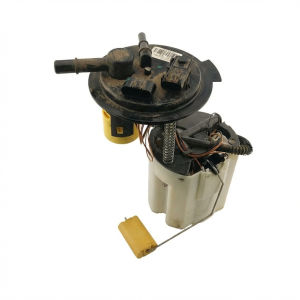
- Fuel Pump Module Assembly
(OEM #ACDelco M100156 (Updated Design))— This is the most common failure point for this code on this vehicle, especially in hot weather, as documented in GM service bulletin 17-NA-335. The updated part is designed to prevent vapor lock.
Trusted brands: ACDelco, Delphi, Spectra Premium
OEM price range: $350-$500
Aftermarket price range: $250-$400 - Fuel Pump Control Module (FPCM)
(OEM #ACDelco 20877116 (2010-2012), 20964304 (2013-2016), 20759945 (2009))— This module controls the in-tank fuel pump and can fail from corrosion or internal faults, causing the same symptoms. It's the second most likely cause if the pump itself is good. Requires programming.
Trusted brands: ACDelco, Standard Motor Products, Dorman
OEM price range: $150-$200
Aftermarket price range: $90-$160
Related Codes That Often Appear With This One
- P069E — This code means 'Fuel Pump Control Module Requested MIL Illumination' and confirms that the FPCM is the module that detected the fault and asked for the Check Engine Light to be turned on.
- P018B — This code for 'Fuel Pressure Sensor 'B' Circuit Range/Performance' is often set because the sensor is accurately detecting the erratic or low fuel pressure caused by the failing in-tank pump, especially during the high-heat vapor lock condition described in TSB 17-NA-335.
- U0109 — This code means 'Lost Communication With Fuel Pump Control Module.' If present, it points directly to a failed FPCM or a wiring issue between the FPCM and the rest of the vehicle, making it the primary fault over the pump itself.
Technical Service Bulletins (TSBs) & Recalls
- 17-NA-335: Addresses stalling in hot weather related to fuel pump performance. Recommends replacing the fuel pump module with an updated design to fix vapor buildup.
- PIP5507B: Addresses persistent stalling in high heat even after a pump replacement, suggesting operational changes like using higher octane fuel. This bulletin notes that in ambient temperatures of 100°F or higher, the vehicle may exhibit hesitation or stalling.
- PIP5411F: An earlier, now superseded bulletin that also advised replacing the in-tank fuel pump for hot weather stalling.
- Bulletin #16-NA-225: Provides a specific procedure to replace the fuel pump module assembly if DTC P2635 and/or P018B are set.
Platform-Specific Known Issues
- GM Technical Service Bulletin (TSB) #17-NA-335 (which supersedes PIP5411F) directly addresses MIL illumination with P2635 and/or P018B in high ambient temperatures (over 100°F). It identifies the cause as 'vapor buildup in fuel feed line' and recommends replacing the fuel pump module with an updated version.
- TSB #PIP5507B was issued for vehicles that continued to have issues *after* a new pump was installed, advising customers in hot climates to use higher octane fuel and avoid long idles.
Mechanic-Grade Diagnostic Values
- FPCM Power Supply Voltage (Ignition ON) — expected: 12.0–12.6 V at the Pink wire (Pin 15) and Red/White wire (Pin 32) of the FPCM connector.. Failure: Voltage below 11.5V suggests a wiring or charging system problem upstream of the module.
- FPCM Ground Circuit Resistance — expected: Less than 0.2 Ω between the Black wire (Pin 1) at the FPCM connector and a clean chassis ground.. Failure: Resistance above 0.2 Ω indicates a poor ground connection, which can cause the module to malfunction under load.
- ECM to FPCM 'Pump On' Signal — expected: With key on, 12V should be present for 2-6 seconds at the Dark Green/White wire (Pin 13) of the FPCM connector.. Failure: No voltage at this pin indicates a problem with the wire from the ECM or the ECM itself. If voltage is present but the pump doesn't prime, the FPCM is suspect.
- Low-Side Fuel Pressure (Idle) — expected: 300-550 kPa (44-80 PSI), commanded by the ECM and visible on a scan tool as 'Fuel Tank Fuel Pressure'.. Failure: Actual pressure significantly deviating from 'Desired Fuel Pressure' PID, especially a sharp drop during hot weather or high load, points to a failing pump.
Scan Tool Commands That Help
- GDS2 / Tech2: Fuel Pump On/Off Command — Use this bidirectional control to manually activate the in-tank fuel pump. If the pump runs when commanded ON, it confirms the pump motor and its power/ground circuit from the FPCM are likely functional. This helps isolate the fault to the control side (ECM signal, FPCM logic).
- GDS2 / Tech2: FPCM Programming (SPS) — This function is mandatory after replacing the Fuel Pump Control Module. The new module must be programmed with the vehicle's VIN using the GM Service Programming System (SPS) via a J2534 interface. The vehicle will not start until this is completed.
- GDS2 / Tech2: Live Data: FPCM Ignition 1 Voltage — When diagnosing a potential FPCM failure or a U0109 code, monitoring this PID confirms if the module itself is seeing proper ignition voltage. If the scan tool shows 0V but a multimeter confirms 12V at the connector pin, it indicates an internal FPCM fault.
Wiring & Ground Locations
- FPCM Connector — Typically mounted to a frame crossmember near the spare tire or above the rear axle, exposed to the elements.. This connector is a primary failure point due to corrosion from road salt and moisture. Key pins to test are Pin 1 (Ground), Pin 13 (ECM Signal), Pin 15 (Ignition Voltage), and Pin 32 (Battery Voltage).
- G305 — Varies by exact model year, but generally located on the chassis frame near the battery area.. This is a major ground point for various engine and chassis components. While not the direct ground for the FPCM, a poor connection here can cause fluctuating system voltage, indirectly affecting FPCM and fuel pump performance.
- ECM Connector X1, Pin 50 — At the Engine Control Module (ECM). The wire is typically Dark Green/White.. This is the source of the 'Fuel Pump On' command signal sent to the FPCM. If there is no signal voltage at the FPCM (Pin 13), testing for 12V at this pin on the ECM connector can determine if the fault is a broken wire or a failed ECM driver.
Real Owner Repair Stories
- Reddit user on r/gmc (2009 GMC Acadia) — Losing low-side fuel pressure, setting codes indicating a bad FPCM.
❌ Tried (didn't work) Replacing the Fuel Pump Control Module (FPCM) four times between two different shops., The modules would work for about a month before failing again.
✅ What actually fixed it The user ultimately replaced the in-tank fuel pump assembly themselves, which resolved the issue. The repeated FPCM failures were likely caused by the failing, original fuel pump drawing excessive current, which overworked and eventually destroyed the new control modules. - Reddit user on r/gmc (2021 GMC Acadia (2nd Gen, but relevant failure mode)) — Sudden, complete loss of power while driving on the highway. Car would not restart or even go into neutral.
❌ Tried (didn't work) N/A - Towed directly to dealer.
✅ What actually fixed it The dealership diagnosed and replaced a failed Fuel Pump Control Module. This story highlights that FPCM failure can be sudden and catastrophic, causing a significant safety risk without prior warning symptoms.
OEM Part Supersession History
M100155→M100156— The updated M100156 module assembly was engineered to address the vapor lock and hot weather stalling issues identified in GM TSB 17-NA-335. It likely includes design changes to better manage fuel temperature and vapor.
Heads up: Installing the older M100155 part, if found, will likely lead to a recurrence of the P2635 code and stalling symptoms in hot weather.
Model Year Variations Within This Range
- 2009, 2010-2012, 2013-2016: The part number for the Fuel Pump Control Module (FPCM) changed several times during the first generation. For example: 20759945 for 2009, 20877116 for 2010-2012, and 20964304 for 2013-2016. It is critical to use the correct part number for the specific model year and VIN when replacing the FPCM.
Diagnostic Flowchart
Other Known Issues on This Vehicle
Issues unrelated to this code that are worth knowing about as an owner of this generation:
- Premature Timing Chain Stretch 🔴 High — Common on 2007-2013 models, often appearing between 70,000 and 120,000 miles. Triggers codes like P0008, P0017, P0018. (Ref: Special Coverage Adjustment #11340C extended warranty coverage to 10 years/120,000 miles for some model years.)
- Cracked 3-5-R Transmission Wave Plate 🔴 High — Prevalent in 2007-2009 models with the 6T70/6T75 transmission, typically before 100,000 miles. Results in loss of 3rd, 5th, and Reverse gears. (Ref: Special Coverage Adjustment #14404B extended warranty to 10 years/120,000 miles. TSB 09-07-30-012F provides repair details.)
- Power Steering Rack Leaks / Failure 🟠 Medium — Common on 2007-2012 models, leading to whining noises, difficult low-speed turning, or sudden loss of power assist.
- Water Leaks into Cabin 🟠 Medium — Often reported on 2007-2012 models, typically from clogged sunroof drains or a leaking evaporator case, which can damage the fuse block and other electronics.
- Ignition Coil Failure 🟠 Medium — A frequent cause of misfire codes (P0300-P0306). Oil leaking from the valve cover gasket into the spark plug tubes often causes the coils to fail prematurely.
Used vs. New Parts: Buying Guide for This Vehicle
When a used part is the smart pick: A used part is generally not recommended for this repair. However, if necessary, a used Fuel Pump Control Module (FPCM) from a low-mileage vehicle in a dry, salt-free climate could be a budget option, but it will still require professional programming. Used wiring harness connectors or pigtails are also viable if the originals are damaged.
Donor-vehicle mileage cap: roughly under 50000 miles for the part to have meaningful remaining life.
What to inspect on the donor part:
- For a used FPCM, inspect the aluminum housing for any white, powdery corrosion.
- Carefully check the electrical connector pins on the module and harness for any signs of green or white corrosion or water intrusion.
- Avoid parts from vehicles with visible signs of flood damage or heavy undercarriage corrosion (salt belt vehicles).
OEM-only on this vehicle (don't cheap out):
- Fuel Pump Module Assembly: The core problem is a design flaw fixed by an updated OEM part (ACDelco M100156). Using a used original-design pump or a low-quality aftermarket unit is highly likely to result in a repeat failure.
Aftermarket brands forum-validated for this vehicle:
- ACDelco (OEM for GM)
- Delphi (Often the Original Equipment Manufacturer for GM, considered a top-tier alternative)
Brands owners have reported issues with on this vehicle:
- Unbranded, low-cost fuel pump assemblies from online marketplaces. Forum discussions frequently cite premature failure of these units, sometimes within months, making the labor-intensive job have to be redone.
Real Owner Stories
Aggregated from forums and TSBs cited above. Mileages and costs reflect what owners reported in those sources.
2017 GMC Acadia 3.6L V6
Symptoms: The vehicle repeatedly stalled in traffic. The owner noticed the issue occurred specifically when the alternator voltage dropped to its lower setting of approximately 12.6V during acceleration.
What fixed it: Replacing the in-tank fuel pump module assembly (the owner had previously tried replacing the fuel line pressure sensor without success).
Source hint: GM-Trucks.com Forum: P2635 Code - Troubleshooting & Recalls
2014 GMC Acadia 3.6L V6
Symptoms: The Check Engine Light came on with code P2635 after the vehicle was driven on a very low tank of fuel. The engine would start but was very slow to rev up.
What fixed it: Replacing the in-tank fuel pump module (identified as a classic symptom of low fuel flow).
Source hint: Reddit r/MechanicAdvice: 2014 gmc Acadia P2635 code
2016-2017 GM Vehicle (Lambda Platform)
Symptoms: A loud 'whining' or 'screaming' noise was coming from the fuel tank area along with the P2635 code.
What fixed it: Replacement of the fuel pump module with an updated part design as per TSB recommendations.
Source hint: GM-Trucks.com Forum: P2635 Code - Troubleshooting & Recalls
Related OBD-II Codes
Frequently Asked Questions
My 2017 GMC Acadia stalls in traffic when it's hot outside. Is there a technical service bulletin for this?
I replaced the fuel pump on my Acadia but it still stalls in high heat. What does GM suggest now?
Can a bad Fuel Pump Control Module (FPCM) cause P2635 on the GMC Acadia?
Does a new Fuel Pump Control Module require special setup for the 2007-2017 Acadia?
Is there a specific ground point I should check for fuel pump issues on this vehicle?
Are there other common mechanical issues on the 2007-2017 Acadia I should be aware of while fixing P2635?
Helpful Videos
Used OEM Parts in Stock
New Aftermarket Parts Available



The information in this article is provided for general reference and educational purposes only. Vehicle specifications, procedures, and part compatibility can vary by production date, trim level, and region. Always consult your vehicle's factory service manual and verify part numbers before purchasing or performing repairs. Safety-critical components such as airbags, seat belts, and braking systems should be installed by a qualified professional.
- GMC Acadia:
- 🧭 Diagnostic Flowchart
- 🎬 Helpful Videos
- 🛍️ Shop This Part
- What's Unique About the 2007-2017 GMC Acadia
- Symptoms You May Notice
- Most Likely Causes
- Rare But Worth Checking
- Diagnosis Steps
- Parts You'll Likely Need
- Related Codes That Often Appear With This One
- Technical Service Bulletins (TSBs) & Recalls
- Platform-Specific Known Issues
- Mechanic-Grade Diagnostic Values
- Scan Tool Commands That Help
- Wiring & Ground Locations
- Real Owner Repair Stories
- OEM Part Supersession History
- Model Year Variations Within This Range
- Other Known Issues on This Vehicle
- Used vs. New Parts: Buying Guide for This Vehicle
- Real Owner Stories
- 2017 GMC Acadia 3.6L V6
- 2014 GMC Acadia 3.6L V6
- 2016-2017 GM Vehicle (Lambda Platform)
- Related OBD-II Codes
- Frequently Asked Questions
- 🎟️ Get 5% Off