

P2636 on 2007-2010 Chevrolet Silverado 2500: Fuel Transfer Fault Causes & Fixes
On dual-tank Silverado models, P2636 indicates a failure to transfer fuel from the rear tank to the front tank. The most common fixes are replacing the corroded Fuel Pump Control Module (FPCM) located on the frame rail or simply turning the vehicle completely off before refueling. Aftermarket FPCMs are often plug-and-play, while OEM units require programming.
- Before any repairs, ensure you are turning the truck completely OFF when refueling. This simple habit change may fix the issue.
- The most likely failed part is the Fuel Pump Control Module (FPCM), not the fuel pump itself. Inspect the FPCM on the frame rail for corrosion before buying parts.
- If you replace the FPCM, be aware that an official GM/ACDelco part will likely require programming by a shop, while some aftermarket modules are pre-programmed.
- This code indicates a problem with the fuel *transfer* system between the two tanks, not the main fuel delivery to the engine.
What's Unique About the 2007-2010 Chevrolet SILVERADO 2500
This code is almost exclusively an issue for Silverado HD and Chassis Cab models equipped with the dual fuel tank option (RPO code N2N). Unlike a simple fuel pressure code, P2636 is about the logic of fuel transfer. A key vulnerability on this platform is the placement of the Fuel Pump Control Module (FPCM) on the exterior frame rail, which makes it highly susceptible to corrosion from road salt and moisture. The original FPCM often had an aluminum housing bolted directly to the steel frame, causing galvanic corrosion that compromises the module's seals and leads to internal failure.
Diagnostic Flowchart
Tap your situation to follow the diagnostic path that matches what you're seeing on this vehicle.
Symptoms You May Notice
- Fuel gauge suddenly drops to empty, often immediately after refueling.
- Low fuel warning light illuminates despite having fuel in the tanks.
- Check Engine Light (Malfunction Indicator Lamp) is on.
- Engine may stall while driving if the front tank runs out of fuel.
- A grinding or knocking noise if an over-pressurized front tank contacts the driveshaft (a related but less common symptom).
- Replacing the front (primary) fuel pump when the issue is with the rear (secondary) transfer pump or the FPCM.
- Replacing the fuel level sensor when the sensor is accurately reporting a lack of fuel transfer.
- Replacing the FPCM without checking for a kinked transfer line, leading to a repeat code.
Most Likely Causes
- Refueling with Engine or Ignition On 🔴 High Probability The fuel level monitoring system performs a check during refueling and can become confused if the ignition is on, falsely triggering the code. This is a well-documented software quirk confirmed by GM.
How to confirm: Question the driver's refueling habits. If they leave the key on, this is the likely cause. The issue will typically only appear immediately after a fill-up.
Typical fix: Advise the owner to always turn the ignition completely off before refueling. Clear the code and see if it returns under proper refueling procedure. This is explicitly stated in GM TSB PIT5208A.
Est. part cost: $0 - Failed Fuel Pump Control Module (FPCM) 🔴 High Probability → Shop Fuel Pump The FPCM is mounted to the driver's side frame rail, often near the spare tire, exposing it to water, salt, and debris. This causes heavy corrosion on the aluminum housing and electrical connector, leading to internal failure.
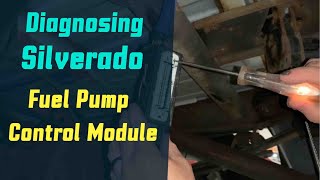
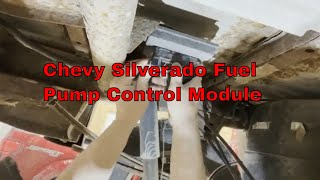
How to confirm: Visually inspect the FPCM for swelling, white, crusty corrosion, or damage to the case and connectors. 🎬 Watch: How to diagnose a failing fuel pump control module. Check for related codes like U0109 (Lost Communication with FPCM) or P069E (FPCM Fault), which strongly point to the module.
Typical fix: Replace the Fuel Pump Control Module. Genuine GM/ACDelco replacement modules (like P/N 20856290) often require programming by a dealer. Aftermarket options, like the Dorman 601-044, are typically plug-and-play and do not require programming.
Est. part cost: $70-$150 - Failed Secondary (Rear) Fuel Pump 🟡 Medium Probability → Shop Fuel Pump The electric pump in the rear tank can wear out and fail like any other fuel pump. This is especially true on high-mileage work trucks.
How to confirm: With a scan tool, command the secondary fuel pump on. Listen for an audible hum from the rear tank. If there is no sound and the FPCM and wiring are confirmed good, the pump has likely failed. A flow test as described in TSB PIT5510 can also be performed: operate the pump for 2 minutes; it should transfer over 2.6 liters (0.7 gallons).
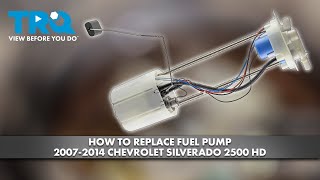
Typical fix: Replace the rear fuel tank's fuel pump module assembly. This requires dropping the rear fuel tank. 🎬 Watch this walkthrough on replacing the fuel pump assembly.
Est. part cost: $250-$500 - Kinked or Clogged Fuel Transfer Line ⚪ Low Probability The line between the two tanks can be kinked or damaged during service or from road debris. TSB PIT5510D specifically warns technicians to check for kinks in the line, even on new replacement parts, as they can be bent during shipping or installation.
How to confirm: If the FPCM and pump are known to be good but fuel is still not transferring, a physical inspection of the fuel lines between the tanks is necessary. The conduit may need to be slid back to reveal a kink in the plastic line underneath.
Typical fix: Repair or replace the damaged section of the fuel transfer line.
Est. part cost: $50-$150
Rare But Worth Checking
- Wiring Harness Damage: The wiring to the FPCM can become chafed or corroded, mimicking a module failure. It's worth inspecting the harness near the FPCM before replacing the module. Specifically, the Dark Green/White signal wire can break between the ECM and FPCM. Check for a solid ground, which is a black wire bolted to the driver's side frame rail near the FPCM.
- Collapsed Rear Fuel Tank: → Shop Fuel Tank On some newer models, TSB 19-NA-206 describes how dirt and debris can clog the rear tank's vent, causing the transfer pump to create a vacuum and collapse the tank. While this TSB is for newer models, a clogged vent on a 2007-2010 truck could still restrict flow and contribute to a P2636 code.
Diagnosis Steps
- First, ask the driver if they refuel with the vehicle running or the key on. If so, advise them to stop, clear the codes, and see if the problem is resolved. This is the official first step recommended by GM TSB PIT5208A.
- Scan for other DTCs. Codes U0109 or P069E strongly point to the FPCM.
- Locate the FPCM on the driver-side frame rail, typically ahead of the spare tire. Visually inspect the module and its electrical connector for heavy corrosion, swelling, or physical damage.
- Using a capable scan tool, command the secondary fuel pump ON while monitoring fuel level data for both tanks.
- Listen for the pump to activate in the rear tank. If it runs, check the scan tool data to see if the rear tank level decreases and the front tank level increases. The change should be about 1 gallon in 2 minutes.
- If the pump does not run, test for power and ground at the FPCM. Check for constant 12V+ at Pin 32 (Red/White) and ignition voltage at Pin 15 (Pink). Check for less than 1 ohm of resistance to ground at Pin 1 (Black). If inputs are good, test the output to the pump. No output indicates a bad FPCM.
- If the pump runs but fuel does not transfer (or transfers slowly), inspect the fuel lines between the tanks for visible kinks or damage, as noted in TSB PIT5510D.
- If the FPCM has power out but the pump doesn't run, the rear fuel pump is the primary suspect.
Parts You'll Likely Need
- Fuel Pump Control Module
(OEM #20856290)— This module is the most common point of failure due to its vulnerable mounting location on the frame rail, leading to corrosion.
Trusted brands: ACDelco (OEM), Dorman (e.g., 601-044, often plug-and-play)
OEM price range: $100-$180
Aftermarket price range: $70-$120 - Secondary Fuel Pump and Sender Assembly — If the transfer pump itself fails, it must be replaced. This part is located inside the rear fuel tank and requires dropping the tank to access.
Trusted brands: ACDelco, Delphi, Spectra Premium
OEM price range: $350-$500
Aftermarket price range: $250-$400
Related Codes That Often Appear With This One
- U0109 — This code means 'Lost Communication With Fuel Pump Control Module' and is a strong indicator that the FPCM has failed or its wiring is compromised.
- P069E — This code indicates an internal fault has been requested by the FPCM itself, pointing directly to a failing module. 🎬 See how to troubleshoot U0109 and fuel pump module faults.
Technical Service Bulletins (TSBs) & Recalls
- PIT5208 / PIT5208A: Documents the issue of the fuel gauge showing empty and P2636 setting after refueling with the key or engine on.
- PIT5510D: Notes that a kinked fuel transfer line can cause a repeat P2636 and provides diagnostic advice, including a specific flow rate test.
- 17067: A product emission recall for 2015-2016 diesel models with dual tanks to correct a fuel transfer issue that sets P2636. While not for the 2007-2010 models, it shows the long-standing nature of this system's sensitivity.
Platform-Specific Known Issues
- A known issue, documented in TSB PIT5208A, where refueling with the ignition on causes the fuel gauge to read empty and sets code P2636.
- TSB PIT5510D warns that the fuel transfer line can become kinked during installation, which will cause a repeat P2636 code even after parts are replaced. The TSB advises technicians to slide back the protective conduit to inspect the line itself.
Mechanic-Grade Diagnostic Values
- FPCM Connector Pin 32 (Red/White) to Ground — expected: 12V+ (Constant Battery Voltage). Failure: No voltage points to a blown fuse (likely the 20A FSCM fuse) or a break in the power wire.
- FPCM Connector Pin 15 (Pink) to Ground — expected: 12V+ with Ignition ON. Failure: No voltage indicates a problem with the ignition circuit or fuse supplying the FPCM.
- FPCM Connector Pin 13 (Dark Green/White) to Ground — expected: 12V for 2-6 seconds when key is first turned to 'ON' (ECM commanding pump prime). Failure: No voltage indicates a problem with the ECM or a broken wire between the ECM (Pin 50) and the FPCM.
- FPCM Connector Pin 1 (Black) to Chassis Ground — expected: < 1.0 ohm. Failure: High resistance indicates a corroded or broken ground connection at the frame rail.
- Secondary Fuel Pump Amperage Draw — expected: 4 to 8 amps at normal operating pressure. Failure: Significantly higher draw suggests a failing pump or restriction; lower draw suggests a wiring or ground issue.
Scan Tool Commands That Help
- Tech2 / GDS2 or equivalent: Fuel Pump ON/OFF Command — Used during diagnosis to manually activate the secondary fuel pump to listen for its operation and to verify power is being sent from the FPCM.
- Dealer-level Scan Tool: PCM-FPCM Handshake Test — This function tests the communication integrity on the CAN bus between the main engine computer and the fuel pump module. A failure indicates a wiring or module firmware issue.
Wiring & Ground Locations
- FPCM Ground — Black wire bolted to the inside of the driver's side frame rail, near the FPCM and spare tire.. This is the main ground for the Fuel Pump Control Module. Corrosion here is extremely common and causes high resistance, leading to low voltage, poor pump performance, and codes P2636 or U0109.
- ECM Pin 50 (Dark Green/White wire) — In the black connector of the Engine Control Module (ECM).. This is the source of the 'pump on' command signal. If there is no voltage at FPCM Pin 13, testing for 12V at this pin can determine if the ECM is sending the signal, isolating the fault to the wire between the ECM and FPCM.
- G303 — On the lower left 'B' pillar on extended cab and crew cab models.. This is a major body ground point. While not the primary FPCM ground, poor connections here can cause a variety of strange electrical issues on the vehicle that could potentially interfere with module communication.
"I Checked Everything" — The Actual Cause
- A common scenario for a repeat P2636 is when a technician replaces the FPCM and/or the rear fuel pump, but the code returns. GM TSB PIT5510D warns that the actual cause is often a kinked fuel transfer line between the two tanks. The kink is frequently hidden under a protective conduit and is missed during visual inspection, restricting fuel flow enough to trigger the code even with all new electronic components.
OEM Part Supersession History
20856290→23184800, then 23199128, then 23482843, and currently 23382215.— Part has been updated multiple times by the manufacturer.
Heads up: These are official GM supersessions. The latest part number, 23382215, requires programming and/or special setup procedures after installation.
Model Year Variations Within This Range
- 2007-2010: No significant variations related to the cause of P2636 have been documented within this specific model year range for dual-tank trucks. The primary causes (refueling procedure, FPCM corrosion, kinked lines) are consistent across these years.
Helpful Videos

Used OEM Parts in Stock
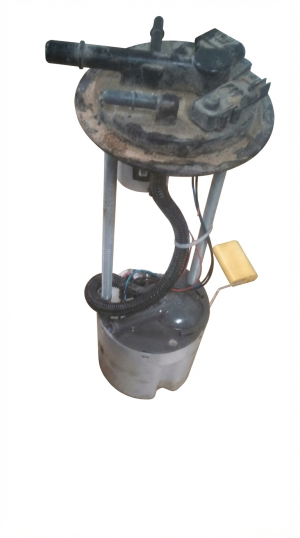
New Aftermarket Parts Available

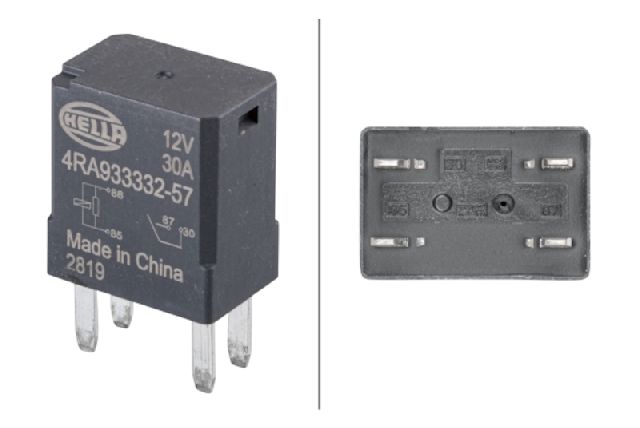



The information in this article is provided for general reference and educational purposes only. Vehicle specifications, procedures, and part compatibility can vary by production date, trim level, and region. Always consult your vehicle's factory service manual and verify part numbers before purchasing or performing repairs. Safety-critical components such as airbags, seat belts, and braking systems should be installed by a qualified professional.
- Chevrolet SILVERADO 2500:
- 🧭 Diagnostic Flowchart
- 🎬 Helpful Videos
- 🛍️ Shop This Part
- What's Unique About the 2007-2010 Chevrolet SILVERADO 2500
- Symptoms You May Notice
- Most Likely Causes
- Rare But Worth Checking
- Diagnosis Steps
- Parts You'll Likely Need
- Related Codes That Often Appear With This One
- Technical Service Bulletins (TSBs) & Recalls
- Platform-Specific Known Issues
- Mechanic-Grade Diagnostic Values
- Scan Tool Commands That Help
- Wiring & Ground Locations
- "I Checked Everything" — The Actual Cause
- OEM Part Supersession History
- Model Year Variations Within This Range
- 🎟️ Get 5% Off