

P2681 on 2013-2014 Ford Fusion: Engine Coolant Bypass Valve Circuit Causes and Fixes
On a 2013-2014 Ford Fusion, especially with an EcoBoost engine, code P2681 is most often caused by a failed engine coolant bypass valve. Before replacing the valve (around $40-$90 for the part), check for a blown fuse in the under-hood fuse box, as a damaged wire could be the root cause.
- P2681 means the computer has lost electrical connection to the coolant bypass valve.
- The most common fix is replacing the valve itself, but always check for a blown fuse first.
- A blown fuse strongly suggests a shorted wire in the engine harness, which must be found and repaired.
- Symptoms include a Check Engine Light, no cabin heat, and potential engine overheating.
- This repair is generally DIY-friendly with basic tools, with a difficulty of 2 out of 5.
What's Unique About the 2013-2014 Ford Fusion
While there are no specific Technical Service Bulletins (TSBs) for code P2681 on the 2013-2014 Fusion, the closely related Ford Escape has well-documented issues with this system. TSBs for the Escape (like SSM 47575) point to a wiring harness that can rub against the engine or chassis, causing a short that blows the fuse for the bypass valve circuit. Given the shared EcoBoost powertrains, Fusion owners should be highly suspicious of a wiring issue or blown fuse. Additionally, owners of the 1.5L and 1.6L EcoBoost engines should be aware of separate, more severe issues regarding potential coolant intrusion into the engine cylinders, which causes different symptoms but is a critical issue for those specific engines.
Symptoms You May Notice
- Check Engine Light is on
- Reduced or no heat from the cabin vents.
- Engine temperature gauge fluctuates, rises rapidly, or shows an overheat warning.
- Engine takes longer than usual to warm up to operating temperature.
- Vehicle may enter a reduced power "limp mode", sometimes with violent shaking.
- Cooling fans may run continuously at high speed, even when the engine is not hot.
- Replacing the thermostat. The thermostat is a mechanical part, whereas P2681 is a purely electrical circuit fault code.
- Replacing the Engine Coolant Temperature (ECT) sensor. A faulty ECT sensor would set its own specific trouble codes (e.g., P0115-P0119), not P2681.
Most Likely Causes
- Failed Engine Coolant Bypass Valve 🔴 High Probability The internal solenoid coil of the valve is a common failure point on many modern Ford vehicles, creating an open circuit. This is the most frequent cause when P2681 appears alone.
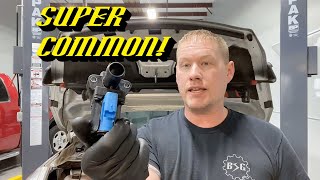
How to confirm: Disconnect the valve's electrical connector. Use a multimeter to measure the resistance between the two pins on the valve itself. A healthy valve should read between 7 and 17 ohms (a reading of 10.1 ohms was shown on a good valve in one video). Some sources state a wider acceptable range of 10-30 Ω or even 10-100 Ω. An infinite resistance (OL) reading indicates a failed, open coil and confirms the valve must be replaced. 🎬 Watch: How to test the valve solenoid with a multimeter.
Typical fix: Replace the engine coolant bypass valve assembly. This requires draining some coolant (often less than a liter is lost), removing the electrical connector, a hose clamp, and two 8mm mounting bolts. Ensure the new valve's O-ring is properly seated before installation to prevent leaks.
Est. part cost: $40-$90 - Blown Fuse / Damaged Wiring Harness 🟡 Medium Probability Related Ford models like the Escape have known issues (TSB SSM 47575 and SSM 48895) where an improperly routed wiring harness chafes against the engine or chassis, causing a short to ground that blows the fuse for this circuit. This is especially likely if other codes appear alongside P2681.
How to confirm: Visually inspect the fuses in the under-hood fuse box (Power Distribution Box). On the related Ford Escape, this circuit is protected by a 10A fuse in position F34. While the Fusion's fuse layout differs, check all 10A and 15A fuses related to the PCM and engine controls (e.g., Fuses 7, 8, 11, 12, 26). If a fuse is blown, inspect the wiring harness leading to the bypass valve for any signs of rubbing, melting, or bare wires.
Typical fix: If a blown fuse is found, locate and repair the shorted wire by insulating it with heat-shrink tubing and electrical tape. Then, replace the blown fuse. Do not simply replace the fuse without finding the short, as it will blow again.
Est. part cost: $1-$10 - Corroded or Loose Electrical Connector ⚪ Low Probability The valve is located in the engine bay where moisture and dirt can compromise the electrical connection over time. On some Escapes, coolant from a leaking valve has been seen to cause corrosion on the connector itself.
How to confirm: Unplug the connector at the coolant bypass valve and visually inspect the pins and terminals for any green or white corrosion, moisture, or damage.
Typical fix: Clean the connector terminals with an electrical contact cleaner and a small brush. Ensure the connector is fully seated and clicks into place. Replace the connector pigtail if corrosion is severe. The pigtail for the 1.6L is available under part number WPT1352.
Est. part cost: $0-$25
Rare But Worth Checking
- Faulty Powertrain Control Module (PCM): → Shop Engine Control Module (ECM) This is very rare. The PCM's internal driver for the valve circuit can fail. This should only be considered after all other possibilities (valve, wiring, fuses) have been exhaustively ruled out.
Diagnosis Steps
- Read the trouble codes with an OBD-II scanner.
- Open the under-hood fuse box and inspect the low-amperage fuses related to the powertrain. Based on Ford EcoBoost platforms, pay close attention to 10A and 15A fuses. For a 2013-2014 Fusion, check fuses F7, F8, F11, F12, and F26 in the engine bay fuse box. If a fuse is blown, do not replace it yet.
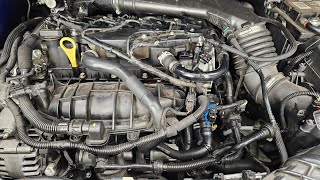
- Locate the engine coolant bypass valve. On 1.6L EcoBoost engines, it's typically mounted to the cylinder head with two 8mm bolts and has one hose and one electrical connector 🎬 See this walkthrough on how to replace the bypass valve. with a blue tab.
- Carefully inspect the wiring harness leading to the valve. Look for any areas where it might be rubbing against the engine, other components, or sharp edges of the chassis. This is a known issue on platform mates.
- If a damaged wire is found, repair it using heat-shrink connectors and wrap the area in protective loom. Then, replace the blown fuse.
- If the wiring and fuse appear intact, disconnect the electrical connector at the bypass valve. Inspect for corrosion.
- Using a multimeter set to Ohms (Ω), measure the resistance across the two pins on the valve itself. A reading of infinity or 'OL' confirms the valve's internal circuit is open and it needs to be replaced. A good valve should read approximately 7-17 Ohms, though some sources list a wider tolerance up to 100 Ohms.
- If the valve's resistance is within spec, the problem lies in the wiring between the connector and the PCM. A wiring diagram is needed to test for continuity and shorts to ground on those specific wires. Check for battery voltage at the power wire and check the ground wire for continuity to a known good ground like the battery negative terminal.
Parts You'll Likely Need
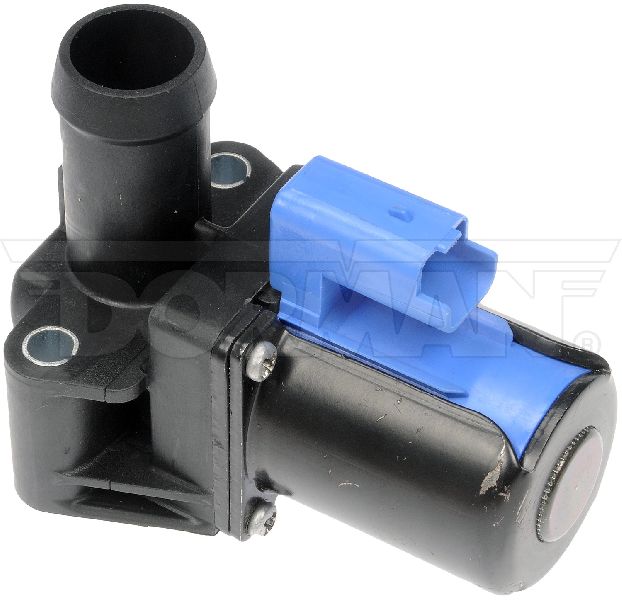
- Engine Coolant Bypass Valve
(OEM #YG-780 (Motorcraft, for 1.6L))— The internal solenoid of this valve is the most common component to fail, causing the 'open circuit' fault.
Trusted brands: Motorcraft, Dorman, SKP
OEM price range: $60-$120
Aftermarket price range: $40-$90
Related Codes That Often Appear With This One
- P0034, P023A, P0245, P0480 — On related Ford models, the coolant bypass valve shares a fuse with the A/C clutch, turbocharger wastegate, and cooling fans. If a wiring short blows this shared fuse, multiple codes may appear at once.
Technical Service Bulletins (TSBs) & Recalls
- SSM 47575 / SSM 48895 (Ford Escape): While for the Escape, these TSBs are highly relevant as they document that code P2681 can be caused by a chafed wiring harness blowing fuse F34. Manufacturer bulletin SSM 48895 specifically notes that an open fuse F34 can result in an illuminated MIL and DTC P2681 in the powertrain control module.
- TSB 20-2100 / TSB 19-2346 (Ford Fusion, others): Documents a known issue of coolant intrusion into the cylinders on 2017-2019 Fusions with the 2.0L EcoBoost engine, a critical cooling system problem separate from P2681. A similar issue affects the 1.5L engine.
- Recall 17S09: Addressed fire risk from overheating on 1.6L EcoBoost engines in 2013-2014 Fusions by installing a coolant level sensor system.
Platform-Specific Known Issues
- While not a direct cause of P2681, 2014 Fusion models with the 1.5L EcoBoost engine are subject to TSB 20-2100 for coolant intrusion into the cylinders due to a block design issue. Symptoms include coolant loss, white smoke, and misfire codes (P030x). This is a severe issue requiring engine replacement and is important context for any cooling system problem on this engine.
- The 1.6L EcoBoost engine used in 2013-2014 Fusions was subject to multiple recalls (e.g., 17S09) for engine overheating that could lead to a cracked cylinder head and fire risk. While the fix involved adding a coolant level sensor, it highlights the sensitivity of the cooling system on this engine.
Mechanic-Grade Diagnostic Values
- Engine Coolant Bypass Valve Solenoid Resistance — expected: 7-17 Ohms is the tightest spec, but some sources allow for a wider range of 10-100 Ohms.. Failure: A reading of 'OL' (Open Loop) or infinite resistance indicates a failed internal coil.
- Valve Position Sensor PID Voltage (Scan Tool) — expected: Voltage should vary smoothly from approximately 0.5V (closed) to 4.5V (fully open) as the valve is commanded by the scan tool.. Failure: A stagnant or erratic voltage reading while commanding the valve suggests a control circuit problem.
- Ground Circuit Voltage Drop — expected: Less than 0.2 volts (200mV).. Failure: A reading above 0.2V indicates excessive resistance in the ground circuit, which can cause the open circuit code.
- Control Circuit Voltage at Connector (Key On, Engine Off) — expected: Depending on system design, one pin should have battery voltage (~12V) from a fuse, and the other is the control wire from the PCM.. Failure: Absence of voltage on the power supply pin points to a blown fuse or open wire from the fuse box. Absence of a signal change on the control wire when commanded points to a wiring or PCM issue.
Scan Tool Commands That Help
- Ford IDS, FORScan, or other professional bidirectional scanner: Coolant Bypass Valve Active Command / On-Off Test — Use this command after confirming the valve's resistance is good. Activating the valve while monitoring voltage at the connector will confirm if the PCM is sending the control signal and if the wiring is intact. If the command is sent but voltage doesn't change at the valve, the fault is in the wiring. If the valve clicks, the circuit is likely good and the valve may be mechanically stuck.
Wiring & Ground Locations
- G104 — A primary engine compartment ground, typically located on the right rear of the transmission or at the left front corner of the engine compartment, near the Battery Junction Box (BJB).. A poor connection at this main ground can cause a variety of intermittent powertrain circuit faults, including P2681.
- G107 — Located in the engine compartment.. This is another ground point for the engine control system. Verifying its integrity is a key step when diagnosing complex electrical faults.
- Battery Junction Box (BJB) — Located in the left side of the engine compartment.. This under-hood fuse box contains the fuses (e.g., F7, F8, F11, F12, F26) that supply power to the PCM and the engine control circuits, including the coolant bypass valve.
- Harness Chafe Point — No single documented point on the Fusion, but based on the related Escape TSB, inspect the engine wiring harness (near part number 12A690) where it may rub against the engine block, transmission, or chassis edges.. This is the most likely location for a short-to-ground that would blow the control circuit fuse, which is a very common cause for this code on Ford EcoBoost platforms.
Real Owner Repair Stories
- Go-Parts.com repair case study (2017 Ford Escape 1.5L (platform mate)) — Check Engine Light, AWD Fault warning, and vehicle entered 'limp mode' with reduced power.
❌ Tried (didn't work) Initially, the owner may have considered replacing the valve itself.
✅ What actually fixed it The owner followed TSB SSM 48895, checked fuse F34 (10A) in the under-hood fuse box and found it was blown. After locating a chafed wire on the engine block, they repaired the wire with tape and replaced the $1 fuse, which resolved all symptoms and codes permanently. - NHTSA ODI #11594427: An owner reported pulling a P2681 engine light error for an issue with the coolant bypass valve on a platform-mate vehicle, following a previous repair where the degas bottle and mount were replaced.
OEM Part Supersession History
BM5Z-18495-A, BM5Z-18495-B→BM5Z-18495-C (Motorcraft YG-780)— Standard part revision and improvement by the manufacturer.
Heads up: The older -A and -B revisions are no longer available and should be replaced with the -C revision.
Diagnostic Flowchart
Other Known Issues on This Vehicle
Issues unrelated to this code that are worth knowing about as an owner of this generation:
- Coolant Intrusion into Cylinders (1.5L, 1.6L, 2.0L EcoBoost) 🔴 High — A widely documented problem across multiple EcoBoost engines, leading to a class-action lawsuit. Can occur at various mileages. Symptoms include coolant loss, white exhaust smoke, and misfires. (Ref: TSB 19-2346 (2.0L), TSB 20-2100 (1.5L), Recall 17S09 (1.6L).)
- Shifter Cable Bushing Failure (6F35 Automatic Transmission) 🟠 Medium — Very common problem. The bushing degrades, causing the shifter cable to detach from the transmission. The car may not go into the selected gear or may roll away when in Park. (Ref: NHTSA Recall 22V-452)
- Harsh Shifting / Transmission Failure (6F35 Automatic Transmission) 🟠 Medium — Common complaints for 2012-2014 models include shuddering, jerking, and hesitation. Problems can range from needing software updates to complete transmission replacement.
- Power Steering Failure 🔴 High — The electronic power steering rack is known to fail, resulting in a sudden loss of power assist. This is an expensive repair, often costing over $2,000. (Ref: Multiple TSBs exist, but no widespread recall for this specific failure.)
- Overheating and Fire Risk (1.6L EcoBoost) 🔴 High — Specific to the 1.6L engine, a design flaw could lead to cylinder head cracking, oil leaks, and potential engine fires. (Ref: NHTSA Recalls 13V-583, 17S09)
Used vs. New Parts: Buying Guide for This Vehicle
When a used part is the smart pick: A used wiring connector pigtail from a salvage yard is a smart, cost-effective choice if only the connector is damaged. The bypass valve itself is a common failure item, so a used valve is a significant gamble and generally not recommended unless the donor vehicle has very low mileage.
Donor-vehicle mileage cap: roughly under 60000 miles for the part to have meaningful remaining life.
What to inspect on the donor part:
- For a connector pigtail: ensure the plastic is not brittle, the locking tab is intact, and the pins are clean and free of corrosion.
- For a valve: inspect for any signs of coolant leakage (white or pink crust) around the seams or electrical connector. Ensure the connector pins are straight and clean.
OEM-only on this vehicle (don't cheap out):
- Powertrain Control Module (PCM) - Due to programming requirements, a new or professionally remanufactured PCM is essential if this rare failure occurs.
Aftermarket brands forum-validated for this vehicle:
- Motorcraft (OEM)
- Dorman
- SKP
Related OBD-II Codes
Frequently Asked Questions
My 2014 Fusion has the 1.6L engine and is overheating. Is this related to the big recall I heard about?
I have code P2681 on my Fusion. Could it be a wiring problem like on the Ford Escape?
What resistance reading confirms the coolant bypass valve has failed on my 2013 Fusion?
Which specific fuses should I check first for a P2681 code on a 2013-2014 Fusion?
My 2014 Fusion has the 1.5L engine, is losing coolant, and has white smoke. Is this P2681?
I need to replace the electrical connector for the coolant bypass valve. Is there a specific part number?
Helpful Videos
We Have This Part in Stock

The information in this article is provided for general reference and educational purposes only. Vehicle specifications, procedures, and part compatibility can vary by production date, trim level, and region. Always consult your vehicle's factory service manual and verify part numbers before purchasing or performing repairs. Safety-critical components such as airbags, seat belts, and braking systems should be installed by a qualified professional.
- Ford Fusion:
- 🧭 Diagnostic Flowchart
- 🎬 Helpful Videos
- 🛍️ Shop This Part
- What's Unique About the 2013-2014 Ford Fusion
- Symptoms You May Notice
- Most Likely Causes
- Rare But Worth Checking
- Diagnosis Steps
- Parts You'll Likely Need
- Related Codes That Often Appear With This One
- Technical Service Bulletins (TSBs) & Recalls
- Platform-Specific Known Issues
- Mechanic-Grade Diagnostic Values
- Scan Tool Commands That Help
- Wiring & Ground Locations
- Real Owner Repair Stories
- OEM Part Supersession History
- Other Known Issues on This Vehicle
- Used vs. New Parts: Buying Guide for This Vehicle
- Related OBD-II Codes
- Frequently Asked Questions
- 🎟️ Get 5% Off