

P2700 on 2009-2014 Ford E-250: Transmission Clutch Failure Causes and Fixes
On a 2009-2014 Ford E-250 with a TorqShift® 5R110W transmission, code P2700 almost always points to an internal transmission failure. A Ford Technical Service Bulletin (TSB 16-0057) identifies a faulty coast clutch cylinder with a failed weld as the primary cause. This is a major, professional-level repair requiring transmission removal and disassembly.
- P2700 on a 2009-2014 E-250 is a serious transmission code, strongly pointing to a specific internal mechanical failure.
- Check for Ford TSB 16-0057, as it directly addresses this code and provides a clear repair path.
- This is not a DIY-friendly repair. It requires transmission removal and disassembly by a professional technician.
- The issue is often accompanied by codes P0751 and P0730, which further confirms the diagnosis in the TSB.
- Simply changing the fluid or replacing external sensors will not fix the root cause if the TSB applies to your vehicle.
What's Unique About the 2009-2014 Ford E-250
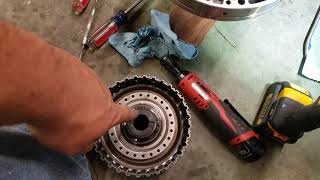
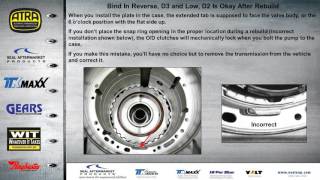
For this specific generation of Ford E-250 with the TorqShift® 5R110W automatic transmission, the P2700 code is the subject of a specific Technical Service Bulletin (TSB 16-0057). This isn't a random failure; Ford identified a specific problem in transmissions built on or before December 15, 2015, where an internal component—the coast clutch cylinder—has a weld that is prone to failure. 🎬 Watch: See exactly how the coast clutch weld fails. This failure prevents the transmission from transmitting torque, leading to a loss of motive power, often when accelerating from a stop. The TSB directly links this failure to DTCs P2700, P0751, and P0730, making diagnosis more direct than on other vehicles.
Diagnostic Flowchart
Tap your situation to follow the diagnostic path that matches what you're seeing on this vehicle.
Symptoms You May Notice
- Illuminated Malfunction Indicator Lamp (Check Engine Light).
- Flashing Tow/Haul light.
- Harsh, delayed, or 'clunking' shifts between gears.
- Transmission slipping, where engine RPMs increase but vehicle speed does not.
- Transmission may enter 'limp mode,' getting stuck in a single gear.
- Delayed engagement when shifting from Park to Drive or Reverse.
- Complete loss of forward and reverse gears.
- No engine braking when coasting downhill. 🎬 Watch: A breakdown of common 5R110W transmission problems.
- Replacing shift solenoids without addressing the underlying mechanical fault described in TSB 16-0057.
- Replacing the entire transmission when only the specific coast clutch components need to be replaced, as outlined in the TSB.
- Assuming a fluid change will fix the problem when significant internal clutch debris is present.
Most Likely Causes
- Faulty Coast Clutch Cylinder and/or One-Way Clutch 🔴 High Probability → Shop Automatic Transmission Coast Clutch Hub This is a known issue documented by Ford in TSB 16-0057 for TorqShift® transmissions built on or before 12/15/2015, affecting E-Series, F-Super Duty, and other models. A related recall (19S20) was issued due to the risk of a failed weld on the coast clutch cylinder causing a loss of power.
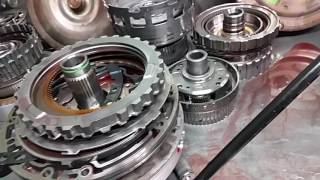
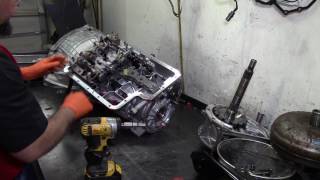
How to confirm: Confirm the vehicle has a TorqShift® transmission built before the specified date and is showing DTCs P2700, P0751, and/or P0730. A technician can perform an air pressure test on the coast clutch port after removing the solenoid body; a hissing sound indicates a leaking cylinder weld. Ultimate confirmation requires transmission disassembly and inspection. 🎬 Watch: A professional teardown and inspection of this transmission.
Typical fix: Remove and disassemble the transmission to replace the coast clutch cylinder and the coast one-way clutch (OWC) assembly.
Est. part cost: $200-$400 for the specific internal parts. - Low or Contaminated Transmission Fluid 🟡 Medium Probability → Shop Transmission Assembly
How to confirm: Check the transmission fluid level and condition. The fluid should be at the correct level, bright red, and not have a burnt smell. Dark, burnt fluid or fluid with metal or non-metallic clutch debris indicates a serious internal problem, likely related to the primary coast clutch failure.
Typical fix: If the fluid is low, top it off and repair any leaks. If it's dirty or contaminated, a fluid and filter change with Motorcraft MERCON LV is a first step, but it will not fix an internal mechanical failure. This is often a symptom, not the root cause for this specific code.
Est. part cost: $75-$150 for fluid and a new filter. - Faulty Transmission Solenoid or Solenoid Body ⚪ Low Probability → Shop Transmission Assembly
How to confirm: A professional scan tool can command solenoids on and off to check for response. The solenoid body can be inspected for sticking valves or clogged passages once the transmission pan is removed. However, owners on forums have reported replacing the solenoid pack for these codes only to find the problem persisted, pointing back to the internal mechanical failure.
Typical fix: Replace the specific faulty solenoid or the entire solenoid body assembly. This is an unlikely fix for this specific code on this vehicle due to the prevalence of the coast clutch failure described in the TSB.
Est. part cost: $100-$300 for a single solenoid, $500-$1000+ for a valve body.
Rare But Worth Checking
- Faulty Transmission Control Module (TCM): → Shop Transmission Assembly While rare, a malfunctioning TCM can misinterpret data and set false codes. This should only be considered after all mechanical and hydraulic issues have been ruled out. A faulty PCM was noted in one forum thread as a separate issue, but the primary cause of P2700 is almost always mechanical.
- Damaged Wiring Harness: Corrosion or damage to the wiring between the TCM and the transmission can cause communication errors or solenoid faults. A visual inspection of the harness is a necessary step in a thorough diagnosis, but is unlikely to be the root cause if P2700 is accompanied by P0751 and P0730.
Diagnosis Steps
- Check and verify the transmission fluid level and condition. Ensure it is full, clean, and of the correct type (MERCON LV). Note any burnt smell or visible debris.
- Use a professional scan tool to confirm the presence of P2700 and check for other related codes like P0751 and P0730.
- Check the transmission build date. If it was built on or before 12/15/2015, TSB 16-0057 is highly relevant.
- Inspect the transmission wiring harness and connectors for any visible damage, corrosion, or loose connections.
- If the TSB applies, a technician can perform an air pressure test on the coast clutch port after removing the transmission pan and solenoid body. A hissing sound confirms a leak in the coast clutch cylinder.
- If the air test confirms a leak, the next step is to follow the TSB service procedure, which involves removing the transmission for internal inspection and replacement of the coast clutch cylinder and OWC.
- If the TSB does not apply and the air test passes, further diagnosis of the valve body, solenoids, and hydraulic pressures would be necessary before condemning internal hard parts.
Parts You'll Likely Need
- Coast Clutch Cylinder
(OEM #7C3Z-7G387-B)— This is the primary causal part identified in Ford's TSB 16-0057 for this specific issue due to a faulty weld.
Trusted brands: Motorcraft
OEM price range: $90-$140
Aftermarket price range: $70-$120 - Coast One-Way Clutch (OWC)
(OEM #7C3Z-7A089-A)— This part is replaced along with the coast clutch cylinder as per the TSB 16-0057 repair procedure.
Trusted brands: Motorcraft
OEM price range: $120-$180
Aftermarket price range: $80-$140 - Transmission Filter and Gasket Kit
(OEM #8C3Z-7A098-D)— This is required as part of the transmission service and reassembly process outlined in the TSB.
Trusted brands: Motorcraft
OEM price range: $40-$60
Aftermarket price range: $20-$40 - Motorcraft MERCON LV Automatic Transmission Fluid
(OEM #XT-10-QLVC)— The transmission must be refilled with the correct specification fluid after the repair. The 5R110W is sensitive to fluid type.
Trusted brands: Motorcraft
OEM price range: $8-$12 per quart
Aftermarket price range: $7-$10 per quart
Related Codes That Often Appear With This One
- P0751 — Stands for 'Shift Solenoid 'A' Performance/Stuck Off'. This code is explicitly mentioned in TSB 16-0057 alongside P2700. The mechanical failure of the coast clutch prevents the hydraulic circuit controlled by Solenoid 'A' from operating correctly, leading the TCM to flag the solenoid's performance.
- P0730 — Stands for 'Incorrect Gear Ratio'. This code is also listed in TSB 16-0057. It is triggered when the TCM detects that the transmission is slipping because the failing coast clutch cannot properly engage and hold the commanded gear, resulting in a mismatch between engine speed and output shaft speed.
Technical Service Bulletins (TSBs) & Recalls
- TSB 16-0057 / TSB160057: Torqshift Transmission - Malfunction indicator lamp (MIL) diagnostic trouble codes (DTCS) P0751, P0730 and/or P2700
Platform-Specific Known Issues
- TSB 16-0057: Ford issued this bulletin for 2009-2016 E-Series vans with a TorqShift® transmission built on or before 12/15/2015. It states that vehicles may exhibit a Malfunction Indicator Lamp with DTCs P0751, P0730, and/or P2700. The prescribed fix is to remove the transmission and replace the coast clutch cylinder and coast one-way clutch assembly.
- Safety Recall 19S20: Related to the TSB, Ford issued a recall because the failing weld on the coast clutch cylinder could cause a sudden loss of motive power, increasing the risk of a crash.
Mechanic-Grade Diagnostic Values
- Line Pressure (in Reverse) — expected: Approx. 100 PSI at idle, 320 PSI at stall speed. Failure: Significantly lower pressure indicates a pump, valve body, or major leak issue.
- Line Pressure (in Drive) — expected: Approx. 70 PSI at idle, 320 PSI at stall speed. Failure: Low pressure points to hydraulic system faults rather than a specific clutch solenoid.
- Shift Solenoid Resistance (SSPC-A, B, C, D, E, TCC) — expected: 4.1 - 5.8 Ω at approx. 70°F (varies by specific solenoid). Failure: A reading outside of this range indicates a faulty solenoid coil.
- Ground Path Voltage Drop — expected: Less than 0.2 Volts. Failure: Voltage greater than 0.2V when measured from the starter body to the negative battery post during cranking indicates a poor ground connection.
Scan Tool Commands That Help
- Ford IDS, FORScan, high-end Snap-On: Output Control / Command Solenoids — To individually command solenoids on and off to check for an electrical response. However, forum experts note that with codes P2700/P0751, the issue is almost always mechanical, making this test less conclusive.
- Ford IDS or equivalent: Transmission Adaptive Strategy Relearn — This procedure is required after any transmission repair or replacement to prevent harsh or firm engagements. It involves a specific sequence of shifting between Park, Reverse, Neutral, and Drive with the engine warm.
Wiring & Ground Locations
- Transmission Case Connector — Large square black connector on the passenger side of the transmission, towards the bell housing.. This is the main electrical interface for all transmission solenoids and sensors. Pin 17 (White/Yellow wire) is the signal for Pressure Switch 'A' (Coast Clutch), which is directly related to P2700.
- Added Ground Strap (Recommended) — From the front of the driver's side cylinder head to the driver's side frame rail, at the same location as the main battery negative cable attachment point.. Poor grounding can cause starter current to seek a path through the transmission, leading to arcing that damages the torque converter and front pump, causing catastrophic failure. Adding this strap provides a direct ground path and is considered a critical preventative measure for the 5R110W.
- PCM Connector 'B' — The Powertrain Control Module (PCM) is located behind the left-hand battery.. This connector contains the control circuits for the transmission solenoids. For example, Pin 9 (Orange/Yellow wire) is the ground control for SSPC-A. Testing can be done at these pins to verify continuity from the PCM to the transmission.
Real Owner Repair Stories
- Ford Truck Enthusiasts Forum (Ford Super Duty with 5R110W) — Sudden loss of transmission function while driving, codes P0751 and P2700.
❌ Tried (didn't work) The owner's initial plan was to replace the Shift Solenoid 'A' (SSPC-A).
✅ What actually fixed it The owner updated the post to warn others that the codes were caused by a lack of hydraulic pressure from a locked-up pump, not the solenoid itself. The final advice was to perform a line pressure test before replacing any electrical components. - PowerStrokeArmy Forum (2006 Ford F-350 6.0L with 5R110W) — No forward gears, only Reverse and Park. Codes P1780, P0751, P2700.
❌ Tried (didn't work) N/A
✅ What actually fixed it A Ford transmission engineer on the forum diagnosed the issue as a failed forward clutch. He stated that because the forward clutch is applied hydraulically and not by a specific solenoid for engagement, the loss of all forward gears with a working reverse is a definitive mechanical failure inside the transmission requiring a rebuild. - Ford Truck Enthusiasts Forum (2007 F-250 6.0L with 5R110W) — No forward or reverse engagement, codes P0766, P0751, P2700, and others.
❌ Tried (didn't work) The owner tested the entire electrical system from the PCM through the harness and solenoids, and all resistance values were correct. He also replaced the line pressure and direct clutch solenoids.
✅ What actually fixed it A forum expert (former Ford Trans Engineer) stated that with no movement in any gear but Park holding, it is a definitive internal mechanical failure or a complete loss of fluid. Electrical faults cannot cause this specific symptom. The transmission required a rebuild or replacement.
"I Checked Everything" — The Actual Cause
- A documented issue shows that numerous transmission range and speed sensor codes (P0706, P0715-P0722) and even a no-start condition can be caused by a shorted Electronic Fan Clutch speed sensor. The fan clutch sensor shares a 5V reference voltage circuit with the transmission sensors inside the PCM. A short in the fan clutch can pull this voltage down, causing the transmission sensors to send inaccurate data and set false codes. The fix is to disconnect the fan clutch connector to see if the transmission codes clear and the vehicle starts, then replace the fan clutch if confirmed.
When the Usual Fixes Don't Work
- While P2700 points to a friction element (clutch) timing issue, real-world technician and owner reports for the 5R110W transmission consistently show that replacing electrical components like solenoids for this code is a common misdiagnosis. The root cause is almost always a significant mechanical or hydraulic failure, such as the specific coast clutch weld failure identified in TSB 16-0057, a failed forward clutch, or a failed front pump. If the vehicle has no movement in any gear (forward or reverse), the problem is confirmed to be mechanical/hydraulic, and electrical diagnosis is irrelevant.
OEM Part Supersession History
5C3Z-7A089-BA, 5C3Z-7A089-CA→7C3Z-7A089-A— Updated design for the Coast One-Way Clutch (OWC) assembly.
Model Year Variations Within This Range
- 2009-2014: While the 5R110W transmission was used across many years, the key distinction for this fault is the build date, not model year. Transmissions built on or before December 15, 2015, are susceptible to the coast clutch cylinder weld failure described in TSB 16-0057. There were also minor running changes, such as an updated pan and filter design around 2008.
Helpful Videos
We Have This Part in Stock

The information in this article is provided for general reference and educational purposes only. Vehicle specifications, procedures, and part compatibility can vary by production date, trim level, and region. Always consult your vehicle's factory service manual and verify part numbers before purchasing or performing repairs. Safety-critical components such as airbags, seat belts, and braking systems should be installed by a qualified professional.
- Ford E-250:
- 🧭 Diagnostic Flowchart
- 🎬 Helpful Videos
- 🛍️ Shop This Part
- What's Unique About the 2009-2014 Ford E-250
- Symptoms You May Notice
- Most Likely Causes
- Rare But Worth Checking
- Diagnosis Steps
- Parts You'll Likely Need
- Related Codes That Often Appear With This One
- Technical Service Bulletins (TSBs) & Recalls
- Platform-Specific Known Issues
- Mechanic-Grade Diagnostic Values
- Scan Tool Commands That Help
- Wiring & Ground Locations
- Real Owner Repair Stories
- "I Checked Everything" — The Actual Cause
- When the Usual Fixes Don't Work
- OEM Part Supersession History
- Model Year Variations Within This Range
- 🎟️ Get 5% Off