

P2700 on 2020-2023 Lincoln Aviator: Transmission Clutch Apply Time Fault Causes & Fixes
On a 2020-2023 Lincoln Aviator, code P2700 almost always points to a problem with the transmission's main control valve body, a known issue documented in multiple manufacturer TSBs. This is a complex and expensive repair, often costing $2,000-$3,500+ at a dealership or qualified shop. The issue is widespread across many Ford and Lincoln vehicles using the 10R80 transmission.
- P2700 on a 2020-2023 Aviator is a serious code that almost certainly points to a known defect in the 10R80 transmission, most commonly the main control valve body.
- This is not an isolated issue; it is a well-documented problem across many Ford and Lincoln vehicles, covered by numerous Technical Service Bulletins.
- Repair is complex and expensive, typically involving valve body replacement and software recalibration by a qualified technician.
- Ignoring symptoms like harsh shifting can lead to more severe internal damage, such as CDF drum failure, resulting in a much costlier transmission rebuild.
What's Unique About the 2020-2023 Lincoln AVIATOR
The 2020-2023 Lincoln Aviator uses a 10-speed (10R80) automatic transmission, co-developed with GM, that is known to have issues with its main control valve body. Multiple Technical Service Bulletins (TSBs) have been issued by Ford specifically for harsh shifting and various transmission fault codes, including P2700, which are often traced back to sticking valves within this assembly. [TSB 21-2434, TSB 22-2102] This makes the valve body a primary suspect on this platform, more so than on other vehicles where P2700 might have different root causes. The problem is so prevalent that class-action lawsuits have been filed regarding the 10R80 transmission's performance.
Diagnostic Flowchart
Tap your situation to follow the diagnostic path that matches what you're seeing on this vehicle.
Symptoms You May Notice
- Harsh, delayed, or erratic shifting.
- A noticeable bump or 'clunk' when the transmission shifts gears, especially the 3-5 shift.
- Transmission slipping or shuddering.
- Delayed engagement when shifting from Park into Drive or Reverse.
- Illuminated Malfunction Indicator Lamp (Check Engine Light).
- Transmission may enter "limp mode," getting stuck in a single gear.
- Clunking noises when shifting into 3rd, 5th, or 8th gear.
- Replacing only one shift solenoid when the entire valve body is the root cause of the problem.
- Assuming the entire transmission needs to be rebuilt without first diagnosing the valve body, which is the most common point of failure for this code on this vehicle.
- Ignoring the need for a TCM software update or adaptive learning reset after repairs, which can cause continued shifting problems.
Most Likely Causes
- Sticking Valves in the Main Control Valve Body 🔴 High Probability → Shop Transmission Valve Body This is a well-documented issue for the 10R80 transmission in this vehicle, as confirmed by multiple manufacturer TSBs (e.g., TSB 21-2434, TSB 22-2102) which explicitly state this as the cause for P2700 and related codes due to sticking valves.
How to confirm: A technician with a Ford Diagnosis and Repair System (FDRS) scan tool can monitor solenoid command data and hydraulic pressures. TSBs suggest first performing a 'PCM - Transmission Accelerated Main Control Break In' routine; if the issue persists, valve body overhaul or replacement is the next step.
Typical fix: Replacement of the main control valve body assembly, followed by a fluid flush and TCM adaptive learning procedure. Ford has updated part numbers for the valve body over time.
Est. part cost: $800-$1500 - Low or Contaminated Transmission Fluid (ATF) 🟡 Medium Probability → Shop Transmission Assembly The 10R80 is highly sensitive to fluid level and condition. Low fluid can cause pressure loss, while degraded fluid can lead to poor lubrication and clutch slip.
How to confirm: Check the transmission fluid level and condition. The fluid should be at the correct level and have a bright red color, not dark, brown, or smell burnt. Note: The 10R80 does not have a traditional dipstick, requiring a technician to check the level from underneath the vehicle.
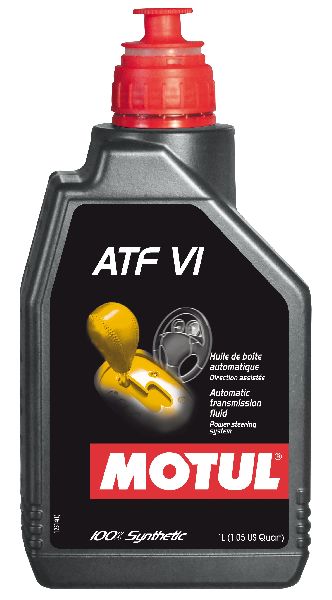
Typical fix: Top off the fluid if low and inspect for leaks. If the fluid is dirty or burnt, perform a complete fluid and filter change using the specified Motorcraft Mercon ULV fluid.
Est. part cost: $150-$400 - Failed Transmission Shift Solenoid ⚪ Low Probability → Shop Transmission Valve Body While a single solenoid can fail, it's less common than the systemic valve body issue. The solenoids are complex and integral to the valve body's function.
How to confirm: A professional scan tool can be used to command the specific solenoid on and off to test its function. The solenoid's electrical resistance can also be checked and compared to the manufacturer's specifications.
Typical fix: Replace the faulty solenoid. This is often done as part of a valve body replacement, as the solenoids are typically integrated into or replaced with the assembly.
Est. part cost: $50-$150 per solenoid
Rare But Worth Checking
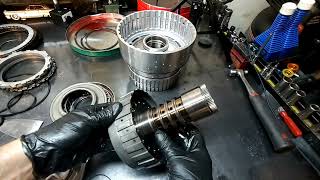
- Internal Mechanical Failure (CDF Drum): A known issue in earlier 10R80s involves a bushing/sleeve in the CDF (Clutch Drum Fortification) drum sliding out of place, causing a loss of hydraulic pressure and erratic shifts. TSB 24-2252 specifically mentions this 'axial movement of the CDF clutch cylinder sleeve' as a potential cause for P2700 and other codes. This is a major repair requiring a full transmission rebuild. 🎬 Watch: See how the CDF drum failure occurs internally.
- Faulty Transmission Control Module (TCM) or Wiring: → Shop Transmission Assembly Electrical issues, such as a damaged wire or a faulty TCM, can mimic hydraulic or mechanical problems. Outdated TCM software is a very common cause of general shifting complaints and should be updated as a first step. This should be investigated after all mechanical and hydraulic causes are ruled out.
Diagnosis Steps
- Check and record any and all stored DTCs in the TCM and PCM.
- Check for any applicable TSBs. For this issue, TSBs 22-2102 and 21-2434 are highly relevant.
- Inspect the transmission fluid level and condition. The fluid must be the correct type (Motorcraft Mercon ULV, P/N XT-12-QULV) and at the proper level. This requires a lift as there is no dipstick.
- Visually inspect the transmission housing and wiring harness for any signs of damage, leaks, or loose connectors.
- Use a high-end diagnostic scan tool (preferably Ford's FDRS) to monitor live transmission data, such as solenoid commands, clutch apply times, and line pressure.
- As per TSB 22-2102, perform the 'PCM - Transmission Accelerated Main Control Break In' routine up to three times to see if the condition clears.
- If the break-in routine fails, the next step is to inspect and test the main control valve body. This is an invasive procedure best left to a professional.
- If the valve body is confirmed to be faulty, replace it, perform a full fluid exchange, and complete the TCM adaptive learning drive cycle procedure.
Parts You'll Likely Need
- Transmission Main Control Valve Body Assembly
(OEM #JL3Z-7A100-C (supercedes previous versions))— This is the most common cause of code P2700 on the 2020-2023 Aviator, as documented in multiple manufacturer TSBs. The assembly contains the solenoids and valves that control shifting. A remanufactured version (JL3Z-7A100-CRM) may also be available.
Trusted brands: Motorcraft
OEM price range: $900-$1500
Aftermarket price range: $700-$1200 - Automatic Transmission Fluid (Mercon ULV)
(OEM #XT-12-QULV)— A fluid and filter change is required when replacing the valve body or servicing the transmission. The 10R80 transmission specifically requires this ultra-low viscosity fluid.
Trusted brands: Motorcraft
OEM price range: $20-$30 per quart
Aftermarket price range: $15-$25 per quart
Related Codes That Often Appear With This One
- P0729 - P0736 — These are gear ratio error codes that frequently accompany P2700, as they all relate to the transmission's inability to properly engage gears. They are listed together in TSBs 21-2434 and 22-2102.
- P2701, P2702, P2703, P2704, P2705 — These codes relate to other friction elements ('B', 'C', 'D', 'E', 'F'). When multiple codes from this family appear, it strongly points to a systemic issue like the main control valve body or low fluid pressure affecting the entire transmission. They are also cited in TSBs 21-2434 and 22-2102.
Technical Service Bulletins (TSBs) & Recalls
- TSB 21-2434: Addresses MIL with various DTCs including P2700 due to sticking valves in the main control valve body for 2020-2022 Aviator/Explorer.
- TSB 22-2102: Similar to 21-2434, points to sticking valves in the main control for P2700 and other codes on 2020 models.
- TSB 23-2250: Supersedes many previous TSBs, covering 2020-2023 Aviators, and lists sticking valves AND a moving CDF clutch sleeve as potential causes.
- TSB 22-2428: A TSB that includes P2700 in a long list of transmission-related fault codes, later superseded by 23-2250.
- TSB 24-2252: Also l
Platform-Specific Known Issues
- TSB 21-2434 & TSB 22-2102: These bulletins directly address an illuminated MIL with DTCs including P2700 through P2705, stating the cause may be sticking valves in the main control valve body. The prescribed fix involves a software-based break-in procedure, and if that fails, overhauling or replacing the valve body.
- TSB 23-2250 / 22-2428: These are superseding bulletins that consolidate previous ones and expand the list of affected vehicles. They add another potential cause: 'axial movement of the CDF clutch cylinder sleeve,' pointing to a known internal mechanical flaw in the 10R80 design.
- Widespread Nature: The issue is not isolated to the Aviator but affects a wide range of Ford and Lincoln products with the 10R80 transmission, leading to class-action lawsuits.
Mechanic-Grade Diagnostic Values
- Shift Solenoid (A-F) Resistance — expected: 5.0 - 5.4 Ohms at 20°C (68°F). Failure: A resistance reading outside of this range indicates a faulty solenoid coil.
- Line Pressure Control (LPC) & TCC Solenoid Current — expected: Operates between 50 mA (low pressure for LPC, low slip for TCC) and 850 mA (high pressure for LPC, full lockup for TCC).. Failure: Current readings that do not correspond to scan tool commands suggest a wiring or solenoid issue.
Hidden / Shadow Codes Worth Checking
- P2700 as a secondary code: Ford diagnostic documentation indicates that P2700 is a general performance code that often sets in conjunction with more specific codes like P0751 (Clutch 'A' Stuck Off) or P0752 (Clutch 'A' Stuck On). Technicians are advised to diagnose the more specific DTC first, as P2700 may simply be an indicator of the performance issue caused by the primary fault. (see via Standard professional scan tool.)
Scan Tool Commands That Help
- Ford Diagnosis and Repair System (FDRS): PCM - Transmission Accelerated Main Control Break In — This service routine is mandated by multiple TSBs (e.g., TSB 23-2250) as a first step for diagnosing harsh shifts and codes like P2700. It cycles specific clutches (up to 3 times) to attempt to free sticking valves in the main control body. This procedure requires the vehicle to be on a frame-engaging lift.
- Ford Diagnosis and Repair System (FDRS): Solenoid Body Strategy Data Download — When the main control valve body/solenoid assembly is replaced. The TCM stores a 13-digit solenoid body strategy number that must match the number physically etched on the new valve body. If it doesn't match, this function must be performed to write the new strategy to the TCM to ensure correct shift pressures and timing.
Wiring & Ground Locations
- 10R80 Case Connector — The main 26-pin electrical connector on the outside of the transmission case.. Damage to this connector or its pins can interrupt signals for power, ground, or solenoid control, leading to various transmission faults including P2700. Key pins include: Pin 17 (Ground), Pin 10 (Fuse/Circuit Breaker Power), Pin 12 (Actuator Supply Voltage), and pins 18-23 which control the various shift solenoids (A-F).
Real Owner Repair Stories
- Reddit user on r/f150 (2018 Ford F-150, 145,000 miles) — Crazy shift problems, including floating between gears and then slamming into another.
❌ Tried (didn't work) Transmission relearn procedure, Replacement of the main control valve body
✅ What actually fixed it The root cause was a failed CDF (Clutch Drum Fortification) drum. A sleeve inside the drum had moved, causing a seal to fail. The owner found a TSB that described the issue, confirming the diagnosis after the valve body replacement did not work. The fix required transmission disassembly to replace the CDF drum.
OEM Part Supersession History
JL3Z-7A100-A→JL3Z-7A100-C— Updated design to address issues with sticking valves and improve durability.
Heads up: The new part is a direct replacement, but requires the 'Solenoid Body Strategy Data Download' procedure with FDRS to program the TCM with the new valve body's specific calibration data.Unknown early versions→JR3Z-7H351-B (and subsequent revisions)— The original CDF drum design had a sleeve prone to moving. The updated part has a machined lip to physically prevent the sleeve from sliding out of place, providing a permanent fix to the problem.
Model Year Variations Within This Range
- 2020 - Mid-2022: Vehicles built on or before August 15, 2022, are equipped with the earlier version of the 10R80 transmission that is susceptible to the CDF clutch cylinder sleeve failure. Vehicles built after this date should have the updated CDF drum with a machined lip from the factory, making this specific failure much less likely. This is noted in TSB 23-2250.
Helpful Videos

We Have This Part in Stock


The information in this article is provided for general reference and educational purposes only. Vehicle specifications, procedures, and part compatibility can vary by production date, trim level, and region. Always consult your vehicle's factory service manual and verify part numbers before purchasing or performing repairs. Safety-critical components such as airbags, seat belts, and braking systems should be installed by a qualified professional.
- Lincoln AVIATOR:
- 🧭 Diagnostic Flowchart
- 🎬 Helpful Videos
- 🛍️ Shop This Part
- What's Unique About the 2020-2023 Lincoln AVIATOR
- Symptoms You May Notice
- Most Likely Causes
- Rare But Worth Checking
- Diagnosis Steps
- Parts You'll Likely Need
- Related Codes That Often Appear With This One
- Technical Service Bulletins (TSBs) & Recalls
- Platform-Specific Known Issues
- Mechanic-Grade Diagnostic Values
- Hidden / Shadow Codes Worth Checking
- Scan Tool Commands That Help
- Wiring & Ground Locations
- Real Owner Repair Stories
- OEM Part Supersession History
- Model Year Variations Within This Range
- 🎟️ Get 5% Off