

P2700 on 2018-2023 Lincoln Navigator: Transmission Apply Time Fault Causes and Fixes
On a 2018-2023 Lincoln Navigator, code P2700 almost always points to an internal failure of the CDF clutch drum in the 10R80 transmission. This is a major repair requiring transmission removal and disassembly, with shop costs typically ranging from $4,500 to $8,000. The failure is due to a well-documented design flaw where a bushing migrates, causing a hydraulic leak.
- P2700 on a 2018-2023 Navigator is a serious code indicating a probable internal transmission failure.
- The most likely cause is a well-documented flaw in the 10R80 transmission's CDF clutch drum, not a simple sensor or fluid issue.
- Repair is complex and expensive, requiring transmission removal and disassembly by a qualified professional.
- Do not ignore this code. Driving with this condition can lead to further transmission damage and unsafe driving conditions.
- When seeking repairs, reference Ford TSBs like 24-2254, as they guide the technician directly to the likely cause.
What's Unique About the 2018-2023 Lincoln NAVIGATOR
The 2018-2023 Navigator uses the Ford 10R80 10-speed automatic transmission, which is known for a specific, widespread issue. Code P2700 is rarely a simple sensor or fluid problem on this vehicle. Instead, it's a strong indicator of a well-documented design flaw with the transmission's CDF clutch drum. TSB 24-2254 explicitly states the cause is 'axial movement of the CDF clutch cylinder sleeve causing hydraulic circuit leaks'. This issue is so prevalent that it has led to multiple class-action lawsuits against Ford.
Diagnostic Flowchart
Tap your situation to follow the diagnostic path that matches what you're seeing on this vehicle.
Symptoms You May Notice
- Harsh, clunky, or abrupt shifts, especially in lower gears like the 3-4 or 4-3 shift.
- Delayed engagement when shifting from Park into Drive or Reverse.
- A noticeable hesitation, shudder, or jerking during acceleration or between shifts.
- Check Engine Light or Malfunction Indicator Lamp (MIL) is illuminated.
- Transmission may enter 'limp mode', getting stuck in a single gear.
- Floating between gears and then slamming into the next gear.
- Replacing only the shift solenoids. While a solenoid can fail, the symptoms of P2700 on this platform are much more likely to be the mechanical CDF drum issue, which a new solenoid will not fix.
- Assuming it's just a software issue. While software updates (per TSBs) can sometimes improve shift quality, they cannot fix the underlying hydraulic leak from a failed CDF drum. The software cannot compensate for a major mechanical-hydraulic failure.
- Performing only a fluid flush. If the fluid is contaminated with clutch material or metal from the failing drum, a simple flush will not resolve the mechanical problem and the code will return quickly.
Most Likely Causes
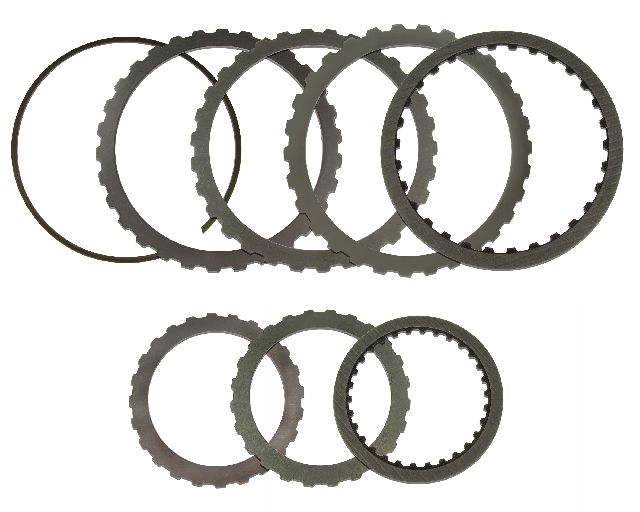
- CDF Clutch Drum Failure 🔴 High Probability → Shop Transmission Clutch Pressure Plate A bushing (sleeve) inside the CDF clutch drum assembly is known to 'walk' or move out of its intended position, which uncovers hydraulic oil ports. This causes a significant pressure loss to the clutch pack, leading to slow/failed application and setting code P2700. This is a widely documented design flaw on the 10R80 transmission affecting vehicles built before mid-August 2022.
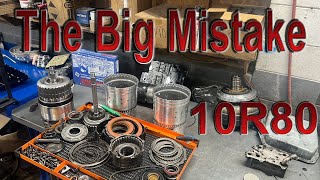
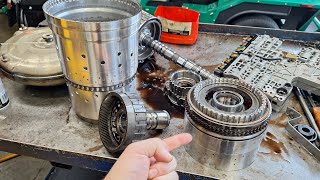
How to confirm: A technician can perform a specific hydraulic pressure test outlined in Ford's TSB 24-2254 to confirm the internal leak. Visual inspection requires transmission disassembly, where the displaced bushing and a damaged or dislodged Teflon seal 🎬 See this teardown showing exactly how the bushing fails internally. will be evident.
Typical fix: The transmission must be removed and disassembled to replace the faulty CDF clutch drum with a revised, updated part from Ford (Part No. JL3Z-7H351-B). This part has a machined lip to prevent the sleeve from moving. Often, the valve body separator plate and other related seals and clutches are replaced at the same time.
Est. part cost: $250-$450 - Sticking Valves in Main Control Valve Body 🟡 Medium Probability → Shop Transmission Valve Body Debris from normal wear or, more likely, the beginning stages of a CDF drum failure can contaminate the fluid and cause microscopic valves within the valve body to stick or wear their bores, impeding proper hydraulic flow. This can cause similar symptoms and is often repaired alongside the CDF drum.
How to confirm: After ruling out the CDF drum, a technician may inspect the valve body for stuck valves or scoring. Sometimes this is replaced as a preventative measure during the larger CDF drum repair.
Typical fix: Overhaul or replacement of the main control valve body assembly. A new separator plate is often recommended.
Est. part cost: $500-$1000 - Low or Contaminated Transmission Fluid ⚪ Low Probability → Shop Transmission Assembly
How to confirm: Check the transmission fluid level and condition per the manufacturer's procedure. The fluid must be the correct type (Motorcraft MERCON ULV) and should be bright red, not dark, burnt, or containing excessive metal shavings.
Typical fix: Perform a transmission fluid and filter change. This is highly unlikely to be a permanent fix for a P2700 code on this platform but is essential basic maintenance. If the code is present, the damage is likely already done.
Est. part cost: $150-$300
Rare But Worth Checking
- Torque Converter Issues:
Diagnosis Steps
- Verify the code with a professional OBD-II scanner that can read Ford-specific transmission data.
- Check the transmission fluid level and condition. The correct fluid is MERCON ULV. If it is dark, burnt, or contains metal shavings, suspect severe internal damage.
- Review live data on the scan tool, looking at commanded vs. actual gear states and clutch apply times.
- Consult Technical Service Bulletins (TSBs) for the 10R80 transmission, specifically TSB 24-2254, which directly addresses P2700 and the CDF drum failure.
- Perform a hydraulic pressure test on the specific clutch circuits as detailed in TSB 24-2254 to confirm an internal leak. This requires specialized equipment.
- If a leak is confirmed, the next step is transmission removal and teardown for inspection and replacement of the CDF clutch drum and related seals.
Parts You'll Likely Need
- CDF Clutch Drum Assembly (Updated)
(OEM #JL3Z-7H351-B (supersedes HL3Z-7H351-A and JL3Z-7H351-A))— This is the component that contains the faulty bushing design. Its replacement with the updated version, which has a machined lip to prevent sleeve movement, is the primary fix for code P2700. 🎬 Watch: A quick overview of the CDF drum replacement process.
Trusted brands: Motorcraft
OEM price range: $350-$500
Aftermarket price range: $230+ - Transmission Overhaul Gasket & Seal Kit — Required for reassembling the transmission after replacing the CDF drum. Includes all necessary gaskets, seals, and Teflon rings that are disturbed during the repair.
Trusted brands: Motorcraft
OEM price range: $200-$400
Aftermarket price range: $150-$300 - Main Control Valve Body Separator Plate — Often replaced during a CDF drum repair as a preventative measure, as they are prone to wear and can cause valve body cross-leaks.
Trusted brands: Motorcraft
OEM price range: $50-$100 - Motorcraft MERCON ULV Automatic Transmission Fluid
(OEM #XT-12-QULV)— The transmission must be refilled with approximately 9-13 quarts of the correct specification fluid after the repair.
Trusted brands: Motorcraft
OEM price range: $8-$12 per quart - Sonnax CDF Drum Saver Kit (Aftermarket Option)
(OEM #129910-01K)— For technicians who are rebuilding the original drum, this aftermarket kit provides an improved sleeve with a locking set screw to prevent it from shifting, offering an alternative to replacing the entire drum.
Trusted brands: Sonnax
Aftermarket price range: $50-$100
Related Codes That Often Appear With This One
- P0751, P0756, P0761, P2701, P2702, etc. — These are all codes for other friction elements and shift solenoids. Because the CDF drum failure causes a widespread hydraulic pressure loss, it can starve multiple clutch packs and trigger a variety of performance codes simultaneously as the TCM detects slow apply times across multiple components.
Technical Service Bulletins (TSBs) & Recalls
- TSB 24-2254: The most current and relevant bulletin. It explicitly names P2700, identifies the cause as the CDF clutch cylinder sleeve movement, and provides a detailed diagnostic procedure to confirm the internal hydraulic leak.
- TSB 22-2428: An earlier version of the bulletin which also lists P2700 and points to the same set of potential causes, including the CDF drum sleeve and main control valve body.
Platform-Specific Known Issues
- The 10R80 transmission in these Navigators is the subject of multiple TSBs and a class-action lawsuit due to harsh and erratic shifting behavior.
- The primary mechanical fault identified by Ford in TSB 24-2254 is the 'axial movement of the CDF clutch cylinder sleeve causing hydraulic circuit leaks,' which directly leads to codes like P2700.
- Ford has released updated versions of the CDF drum to correct the issue. The latest known part is JL3Z-7H351-B. Vehicles built after mid-August 2022 are less likely to have the original faulty part, as stated in TSB 24-2254.
Mechanic-Grade Diagnostic Values
- 'A' Clutch Pack Clearance — expected: 0.026–0.058 in (0.67–1.47 mm). Failure: Clearance outside of this range requires selecting a different thickness selective apply plate to correct.
- Transmission Fluid Temperature for Level Check — expected: 96°C - 101°C (206°F - 215°F). Failure: Checking the fluid level outside this temperature range will result in an inaccurate reading.
Hidden / Shadow Codes Worth Checking
- P163E: Transmission Control Module (TCM) Programmable Parameters Internal Error (see via This code can appear after replacing the main control valve body if the new solenoid strategy file is incompatible with the existing PCM/TCM software. It is visible with a Ford-specific scan tool like IDS. TSB 22-2339 notes this can occur if the 12-digit solenoid body ID is entered instead of the required 13-digit strategy number.)
Scan Tool Commands That Help
- Ford IDS/FDRS: PCM – Transmission Strategy Download — This function is required after replacing the transmission or the main control valve body. The technician must enter the 13-digit solenoid body strategy number from the tag on the new part to ensure the TCM can correctly control the solenoids. Failure to do so can cause erratic shifts or DTCs like P163E.
- Ford IDS/FDRS: Clear All Adaptations / Adaptive Learning Drive Cycle — After any major transmission repair, including CDF drum or valve body replacement, the transmission's learned shift adaptations must be cleared. A specific, multi-step drive cycle must then be performed to allow the TCM to relearn the clutch apply characteristics. Skipping this can result in continued poor shift quality even after the mechanical repair is complete.
- Ford IDS/FDRS with VCMM: Hydraulic Pressure/Vacuum Leak Test — TSB 24-2254 outlines a specific procedure using a Pressure Vacuum Transducer Kit (Rotunda 164-R9833) and VCMM to test the integrity of the CDF clutch hydraulic circuit. This is the definitive diagnostic step to confirm an internal leak before removing the transmission.
Wiring & Ground Locations
- Main Transmission Harness Connector — On the driver's side of the transmission case.. While P2700 is almost always an internal mechanical/hydraulic fault, in extremely rare cases, damage to this connector or its wiring could theoretically interrupt signals to the solenoids. A visual inspection for damage is a quick preliminary check. The official 2018 Navigator wiring diagram manual (OEM Part Number: FCS1288618) contains the specific pinouts for circuit testing.
Real Owner Repair Stories
- Ford F150 Forum user '5.0_FX2' (Ford F-150 with 10R80 (shared transmission)) — Delayed/no engagement when cold, flaring on the 3-5 upshift, hard downshifts into 4th.
❌ Tried (didn't work) A complete transmission rebuild by the dealer to fix the original CDF drum issue.
✅ What actually fixed it The issue was not permanently fixed. One year and 10,000 miles after a dealer rebuild (which was presumed to include the updated CDF drum), the exact same symptoms returned, suggesting either the updated part can still fail, the original repair was done incorrectly, or a non-updated part was used. Another user in the same thread reported being on their second 'new design' drum.
OEM Part Supersession History
HL3Z-7H351-A→JL3Z-7H351-A, then JL3Z-7H351-B— The original design allowed an internal sleeve/bushing to move (walk) out of position, uncovering hydraulic passages and causing pressure loss. The updated JL3Z-7H351-B part features a machined retention lip to physically prevent the sleeve from moving.
Model Year Variations Within This Range
- 2018-2022: Vehicles built on or before August 15, 2022, are equipped with the original, failure-prone CDF clutch drum design as per TSB 24-2254. Vehicles built after this date are expected to have the revised drum (JL3Z-7H351-B) from the factory, making them significantly less likely to experience this specific failure.
Helpful Videos

We Have This Part in Stock


The information in this article is provided for general reference and educational purposes only. Vehicle specifications, procedures, and part compatibility can vary by production date, trim level, and region. Always consult your vehicle's factory service manual and verify part numbers before purchasing or performing repairs. Safety-critical components such as airbags, seat belts, and braking systems should be installed by a qualified professional.
- Lincoln NAVIGATOR:
- 🧭 Diagnostic Flowchart
- 🎬 Helpful Videos
- 🛍️ Shop This Part
- What's Unique About the 2018-2023 Lincoln NAVIGATOR
- Symptoms You May Notice
- Most Likely Causes
- Rare But Worth Checking
- Diagnosis Steps
- Parts You'll Likely Need
- Related Codes That Often Appear With This One
- Technical Service Bulletins (TSBs) & Recalls
- Platform-Specific Known Issues
- Mechanic-Grade Diagnostic Values
- Hidden / Shadow Codes Worth Checking
- Scan Tool Commands That Help
- Wiring & Ground Locations
- Real Owner Repair Stories
- OEM Part Supersession History
- Model Year Variations Within This Range
- 🎟️ Get 5% Off